Last updated: March 2026
Your crew is tough. They don't complain about sore backs, stiff shoulders, or numb hands. They push through it because that's what the job demands. And then one morning, someone can't grip a wrench. Someone else files a WCB claim for a back injury that's been building for two years. Now you're short-handed, your premiums are climbing, and the problem didn't start yesterday.
At Safety Evolution, we help contractors build safety programs every week. The pattern is always the same: ergonomic injuries don't announce themselves until the damage is done. That makes ergonomics the most expensive hazard most employers ignore.
Workplace ergonomics is the practice of designing tasks, tools, and work environments to fit the physical capabilities of workers, reducing the risk of musculoskeletal disorders (MSDs) and improving both safety and productivity. For Canadian employers in construction, oil and gas, manufacturing, and mining, this isn't about desk chairs. It's about keeping your crew healthy enough to keep working.
⚡ Quick Answer
- What: Workplace ergonomics means matching job tasks, tools, and workstations to workers' physical capabilities to prevent musculoskeletal disorders (MSDs)
- Why it matters: MSDs are the leading cause of lost-time injury claims in Canadian workplaces, and construction, oil and gas, and manufacturing workers face the highest risk
- Legal requirement: Every Canadian province requires employers to identify and control ergonomic hazards. In BC, Part 4 of the OHS Regulation has specific Ergonomics (MSI) Requirements. Alberta's OHS Code requires hazard assessments that include ergonomic risks.
- Cost of ignoring it: WCB claims for MSDs average $15,000 to $40,000+ per claim depending on severity and lost time. Premium increases compound for years.
- Where to start: Identify your highest-risk tasks, assess the ergonomic risk factors, and implement controls. SE-AI can flag where your ergonomic program has gaps.
Workplace ergonomics is the practice of designing work tasks, tools, and environments to fit the physical and cognitive capabilities of your workers. For Canadian employers, ergonomics isn't optional: musculoskeletal injuries (MSIs) are the leading cause of lost-time claims across every province, and OHS regulations in Alberta, BC, and Ontario all require employers to identify and control ergonomic hazards.
This guide covers the fundamentals of workplace ergonomics for Canadian employers: what the regulations require, how to identify ergonomic risk factors on your sites, and practical controls that reduce injuries without slowing down production.
What Is Workplace Ergonomics and Why Should Employers Care?
Most contractors hear "ergonomics" and think of office chairs and monitor stands. That's a fraction of the picture. In industrial workplaces, ergonomics covers every task where the physical demands of the job can injure your workers over time: lifting heavy materials, working overhead for hours, gripping vibrating tools, kneeling on concrete, twisting to reach into tight spaces.
The Canadian Centre for Occupational Health and Safety (CCOHS) defines ergonomics as "matching the job to the worker and the product to the user." In practice, that means looking at how your crew actually works and asking: is this task going to hurt someone eventually?
The answer, more often than not, is yes. According to CCOHS, musculoskeletal disorders are the most common type of work-related injury in Canada. In construction and industrial sectors, the numbers are worse. Workers who lift, carry, push, pull, and hold tools for 8 to 12 hours a day are exposed to cumulative forces that break down joints, tendons, and soft tissue over months and years.
Here's what makes ergonomic injuries different from other workplace hazards: there's no single incident to investigate. No near miss to report. Your worker's shoulder doesn't fail because of one bad lift. It fails because of 10,000 lifts with poor body mechanics, combined with overhead reaching, vibration exposure, and cold weather. By the time the WCB claim hits your desk, the damage has been accumulating for a long time.
That's why ergonomics in the workplace deserves the same attention you give to fall protection, confined spaces, or chemical exposure. The injuries are just as real. They just build slower.
What Are the Main Ergonomic Risk Factors in Industrial Workplaces?
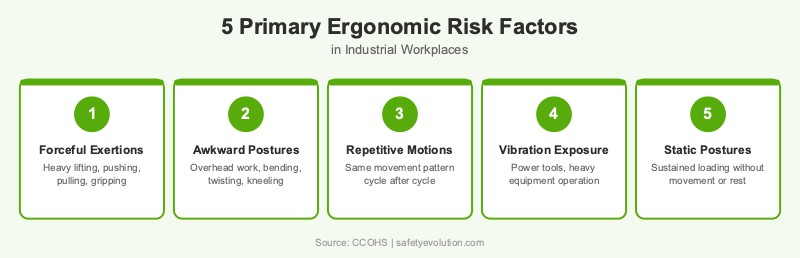
CCOHS identifies several risk factors for work-related musculoskeletal disorders. For construction, oil and gas, and manufacturing employers, these are the ones that matter most:
1. Forceful exertions. Lifting heavy materials, pushing loaded wheelbarrows, pulling cable through conduit, gripping tools with force. Any task that demands significant muscular effort. The heavier the load and the longer the exposure, the higher the risk.
2. Awkward postures. Working overhead, kneeling, bending at the waist, twisting the torso, reaching behind the body. Construction workers spend entire shifts in positions that strain joints and compress nerves. Think about the electrician pulling wire above a drop ceiling or the plumber working under a sink. These postures become hazardous when maintained for extended periods.
3. Repetitive motions. Hammering, drilling, painting, fastening. Any task that uses the same muscle groups and joint movements cycle after cycle. CCOHS notes that repetitive movements are especially hazardous when combined with awkward postures and forceful exertions.
4. Vibration exposure. Hand-arm vibration from power tools (grinders, jackhammers, drills) and whole-body vibration from operating heavy equipment. Prolonged vibration exposure damages blood vessels, nerves, and soft tissue. It's a serious and often overlooked risk factor in construction and oil and gas work.
5. Static postures and sustained loading. Holding a tool or material in position for extended periods without movement. Holding a drill overhead. Supporting a pipe while a coworker welds. Standing in one position on concrete for an entire shift. The muscles contract and stay contracted, restricting blood flow and accelerating fatigue.
Most industrial tasks combine multiple risk factors at once. A scaffold worker might be lifting materials (force), reaching overhead (awkward posture), in cold conditions (temperature), for 10 hours straight (duration). That combination is where injuries develop.
For a deeper look at specific ergonomic hazards in the workplace, including examples from construction and industrial settings, see our detailed guide.
What Does Canadian Law Require for Ergonomics at Work?
Most contractors think ergonomics is a "nice to have." They're wrong. Every Canadian province has legal requirements that apply to ergonomic hazards, even if the regulation doesn't use the word "ergonomics" on every page.
Here's the regulatory landscape:
Federal (Canada Labour Code): The Canada Occupational Health and Safety Regulations require federally regulated employers to prevent musculoskeletal injuries. Canada.ca provides an MSI prevention e-tool to help employers implement effective strategies.
British Columbia: WorkSafeBC's OHS Regulation, Part 4, includes specific Ergonomics (MSI) Requirements (sections 4.46 to 4.53). These require employers to identify factors that may expose workers to the risk of musculoskeletal injury, assess the risk, and implement controls. Employers must also educate workers about MSI risk factors and early signs and symptoms. WorkSafeBC requires employers to monitor the effectiveness of their ergonomic controls and review them at least annually. In 2025, WorkSafeBC launched a targeted MSI Planned Inspectional Initiative, meaning inspectors are actively checking compliance.
Alberta: The Alberta OHS Act, Regulation, and OHS Code require employers to assess hazards in the workplace, which includes ergonomic risks. Part 14 of the OHS Code covers Lifting and Handling Loads, setting requirements for manual handling. Alberta's general duty clause requires employers to take all reasonable steps to protect workers from hazards, and cumulative ergonomic risks fall under that obligation.
Other provinces: Saskatchewan, Manitoba, Ontario, and other provinces have similar general duty provisions requiring hazard identification and control. The specific language and enforcement mechanisms vary, but the core obligation is the same: if a work task can injure your workers, you must identify the risk and do something about it.
The bottom line: if you're a Canadian employer and your crew does physical work, you have a legal obligation to address ergonomic hazards. "We didn't know" is not a defence when OHS shows up.
Ergonomics is also a required element in most safety management systems, including COR (Certificate of Recognition) programs. If you're preparing for a COR audit, your safety program needs to demonstrate that you've identified ergonomic risks and implemented controls. Ignoring ergonomics creates a gap that auditors will find.
What If Your Ergonomic Assessments and Corrective Actions Tracked Themselves?
SE-AI monitors MSD risk assessments, tracks corrective actions to completion, and flags overdue follow-ups before your next WCB review.
Be the First to Try It →
How Do You Conduct an Ergonomic Assessment?
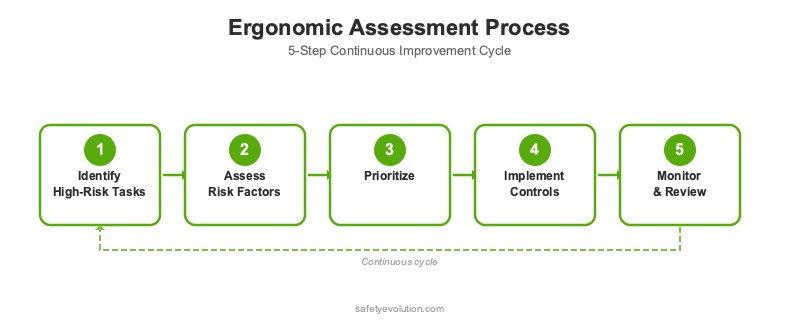
An ergonomic assessment is a structured process for identifying which tasks put your workers at risk and how severe that risk is. You don't need a PhD in biomechanics. You need to look at the actual work being done and apply common sense backed by a consistent method.
Here's a practical approach for industrial employers:
Step 1: Identify high-risk tasks. Walk your site and list every task that involves heavy lifting, repetitive motions, awkward postures, vibrating tools, or sustained physical effort. Talk to your crew. They know which tasks hurt. If someone's been complaining about their wrists, back, or shoulders, that's your starting point.
Step 2: Assess the risk factors. For each task you've identified, evaluate the specific ergonomic risk factors present. How heavy are the loads? How long is the worker in that posture? How many repetitions per shift? Is vibration involved? The combination and duration of risk factors determines the overall risk level.
Step 3: Prioritize. You can't fix everything at once. Rank tasks by injury potential and number of workers exposed. The task that puts 15 people at high risk comes before the task that puts 2 people at moderate risk.
Step 4: Implement controls. Use the hierarchy of controls: eliminate the hazard first, then substitute, then engineer controls, then administrative controls, and finally personal protective approaches. For ergonomics, engineering controls (redesigning the task, providing mechanical assists) are almost always more effective than training workers to "lift properly."
Step 5: Monitor and review. WorkSafeBC requires annual review of ergonomic controls. Even in provinces without that explicit requirement, regular review is essential. SE-AI tracks these review cycles and flags when an assessment is overdue. Did the controls actually reduce the risk? Are workers using them? Have new tasks been introduced?
We've seen contractors try to skip straight to Step 4, buying anti-fatigue mats and back belts without understanding which tasks actually cause the injuries. That's spending money on symptoms. The assessment is what tells you where to spend your money effectively.
What Are the Most Common Ergonomic Injuries in Construction and Industrial Work?
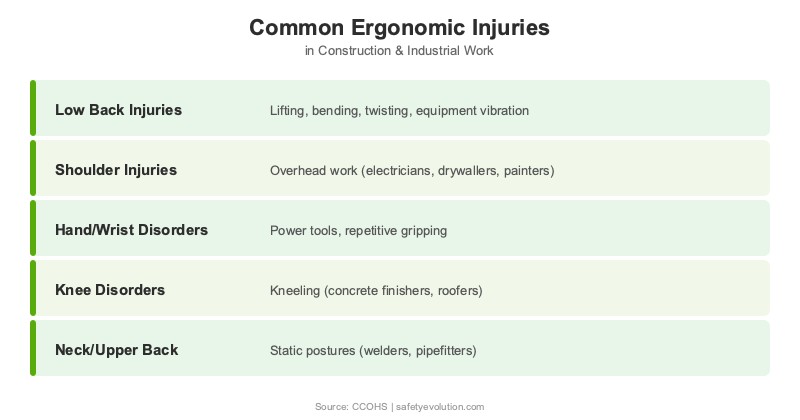
Musculoskeletal disorders are the category of injury that ergonomics aims to prevent. In construction, oil and gas, manufacturing, and mining, the most common MSDs include:
Low back injuries. The most frequent MSD in physical work. Caused by heavy lifting, bending, twisting, and whole-body vibration from operating equipment. A single bad lift rarely causes a back injury on its own; it's the accumulation of thousands of lifts with poor body mechanics, combined with fatigue and sustained awkward postures.
Shoulder injuries (rotator cuff, impingement). Common in trades that involve overhead work: electricians, drywallers, painters, pipefitters. Working with arms above shoulder height compresses tendons and restricts blood flow. Repetitive overhead reaching accelerates the damage.
Hand and wrist disorders (carpal tunnel syndrome, tendinitis). Caused by repetitive gripping, vibrating tools, and sustained wrist flexion. Common in workers who use power tools, hammer repeatedly, or perform detailed assembly work.
Knee disorders. Concrete finishers, tile setters, roofers, and other workers who kneel for extended periods develop bursitis and meniscal damage. Cold, hard surfaces make it worse.
Neck and upper back strain. Caused by static postures, especially when looking down or holding the head in a fixed position. Welders, pipefitters, and instrument technicians are frequently affected.
These injuries don't just hurt your workers. They hurt your business. WCB claims for MSDs are often high-cost and long-duration, which drives up your premium rates for years. In Alberta, a single serious back injury claim can cost $30,000 to $60,000 or more in direct WCB costs. Multiply that by your experience rating, and the impact on your premiums compounds. For a deeper look at manual handling and MSD prevention strategies, see our dedicated guide.
How Do You Control Ergonomic Hazards on a Job Site?
Identifying the problem is step one. Fixing it is where most employers get stuck. Here's a practical framework for controlling ergonomic hazards in industrial settings, using the hierarchy of controls:
Elimination and substitution. Can you remove the hazardous task entirely? Can you substitute a less demanding method? Examples: using pre-fabricated components instead of building on-site (reduces manual handling), switching from a hand-operated tool to a powered alternative (reduces repetitive force), or ordering materials in smaller, lighter packages.
Engineering controls. These change the physical setup of the work. Examples: mechanical lifting devices (hoists, forklifts, vacuum lifts) to reduce manual handling, adjustable-height work platforms to eliminate overhead reaching, anti-vibration tool handles, padded kneeling boards, and material carts to eliminate carrying loads over distance. Engineering controls are the most effective because they don't depend on individual worker behaviour.
Administrative controls. These change how the work is organized. Examples: rotating workers between high-risk and low-risk tasks to reduce cumulative exposure, scheduling rest breaks during physically demanding work, limiting shift length for the most hazardous tasks, and providing ergonomics training on proper body mechanics and early symptom recognition.
Personal approaches. The least effective tier, but still valuable as part of a layered approach. Examples: stretching programs before shifts, wrist supports for workers using vibrating tools, knee pads for kneeling work. These don't eliminate the hazard, but they reduce the impact on the individual worker.
The mistake we see most often: employers jump straight to personal approaches. They buy back braces, run a stretching program, and call it done. That's the equivalent of giving your crew hearing protection and skipping the noise assessment. It's not wrong, but it's not a program. And it won't hold up in a COR audit or an OHS inspection.
Effective ergonomic controls start with the assessment. You need to know which tasks are the problem before you can choose the right solution.
How Do You Build an Ergonomics Program?
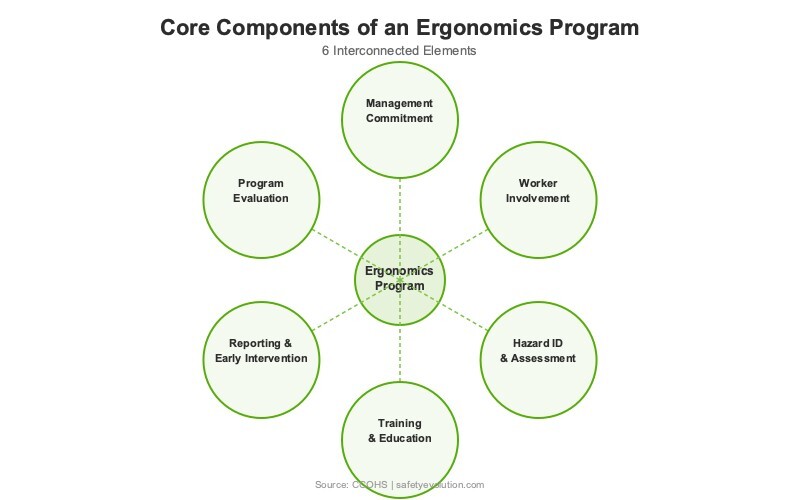
An ergonomics program is a systematic, ongoing approach to managing ergonomic risk in your workplace. It's not a one-time project. CCOHS describes an ergonomics program as having several core components:
Management commitment. Like every safety initiative, this starts at the top. If the owner or GM doesn't take ergonomics seriously, neither will the crew. Commitment means allocating budget for ergonomic controls, integrating ergonomics into your safety program, and holding supervisors accountable for identifying and reporting ergonomic issues.
Worker involvement. Your crew knows which tasks cause pain. Involve them in identifying hazards, selecting controls, and evaluating whether changes are working. This isn't just good practice; it's a regulatory expectation in most provinces.
Hazard identification and assessment. Ongoing, not one-time. New tasks, new equipment, new site conditions all introduce new ergonomic risks. Build ergonomic hazard identification into your existing processes: field-level hazard assessments (FLHAs), job hazard analyses, and site inspections.
Training and education. Workers need to understand what ergonomic risk factors are, how to recognize early signs of MSDs, and what to do about them. Supervisors need to know how to identify ergonomic hazards during task planning. This doesn't need to be a two-day course. A well-run ergonomics toolbox talk is a practical starting point. For more structured training, Safety Evolution's training courses include ergonomics modules designed for industrial workers.
Incident reporting and early intervention. Workers need a way to report ergonomic discomfort before it becomes a full-blown injury. If the only time you hear about ergonomic problems is when a WCB claim is filed, you're already too late. Encourage early reporting and treat MSD symptoms the same way you'd treat a near miss: investigate, identify root causes, and implement corrective actions.
Program evaluation. Track your MSD-related incidents, near misses, and discomfort reports over time. SE-AI surfaces these trends automatically so you can see whether controls are working. Are the numbers going down? Review and adjust annually at minimum.
If you're a small contractor wondering whether you really need a formal ergonomics program, consider this: if your workers do physical work, you already have ergonomic hazards. The question is whether you're managing them proactively or waiting for the WCB claims to pile up. A program doesn't need to be complicated. It needs to be consistent.
What If You Could Just Ask?
“Which job sites have outstanding ergonomic corrective actions?” “What was our MSD incident rate this quarter vs. last?” Get answers from your own safety data in seconds.
Be the First to Try It →
Ergonomics by Industry: What Matters for Your Sector
Ergonomic risks look different depending on your industry. Here's a quick breakdown of the specific challenges for each sector SE works with:
Construction. The highest-risk sector for ergonomic injuries. Workers face heavy manual handling (carrying materials, moving equipment), awkward postures (overhead work, working in trenches, kneeling), repetitive motions (hammering, drilling, fastening), and whole-body vibration (operating equipment). Site conditions change daily, which means ergonomic risks change too. For a detailed guide on construction ergonomics, see our industry-specific post.
Oil and gas. Field workers face extended shifts (often 10 to 14 hours), heavy manual handling in remote locations where mechanical assists may not be available, sustained awkward postures during valve operations and pipe fitting, and hand-arm vibration from tools. Cold weather compounds every risk factor by reducing blood flow and grip strength. Turnaround and shutdown periods intensify all of these exposures due to longer hours and faster pace.
Manufacturing. Repetitive assembly tasks are the dominant risk. Workers perform the same motions thousands of times per shift. Add forceful gripping, standing on concrete for extended periods, and reaching across conveyors, and MSD risk is high. Manufacturing tends to have more stable work environments than construction, which makes engineering controls (workstation redesign, mechanical assists) easier to implement and more effective.
Mining. Combines heavy manual handling, whole-body vibration from equipment operation, awkward postures in confined underground spaces, and extreme environmental conditions. Mining operations often have the budget for engineering controls but may lack the ergonomic assessment expertise to deploy them effectively.
Ergonomics and Your Safety Management System
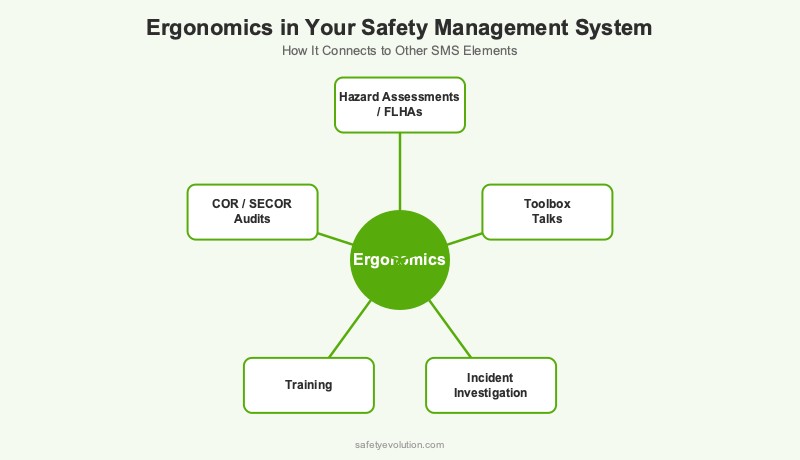
Ergonomics doesn't exist in isolation. It connects to every other element of your safety management system:
Hazard assessments. Your FLHAs and job hazard analyses should include ergonomic risk factors. If your FLHA form doesn't have a section for body mechanics, lifting, awkward postures, or repetitive tasks, add one.
Toolbox talks. A 5-minute toolbox talk on ergonomics before a physically demanding task costs nothing and reinforces awareness. Download our free toolbox talk package for ready-made topics including ergonomics.
Incident investigation. When a worker reports an MSD or soft tissue injury, investigate it the same way you'd investigate any other incident. Use your incident investigation process to identify root causes and implement corrective actions.
Training matrix. Include ergonomics awareness in your training program. Make sure workers and supervisors can identify ergonomic risk factors and know how to report concerns.
COR/SECOR audits. Ergonomics is part of the hazard identification and control elements of COR. SE-AI connects your ergonomic assessment data to your broader safety management system so COR auditors see a complete picture. If your safety program doesn't address ergonomic hazards, that's a gap an auditor will identify. Building ergonomics into your existing program now is easier than scrambling before an audit.
The Real Cost of Ignoring Workplace Ergonomics
Here's the blunt truth: most small contractors don't think about ergonomics until it costs them money. Then it costs them a lot of money.
Direct costs include WCB claims, medical treatment, and workers' compensation premiums. A single MSD claim can cost $15,000 to $40,000 or more in direct costs, depending on severity. Claims involving surgery or permanent disability cost significantly more.
But the indirect costs are what really hurt a small contractor. When your experienced welder is off work for three months with a rotator cuff injury, you're paying for a replacement (if you can find one), absorbing the productivity loss from a less experienced worker, and dealing with project delays. If you have 20 employees and lose two to ergonomic injuries in a year, that's 10% of your workforce. For a company your size, that's devastating.
Then there's the premium impact. WCB experience rating systems mean your claims history directly affects your premiums. A string of MSD claims doesn't just cost you this year; it raises your rates for three to five years. We've seen contractors in Alberta whose WCB premiums jumped 20-30% after two years of ergonomic injury claims. That's money that comes straight off your margin.
On the other side, employers with effective ergonomics programs often see fewer lost-time injuries, lower WCB premiums, higher worker retention (experienced workers stay because the job doesn't destroy their bodies), and improved productivity (workers who aren't in pain work more efficiently). The ROI on ergonomic controls is typically strong, especially for high-exposure tasks where mechanical assists can replace manual handling entirely.
Getting Started: Practical Next Steps for Employers
If you've read this far and you're thinking "we should probably do something about this," here's where to start:
1. Talk to your crew. Ask them which tasks cause the most physical strain. You'll get honest answers. Supervisors can do this during toolbox talks or safety meetings.
2. Walk your site with ergonomic eyes. Watch how work actually gets done. Look for heavy lifting, awkward postures, repetitive motions, and vibrating tools. Note which tasks expose the most workers.
3. Start with your highest-risk tasks. Don't try to assess everything at once. Pick the three to five tasks your crew identified as the most physically demanding and assess those first.
4. Implement one engineering control. Even one change can make a difference. A mechanical hoist for a heavy-lifting task. An adjustable platform for overhead work. A tool balancer for a repetitive assembly operation. Start where the exposure is highest.
5. Build it into your existing program. Add ergonomic risk factors to your FLHA forms. Run an ergonomics toolbox talk. Include MSD tracking in your incident reporting. You don't need a separate ergonomics program; you need to integrate ergonomics into the safety program you already have.
6. Get expert help if you need it. If you're not sure where to start or your injury rates are already high, Safety Evolution's safety services include ergonomic assessment and program development for industrial employers. We work with contractors every day who are building this from scratch. It doesn't have to be complicated.
Workplace ergonomics isn't glamorous. It doesn't get the same attention as fall protection or confined space rescue. But for most industrial employers, it's the hazard that causes the most injuries and costs the most money over time. The contractors who address it proactively protect their crews, their premiums, and their ability to win work.
Frequently Asked Questions
What is workplace ergonomics?
Workplace ergonomics is the practice of designing tasks, tools, workstations, and work environments to fit the physical capabilities and limitations of workers. The goal is to reduce the risk of musculoskeletal disorders (MSDs) such as back injuries, shoulder problems, and repetitive strain injuries. For industrial employers, this means assessing physical job demands like lifting, reaching, gripping, and repetitive motions, then implementing controls to reduce risk.
Is ergonomics legally required for Canadian employers?
Yes. Every Canadian province requires employers to identify and control workplace hazards, which includes ergonomic hazards. British Columbia has the most specific requirements under Part 4 of the WorkSafeBC OHS Regulation (Ergonomics/MSI Requirements, sections 4.46 to 4.53). Alberta's OHS Code requires hazard assessments that include ergonomic risks, with Part 14 covering lifting and handling loads. Federal workplaces are covered by the Canada Occupational Health and Safety Regulations.
What are the most common ergonomic risk factors in construction?
The main ergonomic risk factors in construction are forceful exertions (heavy lifting and carrying), awkward postures (overhead work, kneeling, bending, twisting), repetitive motions (hammering, drilling, fastening), vibration exposure from power tools and heavy equipment, and static postures (holding tools or materials in position for extended periods). These risk factors are identified by CCOHS and apply to most construction trades.
How much do ergonomic injuries cost employers?
Direct WCB claim costs for musculoskeletal disorders typically range from $15,000 to $40,000 or more per claim, depending on severity and lost time. Indirect costs, including replacement labour, productivity loss, project delays, and WCB premium increases, often exceed the direct costs. Premium increases from MSD claims can persist for three to five years under provincial experience rating systems.
How do I start an ergonomics program for my company?
Start by talking to your crew about which tasks cause the most physical strain. Walk your site to observe work practices and identify ergonomic risk factors. Assess your highest-risk tasks first, then implement controls starting with engineering solutions (mechanical assists, adjustable platforms) before relying on training or personal protective approaches. Integrate ergonomics into your existing safety program through FLHAs, toolbox talks, and incident reporting. For help building a program from scratch, SE-AI to identify exactly where your program needs work.
Does ergonomics matter for COR certification?
Yes. COR (Certificate of Recognition) audits evaluate your hazard identification and control processes. Ergonomic hazards are a recognized category of workplace hazard. If your safety program doesn't demonstrate that you've identified ergonomic risks and implemented controls, that's a gap an auditor will flag. Building ergonomics into your existing hazard assessment and control processes strengthens your COR program and reduces audit risk.
Get Weekly Safety Insights
Regulation updates, toolbox talk ideas, and compliance tips. One email per week.