Last updated: March 2026
You know you need a safety program. Every GC asks for one before they'll even look at your bid package. The problem is, nobody hands you a blueprint. You end up Googling templates, copying sections from other companies, and hoping it holds up when the auditor shows up. Then you find out your "safety program" is missing half the elements that actually matter for COR, and you're scrambling three weeks before your audit.
We help contractors build audit-ready safety programs every week at Safety Evolution. Most of the companies that come to us aren't starting from zero. They have something. It's just not structured to survive a real audit. Here's how to fix that.
⚡ Quick Answer: Construction Safety Program Template
- What: A construction safety program is a documented health and safety management system covering policies, hazard controls, procedures, training, and emergency response for your worksite
- COR requirement: Most COR programs across Canada require 14 core elements, from health and safety policy through to joint safety committees
- Audit threshold: You need 80% overall and minimum 50% per element to pass a COR audit
- WCB incentive: In Alberta, COR holders can receive a 10% WCB industry rate refund in year one, then 5% annually
- Timeline: Building a COR-ready program from scratch typically takes 6 to 12 months with dedicated effort
- Free Resource: Download our Construction Health & Safety Manual.
A construction safety program template is a structured document that outlines every policy, procedure, and process your company uses to protect workers and meet regulatory requirements on the job site. When built correctly, it maps directly to the 14 elements auditors evaluate during a COR (Certificate of Recognition) audit. When built poorly, it's a binder that collects dust in the trailer until someone panics.
Why Does Your Construction Safety Program Structure Matter for COR?
Here's what most contractors get wrong: they think a safety program is a stack of policies. Write a fall protection policy, write a PPE policy, staple them together, done.
That's not a safety program. That's a paperwork collection. And auditors can tell the difference in about five minutes.
A COR audit doesn't just check whether you have documents. It evaluates whether your health and safety management system is actually implemented, meaning your crew knows the rules, your supervisors enforce them, and you have records proving it happened. The auditor interviews workers, reviews documentation, and observes site conditions. If your program exists on paper but not on the ground, you'll score below the 80% overall threshold you need to pass.
That's the blunt truth: most contractors who fail their first COR audit don't fail because they're unsafe. They fail because their program doesn't prove they're safe. The documentation doesn't match the reality, or the reality doesn't match the documentation.
If you're not sure whether your current program would survive that kind of scrutiny, can flag the gaps before the auditor does. It monitors your certifications, inspections, and training records across every site and tells you exactly where you stand.
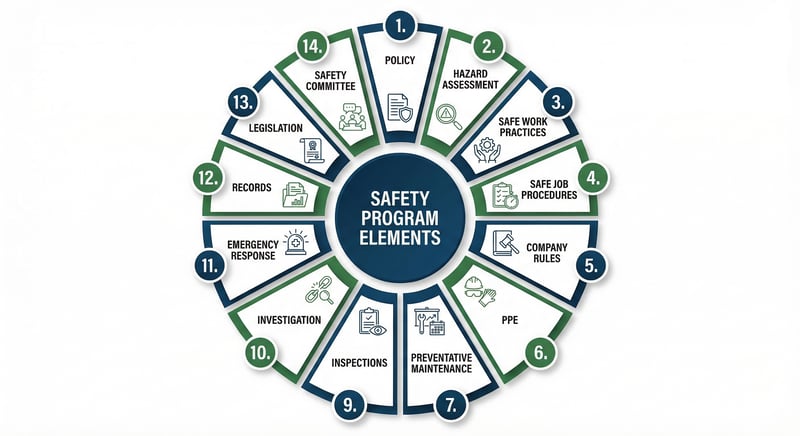
What Are the 14 Core Elements of a COR-Ready Safety Program?
The COR 2020 standard (aligned with ISO 45001) uses 14 elements to evaluate your health and safety management system. The exact wording and weighting can vary by province and certifying partner, but the structure is consistent across Canada. Here's what each element requires and where contractors commonly trip up.
1. Health and Safety Policy
Your policy statement is the foundation. It should be signed by the highest-ranking person in your company (the owner, not the safety coordinator), dated, and clearly state your commitment to worker health and safety. It also needs to outline management responsibilities and worker rights, including the right to refuse unsafe work.
Common mistake: Copying a generic policy from the internet and never updating the date or names. Auditors check whether management can actually articulate the policy, not just whether it exists in a binder.
2. Hazard Assessment and Control
This is the backbone of your program. You need formal hazard assessments for every job or task your company performs (not just the high-risk ones), plus field-level hazard assessments (FLHAs) completed daily before work begins. Controls must follow the hierarchy: elimination, substitution, engineering controls, administrative controls, then PPE as a last resort.
Common mistake: Having FLHAs that look identical every single day. If your crew writes "slips, trips, falls" on every FLHA without considering the actual conditions that morning, the auditor will notice. For practical guidance on FLHAs, check out our guide to conducting a field-level hazard assessment.
3. Safe Work Practices
These are general safety guidelines that apply across your operations: housekeeping standards, how to report hazards, rules for working around mobile equipment, that sort of thing. They're broader than safe job procedures (element 4) and should apply company-wide.
Common mistake: Confusing safe work practices with safe job procedures. Practices are general ("always use three points of contact on ladders"). Procedures are task-specific step-by-step instructions.
4. Safe Job Procedures
Step-by-step instructions for specific high-risk tasks your crew performs. Think confined space entry, hot work, working at heights, lockout/tagout. Each procedure should include the hazards involved, the required PPE, and the exact steps to complete the task safely.
Common mistake: Writing procedures that are so generic they could apply to any company. Your procedures need to reference your actual equipment, your actual site conditions, and your actual crew structure. A 6-person electrical sub in Red Deer has different procedures than a 40-person general contractor in Vancouver. Learn more about building effective procedures in our guide to practical safe work procedures.
5. Company Safety Rules
These are the non-negotiable rules every worker must follow. Zero tolerance items like drug and alcohol policies, mandatory PPE requirements, and disciplinary procedures for violations. Rules must be documented, communicated during orientation, posted where workers can see them, and consistently enforced.
Common mistake: Having rules on paper that nobody enforces. If your rule says "hard hats required at all times" but the auditor visits site and sees bare heads, your whole program credibility takes a hit. The auditor will also interview workers to check whether they know the rules exist.
6. Personal Protective Equipment (PPE)
Document what PPE is required for each task, who provides it, how it's inspected and maintained, and what training workers receive on proper use. This ties directly to your hazard assessments: the PPE requirements should flow from the hazards identified, not the other way around.
Common mistake: No records showing PPE was actually issued to workers. You can have the best PPE policy in the province, but if you can't prove you gave each worker their equipment and trained them on it, you'll lose points.
7. Preventative Maintenance
Every piece of equipment, tool, vehicle, and machinery your company uses needs a documented inspection and maintenance schedule. This includes everything from annual crane inspections down to weekly checks on power tools and fall protection gear.
Common mistake: Relying on operators to "just know" when something needs maintenance. Without a documented schedule and completed inspection records, the auditor has nothing to verify. Our article on developing equipment inspections in 5 easy steps walks through the process.
8. Training and Communication
This element covers orientation for new workers, ongoing training for specific tasks and equipment, supervisor training, and regular safety communication (toolbox talks, safety meetings, bulletins). You need a training matrix showing who needs what training, when they completed it, and when it expires.
Common mistake: No training matrix. Companies do the training but can't prove who attended, when it happened, or when certifications expire. The auditor asks for your training records and you're digging through filing cabinets. tracks training completion and certification expiry dates across your entire crew automatically. Download our free construction safety orientation package to get started with a structured onboarding process.
9. Inspections
Regular, documented workplace inspections by supervisors and workers. These should cover site conditions, equipment, housekeeping, PPE compliance, and hazard controls. Each inspection needs to include corrective actions taken for any deficiencies found, plus follow-up to verify corrections were made.
Common mistake: Inspections that never find anything wrong. If every inspection report says "all good, no issues," the auditor knows it's a checkbox exercise, not a real inspection. Real sites always have something to improve.
10. Incident Investigation and Reporting
Every incident, near miss, and first aid case needs to be reported, investigated, and documented. Investigations should identify root causes (not just "worker error"), and corrective actions should prevent recurrence. There should also be a process for sharing investigation learnings across the company.
Common mistake: Only investigating lost-time incidents. Near misses are gold for preventing the big ones, but most contractors don't track them. If your auditor asks to see your near-miss reports and you have none, that's a red flag. For investigation best practices, see our guide on mastering incident management, and grab our free incident report and investigation kit.
11. Emergency Response
A documented emergency response plan covering fires, medical emergencies, chemical spills, severe weather, and any other site-specific emergencies. The plan should include evacuation procedures, muster points, emergency contacts, first aid provisions, and a schedule for emergency drills.
Common mistake: Having an emergency plan but never practicing it. The auditor will ask workers about the last emergency drill and the location of the nearest first aid kit. If your crew can't answer, you have a problem. Check out our detailed guide to creating an emergency response plan for step-by-step help.
12. Records and Statistics
Track and maintain safety statistics for at least the previous 12 months: incident rates, lost-time injuries, near-miss reports, inspection completion rates, training completion percentages. This data drives your continuous improvement efforts and shows the auditor that you're monitoring your program's effectiveness.
Common mistake: Having no system for tracking safety data. If your "records" are a stack of paper forms in a filing cabinet, pulling meaningful statistics at audit time becomes a nightmare. pulls your safety statistics together automatically so audit prep takes minutes, not weeks.
13. Legislation
You need a process for staying current with applicable OHS legislation and communicating regulatory changes to your workforce. This includes posting required regulatory documents (such as your province's OHS Act or equivalent), maintaining a list of applicable legislation, and updating your program when regulations change.
Common mistake: Referencing outdated legislation. If your program still references regulation sections that were amended two years ago, it signals to the auditor that nobody is maintaining the program.
14. Joint Health and Safety Committee / Safety Representative
Depending on your company size and provincial requirements, you may need a formal joint health and safety committee (JHSC) or a designated safety representative. This element evaluates whether worker participation in safety decisions is formalized, documented, and actually happening (not just on paper).
Common mistake: Having a committee that meets once a year (or never). Most provinces require regular meetings with documented minutes, action items, and follow-up. If you're starting from scratch, read our guide on getting your joint health and safety committee started.
What Does a COR-Ready Safety Program Table of Contents Look Like?
Here's a sample table of contents that maps your safety program directly to the 14 COR audit elements. You can adapt this structure to your company size and industry, but the core sections should all be present:
| Section |
COR Element |
Key Contents |
| 1.0 Health & Safety Policy |
Element 1 |
Policy statement, management commitment, responsibilities, worker rights |
| 2.0 Hazard Assessment & Control |
Element 2 |
Formal hazard assessments, FLHA process, hierarchy of controls, task inventory |
| 3.0 Safe Work Practices |
Element 3 |
General safety guidelines, housekeeping, hazard reporting procedures |
| 4.0 Safe Job Procedures |
Element 4 |
Task-specific procedures (confined space, hot work, heights, etc.) |
| 5.0 Company Safety Rules |
Element 5 |
Drug/alcohol policy, PPE requirements, disciplinary procedures |
| 6.0 Personal Protective Equipment |
Element 6 |
PPE requirements by task, issuance records, inspection/maintenance |
| 7.0 Preventative Maintenance |
Element 7 |
Equipment inventory, inspection schedules, maintenance logs |
| 8.0 Training & Communication |
Element 8 |
Orientation program, training matrix, toolbox talks, safety meetings |
| 9.0 Inspections |
Element 9 |
Inspection checklists, schedules, corrective action tracking |
| 10.0 Incident Investigation |
Element 10 |
Reporting procedures, investigation forms, root cause analysis, corrective actions |
| 11.0 Emergency Response |
Element 11 |
Emergency plan, evacuation procedures, drill records, first aid |
| 12.0 Records & Statistics |
Element 12 |
Safety metrics, incident tracking, leading/lagging indicators |
| 13.0 Legislation |
Element 13 |
Applicable regulations list, change management process, posted requirements |
| 14.0 Joint Health & Safety Committee |
Element 14 |
Committee terms of reference, meeting minutes, action items |
| Appendices |
Supporting docs |
Forms, templates, FLHA blanks, inspection checklists, training records |
Each section should include the actual policy or procedure, plus blank forms and completed sample records that demonstrate implementation. The auditor wants to see both the plan and the proof it's being followed.
How Does a Safety Program Map to COR Audit Requirements?
Most contractors think about their safety program and their COR audit as two separate things. One is "the binder" and the other is "the test." That thinking is exactly what leads to audit failures.
Your safety program IS the thing being audited. The COR audit tool evaluates each of the 14 elements through three lenses:
- Documentation review: Does the policy, procedure, or process exist in writing? Is it current? Is it company-specific?
- Interviews: Can management explain the program? Can workers describe what actually happens on site? Do the answers match?
- Observation: Is the program being followed in practice? Are FLHAs completed? Is PPE being worn? Are inspection records current?
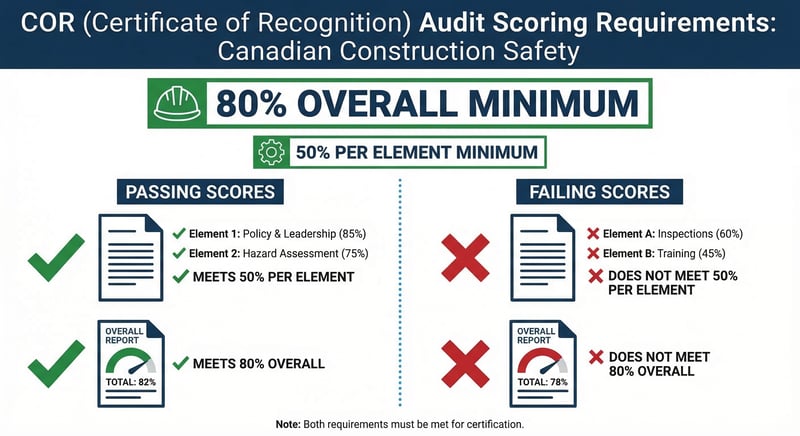
In Alberta, you need a minimum 80% overall score and at least 50% in every individual element to earn your COR. Drop below 50% in even one element and you fail, even if your overall average is above 80%. That means you can't afford to have any element that's just a placeholder.
The WCB incentive makes this worth real money. In Alberta, COR holders are eligible for a 10% industry rate refund on WCB premiums in the first year and 5% every subsequent year they maintain their certification. For a construction company running $2 million in assessable earnings, that refund can be $10,000 or more per year. Across provinces, the specifics vary, but the principle is the same: COR saves you money on premiums.
For a deeper dive into the COR certification process by province, check out our guides to COR certification in Alberta and COR certification in BC.
What Are the Biggest Mistakes Contractors Make When Building a Safety Program?
We've reviewed hundreds of safety programs over the years. The same mistakes show up again and again:
Mistake 1: Buying a template and never customizing it. We see this constantly. A contractor buys a $500 template package, puts their logo on the front page, and calls it done. The auditor opens it up and finds references to "Company XYZ" on page 37, or safe job procedures for tasks the company doesn't even perform. Templates are a starting point, not a finished product.
Mistake 2: Building the program in isolation from the crew. If your safety coordinator writes the entire program at their kitchen table without talking to the workers who actually do the work, it won't reflect reality. And when the auditor interviews your crew and they've never seen the procedures, you lose points in multiple elements.
Mistake 3: Treating it as a one-time project. A safety program isn't something you build once and shelve. It needs regular reviews, updates when tasks or equipment change, and active maintenance of records. The auditor asks to see 12 months of documentation. If your records trail off after month three, it tells a story.
Mistake 4: Ignoring the "soft" elements. Contractors tend to focus on the visible stuff: PPE, procedures, inspections. Then they score 30% on the joint safety committee element because they never set one up. Or they score below 50% on training and communication because there's no documented toolbox talk program. Every element matters. Download our free ultimate guide to toolbox talks if you need a structured program for regular safety communication.
Mistake 5: Not running a gap analysis before the audit. Going into a COR audit without testing your own program first is like writing an exam without studying. A gap analysis compares your current program against the audit requirements, element by element, and tells you exactly where you're weak. runs a gap analysis against all 14 COR elements using your actual safety data, so you know exactly which elements need work before the auditor arrives.
How Do You Build a Construction Safety Program from Scratch?
If you're starting with nothing (or starting over because your current program won't survive an audit), here's the practical path:
Step 1: Get your policy signed and visible. Start with element 1. Write your health and safety policy, have the owner sign it, date it, and post it where workers can see it. This takes an afternoon, not a month. Don't overthink it.
Step 2: Build your task inventory and hazard assessments. List every job your company does. For each one, complete a formal hazard assessment identifying the hazards and controls. This is the most time-consuming part of the program and can take weeks for a mid-size contractor.
Step 3: Write your procedures. For every high-risk task on your list, write a safe job procedure with step-by-step instructions. Include the hazards, required PPE, and emergency response for that specific task.
Step 4: Set up your training program. Build a training matrix showing every role in your company and what training each one needs. Set up an orientation program for new hires, a schedule for toolbox talks, and a system for tracking training completion and certification expiry dates.
Step 5: Create your forms and start using them. You need inspection checklists, FLHA forms, incident report forms, and corrective action tracking sheets. The key word is "start using them." An auditor wants to see 12 months of completed records. The clock starts when your crew starts filling out the paperwork.
Step 6: Fill in the remaining elements. Emergency response plans, preventative maintenance schedules, company rules, safety committee terms of reference, records and statistics tracking, and your legislation management process. None of these are individually difficult, but they add up.
The realistic timeline for building a COR-ready program from scratch is 6 to 12 months with dedicated effort. If you're running a crew during the day and trying to write a safety program at night, it takes longer. That's why many contractors hire help.
Safety Evolution builds audit-ready safety programs for contractors. We don't just hand you a template. We build the program around your actual operations, set up your document control, train your team, and prepare you for the audit. Check out our safety services to see how it works, or to see where your program stands right now.
What Makes the Difference Between a Program That Passes and One That Doesn't?
After helping contractors through dozens of COR audits, the pattern is clear. The programs that pass share three qualities:
They're specific to the company. Not generic, not borrowed, not a template with the logo swapped. The procedures reference actual equipment. The hazard assessments reference actual job sites. The training matrix lists actual employees by name.
They're actively maintained. Records are current. Toolbox talks happened last week, not six months ago. Inspection reports have corrective actions that were actually followed up on. The safety program lives in the daily work, not in a binder on a shelf.
They're understood by everyone, not just the safety coordinator. When the auditor interviews a labourer on your crew and asks "What's the procedure if you find a hazard?" the labourer can answer. That only happens when the program is communicated consistently, through orientations, toolbox talks, posted procedures, and supervisors who reinforce it daily.
For more strategies on audit preparation, read our guide on 3 strategies to pass your next safety audit.
Province-Specific Considerations
While the 14-element COR structure is consistent across Canada, the details vary by province:
- Alberta: Certifying partners include ACSA (Alberta Construction Safety Association) for construction, plus several industry-specific partners. The PIR (Partnerships in Injury Reduction) program through WCB-Alberta offers 10% premium refund in year one and 5% in maintenance years.
- British Columbia: BCCSA (BC Construction Safety Alliance) administers the COR program for construction. WorkSafeBC offers premium discounts through the Partners Program for COR-certified employers.
- Saskatchewan: SCSA (Saskatchewan Construction Safety Association) handles COR for construction. WCB-Saskatchewan offers premium rebates.
- Ontario: IHSA (Infrastructure Health and Safety Association) administers COR 2020, which aligns with the SOSE (Supporting Ontario's Safe Employers) program for WSIB financial incentives.
Always verify the current requirements with your provincial certifying partner, as audit tools, scoring thresholds, and incentive programs can change. For province-specific guidance, see our guide to implementing a health and safety management system.
Make Your Next COR Audit a Breeze
Preparing for a COR audit manually takes weeks of hunting down missing forms. Safety Evolution automatically files and organizes every document, making your digital audit prep take hours instead of weeks.
30-Day Free Trial
Frequently Asked Questions
What should a construction safety program include?
A construction safety program should include 14 core elements aligned with COR 2020 standards: health and safety policy, hazard assessment and control, safe work practices, safe job procedures, company safety rules, PPE management, preventative maintenance, training and communication, inspections, incident investigation and reporting, emergency response, records and statistics, legislation compliance, and a joint health and safety committee. Each section should contain written policies, procedures, blank forms, and evidence of implementation.
How long does it take to build a COR-ready safety program?
Building a COR-ready safety program from scratch typically takes 6 to 12 months with dedicated effort. The program development itself might take 2 to 4 months, but COR auditors require 12 months of implementation records (completed FLHAs, inspection reports, toolbox talk records, etc.) before they can evaluate your program. Working with a safety services provider like Safety Evolution can accelerate the development phase significantly.
What score do you need to pass a COR audit?
In most Canadian provinces, you need a minimum overall score of 80% and at least 50% in every individual audit element to earn your COR. Scoring below 50% in any single element results in a failure, even if your overall average exceeds 80%. COR certification is valid for three years, with mandatory internal maintenance audits required annually.
Can I use a template to build my construction safety program?
Templates are a useful starting point, but they cannot be used as-is. COR auditors evaluate whether your program is specific to your company, your operations, and your worksite conditions. A generic template with your logo on the cover will not pass an audit. You need to customize every section to reflect your actual tasks, equipment, crew structure, and working conditions. Many contractors find it more effective to work with a safety services provider who builds the program around their specific operations.
What WCB premium discount do you get with COR?
WCB premium discounts for COR holders vary by province. In Alberta, the Partnerships in Injury Reduction (PIR) program offers a 10% industry rate refund in the first year and 5% in subsequent maintenance years. Other provinces have similar incentive programs through their respective workers' compensation boards. For a construction company with $2 million in assessable earnings, the annual savings can be $10,000 or more depending on your rate group.
Do I need COR to bid on construction work in Canada?
COR is not legally mandatory in most provinces, but it is practically required for many construction contracts. Most general contractors and major project owners require COR (or SECOR for smaller employers) as a condition of contract before they will consider your bid. Government contracts and large-scale infrastructure projects almost always require COR certification. Without it, you may be locked out of the work that drives your revenue.
Get Weekly Safety Insights
Regulation updates, toolbox talk ideas, and compliance tips. One email per week.