Last updated: March 2026
Your crew is 10 minutes from starting work. You need a toolbox talk topic. You open your phone, search "ergonomics toolbox talk," and get a 3,000-word article that reads like a textbook. That's not going to work at 6:45 AM with a crew that's already thinking about the first pour.
We run safety meetings with contractors every week, and the number one reason toolbox talks fail isn't the topic. It's the delivery. A talk that takes 15 minutes loses people by minute 3. A talk that reads like a policy manual never had them to begin with.
So here's what you actually need: a ready-to-read ergonomics safety meeting script you can print, deliver in 5 minutes flat, and file for your records. No fluff. No jargon. Just the talk.
⚡ Quick Answer
- What: A complete ergonomics toolbox talk script, ready to read aloud at your morning safety meeting
- Time: 5 minutes to deliver, including crew discussion
- Covers: What ergonomic hazards are, how to spot them on site, what to do about them, when to report
- Format: Talking points, discussion questions, crew sign-off
- Why it matters: Musculoskeletal injuries account for roughly 35-40% of lost-time WCB claims across Canadian provinces
- Free resource: Download our free 52 Construction Toolbox Talks PDF package to keep your talks relevant, fast, and consistent.
An ergonomics toolbox talk is a short safety meeting focused on preventing musculoskeletal injuries (MSIs) caused by awkward postures, repetitive motions, forceful exertions, and sustained positions. Unlike a classroom training session, it's designed to be delivered on site, before the work starts, in plain language your crew already understands.
Why Should You Run an Ergonomics Safety Meeting?
Most supervisors think ergonomics is an office thing. Desk chairs, monitor heights, keyboard trays. They're wrong.
On a construction site, ergonomic hazards are everywhere: carrying materials overhead, kneeling on concrete for hours, twisting to reach into a wall cavity, gripping a vibrating tool all day. These aren't dramatic incidents. Nobody falls off a scaffold. Nobody gets hit by a load. Instead, a worker's shoulder starts aching in week two. Their lower back tightens up by Friday. Three months later, they're filing a WCB claim and you're short-handed on a project that's already behind.
Here's the reality: musculoskeletal disorders (MSDs) account for roughly 35-40% of all lost-time compensation claims across Canadian provinces. In Ontario alone, the Workplace Safety and Insurance Board (WSIB) reports MSDs represent over 40% of lost-time claims. That makes ergonomic injuries the single largest category of workplace injury in construction, bigger than falls, bigger than struck-by incidents.
A 5-minute ergonomics toolbox talk won't eliminate the problem. But it puts the hazard on your crew's radar before they start work, and that's when it matters most.
If you're building out a full library of safety meeting content, grab our free toolbox talk package with 50+ ready-to-use topics to keep your meetings covered all year.
What Are Ergonomic Hazards on a Job Site?
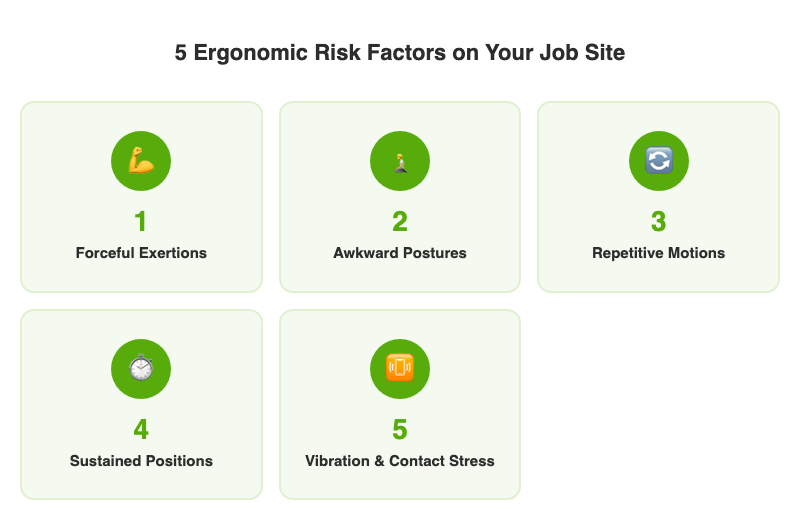
Before you deliver this talk, you need to understand the five main ergonomic risk factors your crew faces. These aren't theoretical categories; they show up on every site, every shift.
1. Forceful exertions. Lifting heavy materials, pushing loaded wheelbarrows, pulling cable through conduit. Any task that demands significant physical force.
2. Awkward postures. Working overhead, kneeling, bending at the waist, reaching behind your body. Any position that puts your joints outside their neutral range.
3. Repetitive motions. Hammering, drilling, tying rebar, shoveling. Any movement performed repeatedly throughout the shift without adequate variation.
4. Sustained positions. Standing on concrete for 8 hours, sitting in equipment without a break, holding a tool at shoulder height for extended periods.
5. Vibration and contact stress. Operating jackhammers, grinders, or compactors. Kneeling directly on hard surfaces. Using tool handles that press into the palm.
The tricky part with ergonomic hazards is that they rarely cause an immediate injury. Workers don't feel them fail; they feel them accumulate. By the time someone reports pain, the damage has been building for weeks or months. That's exactly why you address it in a toolbox talk: to get people thinking about these hazards before they become injuries.
MSD Claims Are Often the Most Expensive and Most Preventable
Use the free 52 Construction Toolbox Talks PDF package to run consistent talks and keep weekly documentation in one place.
Download the 52 Toolbox Talks PDF →
The 5-Minute Ergonomics Toolbox Talk Script
Read this aloud to your crew. Adjust the examples to match today's tasks.
Opening (30 seconds)
"Alright everyone, today's toolbox talk is about ergonomics. I know that sounds like an office word, but it's not. Ergonomics is about how your body interacts with the work you do. And on this site, the way you lift, reach, kneel, and grip your tools directly affects whether you go home feeling fine or wake up at 3 AM with a back that won't let you roll over."
The Hazard (1 minute)
"Musculoskeletal injuries are the number one type of lost-time injury in construction. We're talking about back strains, shoulder injuries, knee problems, wrist pain. These don't happen because of one bad lift. They happen because of weeks or months of doing things in a way that slowly wears your body down.
The five things that cause these injuries are: heavy lifting, awkward postures like working overhead or bent over, doing the same motion over and over, staying in one position too long, and vibration from power tools. Most of the time, you won't feel the damage happening. That's what makes it dangerous."
Spot It Today (1 minute)
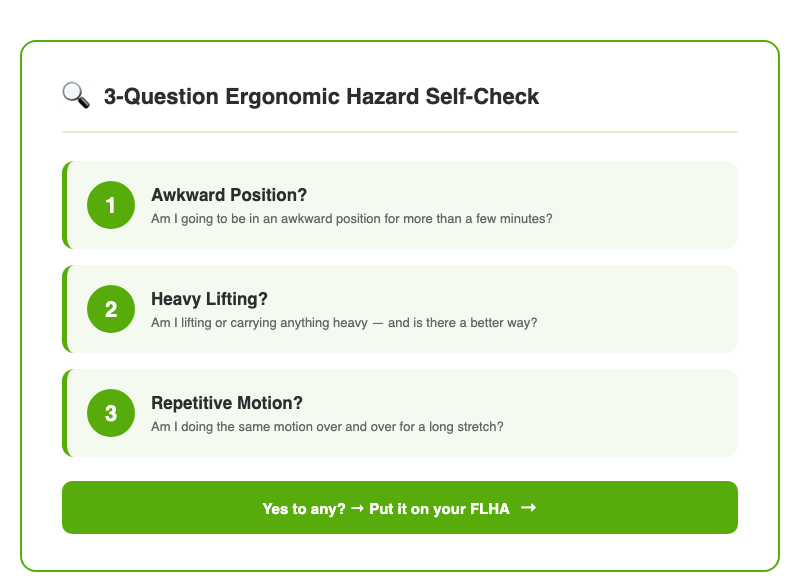
"Before you start your tasks today, I want you to look at your work and ask yourself three questions:
- Am I going to be in an awkward position for more than a few minutes at a time? Think overhead work, kneeling, bending at the waist.
- Am I lifting or carrying anything heavy, and is there a better way to move it? A dolly, a second set of hands, staging materials closer.
- Am I going to be doing the same motion over and over for a long stretch? Shoveling, hammering, drilling in the same position.
If the answer is yes to any of those, that's an ergonomic hazard. Put it on your FLHA."
Control It (1.5 minutes)
"Here's what you can actually do about it:
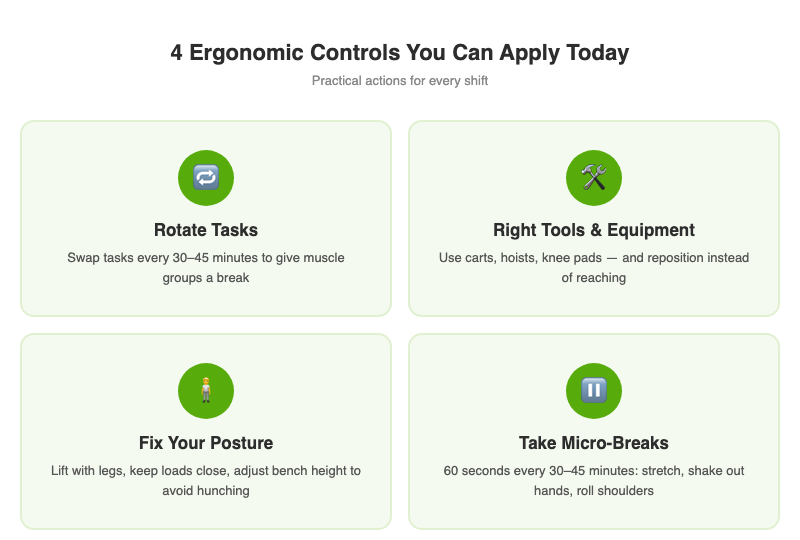
Rotate tasks. If you're doing overhead work, swap with someone doing ground-level work every 30-45 minutes. Give those muscles a break before they give out.
Use the right tools and equipment. If you're lifting materials, use a cart, a hoist, or ask for help. If you're kneeling, use knee pads. If you're working at height on a ladder and reaching, reposition the ladder instead of stretching.
Fix your posture. Lift with your legs, not your back. Keep heavy loads close to your body. If you're working at a bench, adjust it so you're not hunching over. Small changes make a big difference over an 8-hour shift.
Take micro-breaks. Every 30-45 minutes, take 60 seconds to stretch, shake out your hands, roll your shoulders. This isn't slacking off; it's maintenance. You maintain your tools. Maintain your body.
Stage your materials. Before you start a task, set up your work area so the things you need most are at waist height and within arm's reach. Five minutes of setup saves hours of unnecessary reaching and bending."
Report It (30 seconds)
"If you notice pain, stiffness, numbness, or tingling that doesn't go away after a shift, report it. Don't wait until it gets bad. Early reporting means early treatment, and early treatment means you're back to full duty faster. I'd rather deal with a report today than a WCB claim next month.
If you see a task that seems like it's set up in a way that's going to hurt someone, say something. We can engineer that out before it becomes an injury."
Discussion Questions (1 minute)
Ask these to your crew. Give people a few seconds to respond.
- "What task are you doing today that involves heavy lifting, awkward positions, or repetitive motion?"
- "Has anyone dealt with a sore back, shoulders, or knees from work recently? What did you change?"
- "What's one thing we could do differently today to make a task easier on our bodies?"
For more safety meeting topics your crew will actually engage with, check out our guide to safety meeting topics for every workplace environment.
How to Make This Ergonomics Toolbox Talk Work
Delivering the script is the easy part. Making it stick takes a bit more thought.
Make it specific to today's work. The script above gives you the framework. But when you deliver it, swap in the actual tasks your crew is doing that day. "We're pouring concrete on the second floor" hits harder than "heavy lifting" in the abstract. The more specific you are, the more your crew connects the hazard to their actual work. A 15-person mechanical crew in Calgary told us the talks only started working when their supervisor stopped reading generic scripts and started pointing at the actual job site.
Write it on your FLHA. If your crew identifies an ergonomic hazard during the toolbox talk, put it on the field-level hazard assessment. That turns a conversation into a documented control.
Keep it short. The script is designed for 5 minutes. If you run over, you'll lose people. If the topic sparks a good conversation, great. Let it run. But don't force 15 minutes of content into a format that works because it's quick.
Need your full year of toolbox talks planned out? Download our Ultimate Guide to Toolbox Talks with 365 topics, organized by month with delivery tips.
Printable Ergonomics Toolbox Talk Format
Want to print this talk and hand it to your supervisors? Here's how to use it:
- Print the script section above (from "Opening" through "Discussion Questions").
- Add a sign-off section at the bottom with: date, time, supervisor name, topic covered ("Ergonomics"), and lines for each crew member to print their name and sign.
- File it. Keep a copy in your safety binder or upload it to your digital safety management system. If you're using Safety Evolution, your toolbox talks are tracked automatically with digital sign-off and reporting.
Looking for a ready-to-print version with sign-off sheets included? Our free construction toolbox talk package includes 50+ talks in a printable format with built-in attendance tracking.
When to Schedule an Ergonomics Safety Meeting
Run this toolbox talk ergonomics topic at least once per quarter. But there are a few situations where you should run it right away:
- New project startup. New site, new tasks, new ergonomic risks. Run the talk in the first week.
- After an MSD report. If someone reports back pain, a shoulder injury, or repetitive strain, run the talk with the whole crew. Use it as a reset.
- Seasonal transitions. Cold weather stiffens muscles and increases injury risk. Hot weather causes fatigue that leads to sloppy body mechanics. Both are good times for a refresher.
- When tasks change. If your crew shifts from ground-level work to overhead work, from light materials to heavy ones, or from varied tasks to repetitive ones, the ergonomic risks change too.
Are Ergonomic Hazards Showing Up in Your Incident Data?
Use the free 52 Construction Toolbox Talks PDF package to run consistent talks and keep weekly documentation in one place. It flags repetitive strain injuries, awkward posture reports, and manual handling incidents that signal ergonomic gaps in your safety program.
Start Your 30-Day Free Trial →
Ergonomics Toolbox Talk FAQ
What should an ergonomics toolbox talk cover?
An ergonomics toolbox talk should cover the five main ergonomic risk factors (forceful exertions, awkward postures, repetitive motions, sustained positions, and vibration), how to identify them in the day's specific tasks, practical controls workers can apply immediately, and when to report pain or discomfort. Keep it under 5 minutes and include at least one discussion question to engage the crew.
How often should I run an ergonomics safety meeting?
At minimum, once per quarter. Run it more often at project startups, after any musculoskeletal injury report, during seasonal transitions (especially into winter when muscles are stiffer), and whenever your crew's tasks change significantly. Many contractors include ergonomics in their regular weekly toolbox talk rotation.
Do I need to document an ergonomics toolbox talk?
Yes. Record the date, time, topic, presenter name, and attendee signatures for every toolbox talk. This documentation is required for COR and SECOR audits in Canada and demonstrates due diligence if an incident occurs. Use a sign-off sheet or a digital safety management system to track attendance automatically.
What are the most common ergonomic injuries in construction?
The most common ergonomic injuries in construction are lower back strains (from lifting and bending), shoulder injuries (from overhead work), knee disorders (from kneeling on hard surfaces), and hand or wrist conditions like carpal tunnel syndrome (from repetitive gripping and vibrating tools). These musculoskeletal injuries often develop gradually over weeks or months rather than from a single incident.
How do I get my crew to take ergonomics seriously?
Connect it to their body, not to policy. Instead of talking about "musculoskeletal disorder prevention programs," ask who's had a sore back after a long week. Make it about their tasks that day, not abstract concepts. Use the discussion questions to let experienced workers share what they've learned. When a veteran on the crew says "I wish I'd used knee pads 10 years ago," it carries more weight than any safety poster.
Get Weekly Safety Insights
Regulation updates, toolbox talk ideas, and compliance tips. One email per week.