Training
Ergonomics Training for the Workplace
Ergonomics training helps prevent MSIs and meet Canadian OHS requirements. Learn what it covers, who needs it, and how to build a program.
An ergonomics assessment identifies injury risks in your workplace. Learn when one is required, what the process involves, and what you get at the end.
Last updated: March 2026
Your crew has been complaining about sore backs for months. One worker just filed a WCB claim for a shoulder injury. Your safety coordinator pulled the FLHAs from last quarter and found zero documented ergonomic hazards, even though half the tasks involve overhead work and repetitive lifting.
That gap between what's happening on site and what's on paper is exactly where injuries grow. And it's exactly what an ergonomics assessment is designed to close.
At Safety Evolution, we've seen this pattern play out across construction, oil and gas, and manufacturing operations in Alberta and BC. The companies that wait for a WCB claim to trigger action end up spending three to five times more fixing the problem than they would have preventing it.
An ergonomic assessment is a systematic evaluation of how work tasks, tools, and workstation design affect your workers' bodies. In Canadian workplaces, ergonomic assessments are how employers identify the root causes of musculoskeletal injuries and determine what controls to put in place.
This guide explains what happens during an ergonomic assessment, what to expect if you're commissioning one for your workplace, and how to use the findings to reduce injury claims and improve productivity.
An ergonomics assessment is a structured evaluation of work tasks, workstations, tools, and physical demands to identify factors that could cause musculoskeletal injuries (MSIs) in workers. It looks at the fit between the worker and the work, not just the worker's technique.
Most contractors think ergonomic assessments are about office chairs and monitor heights. That's a sliver of what they actually cover. In industrial and construction settings, an ergonomics evaluation examines repetitive motions, forceful exertions, awkward postures, vibration exposure, and contact stress across every task your crew performs.
The goal is not a stack of recommendations nobody reads. The goal is a prioritized list of changes, from quick fixes to engineered solutions, that reduce your injury exposure and keep your people working.
Think of it as a hazard assessment focused specifically on the human body. Where a general hazard assessment identifies all workplace hazards (chemical, physical, biological), an ergonomic assessment drills into the biomechanical risks: how workers move, lift, reach, grip, and sustain postures throughout their shift.
Here's the blunt truth most contractors don't hear until it's too late: there is no magic employee count or revenue threshold that triggers an ergonomic assessment requirement in Canada. The obligation exists from day one if your workers face ergonomic risk factors.
In Alberta, the OHS Code Part 2 (Hazard Assessment, Elimination and Control) requires employers to assess a work site and identify existing and potential hazards before work begins. Ergonomic hazards are hazards. Part 14 (Lifting and Handling Loads) goes further: Section 210 requires a specific hazard assessment before a worker manually lifts, lowers, pushes, pulls, carries, or handles a load that could cause injury. If that assessment identifies potential for musculoskeletal injury, Section 210(3) requires "all reasonably practicable measures" to eliminate or reduce it.
In BC, WorkSafeBC's Ergonomics (MSI) Requirements under Sections 4.46 to 4.53 of the OHS Regulation are more explicit. Employers must identify factors that could expose workers to MSI risk, assess those risks, and implement controls. The regulation requires worker consultation through joint health and safety committees on risk identification, training content, and the evaluation of control measures.
At the federal level, the Canada Occupational Health and Safety Regulations (Part XIX) require federally regulated employers to develop a hazard identification and assessment methodology that specifically addresses ergonomics-related hazards.
The short version: if your workers lift things, work in awkward positions, perform repetitive tasks, or use vibrating equipment, you almost certainly have a regulatory obligation to assess and address ergonomic risk.
Beyond the regulation, these are the situations where an ergonomics assessment isn't optional; it's overdue:
An Ergonomic Assessment Prevents the Injuries You Keep Paying For
SE-AI checks your incident data and hazard assessments for tasks that need ergonomic assessments but have not had one.
Get Early Access →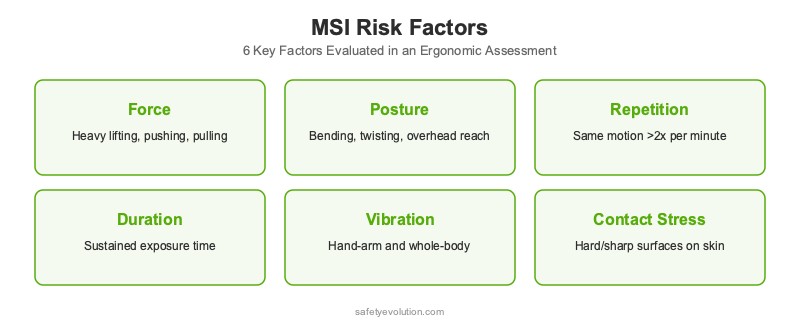
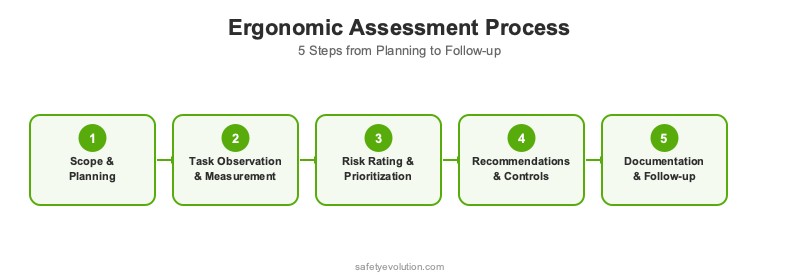
If you've never been through one, here's what to expect. The process is more rigorous than most contractors assume, and that's a good thing. A thorough ergonomics evaluation isn't someone walking through your site with a clipboard for 20 minutes.
Before anyone sets foot on site, the assessor needs to understand your operation. This includes reviewing your current hazard assessments, incident reports, WCB claim history, and job descriptions. The assessor will identify which tasks, roles, or work areas to prioritize based on injury data and risk exposure.
For a 30-person construction company, this might mean focusing on your concrete crew (heavy lifting, repetitive vibration from power tools) and your framing crew (sustained overhead work, awkward postures on scaffolding).
The assessor observes workers performing their actual tasks during a normal shift, not a staged demonstration. They're looking at:
The assessor typically uses standardized tools like the Rapid Entire Body Assessment (REBA), the NIOSH Lifting Equation (a widely adopted risk calculation tool), or the Strain Index to quantify risk levels. These aren't subjective opinions; they're evidence-based scoring systems that produce defensible numbers.
Every identified risk factor gets rated by severity and likelihood. High-risk tasks (those with a strong probability of causing injury without intervention) are flagged for immediate action. Medium-risk tasks get scheduled controls. Low-risk tasks are documented and monitored.
This is where many contractors are surprised. The task they assumed was the biggest problem often isn't. A 15-person drywall crew doing repetitive overhead fastening might score higher on the risk matrix than the two labourers moving heavy material, because frequency and duration matter as much as force.
The assessment report delivers specific recommendations following the hierarchy of controls:
Good recommendations include estimated costs, implementation timelines, and expected risk reduction. You should be able to hand the report to your operations manager and have them start executing within a week.
The formal report documents everything: tasks assessed, risk scores, findings, recommendations, and a follow-up timeline. This document becomes part of your safety management system and provides the evidence trail you need for COR audits, WCB claim management, and regulatory compliance.
A solid assessment includes a scheduled reassessment date, typically 6 to 12 months out, to verify that controls are working and no new risks have emerged.
If you're evaluating your own operations before bringing in a specialist (or if your safety coordinator is running an initial screen), here's what a basic ergonomic assessment checklist should address for industrial and construction workplaces:
This is a screening tool, not a replacement for a professional assessment. But it gives you a starting point to understand where your highest risks sit. You can download our free toolbox talk package for a ready-made ergonomics awareness session you can run with your crew this week.
Let's talk numbers, because vague "it depends" answers help nobody making a budget decision.
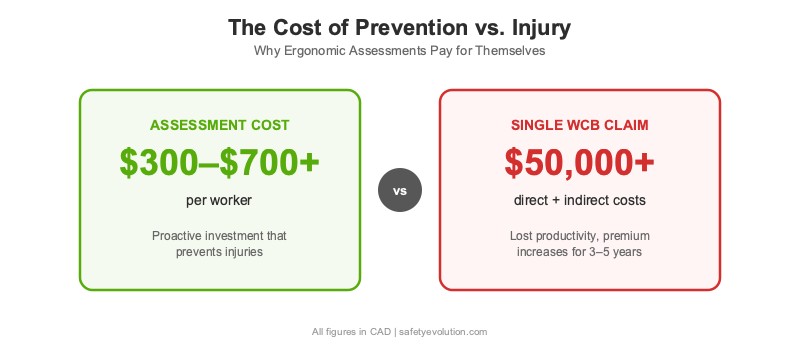
In Canada, a professional ergonomic assessment typically costs between $300 and $700+ per worker or workstation, depending on scope and complexity. A basic office workstation evaluation sits at the lower end. A comprehensive industrial assessment covering multiple tasks, roles, and work areas across a construction or manufacturing site will run higher, often into the thousands when you factor in the full site.
For context: a single lost-time WCB claim for a musculoskeletal injury in Alberta averages well over $50,000 in direct and indirect costs when you include lost productivity, overtime for replacement workers, WCB premium increases, and administrative time. One prevented injury pays for an entire site's worth of assessments many times over.
The companies that see ergonomic assessments as an expense have never done the math on their WCB claims. The companies that see them as an investment track their injury rates going down and their WCB premiums following.
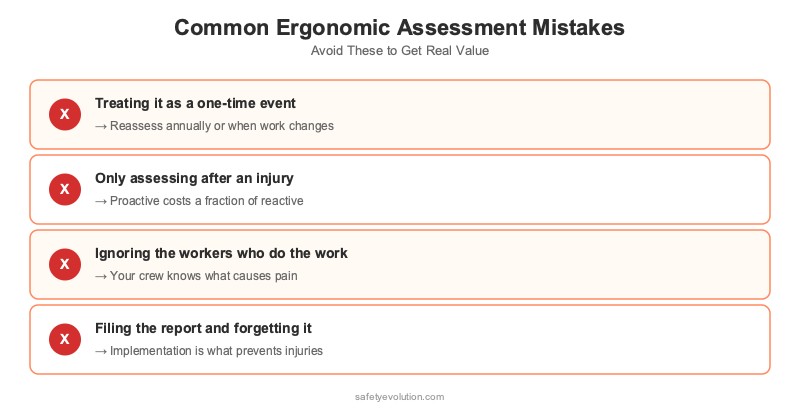
Even well-intentioned companies get this wrong. Here are the patterns we see most often:
Treating it as a one-time event. An ergonomic assessment is a snapshot. Your work changes. Your crew changes. New tools arrive. If your last assessment was three years ago, it's not protecting anyone. Reassessments should happen annually or whenever work processes change significantly.
Only assessing after an injury. By then, you've already lost. The WCB claim is filed. The worker is off. Your premium is going up. Proactive assessments cost a fraction of reactive ones, because you're not also paying for the injury, the claim, and the operational disruption.
Ignoring the workers who do the work. Alberta OHS Code Section 8 requires worker involvement in hazard assessments, and for good reason. Your concrete finisher knows things about their task that no assessor will catch in a two-hour observation. The best assessments combine professional analysis with worker knowledge.
Filing the report and forgetting it. The assessment is only worth what you do with it. If the recommendations sit in a binder while your crew keeps working the same way, you've spent money to create a document that proves you knew about the risk and did nothing. That's worse than never assessing at all.
If you are not sure where to start, SE-AI can analyse your safety records and show you where ergonomic risk fits into your overall program and what to prioritize first.
Have Your High-Risk Tasks Had a Proper Ergonomic Assessment?
SE-AI analyses your safety records to identify tasks that should have ergonomic assessments but do not. It flags high-MSD-risk activities, jobs with repeated strain injury claims, and work processes where ergonomic controls have not been documented.
Get Early Access to SE-AI →An ergonomic assessment is a systematic evaluation of work tasks, tools, workstations, and physical demands to identify risk factors that could cause musculoskeletal injuries (MSIs). The assessor observes workers performing real tasks, measures risk factors like force, posture, repetition, and vibration, then provides prioritized recommendations to reduce injury risk. It applies to any workplace where workers perform physical tasks, not just office environments.
At minimum, reassess annually and whenever work processes, tools, or tasks change significantly. In Alberta, the OHS Code requires hazard assessments to be repeated at "reasonably practicable intervals" and whenever new processes are introduced or existing ones change. After any reported musculoskeletal injury, you should also reassess the affected tasks immediately.
In Canada, ergonomic assessments are typically performed by a Canadian Certified Professional Ergonomist (CCPE), a kinesiologist, or an occupational therapist with ergonomics training. For industrial and construction settings, look for assessors with direct experience in your industry, not just office ergonomics. Your safety consultant or safety management provider can also coordinate assessments as part of your overall safety program.
Professional ergonomic assessments in Canada typically range from $300 to $700+ per worker or workstation. Simple office evaluations sit at the lower end. Comprehensive industrial assessments covering multiple roles, tasks, and work areas cost more. The investment is modest compared to the cost of a single lost-time WCB claim, which can easily exceed $50,000 in direct and indirect costs.
Yes, though the requirement varies by province. All provinces require employers to identify and control workplace hazards, which includes ergonomic hazards. Alberta OHS Code Part 2 and Part 14 require hazard assessments that cover manual handling risks, while BC's WorkSafeBC Sections 4.46 to 4.53 explicitly require MSI risk identification and control. Federally regulated employers must develop specific ergonomic hazard assessment methodologies under Part XIX of the Canada OHS Regulations.
Get Weekly Safety Insights
Regulation updates, toolbox talk ideas, and compliance tips. One email per week.
Ergonomics training helps prevent MSIs and meet Canadian OHS requirements. Learn what it covers, who needs it, and how to build a program.
Workplace ergonomics for construction, oil & gas, and industrial employers in Canada. Risk factors, legal requirements, and how to protect your crew.
Build an ergonomics program that fits your safety management system. 7 components, COR integration, and practical steps for Canadian contractors.