Last updated: April 2026
Your safety program looks solid on paper. You've got binders on the shelf, toolbox talks running most weeks, and your crew knows the basics. Then the auditor shows up, starts pulling documentation, interviewing your people, and walking the site. Three days later, you're staring at a 68% score and a failed certification.
This happens to contractors across Canada more often than anyone admits. At Safety Evolution, we prepare companies for COR audits every month, and the pattern is always the same: it's not the safety program that fails. It's the gap between what's written down and what's actually happening on site.
⚡ Quick Answer: COR Audit Essentials
- What: A COR audit evaluates your health and safety management system against provincial standards using three methods: documentation review, employee interviews, and workplace observations
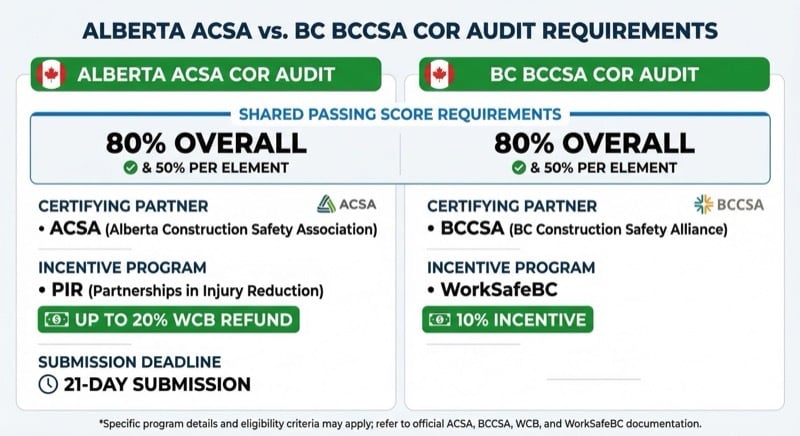
- Passing score: 80% overall with a minimum of 50% on each element (both Alberta and BC)
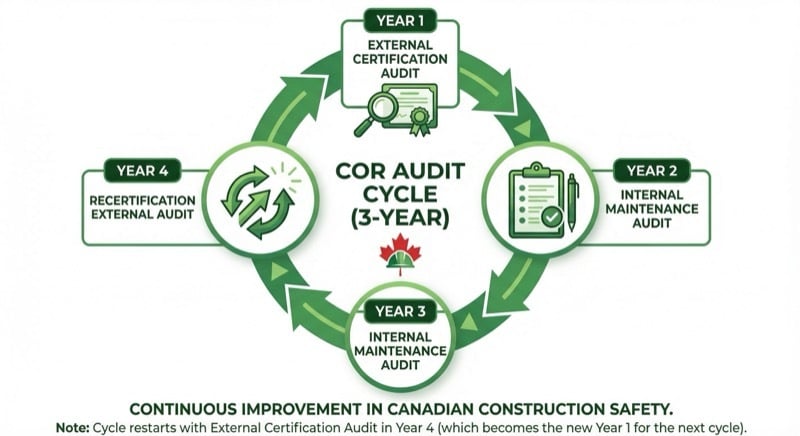
- Cycle: 3-year cycle. External audit in Year 1, internal maintenance audits in Years 2 and 3, recertification in Year 4
- Timeline: Allow 6 to 12 months of preparation if building a safety program from scratch
- WCB incentive: Up to 20% premium refund in Alberta (PIR program); 10% of base assessment premium in BC
- Behind on COR actions? Start your 30-day free trial to track owners, due dates, and audit evidence in one place.
What Is a COR Audit and Why Does It Matter?
A COR (Certificate of Recognition) audit is a structured evaluation of your company's occupational health and safety management system (OHSMS), conducted by a certified auditor to determine whether your program meets provincial standards. It's the gatekeeper between you and certification, and without it, no amount of safety paperwork gets you a COR.
Here's what makes the COR audit different from a basic compliance check: auditors aren't looking at whether you have a safety program. They're evaluating whether your program is working. That means your written policies, your crew's actual behaviour on site, and the documentation connecting the two all need to line up.
For most contractors, COR certification is the difference between winning bids and watching from the sidelines. General contractors across Alberta and BC require COR as a condition of contract, especially on larger projects. And provincially, COR-certified employers qualify for significant WCB premium reductions that can save thousands of dollars per year.
If you're not sure whether your safety program is ready for an audit, Safety Evolution can tell you. It analyses your existing records and flags exactly which elements would fall short.
How Does the COR Audit Process Work Across Canada?
The COR program exists in every province and territory across Canada, but each province runs it through its own certifying partners with their own audit instruments. The core framework is the same everywhere: build a safety management system, get it audited, and maintain certification through annual audits.
Here's the national framework:
Step 1: Join a Certifying Partner
Every province has authorized certifying partners that administer the COR program. You pick the one that fits your industry. In Alberta, the construction industry uses ACSA (Alberta Construction Safety Association). In BC, construction companies go through BCCSA (BC Construction Safety Alliance). Your certifying partner provides training, audit tools, quality assurance, and the administrative backbone of your certification.
Step 2: Build and Implement Your Safety Management System
You can't audit what doesn't exist. Before scheduling an audit, your company needs a functioning health and safety management system that covers all the required elements (more on those below). Most certifying partners require a minimum of three to six months of documented evidence that the program is actually operating before they'll accept an audit submission.
Most contractors think they can build a safety program in a few weeks, hand it off, and pass an audit. They're wrong. Auditors aren't evaluating your manual; they're evaluating months of documented activity, worker knowledge, and site conditions. A program that's been sitting in a binder for two weeks won't produce the interview answers or documentation trail that certification requires.
Step 3: Train a Certified Auditor (or Hire One)
For your initial certification audit, you need an external auditor. This is someone certified through your certifying partner who is independent from your company. For subsequent internal maintenance audits, you can use a peer auditor from your own staff (someone who's completed auditor training).
Step 4: Complete the Certification Audit
The auditor evaluates your program using three methods:
- Documentation review: policies, procedures, training records, inspection logs, incident reports, meeting minutes, FLHA forms, corrective action records
- Employee interviews: workers at every level, from frontline crew to management, asked about safety processes, their training, and how hazards are managed
- Workplace observations: physical site inspections to verify that what's written down matches what's actually happening on the ground
Each method cross-validates the others. If your policy says everyone wears fall protection above 10 feet but the auditor observes workers without it, that's a scoring hit even if the documentation looks perfect.
Step 5: Scoring and Certification
Audit results are scored against standardized elements. To pass, you need a minimum of 80% overall and at least 50% on each individual element. This dual threshold catches companies that ace some areas but completely neglect others.
The auditor submits the completed audit to your certifying partner for quality assurance review. If everything passes QA, your certifying partner issues the COR (in Alberta, jointly with the Government of Alberta; in BC, through WorkSafeBC).
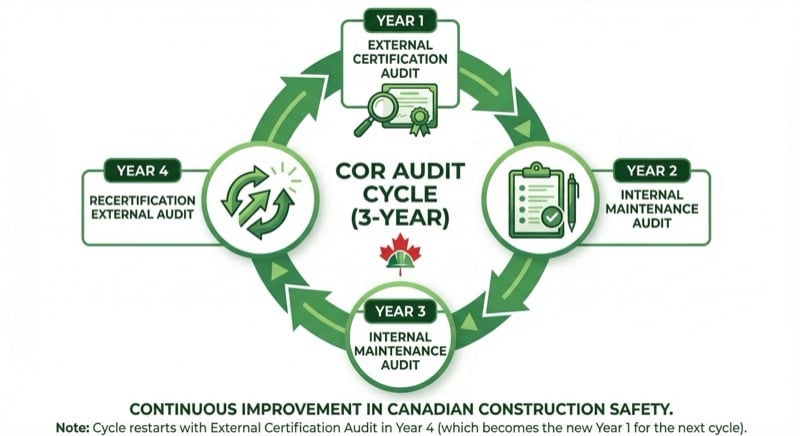
Step 6: Maintain Your COR (3-Year Cycle)
COR isn't a one-and-done certification. It operates on a three-year cycle:
- Year 1: External certification audit (or recertification)
- Year 2: Internal maintenance audit
- Year 3: Internal maintenance audit
- Year 4: External recertification audit (cycle restarts)
In Alberta, maintenance audits need a minimum overall score of 60%. Miss that, or miss your submission deadline, and your certification can lapse.
What Do COR Auditors Actually Evaluate?
This is where most contractors get surprised. The audit isn't one big pass/fail check. It's broken into distinct elements, and you're scored on each one separately. While exact elements vary by certifying partner, here are the core areas every COR audit evaluates:
- Management leadership and commitment: Written health and safety policy, defined responsibilities, resource allocation, management participation in safety activities
- Hazard assessment (formal and field-level): Documented formal hazard assessments for job tasks, plus daily field-level hazard assessments (FLHAs) completed before work begins
- Hazard controls: Evidence that identified hazards have controls in place, following the hierarchy of controls (elimination, substitution, engineering, administrative, PPE)
- Training and competency: Training records for every worker, competency verification, orientation and onboarding documentation, and ongoing refresher training
- Workplace inspections: Regular, documented site inspections with corrective actions tracked to completion
- Incident investigation: A functioning incident investigation process that identifies root causes and implements corrective actions (not just fills out forms)
- Emergency preparedness: Emergency response plans that are documented, communicated to workers, and practiced through drills
- Joint health and safety committee (or health and safety representative): Evidence of active worker participation in safety governance
- System administration: Safety communication processes, records management, and periodic program evaluation
The blunt truth? Most audit failures don't come from having a bad safety program. They come from having a good program on paper that nobody on site can describe. If your workers can't tell the auditor how they report a hazard, what your safety policy says, or when their last toolbox talk happened, your binder full of policies won't save you.
How Is the COR Audit Different in Alberta vs. BC?
While the national COR framework is consistent, the details vary significantly between provinces. Here's what you need to know about the two largest COR programs in western Canada.
Alberta (Through ACSA)
Alberta runs the largest COR program in Canada, with nearly 11,000 active COR and SECOR holders. The Alberta Construction Safety Association (ACSA) is the certifying partner for the construction industry.
Key Alberta details:
What If Your Audit Prep Did Itself?
Safety Evolution checks every COR element against your actual records. Ask “which elements would we fail on today?” and get a scored breakdown instantly.
Start your 30-day free trial →
- Certifying partner (construction): ACSA (Alberta Construction Safety Association). Alberta has 13 total certifying partners across industries.
- Required training before audit: At least one employee must complete PHSM (Principles of Health & Safety Management), LSE (Leadership for Safety Excellence), LEG (Alberta OHS Legislation Awareness), and ATP (Auditor Training Program)
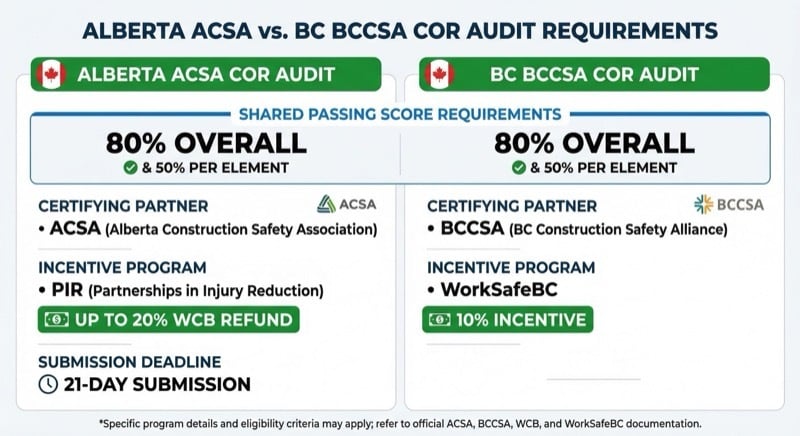
- Audit submission deadline: Completed audits must be submitted to ACSA within 21 days after the last date of data collection
- Passing score: 80% overall, minimum 50% per element
- Maintenance audit score: 60% overall minimum
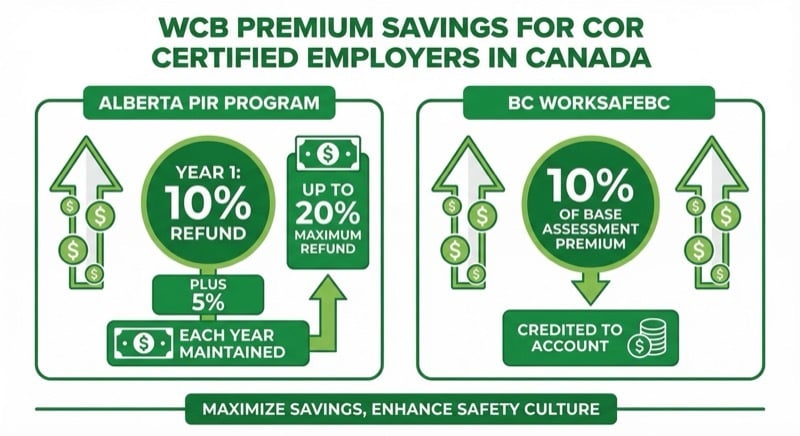
- WCB incentive: Through the Partnerships in Injury Reduction (PIR) program, COR holders receive a 10% industry rate refund in the first year, then 5% each year the COR is maintained (up to 20% total refund on industry-rated premiums)
- Minimum documentation period: At least 3 months of documented safety program activity before your first audit
The PIR refund alone makes COR certification worth the investment for most Alberta contractors. On a $2 million payroll with a typical construction premium rate, that's thousands of dollars back in your pocket every year.
British Columbia (Through BCCSA)
In BC, COR certification is issued by WorkSafeBC, with the BC Construction Safety Alliance (BCCSA) serving as the certifying partner for the construction industry.
Key BC details:
- Certifying partner (construction): BCCSA (BC Construction Safety Alliance)
- Required training: PHSM (Principles of Health & Safety Management) plus internal auditor training for maintenance audits
- Passing score: 80% overall, minimum 50% per element (same as Alberta)
- Internal auditor requirement: Certified internal auditors must conduct at least 2 OHS COR audits within the 3-year period between initial certification and recertification to maintain their auditor status
- WCB incentive: WorkSafeBC calculates the COR financial incentive as 10% of your base assessment premium (assessable payroll × classification unit base rate). Credits are applied directly to your WorkSafeBC account.
- Recertification cycle: External audit in Year 1 and Year 4; internal maintenance audits in Years 2 and 3
One difference that catches BC contractors off guard: WorkSafeBC separates COR certification from incentive eligibility. You can hold a valid COR but still not qualify for the financial incentive if you've received a health and safety conviction or administrative penalty in the previous year, or if you haven't reported payroll on time.
Not sure where your company stands in either province? Safety Evolution checks your current program against audit requirements and shows you exactly which elements need work before the auditor arrives.
What Causes Companies to Fail a COR Audit?
After helping contractors through hundreds of COR audit cycles, we see the same failure patterns repeat. Here are the most common reasons companies fall short:
1. Documentation gaps between policy and practice. You have a hazard assessment procedure, but the field-level hazard assessments your crew is filling out don't match it. Your training matrix shows everyone is current, but three workers can't remember attending their last refresher. The auditor cross-references everything.
2. Workers can't describe the safety program. Interviews carry significant weight in a COR audit. When a frontline worker is asked "What's your company's health and safety policy?" or "How do you report a near-miss?" and they stare blankly, that's points lost. Workers don't need to quote your manual word for word, but they need to demonstrate awareness and participation.
3. Weak management commitment evidence. This is the element that tanks audits for companies that think COR is the safety coordinator's job. Auditors look for evidence that senior leadership actively participates in safety: attending meetings, signing off on inspections, allocating budget, and setting visible priorities. If the owner hasn't touched the safety program in six months, the auditor will notice.
4. Outdated documentation. Safety legislation changes. Your certifying partner updates their audit instrument. Provincial regulations shift. If your safety manual still references requirements from three years ago, or your forms haven't been updated to match current standards, that's a failing element waiting to happen.
5. Incomplete corrective action follow-through. Finding hazards is only half the equation. The audit evaluates whether identified issues were actually corrected, documented, and communicated. An inspection log full of flagged items with no evidence of follow-up is worse than no inspection log at all.
Picture this: a 20-person concrete contractor in Edmonton had a decent safety program, ran their toolbox talks most weeks, and completed FLHAs daily. They scheduled their first COR audit confident they'd pass. The auditor spent two days on site and scored them at 72%. The problem wasn't effort; it was traceability. Their toolbox talks weren't signed. Their training records were in three different spreadsheets with no single source of truth. And when the auditor interviewed the crew, half of them didn't know who the health and safety representative was. None of those are hard fixes, but they're the kind of details that sink an audit.
How Do You Prepare Your Team for COR Audit Interviews?
Interviews are the part of the audit that makes most owners nervous, and for good reason. You can't control what your crew says. But you can set them up to succeed.
The auditor will interview workers at multiple levels: management, supervisors, and frontline workers. They're not looking for scripted answers. They want to see that safety is part of daily operations, not a binder exercise.
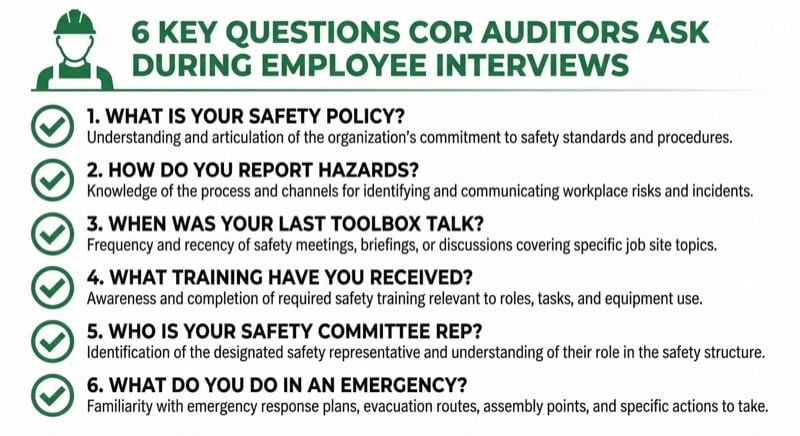
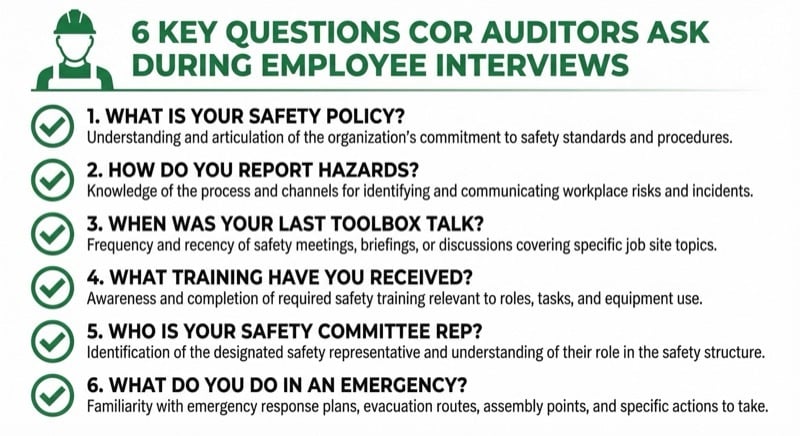
What auditors typically ask workers:
- What is your company's health and safety policy?
- How do you report a hazard or near-miss?
- When was your last toolbox talk or safety meeting?
- What training have you received?
- Do you know who your health and safety committee member or representative is?
- What would you do in an emergency?
The best preparation isn't a crash course the week before the audit. It's making these processes part of your daily operations so workers can answer from experience, not from a last-minute briefing.
Run regular toolbox talks where workers sign in. Review your emergency response plan with the crew at least quarterly. Make sure every worker knows how to complete an FLHA and where to report a hazard. If these things are genuinely part of how you run your sites, the interviews will take care of themselves.
How Do You Build an Audit-Ready Safety Program?
Getting audit-ready isn't a week-long cram session. It's a system that runs year-round. Here's what separates companies that pass on the first attempt from those that scramble:
Start with a gap analysis. Before you even think about scheduling an audit, compare your current program against your certifying partner's audit instrument element by element. ACSA publishes their audit instrument, and BCCSA provides their audit documents to registered employers. Know exactly where you stand before an auditor does.
Build documentation systems that run daily. Safety Evolution monitors your documentation in real time, so you always know whether your records are current. The biggest differentiator between companies that pass and companies that fail is whether safety documentation is a daily habit or a quarterly scramble. Digital tools make this dramatically easier: your crew completes FLHAs on their phones, toolbox talks get signed digitally, inspections auto-generate corrective action tracking. When audit time comes, you're pulling reports, not digging through filing cabinets.
Assign clear ownership for each audit element. Safety Evolution flags when any element falls behind so nothing slips through the cracks. If nobody is responsible for tracking training records, they won't be tracked. Map each audit element to a specific person (or team) and build regular check-ins to verify the documentation is current.
Run an internal pre-audit. Safety Evolution can assess your program against the audit elements anytime, so you always know where you stand. Three to four months before your certification or recertification audit, conduct a full internal audit using the same instrument your external auditor will use. Score it honestly. Every element that falls below 80% is a targeted area for improvement before the real audit.
Don't cram. Auditors can tell when documentation was created the week before the audit. Dates don't lie, and neither do workers during interviews. The company that's been running its program consistently for 12 months will always outscore the one that rushed to fill binders in the last 30 days.
This is exactly what Safety Evolution does for contractors. We build your safety program from the ground up, set up your documentation systems, verify your daily forms, and package everything so you're audit-ready year-round, not just when the auditor is scheduled. If your team is stretched thin and you need someone to own this process, Start your 30-day free trial and see exactly what needs to happen.
What's the Difference Between a COR Audit and a SECOR Audit?
If your company has 10 or fewer employees (or, in some provinces, fewer than 20), you may be eligible for a SECOR (Small Employer Certificate of Recognition) instead of a full COR. The SECOR audit process is simplified: it typically involves a self-assessment reviewed by your certifying partner rather than a full external audit with site observations.
The key differences:
- COR: External audit required. Three methods (documentation, interviews, observations). Scored across all elements. Higher cost and preparation time.
- SECOR: Self-assessment model. Reviewed by certifying partner. Fewer elements evaluated. Faster and more affordable for small companies.
If your company is growing past the SECOR threshold, plan your transition to COR early. The jump in audit requirements is significant, and companies that treat it as "just a bigger version of SECOR" often fail their first COR audit because the documentation depth, interview requirements, and site observation components are genuinely different.
For a deeper look at COR certification itself, read our complete guide to COR certification.
What WCB Premium Discounts Can COR-Certified Companies Earn?
One of the strongest financial reasons to pursue COR is the workers' compensation premium reduction. Both Alberta and BC offer meaningful incentives:
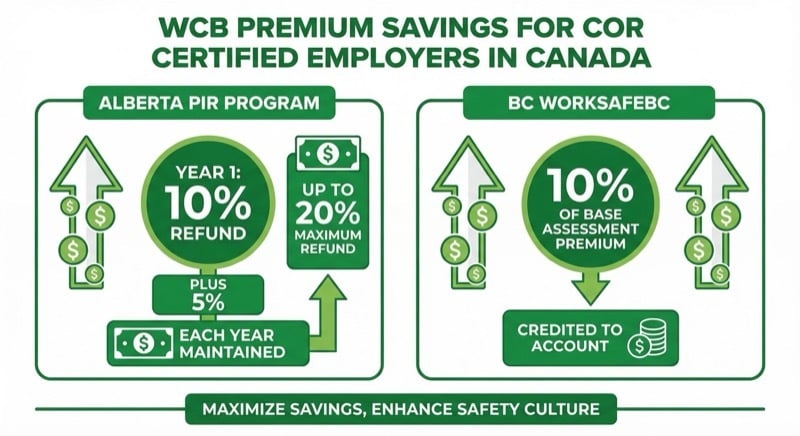
Alberta (PIR Program):
- Enroll in the Partnerships in Injury Reduction (PIR) program through WCB Alberta (free to join)
- First year with COR: 10% refund on your industry-rated premium
- Each subsequent year with maintained COR: 5% refund
- Maximum cumulative refund: up to 20% of your industry-rated premium
- For a contractor with a $1 million payroll in a typical construction rate group, this can mean thousands in annual savings
British Columbia (WorkSafeBC):
- COR incentive calculated as 10% of your base assessment premium (assessable payroll × CU base rate)
- Incentive is credited directly to your WorkSafeBC account (no longer mailed as cheques)
- Must maintain COR in good standing, with no OHS convictions or administrative penalties in the previous year
- Payroll must be reported to WorkSafeBC by the deadline to qualify
The financial math is straightforward: the cost of getting and maintaining COR almost always pays for itself through premium reductions within the first year or two, on top of the competitive advantage of being able to bid on COR-required contracts.
What If You Could Just Ask?
“Do we have 12 months of documented toolbox talks?” “Which workers can't describe our incident reporting process?” Get answers from your own safety data in seconds.
Start your 30-day free trial →
Frequently Asked Questions
How long does it take to prepare for a COR audit?
If you're building a safety management system from scratch, plan for 6 to 12 months of preparation. This includes developing policies, implementing procedures, training staff, and accumulating a minimum of 3 to 6 months of documented safety program activity. Companies with an existing program that needs upgrading may be ready in 3 to 6 months.
What score do you need to pass a COR audit?
Both Alberta and BC require a minimum overall score of 80% and at least 50% on each individual audit element. For annual maintenance audits in Alberta, the minimum overall score is 60%. Failing to meet the threshold on even one element means the audit doesn't pass, even if your overall score is above 80%.
Can I use an internal auditor for my first COR audit?
It depends on the size of your company.
- For Large COR (20+ employees): No. Your initial certification audit and recertification audits (every 3 years) must be conducted by an external certified auditor. Internal auditors can only conduct the annual maintenance audits in Years 2 and 3.
- For Small COR / SECOR (Under 20 employees): Yes. A certified internal auditor (a permanent employee who has completed the required training) can perform the initial certification audit, as well as the ongoing maintenance and recertification audits.
What happens if my company fails a COR audit?
If you fail a certification audit, you won't receive COR and will need to address the deficiencies before attempting another audit. Your certifying partner can provide guidance on specific areas that need improvement. If you fail a maintenance audit, your COR certification may lapse, and you'll lose eligibility for WCB premium discounts until certification is restored.
How much does a COR audit cost?
COR audit costs vary by province, certifying partner, company size, and whether you use an external consultant auditor or a peer auditor. External audit costs typically range from $3,000 to $15,000 or more depending on company complexity. Contact your certifying partner (ACSA in Alberta, BCCSA in BC) for current fee schedules. The WCB premium refund often offsets the audit cost within the first year.
Is COR certification mandatory in Canada?
COR is a voluntary program, not a legal requirement. However, many general contractors and project owners require COR certification as a condition of contract, particularly for construction, oil and gas, and trades work. Without COR, you may be unable to bid on significant projects, making it a practical necessity for many Canadian contractors.
Get Audit-Ready Without the Guesswork
COR certification is one of those things that looks simple on the surface and gets complicated fast when you dig into the elements, the documentation requirements, and the differences between provinces. If you've been putting off the audit because you're not sure your program would hold up, that's exactly the right instinct. Going in unprepared costs more time and money than doing it right the first time.
Safety Evolution builds audit-ready safety programs for contractors across Alberta and BC. We set up your documentation, train your team on what auditors look for, and manage the entire process so you're not scrambling when audit day arrives. Safety Evolution can give you a clear picture of where you stand. No obligations, no sales pitch: just your safety data telling you exactly what it will take to pass.
Get Weekly Safety Insights
Regulation updates, toolbox talk ideas, and compliance tips. One email per week.