Last updated: March 2026
Your crew is tough. They push through sore backs, stiff shoulders, and aching knees because that is what the job demands. But those injuries are not badges of honour. They are warning signs. Musculoskeletal injuries (MSIs) are the most common type of workplace injury in Canada, and they almost always trace back to the same handful of ergonomic risk factors that nobody on site is tracking.
At Safety Evolution, we help contractors build safety programs that catch these problems before they turn into WCB claims. The pattern is almost always the same: the risk factors were there for months, nobody identified them, and nobody controlled them.
⚡ Quick Answer
- What: Ergonomic risk factors are workplace conditions (force, posture, repetition, vibration, contact stress, duration) that increase the likelihood of musculoskeletal injuries
- Why it matters: MSIs account for the largest share of lost-time claims in Canadian construction and industrial workplaces
- Who is responsible: Employers must identify and control ergonomic risk factors under Alberta OHS general duty requirements and WorkSafeBC Part 4 MSI regulations
- How to control them: Use the hierarchy of controls: eliminate the hazard first, then engineer, administrate, and use PPE only as a last resort
Ergonomic risk factors are the specific workplace conditions that increase the likelihood of musculoskeletal injuries (MSIs). Repetitive motion, forceful exertion, awkward posture, vibration, and contact stress are the five categories that account for the majority of soft-tissue injuries in Canadian workplaces.
This guide explains how to identify each risk factor on your job sites, assess the level of risk, and implement controls that bring your exposure down to acceptable levels.
What Are Ergonomic Risk Factors?
Ergonomic risk factors are the characteristics of a job or task that increase the likelihood of a worker developing a musculoskeletal injury (MSI). They include force, awkward posture, repetition, vibration, contact stress, and duration. When these factors combine or persist over long periods, the risk of injury climbs fast.
Most contractors understand hazards like falls and electrical contact. But ergonomic risks are sneakier. A worker does not fall off a scaffold from poor posture. Instead, the damage accumulates over weeks and months until a back gives out or a shoulder tears. By the time you file the WCB claim, the injury has been building for a long time.
If you are not sure where ergonomic risks fit in the bigger picture, our complete guide to workplace ergonomics covers the fundamentals. This post dives into the specific risk factors and how to deal with them on site.
What Are the 6 Ergonomic Risk Factors?
According to CCOHS and provincial regulators across Canada, six primary physical risk factors drive musculoskeletal injuries. Here is what each one looks like on a construction or industrial job site, with real ergonomic risk factor examples your crew deals with every day.
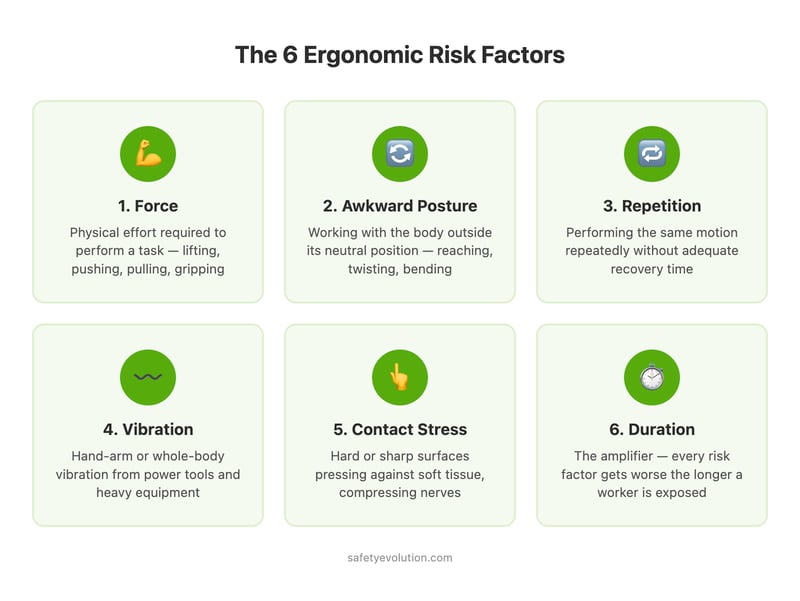
1. Force
Force is the physical effort required to perform a task: lifting heavy materials, pushing loaded wheelbarrows, pulling cable, gripping hand tools. The threshold is not a single heavy lift. It is cumulative force over a shift. A 30-pound load is manageable once. Lifting it 200 times in a day is a different story.
2. Awkward Posture
Working with your body outside its neutral position: reaching overhead, twisting your torso, kneeling for hours, bending forward at the waist. An electrician wiring a panel above shoulder height for two hours. A tiler on their knees all day. WorkSafeBC identifies posture as a primary MSI risk factor under Part 4 of the OHS Regulation, and it is commonly combined with other risk factors.
3. Repetition
Performing the same motion repeatedly without adequate recovery time. A drywaller driving screws overhead, same arm motion, every few seconds, for eight hours. Research classifies tasks with cycle times under 30 seconds as "high repetition." Most construction tasks blow past that threshold.
4. Vibration
Hand-arm vibration (HAV) from power tools like grinders and jackhammers, and whole-body vibration (WBV) from operating excavators and loaders on rough terrain. Alberta OHS has published specific guidance on vibration hazards, recognizing both HAV and WBV as ergonomics risk factors employers must address.
5. Contact Stress
When a hard or sharp surface presses against soft tissue, compressing nerves and restricting blood flow. A plumber kneeling on concrete without knee pads. A scaffold erector gripping cold steel tubes for hours. Contact stress is one of the most overlooked musculoskeletal risk factors in the workplace.
6. Duration
Duration is the amplifier. Every risk factor above gets worse the longer a worker is exposed. A short task in an awkward posture is manageable. The same posture for four hours is not. Both CCOHS and WorkSafeBC recognize that extended exposure to any risk factor significantly increases injury risk.
Unidentified Ergonomic Risks Drive Your Highest Claim Costs
SE-AI checks your safety records for ergonomic risk factors that are not being captured in your hazard assessments.
Get Early Access →
How Do Ergonomic Risk Factors Cause Injuries?
Most contractors think ergonomic injuries happen because someone lifted something too heavy. They are wrong.
The real mechanism is cumulative. Ergonomic risk factors produce micro-damage to muscles, tendons, and nerves that accumulates over time. Your body can repair small amounts of tissue damage overnight. But when the rate of damage exceeds the rate of repair, because the force is too high, the posture too extreme, the repetition too frequent, injury becomes inevitable.
The risk multiplies when factors combine. A task involving high force AND awkward posture AND long duration is exponentially more dangerous than any single factor alone. That is exactly what most construction tasks look like. The training your crew receives should teach them to recognize early warning signs: persistent soreness, tingling, reduced grip strength, and stiffness that does not go away over a weekend.
How Do You Identify Ergonomic Risk Factors on Site?
You do not need a consultant with a clipboard. You need to watch your crew work and ask the right questions.
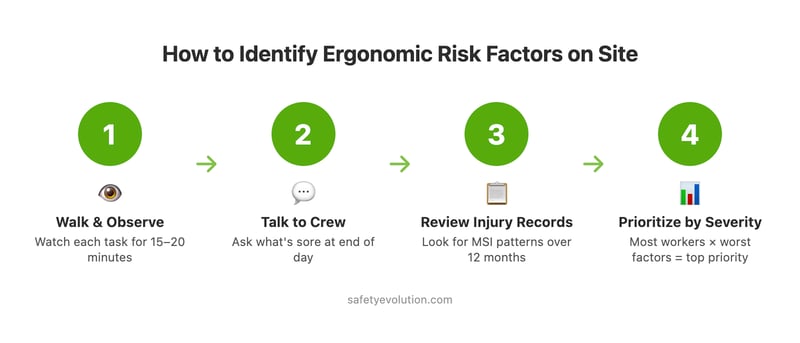
Walk the site and observe. Pick a task. Watch a worker for 15 to 20 minutes. Look for: significant force, awkward body positions, repeated motions (cycle time under 30 seconds), vibrating tools, hard surfaces pressing against the body, and how long the task lasts without a break.
Talk to your crew. Ask: "What part of your body is sore at the end of the day?" You will get more useful information in a five-minute conversation than from a 20-page template. Capture this on your field-level hazard assessments. If your FLHA does not include ergonomic hazards, add a line item.
Review your injury records. Pull the last 12 months of incident reports. If three workers reported lower back pain and they all work on the same task, you have found your highest-priority ergonomics risk. Use your incident investigation process to trace injuries to root causes.
Prioritize by severity and exposure. A task exposing 15 workers to high force, awkward posture, and repetition for eight hours a day goes to the top. A task with mild contact stress for 30 minutes a week can wait. For a structured approach, see our guide on ergonomic assessments.
How Do You Control Ergonomic Risk Factors?
Identifying the risk factors is the easy part. Controlling them is where most contractors get stuck, because the obvious answer ("just buy everyone a back brace") is also the worst one.
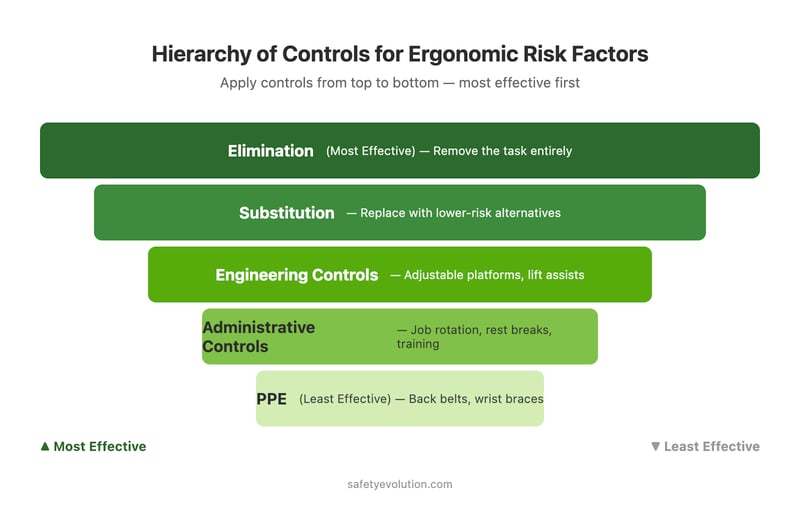
The hierarchy of controls applies to ergonomic risk factors the same way it applies to every other hazard:
- Elimination: Remove the task. Pre-fabricate components off-site. Use a crane instead of manual carries.
- Substitution: Replace high-risk with lower-risk. Power rebar tying tools instead of manual. Lighter-weight materials. Tools with built-in vibration dampening.
- Engineering controls: Adjustable-height platforms eliminate overhead reaching. Mechanical lift assists reduce force. Anti-vibration tool suspensions reduce transmission. Knee pads address contact stress.
- Administrative controls: Job rotation every 2 hours. Rest breaks for tissue recovery. Toolbox talks on ergonomics. Proper ergonomics training.
- PPE: Back belts, wrist braces, knee pads. These reduce exposure but do not eliminate the risk. If a worker needs a back brace to do their job, the job design is the problem.
Here is the blunt truth: most contractors skip straight to PPE because engineering controls cost money upfront. But a single lost-time WCB claim for a back injury costs far more than an adjustable scaffold or a mechanical lift assist. The math is not close.
A Practical Example: Rebar Tying
Picture a 12-person concrete crew on a commercial foundation pour in Edmonton. Four rebar workers spend eight hours tying rebar on a slab-on-grade:
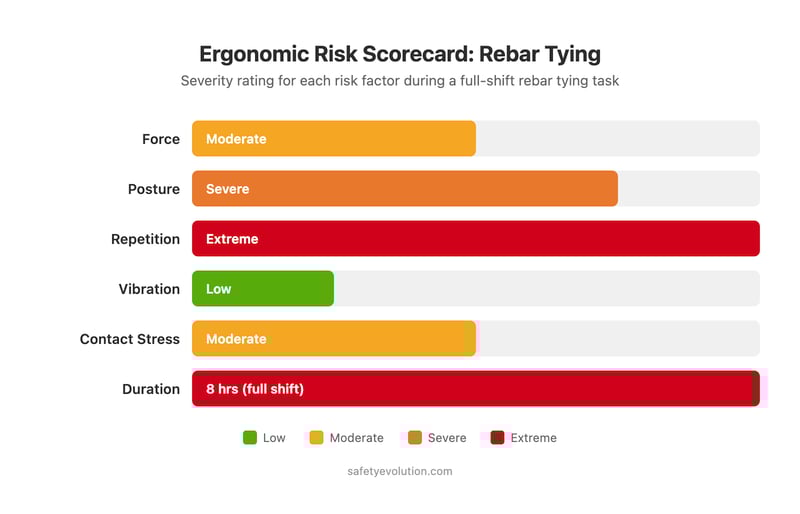
- Force: Moderate. Sustained grip force for hand-tying, plus lifting rebar bundles into position.
- Posture: Severe. Bending forward at the waist for hours. Necks flexed. Wrists non-neutral during every tie.
- Repetition: Extreme. The tie-wire motion repeats every 3 to 5 seconds: over 5,000 repetitions per shift.
- Contact stress: Moderate. Knees on rebar mats. Hands gripping wire.
- Duration: Eight hours with minimal rotation.
Three of six risk factors are moderate to extreme, and they combine for the entire shift. This produces back injuries, shoulder injuries, and carpal tunnel over a season of work.
Controls that work: Power rebar tying tools ($500 to $1,500, reduce repetition and grip force by over 50%). Rebar supports that raise tying height. Job rotation every 2 hours. Knee pads for all rebar workers. 5-minute stretch breaks every hour. None of these are expensive. A single lost-time back injury claim costs tens of thousands, plus the premium increase that follows you for years.
If managing ergonomic risk factors across multiple sites and trades feels overwhelming, Safety Evolution provides done-for-you safety program management that includes ergonomic hazard identification and control planning as part of your overall safety system.
What Do Canadian Regulations Require?
British Columbia: WorkSafeBC Part 4 of the OHS Regulation specifically addresses MSI prevention. Employers must identify risk factors (force, repetition, posture, local contact stress), assess the risk, implement controls, consult with workers and the joint health and safety committee, educate workers, and evaluate control effectiveness.
Alberta: No standalone ergonomics regulation. Ergonomic hazards fall under the OHS Act general duty clause. Alberta OHS has published an ergonomics bulletin series (updated June 2021) covering MSI identification, biomechanical risk factors, manual handling, vibration, and training requirements.
Regardless of province, every employer in Canada has a duty to identify and control workplace hazards. If your workers are getting hurt and you have not addressed the ergonomic conditions causing it, you are not meeting your legal obligations. Building a strong safety program means including ergonomic risk identification as a standard part of your hazard assessment process.
Are Ergonomic Risk Factors Documented in Your Hazard Assessments?
SE-AI analyses your hazard assessments, incident reports, and WCB claims for ergonomic risk factor gaps. It flags tasks where repetitive motion, force, vibration, and awkward postures are not being identified and controlled.
Get Early Access to SE-AI →
Frequently Asked Questions
What are the main ergonomic risk factors in the workplace?
The six primary ergonomic risk factors are force, awkward posture, repetition, vibration, contact stress, and duration. These are recognized by CCOHS, WorkSafeBC, and Alberta OHS as contributors to musculoskeletal injuries. When multiple factors combine in a single task, injury risk increases significantly.
How do you identify ergonomic risk factors on a construction site?
Walk the site and observe workers for 15 to 20 minutes per task, checking for the six risk factors. Talk to your crew about which tasks cause soreness. Review incident reports for MSI patterns. Add ergonomic hazard items to your daily FLHAs. Prioritize by number of workers exposed, injury severity, frequency, and whether multiple risk factors combine.
What is the difference between an ergonomic hazard and an ergonomic risk factor?
An ergonomic hazard is a workplace condition that could cause injury (like a workstation forcing awkward positions). An ergonomic risk factor is the specific physical stressor within that hazard (the awkward posture, the force required, or the repetition). For a deeper look at hazard types, see our guide to ergonomic hazards in the workplace.
Are employers legally required to address ergonomic risk factors in Canada?
Yes. In BC, WorkSafeBC Part 4 explicitly requires employers to identify MSI risk factors, assess risks, implement controls, educate workers, and evaluate effectiveness. In Alberta, ergonomic hazards fall under the OHS Act general duty clause. Every province requires employers to identify and control workplace hazards, which includes ergonomic risk factors.
What are examples of ergonomic risk factors in construction?
Common examples include lifting heavy materials repeatedly (force and repetition), overhead electrical or drywall work (posture and duration), operating jackhammers (vibration and force), kneeling on concrete for tile or rebar work (contact stress and posture), and fastening the same way thousands of times per shift (repetition and duration). Most construction tasks involve multiple risk factors simultaneously.
Get Weekly Safety Insights
Regulation updates, toolbox talk ideas, and compliance tips. One email per week.