Last updated: March 2026
Your best carpenter just told you his back is done. Not from a fall. Not from a struck-by. From picking up sheets of plywood, hauling concrete forms, and carrying bundles of rebar for fifteen years. He will be off work for months. His WCB claim will cost you five figures. And the worst part? You have six other guys on your crew doing the exact same thing, the exact same way, every single day.
Manual handling injuries are not dramatic. They do not make the news. But they are quietly the most expensive, most common, and most preventable injuries in construction. We help contractors across Canada build safety programs that actually reduce these injuries, and the pattern is always the same: nobody takes manual handling seriously until someone's body breaks down.
⚡ Quick Answer
- What: Manual handling ergonomics covers the safe lifting, carrying, pushing, and pulling of loads to prevent musculoskeletal disorders (MSDs)
- Why it matters: MSDs account for roughly 30% of all WorkSafeBC time-loss claims, costing over $2.35 billion in BC alone between 2020 and 2024
- Key regulation: Alberta OHS Code Part 14 and BC OHS Regulation Part 4 both require employers to assess manual handling hazards and provide mechanical aids
- Bottom line: Proper technique helps, but eliminating or reducing manual handling through job planning and equipment is what actually moves the needle
- Free Resource: Download our Construction Health & Safety Manual.
Manual handling ergonomics is the practice of designing work tasks, providing equipment, and training workers to lift, carry, push, and pull loads in ways that prevent musculoskeletal injuries. In construction, oil and gas, and manufacturing, it is the single biggest factor in keeping your crew healthy and your WCB premiums under control.
Why Is Manual Handling the Biggest Injury Risk in Construction?
Most contractors think falls and struck-by incidents are their biggest injury risk. They are wrong. Musculoskeletal injuries from manual handling, overexertion, and repetitive strain quietly generate more time-loss claims than any other category in most Canadian provinces.
In British Columbia, WorkSafeBC accepted over 88,000 time-loss claims for MSIs between 2020 and 2024. That is roughly 30% of every time-loss claim in the province, and the total cost exceeded $2.35 billion over that five-year period. Construction is one of the sectors with the highest rates. According to the Canadian Centre for Occupational Health and Safety (CCOHS), about three out of every four workers whose job includes manual material handling will experience back pain at some point in their career.
The costs are not just medical. A single serious back injury means weeks or months of lost productivity, retraining costs, overtime for the rest of your crew, and WCB premium increases that follow you for years. For a 15-person electrical sub or a mid-size GC, one bad quarter of manual handling injuries can wipe out the profit on a project.
If you are not sure where your program stands, and show you exactly where manual handling risks are going unaddressed.
What Does Canadian Law Require for Manual Handling Safety?
Both Alberta and BC have specific, enforceable requirements for manual handling. These are not suggestions. If an inspector shows up and your crew is muscling loads without a documented hazard assessment, you have a compliance problem.
Alberta OHS Code Part 14: Lifting and Handling Loads
Alberta's requirements are straightforward and practical:
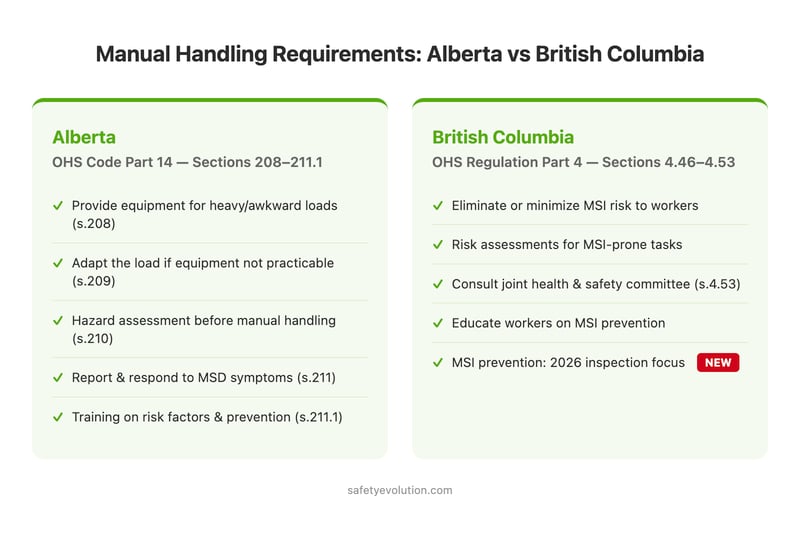
- Provide equipment first (s.208): Where reasonably practicable, the employer must provide appropriate equipment for lifting, lowering, pushing, pulling, carrying, or handling heavy or awkward loads. Workers must use it.
- Adapt the load if equipment is not available (s.209): If mechanical aids are not practicable for a specific situation, you must either adapt the load to make it safer to handle or minimize the manual handling required.
- Hazard assessment before manual handling (s.210): Before a worker manually handles a load that could cause injury, the employer must assess the weight, size, shape, frequency of movement, and manner of handling.
- Respond to reported symptoms (s.211): When a worker reports what they believe to be work-related MSI symptoms, the employer must promptly review that worker's activities (and similar tasks done by other workers), identify work-related causes, and take corrective measures.
- Training (s.211.1): Workers exposed to MSI risk must be trained on risk factor identification, early signs and symptoms, and preventive measures including mechanical aids and altered work procedures.
BC OHS Regulation Part 4: Ergonomics (MSI Requirements)
British Columbia's sections 4.46 through 4.53 follow a similar structure but with added emphasis on worker involvement:
- Employers must eliminate or, if that is not practicable, minimize the risk of MSI to workers
- Risk assessments must be conducted for tasks with MSI risk factors
- Employers must consult with their joint health and safety committee (s.4.53)
- WorkSafeBC has made MSI prevention a key inspectional focus for 2026, targeting construction, healthcare, retail, and transportation
Here is the blunt truth: most contractors have some version of "lift with your legs" in their safety manual, and that is the extent of their manual handling program. That will not hold up to an inspection. Provincial regulators expect documented hazard assessments, evidence of mechanical aid consideration, and training records.
Need help building a manual handling program that actually meets regulatory requirements? Safety Evolution acts as your done-for-you safety department, handling the documentation, training, and compliance so you can focus on running your crew.
Need a Complete Safety Program?
Stop starting from scratch. Download our Free Construction Health & Safety Manual to get compliant fast.
Download the Free Manual →
What Are the Biggest Manual Handling Risk Factors on a Construction Site?
Knowing the risk factors is the first step in your job hazard analysis. The CCOHS identifies these as the primary contributors to manual handling injuries:
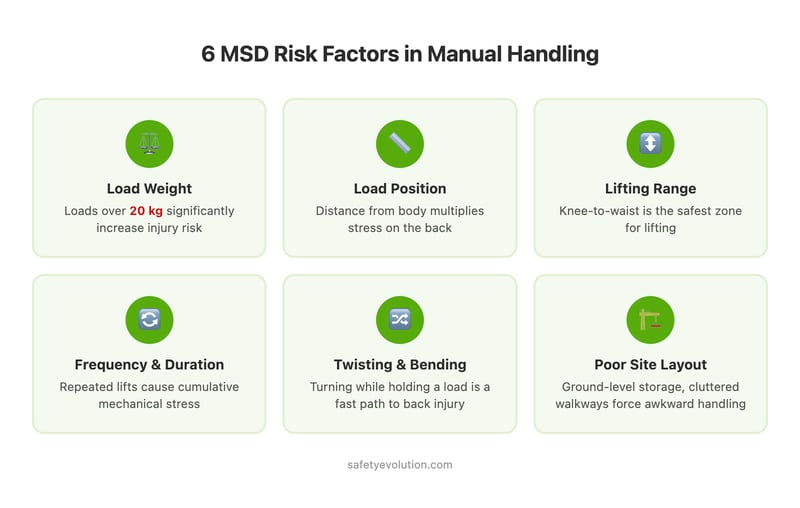
- Load weight: Loads over 20 kg significantly increase injury risk. On a construction site, that covers most building materials: drywall sheets, concrete bags, bundles of lumber, pipe sections.
- Load position: A load lifted far from the body puts dramatically more stress on the back than the same weight held close. Bulky or awkward items force workers into unbalanced positions.
- Lifting range: The safest lifting zone is between knee and waist height. Lifting from the ground or above the shoulders multiplies injury risk.
- Frequency and duration: Repeated lifts, even at moderate weight, cause cumulative mechanical stress. A bricklayer handling 200 blocks in a shift is at higher risk than someone doing one heavy lift.
- Twisting and bending: Turning while holding a load is one of the fastest ways to injure your back. Tight spaces on construction sites force this constantly.
- Poor site layout: Materials stored at ground level or stacked too high, cluttered walkways, and inadequate staging areas all force awkward handling.
When you run your next field level hazard assessment, look at every task through this lens: is anyone lifting, carrying, pushing, or pulling something that could be done a better way?
How Do You Actually Reduce Manual Handling Injuries?
"Lift with your legs" is not a manual handling program. It is a slogan. Real MSD prevention follows the hierarchy of controls: eliminate the hazard first, engineer it down second, and rely on training and technique as a last resort.
1. Eliminate the manual handling entirely
Ask the question before every task: does a person need to lift this at all? In many cases, the answer is no.
- Order materials delivered to the point of use, not the laydown yard. Pay the crane operator to place drywall bundles on the floor where they will be installed.
- Use pre-fabricated assemblies. A plumbing crew that assembles pipe runs on the ground and crane-lifts them into place does a fraction of the manual handling compared to piece-by-piece installation at height.
- Coordinate deliveries with equipment availability. If the telehandler is on site Tuesday, schedule your heavy material deliveries for Tuesday.
2. Use mechanical aids
Alberta OHS Code s.208 is clear: where reasonably practicable, provide the equipment. For construction, that means:
- Dollies and carts: For moving shingles, fastener boxes, tool bins across flat surfaces
- Panel lifts and drywall jacks: One person with a drywall lift replaces two people holding a sheet overhead
- Vacuum lifters: For glass, stone panels, and smooth heavy materials
- Conveyor systems: For moving material between elevations on larger projects
- Pallet jacks and forklifts: For palletized materials
- Adjustable-height work platforms: Keep the work in the safe lifting zone between knees and shoulders
A 12-person framing crew we worked with in northern Alberta was burning through back injury claims every winter. Frozen lumber, heavy snow loads, everything done by hand. They invested in a compact telehandler and a set of material carts. Their manual handling claims dropped to zero the following year. The equipment paid for itself in reduced WCB premiums alone.
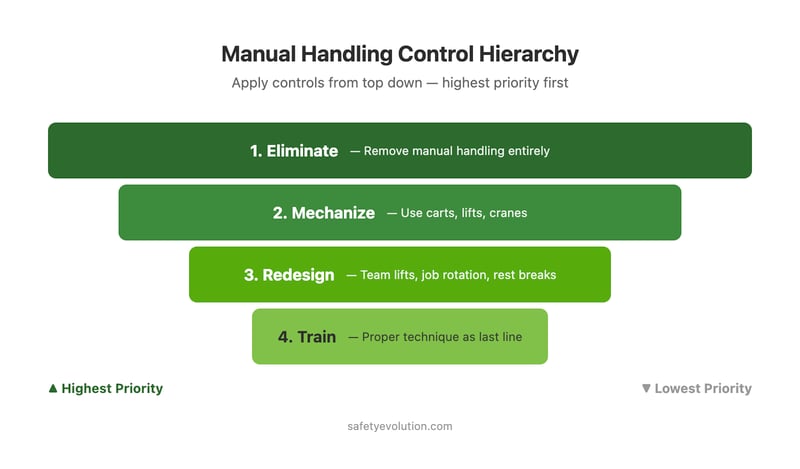
3. Redesign the task
When you cannot eliminate or mechanize, redesign the task to reduce the load on workers' bodies:
- Team lifts: Two-person lifts for anything over 23 kg (roughly 50 lbs), with one person calling the lift sequence
- Job rotation: Rotate workers through heavy and light tasks throughout the shift so no one accumulates eight hours of repetitive strain
- Rest breaks: Build recovery time into physically demanding tasks. Fatigue makes technique sloppy, and sloppy technique causes injuries.
- Staging and storage: Store materials at waist height where possible. Never store heavy materials above shoulder height or at ground level if they will need to be handled repeatedly.
- Break loads down: Split bulk materials into smaller, more manageable units. Carry two trips of lighter loads instead of one trip with a heavy load.
4. Train your crew on proper technique
Technique training is the last line of defense, not the first. But it still matters. Effective manual handling training covers:
- Planning the lift before starting: assess the weight, check the path, identify where to set down
- Standing close to the load with feet shoulder-width apart
- Bending at the knees and hips, keeping the back straight
- Gripping the load firmly with both hands, keeping it close to the body
- Lifting with the legs, not the back; tightening core muscles
- Moving feet to turn; never twisting at the waist while carrying a load
- Setting the load down by reversing the process: bend knees, keep back straight
But here is the part most training programs miss: teach workers to recognize when they should not lift at all. The best manual handling technique in the world will not protect someone trying to solo-carry a 40 kg concrete form in an awkward position. Workers need to feel empowered to stop, ask for help, or request equipment without being seen as slowing down the job.
How Do You Build a Manual Handling Program That Sticks?
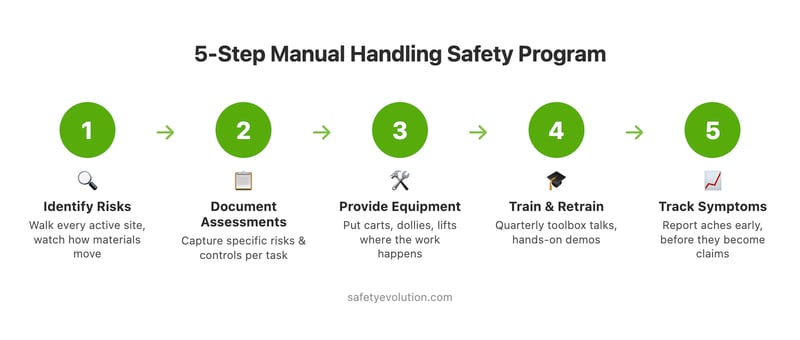
The difference between a box-ticking exercise and a program that actually reduces injuries comes down to five things:
- Identify your high-risk tasks. Walk every active job site. Watch how materials actually move from delivery to installation. The biggest risks are often in tasks nobody thinks about: carrying tools up ladders, moving temporary barriers, stacking materials at the end of the day.
- Document your hazard assessments. Alberta s.210 and BC s.4.47 both require this. Use your safe work procedures to capture the specific manual handling risks for each task and the controls in place.
- Make mechanical aids available and accessible. Equipment locked in the shop does not prevent injuries on site. Put carts, dollies, and lifting aids where the work happens.
- Train and retrain. Initial training is not enough. Run toolbox talks on manual handling at least quarterly. Make it hands-on: demonstrate proper technique, practice team lifts, and show workers how to use the mechanical aids on site.
- Track and respond to early symptoms. Create a culture where workers report aches, stiffness, and tingling before they become full-blown injuries. Alberta s.211 requires you to act when symptoms are reported. If you wait for the WCB claim, you have already failed.
Track Ergonomic Hazards Before They Become Claims
Waiting for a manual handling injury to occur is too late. Give your workers the ability to report hazards and near-misses instantly from the field using the Safety Evolution app.
30-Day Free Trial
Frequently Asked Questions
What is manual handling ergonomics?
Manual handling ergonomics is the practice of designing lifting, carrying, pushing, and pulling tasks to fit workers' physical capabilities. It includes selecting mechanical aids, adjusting workstation heights, planning material storage, and training workers on proper techniques to prevent musculoskeletal disorders.
What are the most common manual handling injuries in construction?
The most common injuries are lower back strains and sprains, shoulder injuries from overhead lifting, knee injuries from ground-level lifts, and cumulative strain injuries in the wrists, elbows, and neck. Most develop gradually from repeated handling over weeks and months rather than from a single heavy lift.
Does Alberta or BC set a maximum weight limit for manual lifting?
Neither Alberta nor BC sets a single maximum weight limit. Instead, both provinces require employers to assess the full context of each lifting task: the weight, size, shape, frequency, and manner of handling. The CCOHS notes that loads over 20 kg significantly increase injury risk, but the legal requirement is to conduct a hazard assessment and implement controls based on the specific situation.
What equipment can reduce manual handling on construction sites?
Common mechanical aids for construction include dollies and carts, panel lifts and drywall jacks, vacuum lifters for smooth heavy materials, conveyor systems, pallet jacks, forklifts, telehandlers, and adjustable-height work platforms. Alberta OHS Code s.208 requires employers to provide appropriate equipment where reasonably practicable.
How often should manual handling training be refreshed?
While provincial regulations do not specify a fixed retraining interval, best practice in construction is quarterly toolbox talks on manual handling plus formal refresher training annually. Training should also be repeated when workers move to new tasks, when new equipment is introduced, or when incident reports indicate technique problems.
Get Weekly Safety Insights
Regulation updates, toolbox talk ideas, and compliance tips. One email per week.