COR
WCB Premium Discounts: How COR Saves Money
COR-certified contractors earn 10%-20% WCB premium discounts. Province-by-province breakdown with real math at $1M, $5M, $10M payroll.
COR certification requirements, costs, and timelines for every Canadian province. Compare certifying bodies, WCB discounts, and get your province guide.
Last updated: March 2026
You need COR certification, but you're not sure which province's rules apply, what it actually costs, or how long the process takes. You've spent an hour reading different websites and every province seems to do it differently. That's because they do.
COR is a national standard, but it's delivered province by province, each with its own certifying body, fee schedule, training requirements, and WCB incentives. At Safety Evolution, we help construction contractors across Canada navigate COR certification. We've guided companies through the process in Alberta, BC, Saskatchewan, Manitoba, Ontario, New Brunswick, and Nova Scotia. This guide puts everything in one place so you can stop guessing and start planning.
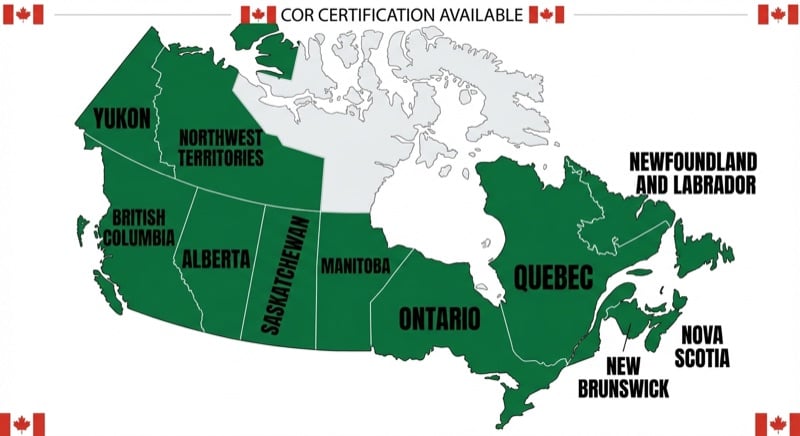
COR (Certificate of Recognition) is a voluntary, audit-based employer certification program in Canada that verifies a company has implemented an occupational health and safety management system meeting nationally recognized standards. The program is designed to motivate employers to take a proactive role in workplace safety, going beyond minimum regulatory compliance.
COR is nationally registered, trademarked, and endorsed by the Canadian Federation of Construction Safety Associations (CFCSA). It's delivered through member associations in each province and territory that have a formal Memorandum of Understanding (MOU) to serve as the Authority Having Jurisdiction in their region.
The critical thing to understand: although COR is a national standard, certification must be granted by the certifying body in each province where you work. A COR certificate from Alberta doesn't automatically cover you in Ontario. You either need certification from the local certifying body or you need to apply for reciprocity.
For a deeper overview of the COR program itself, see our complete guide to the Certificate of Recognition.
Most contractors think of COR as a piece of paper. They're wrong. COR is the difference between winning work and watching from the sidelines.
Here's what COR actually does for your business:
If you need help building the safety program foundations, Safety Evolution offers a complete orientation and onboarding package and a 365-topic toolbox talk package that support COR documentation requirements.
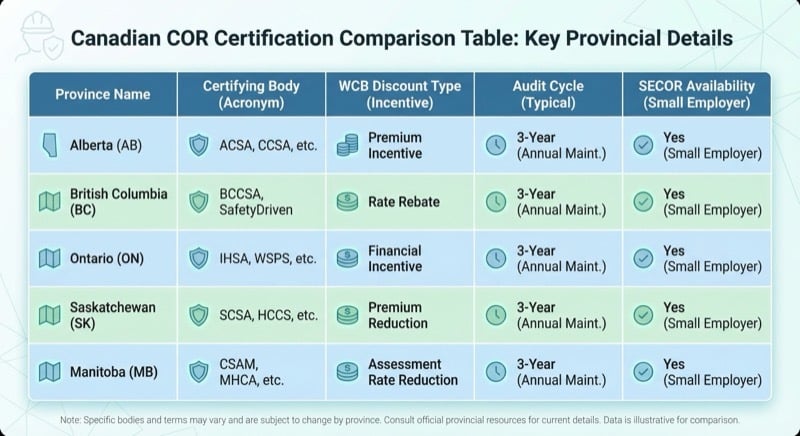
Every province runs COR differently. Here's a side-by-side comparison of the key details you need to know:
| Province | Certifying Body | Key Requirements | WCB Discount | Estimated Cost Range | Typical Timeline |
|---|---|---|---|---|---|
| Alberta | ACSA (construction), Energy Safety Canada, and 8+ other certifying partners | Training + internal audit + external audit | 10%–20% premium rebate (PIR program) | $3,000–$10,000+ (varies by certifying partner) | 6–18 months |
| British Columbia | BCCSA (construction) and 8+ other certifying partners | Training + internal audit + external audit | 10%–20% premium rebate | $3,000–$10,000+ (varies by certifying partner) | 6–18 months |
| Saskatchewan | SCSA (construction), HCSAS, SASM, STA | Training + program development + internal & external audit | Premium rebate available | Varies by certifying partner | 6–12 months |
| Manitoba | CSAM (construction), MHCA, and others | Training + program implementation + audit | 15% or $3,000 (whichever is greater) under SAFE Work Certified | Varies by certifying partner | 6–12 months |
| Ontario | IHSA (Infrastructure Health and Safety Association) | Training + program development + internal & external audit; 3-year cycle | WSIB rebate available for qualifying employers | Based on daily rate; varies by company size | 6–18 months |
| New Brunswick | NBCSA (New Brunswick Construction Safety Association) | 6 required training courses + internal & external evaluation | No direct rebate; improved experience rating over time | Training + evaluation fees (contact NBCSA) | 6–12 months |
| Nova Scotia | CSNS (Construction Safety Nova Scotia) | 4 required courses + compliance training + 5-step certification process | Practice Incentive Rebate (construction/trucking) | Year 1 evaluation FREE for members; $983–$1,375 for non-members | 4–12 months |
Note: Cost ranges are estimates based on typical industry experience and published fee schedules. Actual costs vary by company size, existing program maturity, and certifying partner. Contact your provincial certifying body for current pricing.
Not sure what will fail your COR audit?
See where your documentation is weak before the audit, then fix owners, due dates, and evidence fast.
Start Your 30-Day Free Trial →Each province has its own certifying body, training requirements, fee schedules, and audit processes. We've created detailed guides for every major province so you can get the specifics for your jurisdiction:
While every province has its own specifics, the core COR process follows a similar structure across Canada:
Complete the required training courses through your provincial certifying body. The number of courses varies: New Brunswick requires 6, Nova Scotia requires 4 plus compliance training, and western provinces typically require safety management, auditing, and leadership courses. Training can take anywhere from a few days to several weeks depending on the province and format (in-person vs. eLearning).
Build a comprehensive health and safety management system for your company. This includes written policies, hazard assessments, safe work procedures, emergency response plans, training matrices, inspection processes, and incident investigation procedures. The program must be genuinely implemented, not just documented. Your crew needs to be following the procedures, and you need records to prove it.
This is consistently the longest and most challenging step across all provinces. Companies with an existing safety program may only need to fill gaps. Companies starting from scratch should budget 3 to 9 months for this step alone.
Safety Evolution's incident investigation kit and online training courses can help you build the documentation and competencies required at this stage.
Conduct an internal audit of your safety program using your province's audit instrument (most provinces now use the COR Harmonized Audit Instrument or their own version). A qualified internal auditor, typically someone from your company who completed the auditor training course, evaluates every element of your safety management system.
Your certifying body arranges an external audit by a qualified third-party auditor. This auditor reviews your documentation, conducts site visits, and interviews workers and management. The external audit verifies that your safety program is genuinely operational, not just a binder on a shelf.
For detailed tips on what the auditor looks for and how to prepare, see our guide to passing your COR audit.
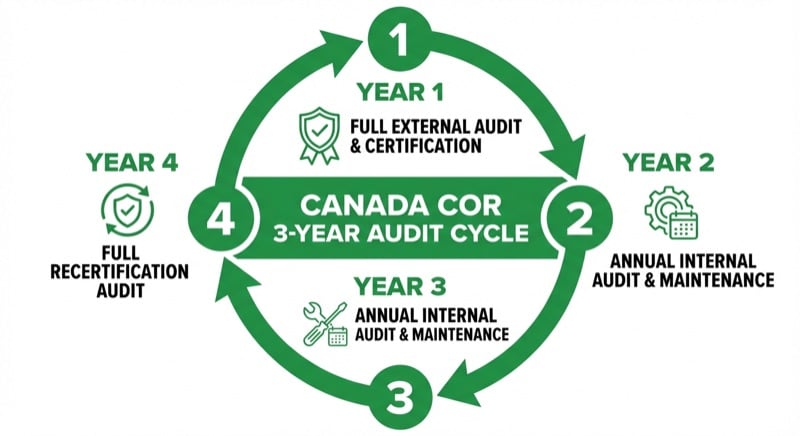
If you pass both audits, you receive your COR certificate and Letter of Good Standing. In most provinces, this is valid for one year, with annual internal audits required for maintenance and a full recertification audit every 3 to 4 years (the cycle varies by province).
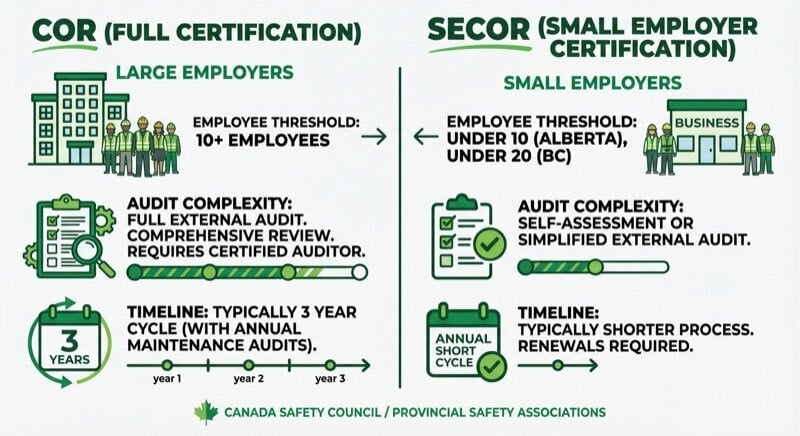
SECOR (Small Employer Certificate of Recognition) is a streamlined version of COR designed for smaller companies. The specific name and employee threshold varies by province:
If you're a smaller contractor, SECOR may be a faster and less expensive path to certification. But understand that SECOR and COR are different certifications. Some GCs specifically require full COR, not SECOR. Check the tender requirements before choosing your path. For a full comparison, see our guide to getting SECOR certified.
If your company holds COR in one province and needs to work in another, you don't necessarily have to start the full certification process over. COR reciprocity allows companies to have their existing certification recognized in a new province through a streamlined application.
Here's how reciprocity generally works:
Reciprocity is not automatic. Each province processes applications individually. Start the process well before your project start date.
Regardless of which province you're in, these steps will set you up for success:
Most provinces use the COR Harmonized Audit Instrument or their own version of it. While the specifics vary, auditors typically evaluate these core elements of your safety management system:
The auditor will review your documentation, conduct site observations, and interview workers and management at all levels. The interviews are critical. If your foreman can't describe the safety program or your workers have never heard of your hazard assessment process, the auditor will score those elements accordingly.
For a detailed walkthrough of what auditors look for and how to prepare, read our guide to passing your COR audit.
One of the biggest financial benefits of COR is the WCB premium savings. Here's how each province handles it:
The bottom line: in most provinces, COR certification pays for itself through WCB premium savings within the first year or two. The combination of lower premiums, fewer incidents, and access to better-paying projects makes COR one of the highest-ROI investments a construction company can make.
After helping contractors across Canada get COR certified, here are the mistakes we see most often:
Still chasing COR evidence across files and inboxes?
Centralize corrective actions and audit proof so your next provincial COR review is predictable.
Start Your 30-Day Free Trial →COR is technically voluntary, but in practice it's required for most commercial and public construction work in Canada. General contractors across all provinces increasingly require COR from their subcontractors. In provinces like Nova Scotia, it's required for public tenders. In Alberta, it's been the industry baseline for years. Not having COR limits which projects you can bid on.
COR costs vary significantly by province and certifying partner. In western provinces like Alberta and BC, total costs (training, program development, audits) typically range from $3,000 to $10,000 or more depending on company size and complexity. In Nova Scotia, the evaluation itself is free for CSNS members in year one. In Ontario, IHSA charges based on a daily rate. Contact your provincial certifying body for current pricing specific to your situation.
Not automatically. COR must be granted by the certifying body in each province where you work. However, COR reciprocity allows companies with valid certification in one province to apply for recognition in another province through a streamlined process. Requirements vary by province. Contact the certifying body in the province where you need recognition to start the reciprocity application.
SECOR (Small Employer Certificate of Recognition) is a streamlined version of COR designed for smaller companies. In Alberta, SECOR covers companies with fewer than 10 WCB-registered employees. In BC, "Small COR" covers companies with 19 or fewer employees. SECOR has a simplified audit process but provides the same type of safety certification. Note: some GCs require full COR, not SECOR, so check tender requirements before choosing your path.
Most companies complete COR certification in 6 to 18 months, depending on the province and the current state of their safety program. Training takes a few days to a few weeks. Safety program development and implementation is the longest phase, typically 3 to 9 months. Companies with an existing safety program can often complete the process in 4 to 6 months. Start at least 6 months before any tender deadline that requires COR.
Most provinces offer some form of WCB premium incentive for COR-certified employers, but the structure varies. Alberta and BC offer direct premium rebates of 10% to 20%. Manitoba offers 15% or $3,000 (whichever is greater). Nova Scotia offers a Practice Incentive Rebate for construction and trucking companies. Some provinces, like New Brunswick, don't offer a direct COR rebate but COR-certified companies benefit from improved experience ratings over time. Check with your provincial WCB for current incentive details.
Get Weekly Safety Insights
Regulation updates, toolbox talk ideas, and compliance tips. One email per week.
COR-certified contractors earn 10%-20% WCB premium discounts. Province-by-province breakdown with real math at $1M, $5M, $10M payroll.
Your complete guide to forklift training, certification, and employer obligations across every Canadian province.
What employers must provide for first aid at work in Canada. Assessment steps, attendant levels, kit rules, and records by province.