Last updated: April 2026
You already know COR costs money. The training, the audits, the program development, the hours your team spends on documentation instead of production. So when someone tells you COR "pays for itself," your first thought is probably: prove it.
Fair enough. At Safety Evolution, we help contractors across Canada get COR certified every week. We have seen the numbers firsthand, and the financial case is not theoretical. COR-certified employers in Canada can earn WCB premium discounts ranging from 10% to 20% depending on their province. On a $5 million payroll, that is $7,500 to $50,000 back in your pocket every single year.
This guide breaks down exactly how much COR saves contractors in each province, with real math you can plug into your own numbers today.
⚡ Quick Answer: WCB Premium Discounts for COR
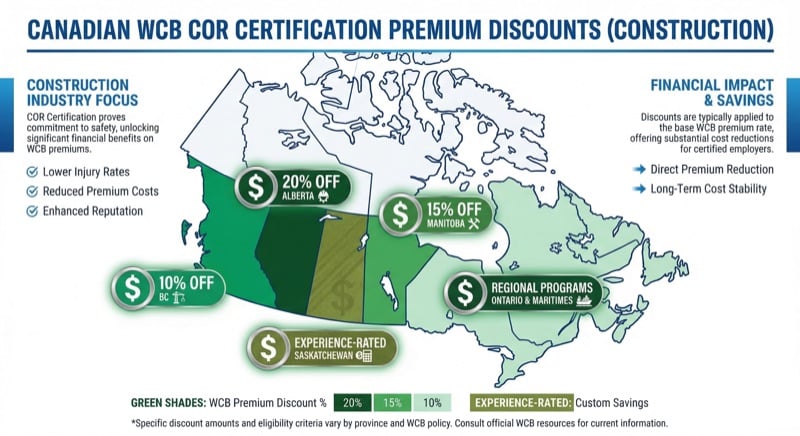
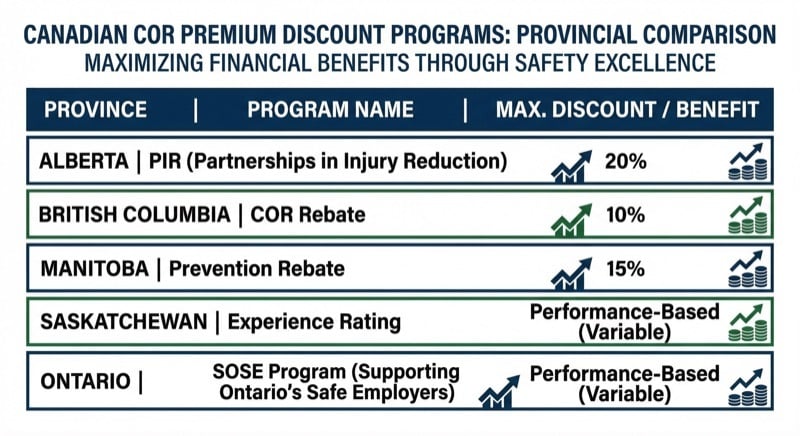
- Alberta: Up to 20% WCB premium refund through the PIR program
- British Columbia: 10% COR incentive credited to your WorkSafeBC account
- Manitoba: 15% Prevention Rebate or $3,000, whichever is greater
- Saskatchewan: Improved experience rating reduces premiums over time
- Ontario: Rebates through the Supporting Ontario's Safe Employers (SOSE) program
- Nova Scotia: Practice Incentive Rebate for construction and trucking employers with COR
- New Brunswick: Experience rating improvements tied to safety performance
- Behind on compliance actions? Start your 30-day free trial to track owners, due dates, and audit evidence in one place.
How Do WCB Premiums Work in Construction?
Before we get into the discounts, you need to understand what you are paying and why. Workers' Compensation Board (WCB) premiums are mandatory insurance payments that every employer in Canada pays based on their industry classification and total payroll. Your premium rate is expressed as dollars per $100 of assessable payroll.
In construction, those rates are higher than most industries because the work is inherently riskier. Depending on your province and trade, you could be paying anywhere from $2 to $10+ per $100 of payroll. For a contractor running $5 million in annual payroll at a rate of $3 per $100, that is $150,000 per year in WCB premiums alone.
Two factors primarily drive your rate:
- Industry rate: Your base rate is set by the historical claim costs in your industry classification. You cannot control this directly.
- Experience rating: Most provinces adjust your rate up or down based on YOUR company's claims history compared to similar employers. Fewer claims = lower rate. More claims = higher rate.
COR certification plugs into this system in two ways. First, it directly qualifies you for premium discounts or rebates in most provinces. Second, the safety management system you build to earn COR reduces your incidents, which improves your experience rating over time. The discount is the quick win. The experience rating improvement is the compounding return.
What Is COR and Why Does It Affect Your Premiums?
Most contractors think COR is just another box to check so they can bid on work. They are wrong.
The Certificate of Recognition (COR) is a nationally recognized safety certification that proves your health and safety management system meets provincial standards. It is administered through certifying partners in each province (ACSA in Alberta, BCCSA in BC, SCSA in Saskatchewan, and others). To learn more about the certification itself, check out our complete guide to COR certification in Canada.
Here is the part most people miss: provincial WCB boards created financial incentive programs specifically to reward COR-certified employers. The logic is straightforward. Employers with certified safety management systems have fewer claims. Fewer claims cost the system less money. So the WCB shares some of that savings back with you.
The blunt truth? The WCB is not giving you a discount because they care about your bottom line. They are giving you a discount because you are statistically less likely to cost them money. That is fine. Take the money.
Not sure where your safety program stands? Safety Evolution can check your safety documentation and show you exactly where you sit and what gaps you need to close to qualify for the COR premium discount.
Province-by-Province COR Premium Discounts
Every province runs its own WCB and its own incentive programs. The discount structure, eligibility rules, and program names all differ. Here is what each province offers as of early 2026. Note that programs and rates can change; always confirm current details with your provincial WCB.
Alberta: Partnerships in Injury Reduction (PIR)
Alberta has the most generous COR discount program in Canada. The Partnerships in Injury Reduction (PIR) program offers refunds of up to 20% of your WCB premium, and COR is the entry ticket.
How it works:
- Year 1 with COR: 10% industry rate refund
- Subsequent years maintaining COR: 5% industry rate refund
- Performance improvement measure: 1% refund for every 1% you improve your own historical claim cost performance, up to 20%
- Industry leadership measure: 10% to 20% refund if you significantly outperform your industry average over two consecutive years
WCB Alberta always uses the measure that gives you the greatest refund. So a contractor who earns COR and also improves their claims performance could see the full 20%.
Example: A general contractor in Edmonton with $5 million payroll and a WCB rate of $3.00 per $100 pays $150,000 in annual premiums. A 10% COR refund puts $15,000 back. Hit the full 20% through combined performance improvement, and that is $30,000 per year.
British Columbia: COR Incentive Program
In BC, employers who achieve and maintain COR certification through the BCCSA or another approved certifying partner may be eligible for a 10% incentive payment on their WorkSafeBC premiums.
How it works:
- COR-certified employers in good standing are considered for a 10% incentive annually
- The incentive is credited directly to your WorkSafeBC account (not mailed as a cheque)
- You must have an active WorkSafeBC account, reported payroll, and no safety violations resulting in conviction or administrative penalty in the previous year
- The incentive is separate from WorkSafeBC's experience rating adjustment, which can provide additional discounts of up to 50% based on your claims record
Example: A mechanical contractor in Vancouver with $5 million payroll and a WorkSafeBC rate of $3.50 per $100 pays $175,000 in premiums. The 10% COR incentive returns $17,500. Stack that with a good experience rating discount, and total savings climb significantly.
Manitoba: Prevention Rebate Program
Manitoba's Prevention Rebate is straightforward and generous. COR-certified employers through the Construction Safety Association of Manitoba receive a rebate of 15% of their WCB premium, or $3,000, whichever is greater.
How it works:
- 15% of your WCB assessment premium OR $3,000, whichever is greater
- Small employers (with lower premiums) are guaranteed at least $3,000, up to a maximum of 50% of their assessment premium
- Must hold valid COR certification and complete WCB annual payroll reporting
- Rebate is issued by cheque or credited to your WCB account
Example: A concrete contractor in Winnipeg with $5 million payroll and a rate of $2.80 per $100 pays $140,000 in premiums. The 15% Prevention Rebate returns $21,000. For a smaller contractor with $500,000 payroll paying $14,000 in premiums, the guaranteed $3,000 minimum still represents a meaningful return.
Saskatchewan: Experience Rating Through COR
Saskatchewan does not offer a direct COR premium rebate like Alberta or BC. Instead, the financial benefit comes through Saskatchewan WCB's experience rating system. COR certification through the Saskatchewan Construction Safety Association (SCSA) helps you build the safety systems that reduce claims, which in turn improves your experience rating and lowers your premiums over time.
How it works:
- Saskatchewan WCB uses experience rating to adjust your premium based on your claims history relative to your industry
- The 2025 average employer premium rate is $1.28 per $100 of payroll, among the lowest in Canada
- Employers with better-than-average claims performance receive discounts; worse-than-average receive surcharges
- COR certification is the most structured way to build the safety management system that drives claims down
Example: While there is no instant rebate cheque, a contractor who earns COR and reduces their claims experience can see meaningful premium reductions through improved experience rating over 2 to 3 years.
Ontario: Supporting Ontario's Safe Employers (SOSE) Program
Ontario operates differently from western provinces. The WSIB's Ontario Safe Employers Rebate Program provides premium rebates to employers who participate in the Supporting Ontario's Safe Employers (SOSE) program and achieve recognition from the Chief Prevention Officer.
How it works:
- Voluntary program: apply through the Ministry of Labour, Immigration, Training and Skills Development
- Achieve Chief Prevention Officer recognition for investing in health and safety
- Eligible for WSIB rebates for up to three consecutive years
- Rebate amount depends on premiums paid, your predictability rating, and which year of the program you are in
- Ontario's average premium rate was $1.25 per $100 in 2025, dropping to $1.23 per $100 in 2026
- Cannot participate simultaneously in the WSIB Health and Safety Excellence program
Ontario does not have COR in the same structure as western provinces. The SOSE program serves a similar purpose but through a different recognition pathway. For contractors working in Ontario, the financial incentive is real but requires navigating the WSIB's specific program requirements.
Nova Scotia: Practice Incentive Rebate (PIR)
Nova Scotia's WCB offers a Practice Incentive Rebate specifically for employers in the construction and trucking industries who hold a valid COR or WCB Safety Certified accreditation.
How it works:
- Available to construction and trucking employers with valid COR or Safety Certified accreditation
- Rebate amount is based on WCB premiums paid during the relevant period
- The WCB automatically identifies eligible employers through the certification database; no separate application needed
- Rebate is issued by cheque mailed to the organization
New Brunswick: Experience Rating and COR
New Brunswick's WorkSafeNB uses an experience rating system that rewards employers with fewer and less severe injuries with lower premiums. COR certification through the New Brunswick Construction Safety Association (NBCSA) does not directly trigger a premium rebate, but it builds the safety infrastructure that improves your experience rating.
How it works:
- Employers qualify for experience rating if their basic average annual assessment premium is $2,000 or more over the exposure period
- Better safety performance relative to your rate group results in lower premiums
- COR through NBCSA is the structured approach to building the safety program that drives that improved performance
Not sure what will fail your COR audit?
See where your documentation is weak before the audit, then fix owners, due dates, and evidence fast.
Start Your 30-Day Free Trial →How Much Can COR Actually Save You? The Math
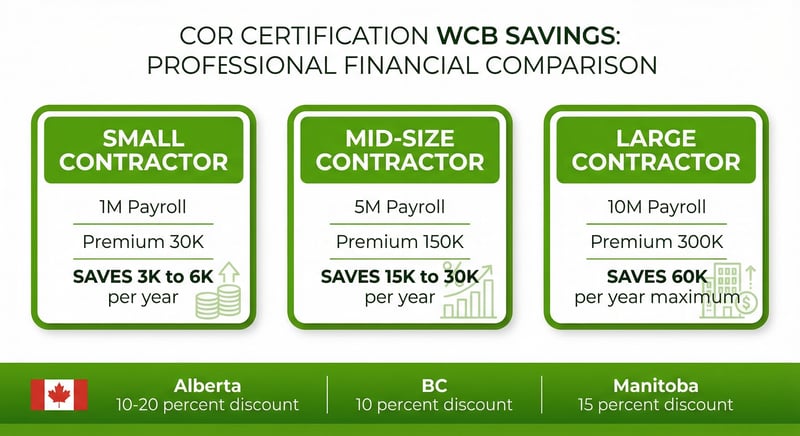
Here is where we stop talking in percentages and start talking in dollars. Below are estimated savings for three common contractor payroll tiers, using a mid-range construction WCB rate of $3.00 per $100 of payroll. Your actual rate will depend on your industry classification and province.
Important: These are estimates based on publicly available program rates as of early 2026. Actual savings depend on your specific industry rate, province, claims history, and program eligibility. Always confirm current rates and programs with your provincial WCB.
$1 Million Payroll
| Province |
Annual Premium (est.) |
COR Discount |
Annual Savings (est.) |
| Alberta | $30,000 | 10%-20% | $3,000 - $6,000 |
| BC | $30,000 | 10% | $3,000 |
| Manitoba | $30,000 | 15% or $3,000 min | $4,500 |
| Saskatchewan | $30,000 | Experience-rated | Varies |
| Ontario | $30,000 | SOSE rebate | Varies |
| Nova Scotia | $30,000 | PIR rebate | Varies |
$5 Million Payroll
| Province |
Annual Premium (est.) |
COR Discount |
Annual Savings (est.) |
| Alberta | $150,000 | 10%-20% | $15,000 - $30,000 |
| BC | $150,000 | 10% | $15,000 |
| Manitoba | $150,000 | 15% or $3,000 min | $22,500 |
| Saskatchewan | $150,000 | Experience-rated | Varies |
| Ontario | $150,000 | SOSE rebate | Varies |
| Nova Scotia | $150,000 | PIR rebate | Varies |
$10 Million Payroll
| Province |
Annual Premium (est.) |
COR Discount |
Annual Savings (est.) |
| Alberta | $300,000 | 10%-20% | $30,000 - $60,000 |
| BC | $300,000 | 10% | $30,000 |
| Manitoba | $300,000 | 15% or $3,000 min | $45,000 |
| Saskatchewan | $300,000 | Experience-rated | Varies |
| Ontario | $300,000 | SOSE rebate | Varies |
| Nova Scotia | $300,000 | PIR rebate | Varies |
Look at those numbers. An Alberta contractor with $10 million in payroll who achieves COR and improves their claims performance could save $60,000 per year. Over five years, that is $300,000. And that does not even count the experience rating improvements that compound on top of the direct COR rebate.
Is COR Worth It? The Real ROI Calculation
Here is the question every contractor actually wants answered. You are not asking "what is COR." You are asking "will I get more back than I put in." For a broader look at the certification itself, see our complete guide to COR certification in Canada.
Let us do the math with a real scenario.
A 40-person electrical subcontractor in Calgary with $3 million annual payroll:
- WCB premium rate: approximately $3.00 per $100 (typical for electrical construction in Alberta)
- Annual WCB premium: $90,000
- COR certification costs (estimated): $8,000 to $15,000 in the first year (training, audit fees, program development time)
- Annual maintenance costs (estimated): $3,000 to $5,000 (internal audit, training updates, documentation)
Year 1 return:
- PIR COR refund (10%): $9,000
- Minus certification costs: -$12,000 (estimated midpoint)
- Net Year 1: -$3,000 (small investment cost)
Year 2+ return:
- PIR COR refund (5% base, potentially up to 20% with improved performance): $4,500 to $18,000
- Minus annual maintenance: -$4,000 (estimated)
- Net Year 2+: $500 to $14,000 per year
5-year projection (conservative, using 10% average refund):
- Total refunds: $45,000
- Total costs: $28,000 (Year 1 setup + 4 years maintenance)
- Net 5-year savings: $17,000+
And here is what the spreadsheet does not show you: fewer incidents means fewer stop-work orders, fewer missed deadlines, and fewer conversations with OHS inspectors. It means crews that go home safe, which means crews that show up tomorrow. The WCB discount is the measurable return. The operational stability is the real payoff.
If you are running a larger operation, the math gets even more compelling. A $10 million payroll contractor in Alberta earning 15% through PIR is looking at $45,000 per year in refunds. That pays for your entire safety program and then some.
The Hidden Savings Most Contractors Miss
The WCB premium discount is the savings you can put in a spreadsheet. But contractors who have been through the COR process will tell you the biggest financial impacts are the ones that do not show up on a WCB statement:
- Winning bids you could not win before. Many GCs require COR or equivalent certification just to be on the bid list. No COR means no bid. No bid means zero revenue from that client. If COR opens the door to even one $500,000 project, the entire certification cost is paid for.
- Lower insurance costs. Some commercial liability insurers offer better rates to COR-certified employers. The discount varies, but it is worth asking your broker.
- Reduced incident costs. The average cost of a lost-time workplace injury in Canada typically runs into tens of thousands of dollars when you factor in direct costs, lost productivity, replacement labour, and administrative time. Prevent two or three injuries per year, and you have covered your COR investment easily.
- Experience rating improvements. This is the compounding effect. As your claims history improves (because your safety systems actually work), your experience rating adjusts downward, reducing your base premium beyond the COR discount. This takes 2 to 3 years to fully materialize, but it is the gift that keeps giving.
Building and maintaining these safety systems is real work. If you do not have the internal capacity to build an audit-ready safety program, Safety Evolution builds compliance-ready programs for contractors across Canada. We handle the documentation, the training, the audit prep, and the ongoing maintenance so your team can focus on production.
How to Get Started with COR
If you have read this far and the numbers make sense, here is the path forward. The process is not complicated, but it does require commitment. Getting COR is not a weekend project. Depending on the state of your current safety program, most contractors complete the process in 6 to 18 months.
- Assess where you stand today. Do you have a documented safety program? Are your crews completing FLHAs, toolbox talks, and inspections consistently? If not, that is step one.
- Choose your certifying partner. Each province has approved certifying partners (ACSA in Alberta, BCCSA in BC, SCSA in Saskatchewan, etc.).
- Build or upgrade your safety management system. Your program needs to meet provincial audit standards across all required elements. This is where most contractors get stuck, because the gap between "we have a safety binder" and "we have an audit-ready program" is larger than most people expect.
- Complete the required training. Your internal auditor, safety personnel, and management all need specific training.
- Pass the external audit. A certified auditor evaluates your safety management system against provincial standards. You need a minimum overall score (typically 80% in Alberta) and minimum scores on each individual element.
- Register with your WCB incentive program. In Alberta, this means registering with PIR. In BC, the incentive is automatic through your certifying partner. Each province has its own process.
If you have a small team (no more than 10 employees in Alberta), you may qualify for SECOR (Small Employer COR), which is a streamlined version of COR with a simpler audit process. SECOR-certified employers are also eligible for PIR refunds in Alberta.
Wherever you are in this process, Safety Evolution can help. We build audit-ready safety programs for contractors every week. From gap analysis to documentation to audit prep, we handle the heavy lifting so you can focus on running your crew. Safety Evolution can check your current program and flag exactly what needs to be fixed before your next COR audit.
Side-by-Side Province Comparison
| Province |
Program Name |
Max COR Discount |
How It Works |
| Alberta | PIR (Partnerships in Injury Reduction) | Up to 20% | Direct refund; 10% Year 1, 5% ongoing, up to 20% with performance |
| British Columbia | COR Incentive Program | 10% | Annual incentive credited to WorkSafeBC account |
| Manitoba | Prevention Rebate | 15% or $3,000 min | Rebate by cheque or WCB credit; $3,000 minimum for small employers |
| Saskatchewan | Experience Rating | Varies | COR drives claims reduction, improving experience rating over time |
| Ontario | SOSE / Ontario Safe Employers | Varies | Rebate based on premiums, predictability rating, and program year |
| Nova Scotia | Practice Incentive Rebate | Varies | Rebate for construction/trucking employers with COR or Safety Certified |
| New Brunswick | Experience Rating | Varies | Improved safety performance = lower premiums through experience rating |
Looking for COR certification details for a specific province? We have detailed guides for Alberta and British Columbia, with more provinces coming soon.
Stop Leaving Money on the Table
Every year you operate without COR in a province that offers premium discounts, you are writing a cheque to your WCB that is bigger than it needs to be. For most construction contractors, COR pays for itself within the first year or two through direct WCB rebates alone. Factor in the bids you can now win, the incidents you prevent, and the experience rating improvements that compound over time, and the ROI is not even close.
The contractors who do well with COR are not the ones who treat it as a paperwork exercise. They are the ones who use the certification process to actually build a safety program that works on site, every day. That is the difference between a $15,000 rebate cheque and a safety culture that protects your people and your business.
Safety Evolution builds audit-ready COR and SECOR programs for contractors across Canada. We handle the program development, documentation, training, and audit preparation. Your crew stays focused on production. Start your 30-day free trial and see exactly where your program stands against COR requirements.
Free Resources to Get You Started
Building toward COR? These free resources will help you put the foundational elements in place:
Still chasing COR evidence across files and inboxes?
Centralize corrective actions and proof so your next review is predictable.
Start Your 30-Day Free Trial →
Frequently Asked Questions
How much can COR save on WCB premiums?
COR-certified employers can earn WCB premium discounts ranging from 10% to 20% depending on the province. In Alberta, the PIR program offers up to 20%. In BC, the COR incentive is 10%. In Manitoba, the Prevention Rebate is 15% or $3,000, whichever is greater. For a contractor with $5 million in payroll and a $3.00/$100 rate, this translates to estimated annual savings between $15,000 and $30,000 in provinces with direct rebate programs.
Does COR certification pay for itself?
For most construction contractors, yes. Initial COR certification typically costs an estimated $8,000 to $15,000 (including training, audit fees, and program development), with annual maintenance costs of approximately $3,000 to $5,000. In provinces with direct rebate programs, a contractor with $1 million or more in annual payroll will typically recover their investment within 1 to 2 years through WCB premium refunds alone, not counting additional savings from winning more bids and reducing incident costs.
Which province has the best COR premium discount?
Alberta currently offers the most generous COR-related WCB discount through the Partnerships in Injury Reduction (PIR) program, with potential refunds of up to 20% of your premium. Manitoba's Prevention Rebate at 15% (with a $3,000 minimum) is also highly competitive, especially for smaller contractors. BC's 10% COR incentive is consistent and straightforward. Programs and rates can change, so always confirm current details with your provincial WCB.
Do I need COR to get a WCB discount?
In most western Canadian provinces (Alberta, BC, Manitoba), COR certification is the primary pathway to earn WCB premium discounts or rebates. Some provinces also offer experience rating adjustments based on your claims history, which you can improve without COR, but COR gives you the structured safety management system that drives those improvements. In Ontario, the WSIB's Supporting Ontario's Safe Employers program provides a similar incentive pathway.
Is SECOR eligible for WCB premium discounts?
Yes. In Alberta, SECOR (Small Employer Certificate of Recognition) certified employers are eligible for PIR refunds, just like COR-certified employers. The same 10% first-year refund and up to 20% maximum applies. SECOR is designed for employers with no more than 10 employees and has a simpler audit process, but the WCB discount eligibility is the same.
How long does it take for COR to reduce my WCB premiums?
Direct COR rebates (such as Alberta's PIR refund or BC's COR incentive) typically start the year after you achieve certification. In Alberta, you can earn a refund in your first year of COR if you complete certification by year-end. Experience rating improvements, which provide additional premium reductions, take 2 to 3 years to fully materialize as your improved claims history is reflected in your rate.
Get Weekly Safety Insights
Regulation updates, toolbox talk ideas, and compliance tips. One email per week.