Last updated: April 2026
You're bidding on a public construction project in Nova Scotia. You've got the crew, the equipment, and the competitive price. But there's one line in the tender requirements that stops you cold: "COR certification required." Without it, your bid package goes straight to the recycling bin.
This isn't hypothetical. Most public construction projects in Nova Scotia now require COR certification. And an increasing number of private GCs are making it a condition of contract too. At Safety Evolution, we help contractors across Canada build safety programs that get certified and stay certified. Here's exactly how COR works in Nova Scotia.
⚡ Quick Answer
- What: COR (Certificate of Recognition) is a safety certification for construction employers in Nova Scotia
- Certifying body: Construction Safety Nova Scotia (CSNS)
- Requirements: 4 required training courses + compliance-based training, then a 5-step process from implementation to certification maintenance
- Cost: Year 1 evaluation is FREE for CSNS members; $983 for Associate Member Plus; $1,375 for Associate Members
- WCB benefit: COR qualifies you for WCB Nova Scotia's "Safety Certified" designation, which can earn premium rebates through the Practice Incentive Rebate program
- Why it matters: Required for most public construction tenders in Nova Scotia and increasingly demanded by private GCs
- Behind on COR actions? Start your 30-day free trial to track owners, due dates, and audit evidence in one place.
What Is COR Certification in Nova Scotia?
COR (Certificate of Recognition) is a nationally recognized safety certification that verifies a construction employer has a fully implemented occupational health and safety management system meeting national standards. In Nova Scotia, COR is administered by Construction Safety Nova Scotia (CSNS), which serves as the Authority Having Jurisdiction to grant COR in the province.
CSNS is an industry-founded and funded membership-based not-for-profit association. With over 7,000 member companies and more than 1,150 firms holding COR certification, CSNS is one of the most active certifying bodies in Atlantic Canada. All companies with a current WCB account under construction industry classification codes (4011-4499 and 3551) are automatically members of the association.
If you need help building the safety program documentation required for COR, Safety Evolution offers a complete orientation and onboarding package and online training courses that align with COR requirements across all provinces.
Why Does COR Matter in Nova Scotia?
Most contractors think COR is a "nice to have" for safety-conscious companies. They're wrong. In Nova Scotia, COR is a business requirement.
Here's the reality:
- Public tenders require it. If you're bidding on work with the Province of Nova Scotia, especially in construction, you need COR certification (or WCB Safety Certified status) to qualify.
- Private GCs are following suit. More businesses, municipalities, and institutions in NS are adding COR as a tender requirement.
- WCB premium savings. COR certification qualifies you for WCB Nova Scotia's Safety Certified designation, which makes you eligible for the Practice Incentive Rebate program. For construction and trucking companies, this rebate offers a percentage back on your premiums.
- Competitive advantage. With 1,150+ firms already COR certified through CSNS, not having it puts you at a disadvantage when GCs compare subcontractors.
Ready to get started? Safety Evolution can check your safety documentation against Nova Scotia COR requirements and show you exactly what gaps need closing.
What Training Is Required for COR in Nova Scotia?
CSNS requires completion of four core training courses, plus any compliance-based training specific to your operations:
4 Required Training Courses
- Principles Health & Safety Management Covers the fundamentals of developing and managing an occupational health and safety program. This is your foundation course.
- Hazard Identification & Control Teaches how to systematically identify workplace hazards, assess risks, and implement effective controls. Essential for your FLHAs and safe work procedures.
- COR Evaluation Trains you on how to conduct the internal COR evaluation using CSNS's evaluation instrument. You'll use this skill every year for certification maintenance.
- Leadership for Safety Excellence Focuses on building safety leadership throughout your organization, from the owner to the site supervisor to the lead hand.
Compliance-Based Training
Beyond the four core courses, CSNS requires any compliance-based training relevant to your operations. This could include WHMIS, fall protection, confined space entry, scaffolding, or other hazard-specific training depending on the work your crew performs. Don't skip this requirement. The external evaluator will check for it.
CSNS offers training through their Dartmouth and Sydney offices, as well as eLearning options through their online platform at constructionsafetynsonline.ca. Contact CSNS at 902-468-6696 or info@constructionsafetyns.ca for scheduling.
Not sure what will fail your Nova Scotia COR audit?
See where your documentation is weak before the audit, then fix owners, due dates, and evidence fast.
Start Your 30-Day Free Trial →What Are the 5 Steps to COR Certification in Nova Scotia?
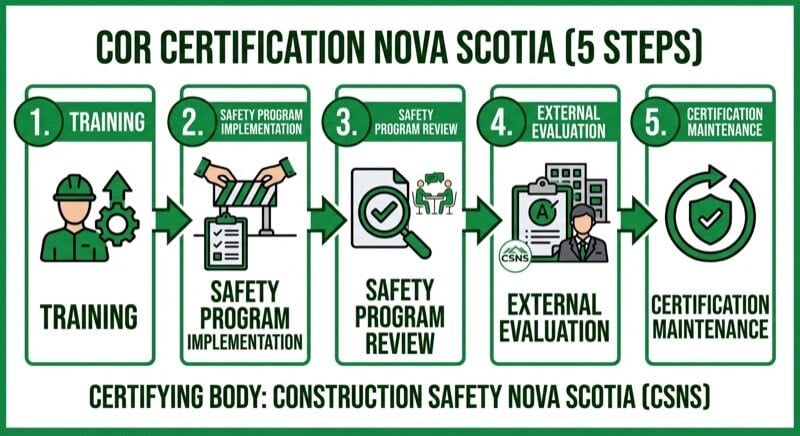
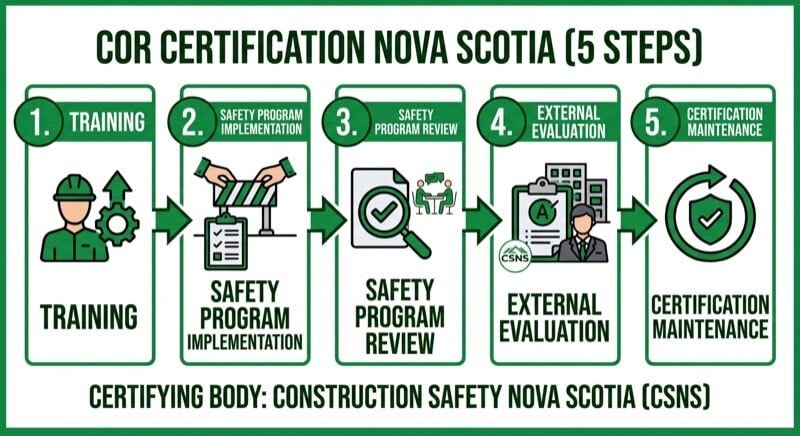
CSNS breaks the COR process into five clear steps. Here's what each one actually involves:
Step 1: Training
Complete all four required training courses plus your compliance-based training. This is the entry point. You can't move forward until your key personnel have completed these courses. Plan for several weeks to work through the schedule, depending on course availability.
Step 2: Safety Program Implementation
This is the hardest step, and it's where most companies stall. You need to take what you learned in training and build a functioning safety program tailored to your company. CSNS requires you to:
- Complete a Comprehensive Hazard Assessment for your operations
- Implement safe work practices your crew actually follows on site
- Write safe job procedures for your specific tasks and hazards
- Create or update policies to reflect the new safety standards
- Provide supporting documentation that proves your safety program is functioning and benefiting your company
Here's where contractors get tripped up: they write a beautiful safety manual, put it in a binder, and assume they're ready. They're not. "Provide supporting documentation" means you need evidence that the program is being used. That means completed FLHAs, documented toolbox talks, inspection reports, training records, incident investigations. Paper in a binder doesn't count. Paper that proves your crew is doing the work does.
If you're struggling with toolbox talk documentation, Safety Evolution's 365-topic toolbox talk package gives you a full year of ready-to-use talks that satisfy COR documentation requirements.
Step 3: Safety Program Review
Once your program is implemented and you've built up supporting documentation, submit the following to CSNS:
- Completed COR Evaluation Instrument (your internal audit)
- Your Safety Manual (first year only; not required for renewals)
- Payment of the evaluation fee
CSNS reviews your submission to confirm it's complete before scheduling the external evaluation.
Step 4: External Evaluation
A CSNS safety advisor contacts you to book an external audit. The evaluator visits your workplace, reviews your documentation, interviews workers and management, and assesses whether your safety program is genuinely operational.
This is the moment of truth. The evaluator isn't just checking that documents exist. They're checking that your crew knows the policies, that supervisors conduct inspections, and that the program lives on the job site, not just in the office. For tips on preparing for the audit itself, see our guide to passing your COR audit.
Step 5: Certification Maintenance
After you receive your COR certificate, you must maintain your safety program, complete a yearly evaluation, and pay the COR evaluation fee to receive your annual Letter of Good Standing.
CSNS performs random COR evaluations on 5% of certified companies each year. This isn't a suggestion. It's a quality control measure to maintain the integrity and standard of COR certification in Nova Scotia. If your company is selected for a random evaluation and your program has slipped, you risk losing your certification.
How Much Does COR Certification Cost in Nova Scotia?
CSNS publishes their evaluation fees based on your membership level. Here's the current fee schedule:
| Year |
Member |
Associate Member Plus |
Associate Member |
| Year 1 (first submission) |
FREE |
$983 |
$1,375 |
| Years 2 and 3 |
$144 |
$288 |
$385 |
| Year 4 (recertification) |
$592 |
$983 |
$1,375 |
If your company has a WCB account under construction industry classification codes (4011-4499 and 3551), you're automatically a CSNS member. That means your first COR evaluation is free. That's a significant incentive to get started now rather than waiting.
Keep in mind: these fees cover the evaluation only. You'll also need to budget for training course costs, the time your team spends building the safety program, and any consulting support you bring in to close gaps. The total investment depends on your company size and the current state of your safety documentation.
Beginning January 1, 2024, a Return to Work (RTW) policy and program is also required for COR and WCB Safety Certification. Factor this into your program development if you haven't already.
How Does COR Affect WCB Premiums in Nova Scotia?
WCB Nova Scotia runs the "Safety Certified" program, which is the province's standard for safety management. COR certification through CSNS qualifies you for WCB Safety Certified status.
Here's why that matters financially:
- Practice Incentive Rebate: If you're in the construction or trucking industries, WCB Nova Scotia offers a rebate program that gives you a percentage back on your premiums when you meet key safety performance standards, including being Safety Certified.
- Business reputation: WCB Safety Certified status shows workers, customers, and your community that safety isn't just paperwork. It's a verified standard you maintain.
- Potential expansion: WCB Nova Scotia has indicated this rebate program may expand to other industries in future years.
The exact rebate percentage depends on your premium level and safety performance metrics. Contact WCB Nova Scotia's employer incentives team at employer.incentives@wcb.ns.ca for details specific to your company.
For context on how COR-based WCB incentives work in other provinces, see our guides for COR in Alberta (where rebates range from 10% to 20%) and COR in BC.
What Documents Do You Need for COR in Nova Scotia?
The documentation side of COR trips up more contractors than the training does. Here's a realistic list of what you'll need to have in place before your evaluation:
- Health and safety policy: A written policy signed by senior management that commits your company to workplace safety. Not a generic template. A policy that reflects your actual operations.
- Comprehensive hazard assessment: A systematic assessment of every significant hazard in your workplace. This includes your office, your shop, your vehicles, and every type of job site your crew works on.
- Safe work procedures: Written procedures for your high-risk tasks. If your crew does roofing, scaffolding, trenching, or confined space work, each task needs its own documented procedure.
- Training records: Proof that every worker has completed the training required for their tasks. This includes COR-specific training, compliance training (WHMIS, fall protection, etc.), and task-specific training.
- Inspection records: Documented workplace inspections conducted regularly. Weekly site inspections, equipment inspections, and pre-job inspections should all be on file.
- Toolbox talk records: Documented safety meetings showing dates, topics, attendees, and signatures. Weekly toolbox talks are the standard.
- Incident investigation reports: Every incident, near miss, and first aid case should be investigated and documented with corrective actions. Use Safety Evolution's incident investigation kit if you need a structured process.
- Return to Work program: As of January 2024, this is mandatory for COR in Nova Scotia. You need a written RTW policy, designated RTW coordinator, and a tracking system for outcomes.
- Emergency response plan: A documented plan for emergency situations specific to your work environments.
The key detail most contractors miss: you need records that show these systems have been active over time. An evaluator can tell the difference between six months of genuine safety documentation and a weekend of backfilling. Don't try to fake it.
How Long Does COR Certification Take in Nova Scotia?
CSNS states that the overall duration varies between companies. That's accurate but not helpful when you're trying to plan.
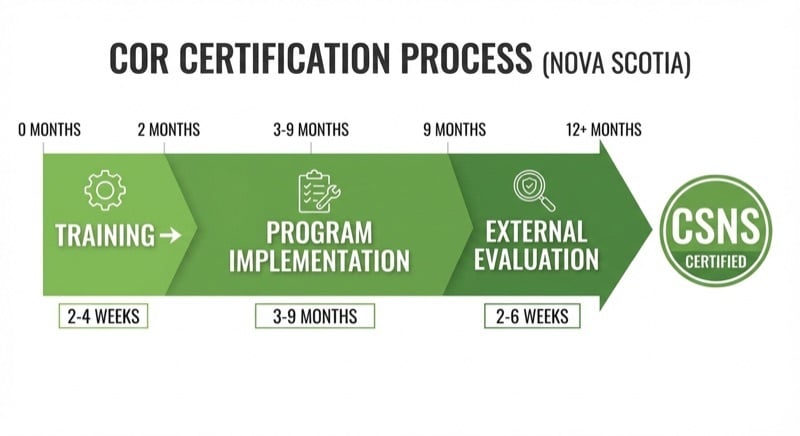
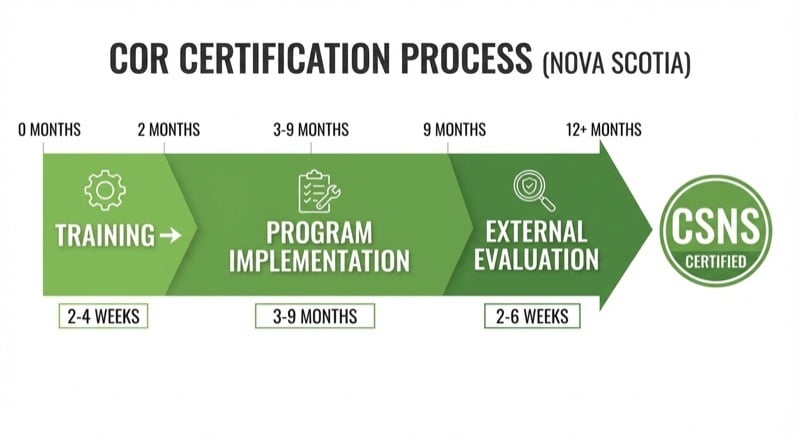
Here's a realistic breakdown:
- Training: 2 to 4 weeks for all four core courses, depending on CSNS scheduling and your team's availability
- Safety program implementation: 3 to 9 months. This is the variable. Companies with an existing safety program may only need to fill gaps and generate documentation. Companies starting from scratch need significantly more time.
- Evaluation submission and external audit: 2 to 6 weeks from submission to audit completion, depending on CSNS's schedule
Total realistic timeline: 4 to 12 months for most construction companies. If you're planning to bid on a specific project that requires COR, start the process at least 6 months before the tender deadline. Rushing the implementation phase produces a weak program that fails the external evaluation.
If you need to accelerate the process, Safety Evolution can help you build a construction safety program that meets COR standards from day one.
Still chasing Nova Scotia COR evidence across files and inboxes?
Centralize corrective actions and audit proof so your next review is predictable.
Start Your 30-Day Free Trial →
Frequently Asked Questions
Is COR mandatory for construction companies in Nova Scotia?
COR is not legally mandated by WCB Nova Scotia for all construction companies. However, it is effectively required for most public construction tenders in the province. Bidding on work with the Province of Nova Scotia, municipalities, and many private GCs requires COR certification or WCB Safety Certified status. Without it, you're locked out of a growing share of available work.
What is the difference between COR and WCB Safety Certified in Nova Scotia?
COR is administered by CSNS specifically for the construction industry. WCB Safety Certified is WCB Nova Scotia's broader safety management certification. COR certification through CSNS qualifies you for WCB Safety Certified status. Both demonstrate that your workplace safety programs meet recognized standards, but COR is the construction-industry pathway to that designation.
How much does COR cost for CSNS members?
For CSNS members (companies with WCB accounts under construction classification codes 4011-4499 and 3551), the first-year COR evaluation is free. Years 2 and 3 cost $144 per year. Year 4 (recertification) costs $592. These are evaluation fees only; training course costs and program development time are additional.
Can I get COR reciprocity in Nova Scotia from another province?
COR is a national standard delivered through provincial certifying bodies under the CFCSA framework. If you're COR certified in another province and need to work in Nova Scotia, contact CSNS directly to discuss reciprocity options. Each province handles reciprocity through their own application process.
What happens if I'm selected for a random COR evaluation?
CSNS performs random COR evaluations on 5% of certified companies each year to maintain the standard's integrity. If selected, a CSNS evaluator audits your safety program the same way they would during a scheduled evaluation. If your program meets the standard, nothing changes. If it falls short, you may need to take corrective action to maintain your certification.
Do I need a Return to Work program for COR in Nova Scotia?
Yes. As of January 1, 2024, a Return to Work (RTW) policy and program is required for COR and WCB Safety Certification in Nova Scotia. Your RTW program must demonstrate a clear plan, identify the right people involved, and include a way to track outcomes. Build this into your safety program from the start.
Get Weekly Safety Insights
Regulation updates, toolbox talk ideas, and compliance tips. One email per week.