SECOR
How to Pass a COR Audit in Canada
COR audits require 80% to pass. Here's what auditors evaluate, where contractors fail, and how to prepare in Alberta and BC.
COR in Manitoba earns a 15% WCB rebate. Get the CSAM steps, 4 required courses, audit scoring thresholds, and realistic timelines to certification.
Last updated: April 2026
You're paying full WCB premiums in Manitoba while the GC down the street gets a 15% rebate. Same industry, same risk, same workers. The difference? They have COR. Manitoba's Prevention Rebate is one of the most generous in Canada, and every year you operate without COR is money you're handing back to WCB.
At Safety Evolution, we help contractors across Canada get COR certified and build safety programs that actually pass audits. Manitoba's COR process has specific requirements that catch people off guard, from the three audits in your first year to the 15-section audit instrument with minimum scoring thresholds. This guide covers exactly what you need to know so you can plan, budget, and get certified without surprises.

COR (Certificate of Recognition) is a nationally recognized safety certification that verifies your company has a health and safety management system meeting national standards. In Manitoba, the COR program is administered by the Construction Safety Association of Manitoba (CSAM) as a certifying partner with SAFE Work Manitoba.
COR in Manitoba isn't optional if you want to compete for serious work. GCs require it. Public sector projects require it. And unlike some provinces where the WCB discount is modest, Manitoba offers one of the strongest financial incentives in the country to get certified.
If you are not sure where your safety program stands right now, Safety Evolution can check your safety documentation against Manitoba COR requirements and show you exactly what needs fixing.
The Construction Safety Association of Manitoba (CSAM) is the certifying partner for COR in the province. CSAM works in partnership with SAFE Work Manitoba, which oversees the Prevention Rebate Program that rewards COR-certified employers with WCB premium reductions.
CSAM delivers the required training courses, conducts audits, and manages the ongoing certification cycle. Their COR Program Manager is Keith Steffano, and the CSAM team guides companies through the process from registration to certification.
SAFE Work Manitoba is the provincial agency responsible for workplace safety and prevention. They set the standards; CSAM implements the COR program on the ground. Understanding this relationship matters because your WCB rebate comes through SAFE Work Manitoba, while your certification comes through CSAM.
Here's the number that gets contractors' attention:
The Prevention Rebate Program is overseen by SAFE Work Manitoba and is available to all employers who maintain COR certification. This isn't a one-time benefit. You receive the rebate every year you maintain your certification and meet the program requirements.
Let's put this in perspective. A mid-size construction company in Manitoba with $200,000 in annual WCB premiums saves $30,000 per year with COR. Over a three-year certification cycle, that's $90,000 back in your pocket. The investment in training, program development, and audits pays for itself in the first year for most companies.
Most contractors think COR is just about winning bids. In Manitoba, they're missing the bigger picture. The WCB rebate alone makes the math obvious, and that's before you factor in fewer incidents, lower claims costs, and access to better contracts.
CSAM requires four specific training courses before you can pursue COR certification. These aren't optional, and you can't substitute other courses for them:
The senior management representative takes one course (Principles of Safety Management). A permanent full-time employee needs to complete all four courses, including the Safety Auditor course that qualifies them to conduct your internal audits.
Don't underestimate the time commitment here. Each course takes days, not hours. Factor in scheduling, travel if needed, and the fact that you're pulling key people off job sites to attend training. Build this into your timeline from the start. If your team needs other safety training courses, tackle those at the same time to minimize downtime.
Not sure what will fail your Manitoba COR audit?
See where your documentation is weak before the audit, then fix owners, due dates, and evidence fast.
Start Your 30-Day Free Trial →Your safety program needs to address all 15 sections of CSAM's audit instrument. Here's what that means in practice:
You need written health and safety policies signed by senior management, formal hazard identification processes for every job site, safe work procedures for your high-risk tasks, a comprehensive training matrix showing who's been trained on what, documented toolbox talks and safety meeting records, incident investigation procedures with root cause analysis, emergency response plans for every site, workplace inspection programs, PPE policies, preventative maintenance records, and management review processes.
The 15-section audit instrument means there's nowhere to hide. If you've been strong on PPE and safe work procedures but weak on management review and statistics tracking, the audit will find it. Every section needs at least 50%, which means you need meaningful documentation and evidence of implementation in all 15 areas.
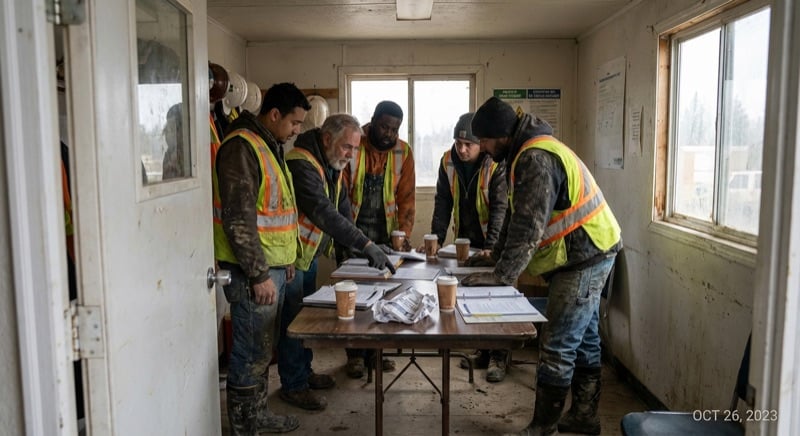
One detail that trips up Manitoba contractors: the audit doesn't just evaluate your written program. It evaluates implementation. The auditor will interview your workers on site. If your crew can't describe your emergency procedures, can't explain how they report hazards, or has never seen your safety manual, your written program is worthless. The disconnect between what's on paper and what happens on site is the number one reason contractors fail their first audit.
Build your program with your crew's input from the start. Walk your foremen through the hazard assessment process. Make sure your workers know where the safety manual is and what's in it. Practice your emergency procedures, not just document them. When your workers can answer the auditor's questions confidently, your program is working.
Manitoba's COR audit is one of the most rigorous in the country. Here's what you're facing:
In your first year pursuing COR, you must complete three audits:
Three audits in one year. That's not a typo. Manitoba takes this seriously, and the triple-audit structure in Year 1 is designed to ensure your program is genuinely functional, not just paper-deep.
Manitoba's COR audit uses a comprehensive 15-section audit instrument. To pass, you must score:
This dual-threshold scoring means you can't compensate for a weak area by over-performing in another. If your emergency preparedness section scores 40%, you fail, even if every other section scores 95%. Every section of your safety program needs to meet a baseline standard.
The blunt truth about Manitoba's audit: the 80% overall threshold is achievable for companies that have genuinely implemented their program. The 50% per-section minimum is what catches people. Most failures happen because one or two sections were neglected during program development. Typically, it's training documentation or incident investigation procedures that come up short.
After your initial certification year, the maintenance cycle looks different:
COR is valid for 3 years. At the end of your three-year cycle, you go through the full audit process again for re-certification.
Here's the full process from start to finish:
If you're building a safety program from scratch, start with a solid safety program template that covers all the required elements. This saves months of guesswork and ensures you don't miss critical sections that the audit instrument covers.
Here's what separates companies that pass their Manitoba COR audit on the first attempt from those that don't:
Preparation starts at program development, not audit scheduling. The companies that pass build their program with the audit instrument in mind from Day 1. They look at all 15 sections, understand what evidence the auditor needs for each one, and build their documentation and processes accordingly.
Workers can answer questions. When the auditor interviews your crew, they need to demonstrate awareness of your safety program. Can your foreman describe the hazard assessment process? Can a labourer explain their right to refuse unsafe work? Can your safety person walk through the incident investigation procedure? Worker knowledge is a direct reflection of implementation quality.
Evidence of ongoing activity. The auditor wants to see records that demonstrate consistent safety activity over time, not a burst of paperwork in the weeks before the audit. Regular toolbox talk records, completed FLHAs, inspection reports with follow-up actions, and training logs that show ongoing competency development all tell the auditor that your program is alive, not just documented.
A mid-size mechanical contractor in Winnipeg shared this experience: they failed their first audit attempt because their emergency response plans were generic, copied from a template, and none of their site crews had ever practiced an emergency drill. Their documentation was professional, but implementation was absent. They regrouped, ran site-specific emergency drills at every active project, updated their plans with actual muster points and local hospital addresses, and documented everything with photos and sign-in sheets. They passed the re-audit with strong scores across all 15 sections. The difference wasn't the quality of the written plan; it was the quality of the implementation.
Realistic timeline from registration to certification:
Total realistic timeline: 9 to 16 months for most companies.
Companies that already have some safety documentation in place, regular safety management practices, and experienced supervisors can move through the process faster. Companies starting from zero should budget the full 12 to 16 months and plan accordingly.
Beyond the 15% WCB rebate, COR certification in Manitoba delivers real competitive advantages:
The real cost of not having COR in Manitoba is not just the missing 15% rebate. It is the bids you never get invited to, the GCs who will not return your calls, and the incidents that happen because your safety program was never formalized. If you are not sure where to start, Safety Evolution can analyse your safety documentation and show you exactly which gaps to close first.
COR is a national program with province-specific requirements. If you work across provincial lines, check our province-specific guides:
For a broader overview of the COR program nationally, see our guide to the Certificate of Recognition (COR).
Still chasing Manitoba COR evidence across files and inboxes?
Centralize corrective actions and audit proof so your next Manitoba COR review is predictable.
Start Your 30-Day Free Trial →COR-certified employers in Manitoba receive a Prevention Rebate of 15% of their WCB assessment premium. Small employers receive a flat $3,000 rebate, capped at 50% of their premium. The rebate is available annually for as long as you maintain your COR certification.
The four required CSAM courses are: Principles of Safety Management (for owner/senior management), Leadership for Safety Excellence, Hazard Identification and Risk Control, and Safety Auditor. A permanent full-time employee must complete all four courses; the owner or senior manager must complete Principles of Safety Management.
You need a minimum of 50% in each of the 15 individual audit sections AND a minimum of 80% overall. Both thresholds must be met. Falling below 50% in any single section results in a failed audit, regardless of your overall score.
Three audits are required in Year 1: a company self-audit conducted by your trained internal auditor, a CSAM audit conducted by their auditor, and an independent third-party audit. In Years 2 and 3, the requirement drops to a company self-audit plus a CSAM verification review.
Most companies need 9 to 16 months from registration to certification. This includes 2 to 3 months for training, 4 to 8 months for safety program development and implementation, and 1 to 2 months for the three Year 1 audits. Companies with existing safety programs may complete the process faster.
Get Weekly Safety Insights
Regulation updates, toolbox talk ideas, and compliance tips. One email per week.
COR audits require 80% to pass. Here's what auditors evaluate, where contractors fail, and how to prepare in Alberta and BC.
COR in Ontario is required for City of Toronto and Metrolinx bids. IHSA steps, 14 audit elements, training costs, and realistic certification...
COR audit checklist for construction: what auditors check, scoring thresholds, element-by-element prep guide, and interview tips to pass your next...