Last updated: April 2026
You just lost a bid in New Brunswick because you didn't have COR. The GC didn't even read your safety manual. They checked for the certificate, didn't see it, and moved on to the next sub.
That's the reality for construction contractors in New Brunswick right now. COR certification is becoming the minimum standard for winning work, and companies without it are getting left behind. At Safety Evolution, we help contractors across Canada build safety programs that pass audits and win bids, so we see this pattern every week.
⚡ Quick Answer
- What: COR (Certificate of Recognition) is a nationally recognized health and safety certification for construction employers in New Brunswick
- Certifying body: New Brunswick Construction Safety Association (NBCSA)
- Requirements: Complete 6 training courses + internal and external evaluation of your company H&S program
- Validity: Certificate and Letter of Good Standing valid for 1 year, renewed through annual audit
- Why it matters: Required by most GCs to bid on construction projects in NB; helps lower WCB assessment rates over time
- Behind on COR actions? Start your 30-day free trial to track owners, due dates, and audit evidence in one place.
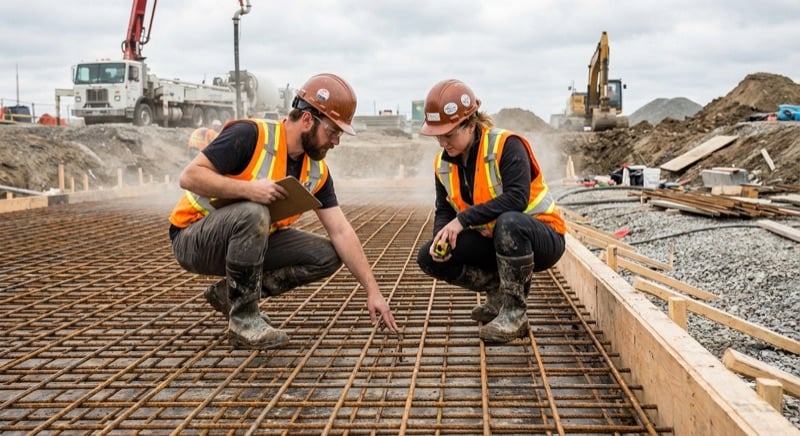
What Is COR Certification in New Brunswick?
COR (Certificate of Recognition) is a nationally recognized occupational health and safety accreditation program that verifies a fully implemented safety and health management system meeting national standards. In New Brunswick, the program is administered by the New Brunswick Construction Safety Association (NBCSA), which serves as the Authority Having Jurisdiction to grant COR in the province.
The objectives of COR are practical: give construction employers effective tools to develop, implement, assess, and continuously improve their safety and health management systems. The goal is to prevent incidents and injuries, along with the human and financial costs that follow.
COR is nationally registered, trademarked, and endorsed by the Canadian Federation of Construction Safety Associations (CFCSA). Each province has its own certifying body with a formal Memorandum of Understanding to deliver COR in their jurisdiction. In New Brunswick, that's the NBCSA. If you're looking for COR in other provinces, check our guides for Alberta and British Columbia.
Most contractors think COR is just another certificate you hang on the wall. They're wrong. COR is a living system. It requires your entire company to operate under a verified health and safety program, and it gets audited every single year. You can't fake it, and you can't set it and forget it.
Who Needs COR in New Brunswick?
If you're a construction contractor or employer in a related industry in New Brunswick, COR should be on your radar. Here's why:
- GCs are requiring it. More general contractors in NB will not consider subcontractors who don't hold a valid COR certificate.
- It proves due diligence. WorkSafeNB regulates workplace safety in the province. Holding COR demonstrates you've gone beyond minimum compliance and established a verified safety management system.
- It lowers your costs. COR-certified companies typically see lower lost-time claim rates, which helps reduce WCB assessment rates over the long term.
- It protects your people. The program is proven to reduce the frequency of workplace incidents, accidents, injuries, and fatalities.
If your crew is doing work on construction sites in New Brunswick and you want to stay competitive, COR isn't optional anymore. It's the cost of doing business.
Need help building a safety program that meets COR standards? Safety Evolution can check your safety documentation against New Brunswick COR requirements and show you exactly what gaps need closing.
What Are the 6 Required COR Training Courses?
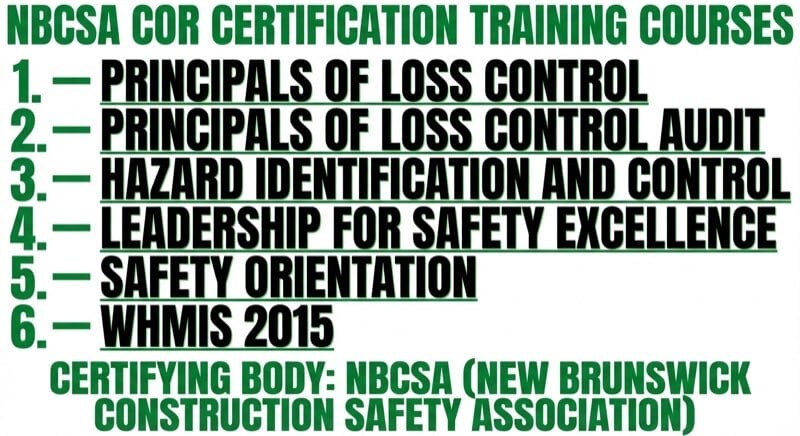
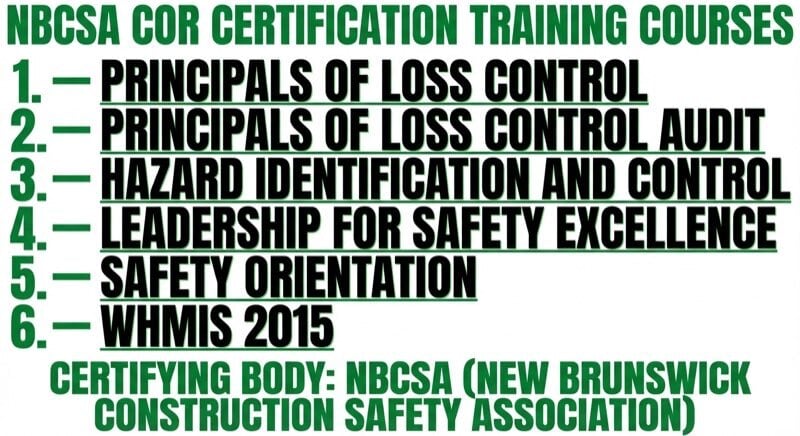
The NBCSA requires completion of six specific training courses before you can pursue COR accreditation. These aren't optional electives. Every one of them is mandatory:
- Principals of Loss Control Covers the foundations of workplace health and safety management, including employer and worker responsibilities under New Brunswick's OHS legislation.
- Principals of Loss Control Audit Teaches you how to conduct internal safety audits using the COR Harmonized Audit Instrument. This is the skill you'll use every year to maintain certification.
- Hazard Identification and Control Covers how to identify, assess, and control workplace hazards. Think FLHAs, job hazard analyses, and safe work procedures for your specific operations.
- Leadership for Safety Excellence Focuses on building safety leadership within your organization. This isn't a fluffy leadership seminar. It's about making safety part of how your supervisors and foremen actually run the site.
- Safety Orientation (eLearning) Available online. Covers the basics every worker needs before setting foot on a job site. If you need a structured orientation and onboarding package, Safety Evolution offers one that aligns with COR requirements.
- WHMIS 2015 (eLearning) Also available online. Covers the Workplace Hazardous Materials Information System, which is required for any workplace where workers may be exposed to hazardous products.
The NBCSA has their January to June 2026 training schedule live on their website at nbcsa.ca. Plan ahead, because courses fill up and you need all six completed before you can move to the evaluation stage.
Not sure what will fail your New Brunswick COR audit?
See where your documentation is weak before the audit, then fix owners, due dates, and evidence fast.
Start Your 30-Day Free Trial →How Do You Get COR Certified in New Brunswick?
The process has two major phases: training and evaluation. Here's how it works step by step:
Phase 1: Complete All 6 Training Courses
Register through the NBCSA and complete all six required courses listed above. Four are classroom-based (or virtual), and two are available as eLearning. Budget several weeks to get through all of them, depending on the NBCSA's schedule and your team's availability.
Phase 2: Build and Implement Your Safety Program
This is where most companies hit a wall. You need a company-wide health and safety program that covers all the elements the COR audit instrument evaluates. That means written policies, hazard assessments, safe work procedures, training records, inspection processes, incident investigation procedures, and more.
Here's the blunt truth: most contractors underestimate how much documentation COR requires. You can't just write a safety manual and call it done. The program needs to be implemented, meaning your crew actually follows the procedures, your supervisors conduct the inspections, and you have records to prove it.
If you need templates and tools to build out your documentation, Safety Evolution's toolbox talk package and incident investigation kit can help you fill the gaps.
Phase 3: Internal Evaluation
Once your program is implemented, you conduct an internal audit using the COR Harmonized Audit Instrument. This is why the Principals of Loss Control Audit course matters. You need someone qualified within your company to assess every element of your safety program and document the results.
Phase 4: External Evaluation
After your internal audit is complete, the NBCSA arranges an external evaluation of your company-wide health and safety program. An external auditor reviews your documentation, interviews workers and management, and verifies that your safety program is genuinely operational, not just a binder on a shelf.
Phase 5: Certification
If you pass both the internal and external evaluations, the NBCSA awards you a COR certificate and Letter of Good Standing. Both are valid for one year.
How Do You Maintain COR Certification?
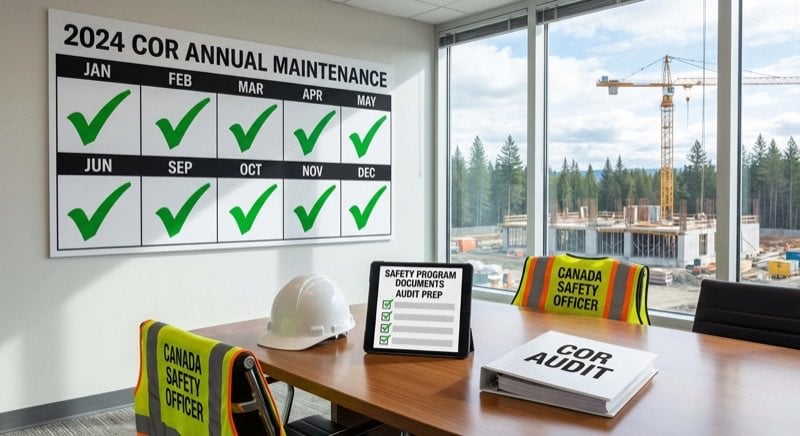
COR is not a one-time achievement. Once certified, you must complete an annual audit to renew your certificate and Letter of Good Standing every year. Skip the audit, and you lose your certification. Lose your certification, and you lose the ability to bid on work that requires it.
The annual maintenance audit follows the same COR Harmonized Audit Instrument. You'll conduct an internal audit, and the NBCSA may require an external evaluation as part of the renewal process. Keep your documentation current, your training records up to date, and your safety program actively running.
This is where many contractors stumble. They push hard to get certified, then let the program slide for 11 months until audit season rolls around. That approach fails. The auditor will see the gap in documentation, and your crew will confirm it in interviews.
What About COR Reciprocity for Out-of-Province Companies?
If your company already holds COR certification in another province and you need to work in New Brunswick, you don't have to start from scratch. The NBCSA offers COR reciprocity for out-of-province companies through a straightforward application process.
COR reciprocity is available to companies that are COR certified through any CFCSA member association but don't have a permanent base of operations in New Brunswick. You'll need to apply through the NBCSA using their reciprocity application form, available on their website.
If you're working across multiple provinces, our COR overview guide explains how the national program works and what reciprocity looks like in practice.
What Are the Benefits of COR in New Brunswick?
The NBCSA outlines several concrete benefits for COR-certified employers:
- Proven reduction in the number and frequency of workplace incidents, accidents, injuries, and fatalities
- Increased protection from OHS liability and help establishing due diligence
- Lower lost-time claim rates, which helps reduce WCB assessment rates over the long term
- Reduced risk of damage to equipment and property
- Province-wide access to affordable, industry-specific safety training through the NBCSA
- A level playing field where all contractors meet required H&S standards
- Improved competitiveness and profitability
- Third-party verification of your health and safety practices
- Better record keeping
- Improved recruitment and retention of workers
For your workers and sub-trades, COR creates a healthier and safer work environment, raises safety awareness, and improves morale and productivity.
For owners and purchasers hiring your company, COR certification provides third-party verification that your safety program meets national standards, which means fewer project delays and lower project costs.
How Does COR Certification Affect WCB Premiums in New Brunswick?
WorkSafeNB is the regulatory body overseeing workers' compensation in New Brunswick. While NB doesn't currently offer a direct COR-based premium rebate program like some western provinces do, COR certification still impacts your WCB costs in meaningful ways.
COR-certified companies typically have lower incident rates and fewer lost-time claims. Over time, this improves your experience rating with WorkSafeNB, which directly reduces your assessment premiums. The savings compound: fewer incidents mean fewer claims, which means lower rates year over year.
For comparison, provinces like Alberta and BC offer direct premium rebates of 10% to 20% for COR-certified companies. New Brunswick's model works differently, but the financial benefit of a strong safety record remains real. Check our COR audit preparation guide for tips on building a program that delivers measurable safety improvements.
Still chasing New Brunswick COR evidence across files and inboxes?
Centralize corrective actions and audit proof so your next review is predictable.
Start Your 30-Day Free Trial →
Frequently Asked Questions
How long does it take to get COR certified in New Brunswick?
The timeline varies depending on your company's current safety program maturity. You'll need to complete all 6 required NBCSA training courses, build and implement a full safety program, and pass both an internal and external evaluation. For most construction companies starting from scratch, expect 6 to 12 months. Companies with an existing safety program may complete the process faster.
What does COR certification cost in New Brunswick?
Costs depend on the number of employees being trained and the complexity of your operations. You'll pay for 6 NBCSA training courses (4 classroom + 2 eLearning), plus the time and resources needed to build your safety program and prepare for audits. Contact the NBCSA directly at nbcsa.ca for current course pricing and evaluation fees.
Can I transfer my COR certification from another province to New Brunswick?
Yes. The NBCSA offers COR reciprocity for companies that are already COR certified through a CFCSA member association in another province. You'll need to complete a reciprocity application through the NBCSA. This applies to companies that don't have a permanent base of operations in New Brunswick.
How often do I need to renew COR in New Brunswick?
COR certification and your Letter of Good Standing are valid for one year. You must complete an annual audit to renew. If you miss the annual audit, your certification lapses and you'll need to go through the full evaluation process again.
Is COR mandatory in New Brunswick?
COR is not legally mandated by WorkSafeNB, but it is effectively required for most commercial construction work in the province. General contractors increasingly require COR certification from their subcontractors as a condition of contract. Without it, you're locked out of a growing number of bids. For more on the national COR landscape, see our complete COR guide.
Get Weekly Safety Insights
Regulation updates, toolbox talk ideas, and compliance tips. One email per week.