Last updated: April 2026
You just lost a bid in Saskatchewan because you didn't have COR. The GC didn't even look at your price, your crew's experience, or your safety record. No COR, no conversation. That's the reality for contractors working in this province, and it's not going to change.
At Safety Evolution, we help contractors across Canada build safety programs and get COR certified. We've seen firsthand how Saskatchewan's process works, what trips people up, and where companies waste months going in circles. This guide breaks down the real steps, costs, and timelines so you can plan properly and stop guessing.
⚡ Quick Answer
- What: COR (Certificate of Recognition) is a nationally recognized safety certification administered in Saskatchewan by the SCSA
- Cost: Registration is FREE for SCSA members; $325 for non-members. Total program costs (training, program development, audit) vary by company size
- Timeline: Most companies need at least 6 months to build a basic safety program, plus time for training and external audit
- Why it matters: Required by most GCs for bid qualification; recognized across provinces; demonstrates a real commitment to workplace safety
- Behind on COR actions? Start your 30-day free trial to track owners, due dates, and audit evidence in one place.
What Is COR Certification in Saskatchewan?
COR (Certificate of Recognition) is a nationally trademarked safety certification that verifies your company has implemented a comprehensive health and safety program meeting national standards. In Saskatchewan, the program is administered by the Saskatchewan Construction Safety Association (SCSA).
COR isn't just a piece of paper. It's proof that your company has a functioning safety management system, that your crew is trained, that your hazard assessments are documented, and that you're doing internal audits to keep everything current. GCs across Saskatchewan require it before they'll put you on a bid list, and many public sector projects won't consider you without it.
If you are running a crew of any size in Saskatchewan's construction industry, COR is the baseline. Without it, you are invisible to the people handing out work. If you need help figuring out where your safety program stands, Safety Evolution can check your documentation against Saskatchewan COR requirements and show you exactly what needs fixing.
Who Administers COR in Saskatchewan?
The Saskatchewan Construction Safety Association (SCSA) is the certifying partner for COR and SECOR in the province. They're the ones who process your application, deliver required training, provide safety advisors, and conduct external audits.
The SCSA has offices in both Regina and Saskatoon. One of the most underused benefits of SCSA membership is access to their safety advisors, who can guide you through every step of the certification process at no extra cost. Most contractors don't realize this until they've already spent months trying to figure it out alone.
How Much Does COR Cost in Saskatchewan?
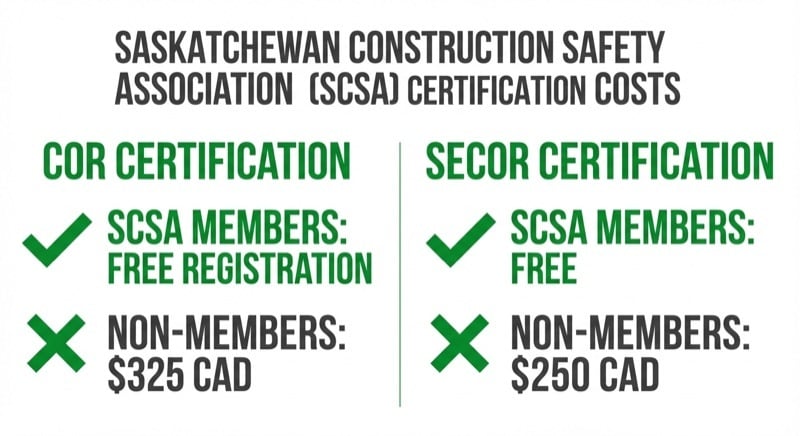
Here's where Saskatchewan stands out from other provinces. Registration fees through the SCSA are some of the lowest in Canada:
- COR registration (SCSA members): FREE
- COR registration (non-members): $325
- SECOR registration (SCSA members): FREE
- SECOR registration (non-members): $250
Those are just registration fees. Your total investment will include training course fees, time spent developing your safety program, and the hours your team puts into implementation. For most companies, the real cost isn't the fees; it's the time your people spend building the program while still running jobs.
Most contractors think COR is expensive. They're wrong. The registration itself costs almost nothing if you're an SCSA member. The real expense is the time commitment, and that's where having a clear plan (or proper training) makes the difference between a 6-month process and a 14-month headache.
What Are the Steps to Get COR Certified in Saskatchewan?
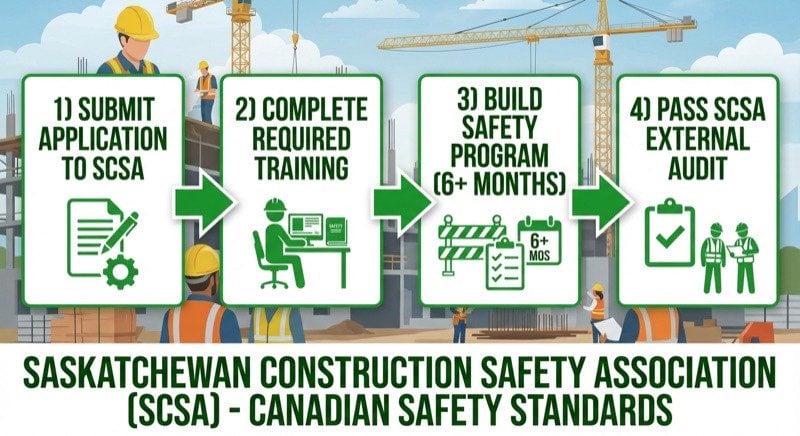
The SCSA lays out a clear path. Here's what it actually looks like on the ground:
Step 1: Submit your COR application
You apply directly through the SCSA. If you're already an SCSA member, registration is free. If not, you'll pay $325 and should seriously consider joining, since membership unlocks free registration, safety advisor access, and training discounts.
Step 2: Complete required training
The SCSA requires specific training courses before you can move forward. These cover safety management principles, hazard identification, and auditing. Your designated safety person (and often the owner or senior manager) needs to complete these courses. Don't skip this step or try to shortcut it. The training gives you the knowledge to actually build the program, not just check a box.
Step 3: Develop and implement your safety program
This is where most companies stall. You need a comprehensive safety program that covers hazard assessments, safe work procedures, training records, emergency response plans, incident investigation processes, and more. The SCSA states that most companies need at least six months to build a basic safety program.
Six months is the minimum. If you're starting from scratch with no safety documentation, no toolbox talk program, and no formal hazard assessment process, budget closer to 9 to 12 months. The companies that try to rush it usually end up failing their first audit and starting over.
SCSA safety advisors are available to provide guidance and support to members throughout this process. Use them. They've seen hundreds of safety programs, and they can tell you in 30 minutes what's missing from yours.
Step 4: External audit by the SCSA
Once your program is built and implemented (not just written, but actually being used on your sites), the SCSA conducts an external audit. This audit verifies that your health and safety program is achieving desired results and that your company meets the standards necessary for COR certification.
The audit looks at documentation, interviews your workers, and reviews your site practices. If your program exists only in a binder on a shelf and your crew can't describe their safety responsibilities, you won't pass. The auditor needs to see that your program lives on your job sites, not just in your office.
Not sure what will fail your Saskatchewan COR audit?
See where your documentation is weak before the audit, then fix owners, due dates, and evidence fast.
Start Your 30-Day Free Trial →What Does a Saskatchewan COR Safety Program Include?
Your safety program is the foundation of COR. The SCSA's external audit evaluates whether your program is comprehensive, implemented, and effective. Here's what a complete safety program in Saskatchewan needs to cover:
- Health and safety policy: A written policy signed by the owner or senior management, communicated to every worker on every site
- Hazard assessments: Formal processes for identifying hazards before work begins. This means FLHAs for every task, site-specific hazard assessments for every project, and documentation proving your crew actually reviews them
- Safe work procedures: Written procedures for high-risk tasks specific to your operations. Generic templates won't cut it; your procedures need to reflect the actual work your crew does
- Training records: Documentation of every training course, orientation session, and competency assessment for every worker. If you can't prove someone was trained, they weren't trained as far as the auditor is concerned
- Emergency response plans: Site-specific emergency procedures, first aid provisions, muster points, and contact information. These need to exist for every active project
- Incident investigation procedures: A formal process for investigating incidents and near misses, identifying root causes, and implementing corrective actions. Having an incident investigation system in place before your first incident is critical
- Inspection programs: Regular workplace inspections with documented findings and follow-up on deficiencies
- Safety meeting records: Documentation of toolbox talks, safety committee meetings, and pre-job briefings
The key word in all of this is "documented." Saskatchewan contractors are often doing good safety work on site but failing to keep the records that prove it. Your crew might run a toolbox talk every Monday morning, but if nobody writes down what was discussed and who attended, it didn't happen for COR purposes.
If you're wondering how to structure all of this, a construction safety management guide can help you understand what each element looks like in practice, not just on paper.
How Do You Maintain COR Certification in Saskatchewan?
Getting COR is only half the battle. Keeping it requires ongoing work:
- Annual internal audit: Every year, you must conduct an internal audit of your safety program and submit the results to the SCSA. This is done by your own trained internal auditor (someone who completed the SCSA's auditor training).
- SCSA external audit every 3 years: The SCSA comes back every three years to conduct a full external audit. This is the big one. If you've been coasting on your internal audits and letting your program slide, the external audit will catch it.
The blunt truth: most companies treat the annual internal audit as a formality. They fill out the paperwork, check the boxes, and file it away. Then the three-year external audit comes around and they scramble. The companies that actually use the annual audit as a real check on their program, looking for gaps and fixing them, are the ones that pass the external audit without stress. For guidance on how to pass your COR audit, preparation starts with treating every internal audit like it's the real thing.
What Is SECOR in Saskatchewan?
SECOR (Small Employer Certificate of Recognition) is the COR equivalent for Saskatchewan companies with 9 or fewer employees. It verifies that your company has implemented a comprehensive health and safety program that meets national standards, scaled appropriately for a smaller operation.
The process mirrors COR: apply, train, build your program, and pass an external audit. The difference is that the requirements are scaled for small employers. You still need a real safety program, but the documentation and audit expectations are proportional to your company size.
SECOR registration is free for SCSA members and $250 for non-members. The maintenance cycle is the same: annual internal audit plus an SCSA external audit every three years.
If you're running a small electrical or plumbing crew in Saskatoon or a concrete finishing operation in Regina, SECOR gets you on the bid list without the overhead of a full COR program. For more detail on the small employer path, read our complete guide to SECOR certification.
Does COR Give You a WCB Discount in Saskatchewan?
Saskatchewan's WCB operates an experience rating program that adjusts your premium rate based on your claims history. The 2026 average employer premium rate is $1.22 per $100 of payroll, down from $1.28 in 2025.
While Saskatchewan's WCB does not offer a direct COR-specific rebate in the same way that some other provinces do (like Manitoba's flat 15% Prevention Rebate), having COR directly impacts your ability to qualify for experience rating discounts. Companies with COR typically have lower incident rates, fewer claims, and better safety documentation, all of which feed into a favourable experience rating adjustment.
The financial benefit of COR in Saskatchewan comes through two channels: lower WCB premiums over time through better claims experience, and access to bids that require COR as a pre-qualification. Both of these add up to real money. A 25-person construction company in Saskatchewan could see thousands of dollars in annual WCB savings from improved claims experience alone.
What About COR Reciprocity in Saskatchewan?
If your company already holds COR in another province and you're working in Saskatchewan without a permanent office here, you can apply for COR equivalency through the SCSA. This is the reciprocity pathway.
COR is nationally trademarked and endorsed by members of the Canadian Federation of Construction Safety Associations (CFCSA), which means certifications are recognized across participating provinces. Instead of starting from scratch in Saskatchewan, you contact the SCSA and request a letter of reciprocity.
This is a significant advantage for companies expanding into Saskatchewan from Alberta or British Columbia. Your existing safety program and audit history carry over; you don't have to rebuild everything from the ground up. Contact the SCSA directly to start the reciprocity process.
How Long Does COR Take in Saskatchewan?
Realistic timeline from application to certification:
- Training completion: 1 to 2 months (depending on course availability and your schedule)
- Safety program development: 6 months minimum (the SCSA's own estimate). Closer to 9 to 12 months if starting from zero.
- Implementation and documentation: Overlaps with development. Your program needs to be actively used on sites, not just written.
- External audit scheduling and completion: 1 to 2 months after your program is ready
Total realistic timeline: 8 to 14 months for most companies.
The companies that finish faster are the ones that had some form of safety program already in place, even if it was informal. The ones that take longer are usually trying to do it themselves without guidance, making mistakes they don't catch until audit time. If you want to build a strong foundation, our safety program template guide walks you through what a complete program looks like.
What Does an SCSA External Audit Actually Evaluate?
When the SCSA sends their auditor to your company, they're looking at three things: documentation, implementation, and worker knowledge. Understanding what the auditor evaluates helps you prepare properly.
Documentation review: The auditor examines your safety manual, policies, procedures, training records, hazard assessments, inspection reports, incident investigation files, toolbox talk records, and meeting minutes. If it's not written down, it doesn't exist. Your documentation needs to show consistent, ongoing safety activity, not a burst of paperwork in the weeks before the audit.
Worker interviews: The auditor will pull aside workers on site and ask them about your safety program. Can they describe their right to refuse unsafe work? Do they know who the safety representative is? Can they explain the hazard assessment process? Can they identify emergency procedures? If your crew has never been walked through the safety program, this is where your audit falls apart.
Site observation: The auditor may visit an active job site to observe safety practices firsthand. Are workers wearing required PPE? Are FLHAs posted at the work area? Is housekeeping acceptable? Does the site match what your documentation claims?
Here's a scenario that plays out more often than it should: a 20-person drywall company in Saskatoon spends months writing a beautiful safety manual. Policies are thorough, procedures are detailed, and everything looks professional in the binder. The auditor arrives, interviews three crew members on site, and none of them have ever heard of the company's hazard assessment procedure. They don't know the emergency muster point. They've never attended a documented safety meeting. The audit fails, and those months of documentation work were wasted because the program never made it from the office to the field.
The lesson: implementation matters more than documentation quality. A rough, handwritten FLHA that your crew actually fills out every morning is worth more than a beautifully formatted template that sits blank in a filing cabinet.
Common Mistakes Saskatchewan Contractors Make with COR
After helping contractors across Canada get certified, we see the same mistakes in every province. Saskatchewan is no exception:
- Building the program in a vacuum. Writing policies in the office without input from your crew on site. The auditor will interview your workers. If they've never seen your safety manual, you fail.
- Treating training as a one-time event. COR requires ongoing training, not just the initial courses. Your employee orientation and ongoing competency records need to be current.
- Ignoring the annual internal audit. It's tempting to phone it in, but the internal audit is your early warning system. Use it to find problems before the SCSA's external auditor does.
- Not using SCSA safety advisors. These are free for members. They've helped hundreds of companies through the process. Not using them is leaving money and time on the table.
- Rushing the timeline. Submitting for an external audit before your program is truly implemented. If your crew has only been doing FLHAs for two weeks, the auditor will see right through it.
Why COR Matters for Saskatchewan Contractors
Beyond the bid qualification requirement, COR delivers measurable benefits:
- Reduced incidents: Companies with COR have documented lower injury rates. Fewer incidents mean fewer WCB claims, fewer project delays, and a crew that actually wants to show up to work.
- Competitive advantage: With more GCs requiring COR as a pre-qualification, having it puts you ahead of competitors who don't.
- Cross-province recognition: If you expand operations into Alberta, BC, Manitoba, or Ontario, your Saskatchewan COR is recognized through reciprocity agreements.
- Improved safety culture: The process of building a COR program forces you to formalize safety practices that might have been informal. That structure protects your people and your business.
If your safety program needs work, or you are not sure where the gaps are, Safety Evolution can analyse your documentation and flag the exact gaps between your current program and what Saskatchewan COR auditors look for.
COR Certification in Other Provinces
COR is a national program, but each province has its own certifying partner, costs, and requirements. If you operate across provincial lines, check our province-specific guides:
For a broader overview of the COR program nationally, see our guide to the Certificate of Recognition (COR).
Still chasing Saskatchewan COR evidence across files and inboxes?
Centralize corrective actions and audit proof so your next review is predictable.
Start Your 30-Day Free Trial →
Frequently Asked Questions
How much does COR certification cost in Saskatchewan?
COR registration is free for SCSA members and $325 for non-members. Total program costs including training, safety program development, and implementation time vary by company size and complexity. The registration fee is only a small part of the total investment; most of the cost is the time and effort required to build and implement your safety program.
How long does it take to get COR certified in Saskatchewan?
Most companies need 8 to 14 months from application to certification. The SCSA states that building a basic safety program takes at least 6 months. Add training time (1 to 2 months) and external audit scheduling (1 to 2 months). Companies with an existing safety program may complete the process faster.
What is the difference between COR and SECOR in Saskatchewan?
SECOR (Small Employer Certificate of Recognition) is designed for companies with 9 or fewer employees. It follows the same general process as COR (apply, train, build program, audit) but with requirements scaled for smaller operations. SECOR registration is free for SCSA members or $250 for non-members.
Can I transfer my COR from another province to Saskatchewan?
Yes. If you hold COR in another province and are working in Saskatchewan without a permanent office, you can apply for COR equivalency (reciprocity) through the SCSA. COR is nationally recognized through the Canadian Federation of Construction Safety Associations (CFCSA). Contact the SCSA directly to request a letter of reciprocity.
Does COR give you a WCB discount in Saskatchewan?
Saskatchewan's WCB uses an experience rating program that adjusts premiums based on claims history. While there is no direct COR-specific rebate, COR-certified companies typically have lower incident rates and fewer claims, which leads to favourable experience rating adjustments and lower premiums over time.
Get Weekly Safety Insights
Regulation updates, toolbox talk ideas, and compliance tips. One email per week.