Last updated: April 2026
You just lost a bid. Not because your price was wrong or your crew wasn't qualified. Because you didn't have SECOR. The GC looked at your package, saw no safety certification, and moved on to the next sub. It happens every week in Alberta, and it stings every time.
At Safety Evolution, we build safety programs for small contractors across Alberta. We see this exact scenario play out constantly: capable crews locked out of work because they haven't gone through the SECOR process. Here's what you actually need to know to get certified, what it costs, and where most contractors get stuck.
Quick Answer: SECOR in Alberta
- What: SECOR (Small Employer Certificate of Recognition) is a safety certification for Alberta employers with no more than 10 employees at any given time
- Certifying partner: Alberta Construction Safety Association (ACSA) for construction employers
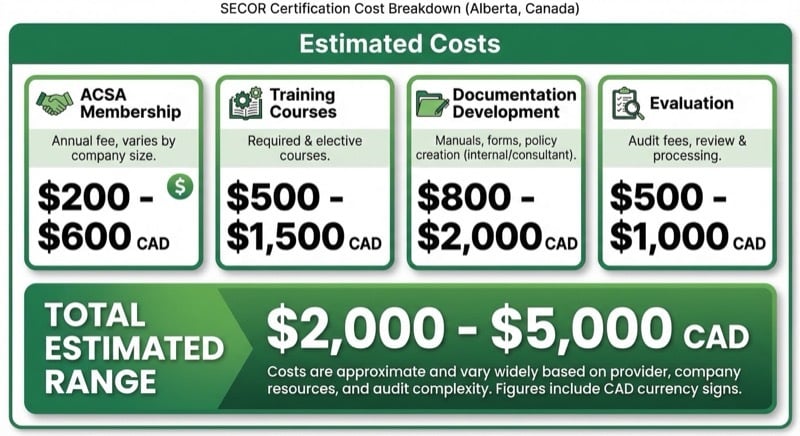
- Cost: Estimated $2,000 to $5,000 CAD total (training, membership, documentation development)
- Timeline: Typically 3 to 6 months, depending on your existing safety documentation
- Why it matters: Required by many GCs to bid on work; earns WCB premium refunds of up to 20% through the PIR program
- Behind on compliance actions? Start your 30-day free trial to track owners, due dates, and audit evidence in one place.
What Is SECOR Certification in Alberta?
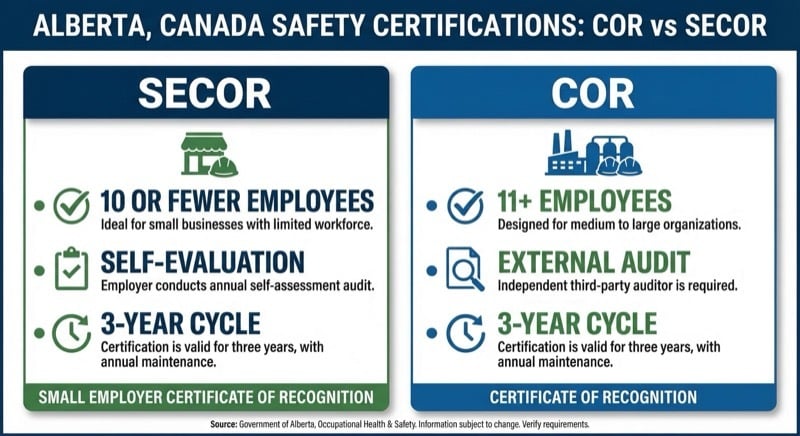
SECOR (Small Employer Certificate of Recognition) is a safety certification awarded to Alberta employers with no more than 10 employees at any given time who have developed and implemented a health and safety management system (HSMS) that meets provincial standards. The program is administered through certifying partners like the Alberta Construction Safety Association (ACSA), and the certification is part of the Government of Alberta's Partnerships in Injury Reduction (PIR) program.
Think of it this way: SECOR is the smaller version of COR (Certificate of Recognition). If your company has 10 or fewer employees (counting everyone on your WCB-Alberta account, including owners, part-timers, and admin staff), you qualify for SECOR instead of the full COR. The threshold is strict: ACSA states your company "cannot have more than 10 employees at any given time within the past 12 months."

Most contractors think SECOR is just a box to check for bidding. They're wrong. A properly built SECOR program becomes the backbone of how your crew operates safely every day. The companies that treat it like paperwork are the same ones scrambling before every audit cycle. The ones that build it into their daily operations? They pass maintenance reviews without breaking a sweat, and their crews go home in one piece.
Not sure if SECOR is the right path for your company? Safety Evolution can check your safety documentation and show you whether SECOR or full COR makes more sense for your Alberta operation.
How Much Does SECOR Cost in Alberta?
Let's talk numbers, because that's what you're here for. These are estimated ranges based on industry experience; actual costs vary by your certifying partner and company situation.
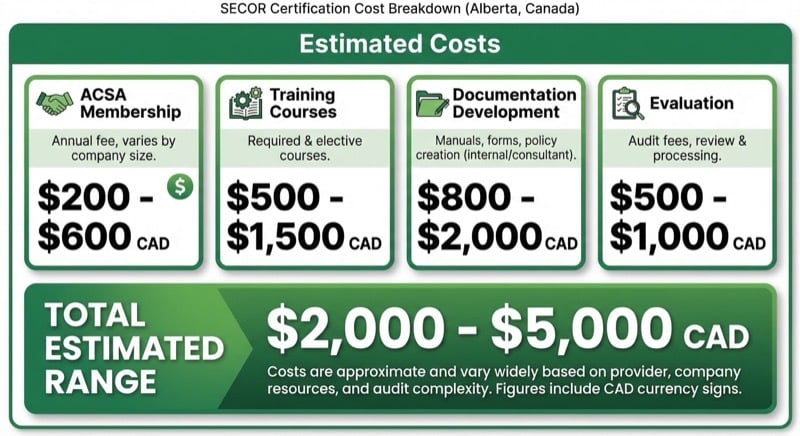
| Cost Item |
Estimated Range (CAD) |
| ACSA Membership |
$150 to $500/year |
| PHSM for SECOR training course |
$300 to $600 |
| Industry-specific safety training (CSTS, RSTS, ESTS, or PCST) |
$100 to $300 |
| Safety program development (if hiring help) |
$1,500 to $3,500 |
| Documentation and evaluation prep |
$0 to $500 (DIY vs. assisted) |
| Estimated Total |
$2,000 to $5,000 CAD |
Here's the blunt truth: the training and membership fees are the cheap part. The real cost is your time. Building a legitimate health and safety management system, gathering three months of documentation, making sure your FLHAs and toolbox talks are actually happening and getting recorded. That's where most small contractors stall.
If you're a 6-person framing crew and nobody on your team has formal safety training, you're looking at the higher end of that range. If you already have decent safety documentation and just need to formalize it, you could come in well under $3,000 CAD.
Need a head start on your documentation? Download our free toolbox talk package with 50+ ready-to-use topics that cover the weekly safety meeting requirements for your SECOR program.
What Are the Steps to Get SECOR Certified?
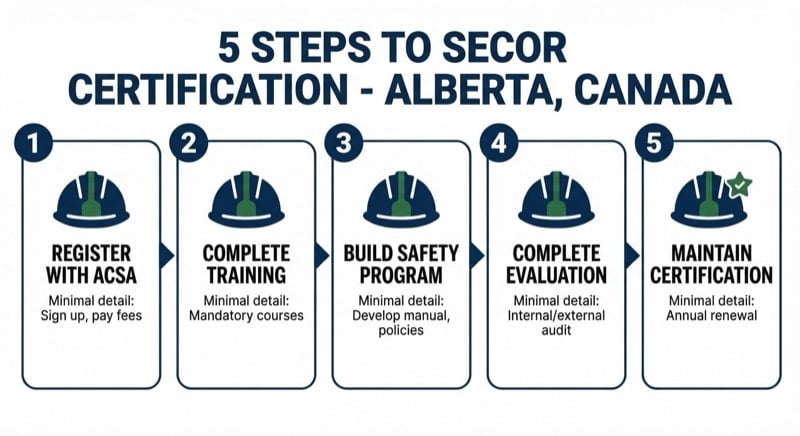
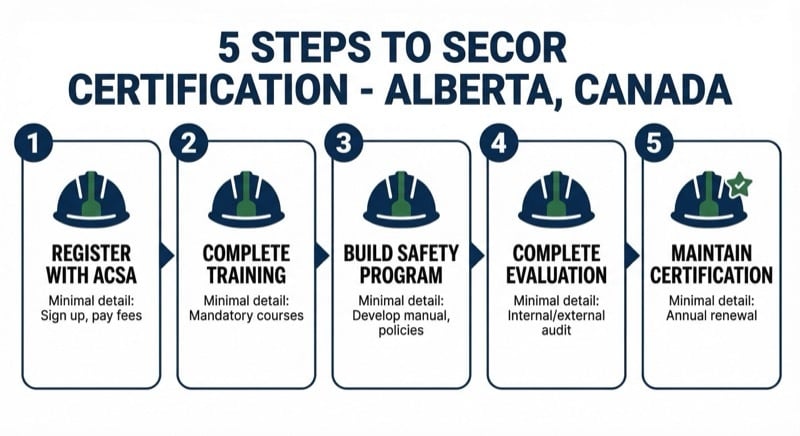
According to ACSA, here's the process. It looks straightforward on paper. The friction is in the details.
Step 1: Confirm You're Eligible
Your company must have no more than 10 employees at any given time within the past 12 months. That count includes everyone on your WCB-Alberta account: owners, managers, admin staff, part-timers, temporary workers, family members, and volunteers. If you've had 11 people on payroll at any point in the last year, even briefly during a busy stretch, you don't qualify for SECOR. You'll need full COR instead.
Step 2: Get Your ACSA Membership and Complete Required Training
You need an active ACSA membership and a current WCB-Alberta account. Then at least one full-time employee must complete two training courses:
- Principles of Health and Safety Management for SECOR (PHSM for SECOR) or the full PHSM course
- One industry-specific training course: CSTS 2020 (construction), RSTS (roadbuilding), ESTS 2024 (electrical), or PCST (pipeline)
These courses don't have to be completed by the same person. You can split them across different employees. That flexibility matters when you're running a small crew and can't afford to pull one person off site for a week.
Step 3: Build and Implement Your Safety Program
This is where most contractors hit the wall. You need to develop a health and safety management system that covers all the elements in ACSA's SECOR evaluation tool. That means written policies, hazard assessments, safety meeting records, incident reporting procedures, inspections, emergency response plans, and more.
Then you need to actually run it. ACSA requires a minimum of three months of documented safety activity before you can submit your evaluation. Three months of toolbox talks, FLHAs, inspections, and incident reports. If your crew isn't already doing this daily, that's three months of building new habits while running your jobs.
Starting from scratch? Grab our free construction safety orientation package to cover your onboarding and orientation element right away.
Step 4: Complete and Submit the SECOR Evaluation
Unlike full COR (which requires an external auditor), SECOR uses a self-evaluation tool. You complete ACSA's evaluation form, attach supporting documentation, and submit it electronically. ACSA only accepts email or cloud link submissions since March 2020.
The person who completes the evaluation (the "assessor") can be internal or external, but must hold the PHSM for SECOR certificate. Keep your submission organized: one folder per element, clearly labeled. ACSA will return sloppy submissions.
Step 5: Maintain Your Certification
SECOR is valid for three years, but you can't just forget about it until renewal. In the two interim years, you must complete a maintenance evaluation to keep your certification active and stay eligible for WCB premium refunds. Every three years, at least one employee must also complete a continuing education course (minimum four hours).
Not sure if your current safety documentation would hold up to a SECOR evaluation? Safety Evolution can check your documentation against Alberta SECOR evaluation criteria and flag exactly where the gaps are.
Not sure if your Alberta SECOR documentation would pass review?
See missing elements before evaluation day, then assign owners, due dates, and proof in one workflow.
Start Your 30-Day Free Trial →How Does SECOR Save You Money on WCB Premiums?

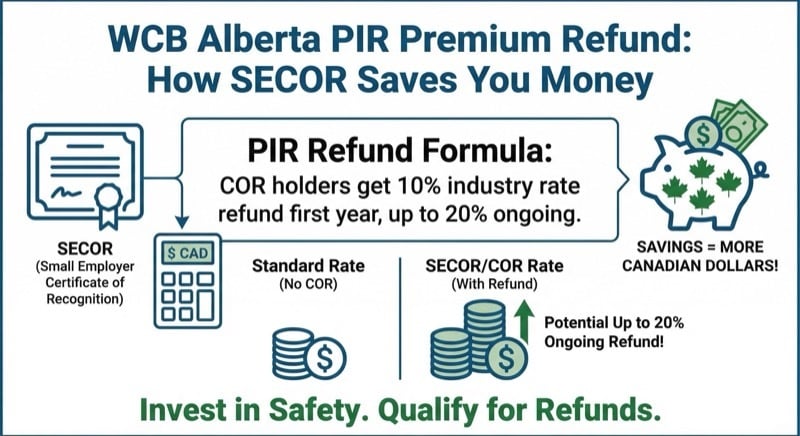
This is the part that gets owners to pay attention. SECOR qualifies you for WCB-Alberta's Partnerships in Injury Reduction (PIR) program. According to WCB-Alberta, COR/SECOR holders are eligible for refunds of up to 20% of their industry-rated premium.
Here's how the refund structure works:
- First year with COR/SECOR: 10% industry rate refund
- Ongoing years: 5% refund for maintaining your COR/SECOR, plus additional refunds up to 20% if you improve your claims performance or outperform your industry average
For a small contractor with $400,000 in annual assessable payroll, even a 10% refund could mean $2,000 to $4,000 CAD back in your pocket, depending on your industry rate. Over three years, that often covers the entire cost of getting certified.
The catch? You must be registered in the PIR program before the end of the year to qualify for that year's refund. Don't wait until December to start the process.
Where Do Most Alberta Contractors Get Stuck?
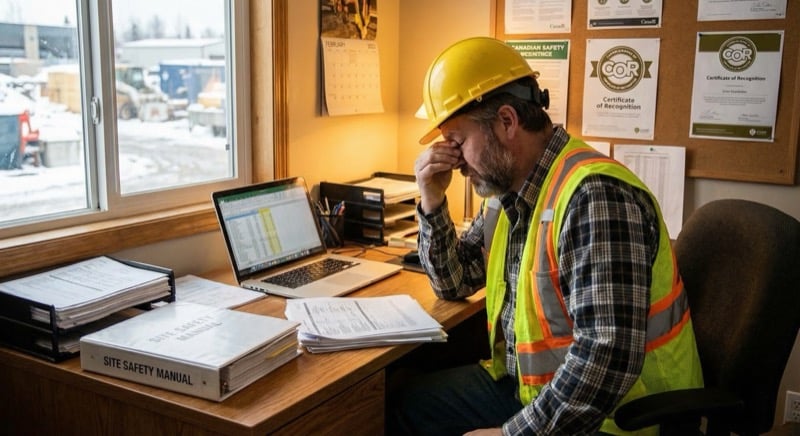
After helping contractors across Alberta build audit-ready safety programs, we see the same patterns:
They underestimate the documentation. You can't fake three months of safety records in a weekend. The evaluation requires samples of toolbox talks, hazard assessments, inspection reports, and incident documentation that demonstrate your system is actually running. Backdating paperwork is a fast way to fail your evaluation. Download our free incident report and investigation kit to make sure you're capturing what evaluators actually look for.
They count employees wrong. ACSA counts everyone on your WCB account, not just your field crew. That owner who "doesn't really work on site"? Counted. The part-time bookkeeper? Counted. The summer student? Counted. We've seen contractors start the SECOR process only to realize they had 12 people on their WCB account and needed full COR instead. Check your count before you invest time and money.
They try to build the program alone. Running a small crew and writing a complete health and safety management system from scratch are two different skill sets. Most contractor owners are great at their trade and terrible at compliance documentation. That's not a knock; it's the reality of running a small business. The ones who get certified fastest are the ones who get help building the system so they can focus on running their crew.
That's exactly what Safety Evolution does. We build your safety system, control your documents, verify daily compliance, and package everything for GC submittals and audits. You run your crew. We handle the safety program.
SECOR vs. COR: Which Do You Need?
Quick decision tree:
- 10 or fewer employees on your WCB-Alberta account at any time in the past 12 months? You qualify for SECOR.
- 11 or more employees? You need full COR. See our Alberta COR certification guide.
- Planning to grow past 10? Consider going straight to COR. Transitioning from SECOR to COR later means rebuilding parts of your program and going through the full external audit process.
Both certifications satisfy GC prequalification requirements and make you eligible for WCB PIR refunds. The main differences: SECOR uses a self-evaluation instead of an external audit, has a simplified evaluation tool, and is designed for the reality of running a very small operation.
Looking for SECOR information specific to British Columbia? See our BC Small COR guide.
Ready to Get Started?
SECOR certification is one of the highest-ROI moves a small Alberta contractor can make. It unlocks bids, saves you money on WCB premiums, and builds a safety system that protects your crew and your business.
The hardest part is not the training or the evaluation. It is building the safety program and sticking with it long enough to have legitimate documentation. If you want help getting it right the first time, Safety Evolution can check your existing documentation and show you exactly where you stand and what it takes to get Alberta SECOR certified.
Still chasing SECOR evidence across files and inboxes?
Centralize corrective actions and evaluation proof so your Alberta SECOR review is predictable.
Start Your 30-Day Free Trial →
Frequently Asked Questions
How many employees can I have and still qualify for SECOR in Alberta?
According to ACSA, your company cannot have more than 10 employees at any given time within the past 12 months. This count includes all staff on your WCB-Alberta account: owners, managers, admin staff, part-time workers, temporary staff, family members, and volunteers. If you exceed 10 at any point, you need full COR certification instead.
How long does it take to get SECOR certified in Alberta?
Most contractors complete SECOR certification in 3 to 6 months. The timeline depends on your existing safety documentation. ACSA requires a minimum of three months of documented safety activity before you can submit your evaluation. If you're starting from scratch, budget closer to 6 months. Companies with an existing safety program in place may be faster.
What training courses are required for SECOR in Alberta?
At least one full-time employee must complete two ACSA courses: (1) Principles of Health and Safety Management for SECOR (PHSM for SECOR) or the full PHSM course, and (2) one industry-specific training course such as CSTS 2020 (construction), RSTS (roadbuilding), ESTS 2024 (electrical), or PCST (pipeline). These courses can be split between different employees.
Does SECOR require an external audit in Alberta?
No. Unlike full COR, SECOR uses a self-evaluation process. You complete ACSA's SECOR evaluation tool with supporting documentation and submit it electronically. The assessor can be internal or external to the company, but must hold the PHSM for SECOR certificate. ACSA's Quality Assurance team reviews the submission.
How much can I save on WCB premiums with SECOR in Alberta?
Through WCB-Alberta's Partnerships in Injury Reduction (PIR) program, SECOR holders are eligible for premium refunds of up to 20% of their industry-rated premium. In the first year, you receive a 10% industry rate refund. Ongoing, you earn 5% for maintaining your COR/SECOR, with additional refunds possible based on claims performance improvements.
How often do I need to renew SECOR in Alberta?
SECOR is valid for three years. In the two interim years, you must complete a maintenance evaluation to keep your certification active and remain eligible for WCB PIR refunds. Every three years, at least one full-time employee must also complete a continuing education course with a minimum of four hours.
Get Weekly Safety Insights
Regulation updates, toolbox talk ideas, and compliance tips. One email per week.