Last updated: March 2026
You just hired three new operators and your site supervisor is asking if their forklift tickets from a previous employer still count. Meanwhile, a GC on your next bid wants proof that every operator on site is certified. You are not sure what "certified" actually means in Canada, and you have a nagging feeling that the paperwork in your filing cabinet might not hold up if a WorkSafeBC or OHS inspector shows up tomorrow.
You are not alone. At Safety Evolution, we help contractors across Canada build safety programs from the ground up, and forklift training confusion is one of the most common problems we see. This guide breaks down exactly what you need as an employer: what the law actually requires, what "certification" means (and why there is no such thing as a forklift "license" in Canada), how much it costs, and how to stay compliant province by province.
» Quick Answer
- What: Every Canadian employer must ensure forklift operators are trained and evaluated to CSA B335-15 (or equivalent provincial standard) before operating a lift truck on site
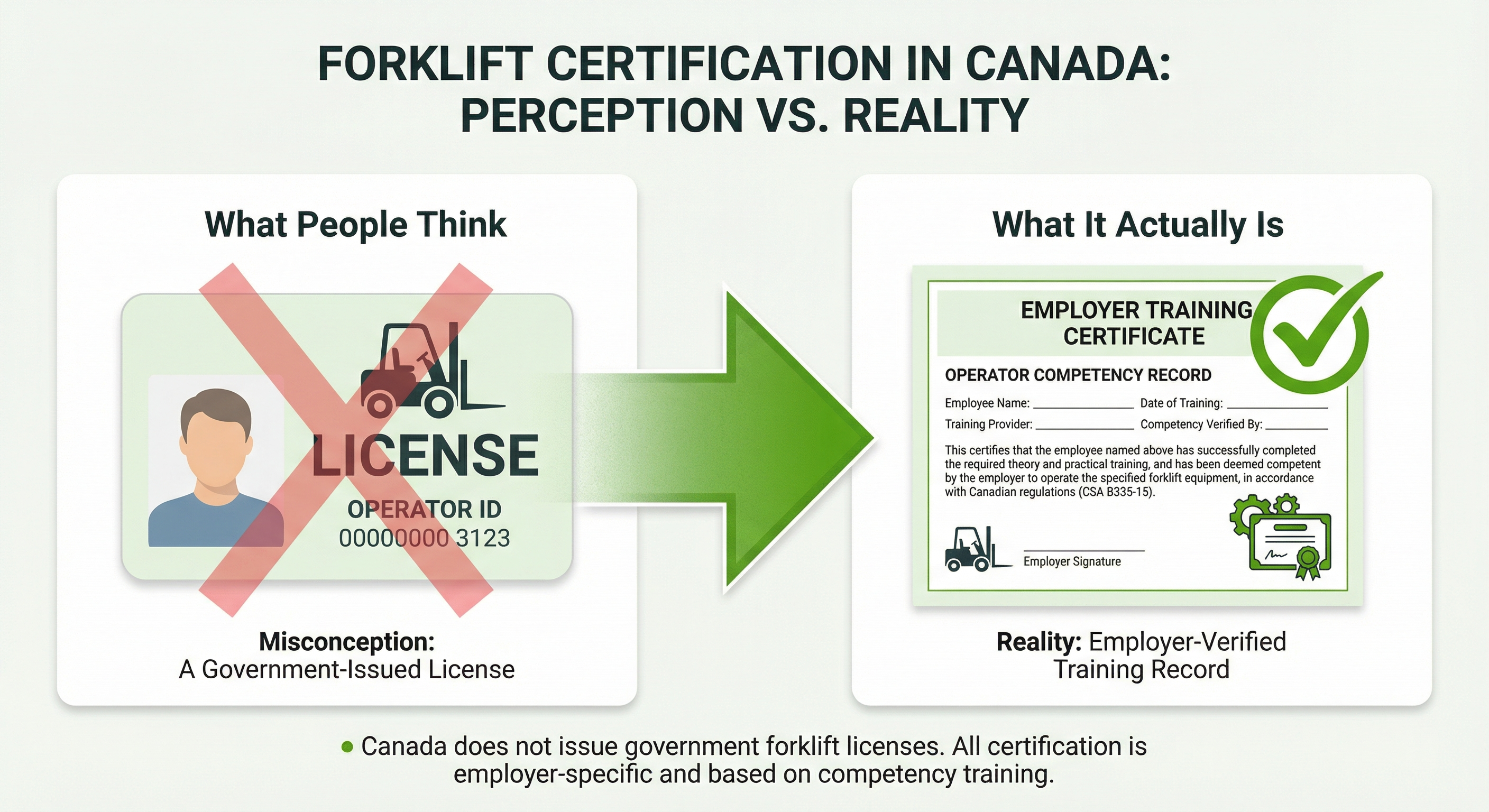
- "License" vs certification: Canada does not issue government forklift licenses. What people call a "forklift license" is actually an operator training certificate issued by an employer or training provider
- Cost: Typically $150 to $500 per operator for third-party training; renewal training runs $100 to $300
- Renewal: CSA B335-15 recommends refresher training every 3 years, and many provinces enforce this as a requirement
- Employer obligation: The employer is always responsible for ensuring training is completed, records are kept, and operators are competent for their specific workplace
Below, we cover what Canadian law actually requires for forklift operator training, what "certification" means (and what it does not), how much it costs, and how to build a compliant training program without overpaying.
What Is Forklift Certification in Canada?
Forklift certification in Canada is proof that an operator has completed training and demonstrated competency to safely operate a powered industrial truck (lift truck) under CSA B335-15 standards. It is not a government-issued license. It is a training record, maintained by the employer, that proves the operator was trained on both theory and practical skills and passed an evaluation.
This distinction matters because many people search for a "forklift license" without realizing that no level of government in Canada issues one. The word "license" implies a government registry, like a driver's license. Forklift certification is employer-driven. You, as the employer, are responsible for ensuring your operators are trained, even if you use a third-party provider to deliver the training.
For a deeper look at why this distinction matters and what it means for your liability, read our guide: Forklift License vs Certification: What Canadian Employers Need to Know.
What Does CSA B335-15 Require?
CSA B335-15 is the national safety standard for lift trucks in Canada, published by the Canadian Standards Association. Most provinces reference this standard directly in their OHS legislation. It covers the key elements of a lift truck safety program, including operator training, trainer qualifications, and maintenance requirements.
Under CSA B335-15, forklift operator training must include:
- Classroom (theory) training: Covers load handling, stability, hazard recognition, pre-operation inspections, and regulatory requirements
- Practical (hands-on) training: Supervised operation of the specific type of lift truck the operator will use on site
- Evaluation: A written or oral knowledge test plus a practical driving test to confirm competency
- Workplace-specific training: Training on the specific hazards, layout, and conditions of the worksite where the operator will be working
One thing that catches many employers off guard: the standard requires that training be specific to the class of forklift. An operator certified on a counterbalance forklift is not automatically certified to operate a reach truck, order picker, or rough terrain forklift. Each class requires its own training and evaluation.
For a detailed breakdown of BC-specific CSA B335-15 requirements, see our guide: BC Forklift Certification: CSA B335-15 Requirements for Employers.
What Are the Different Forklift Classes?
Powered industrial trucks are grouped into seven classes, each requiring specific training:
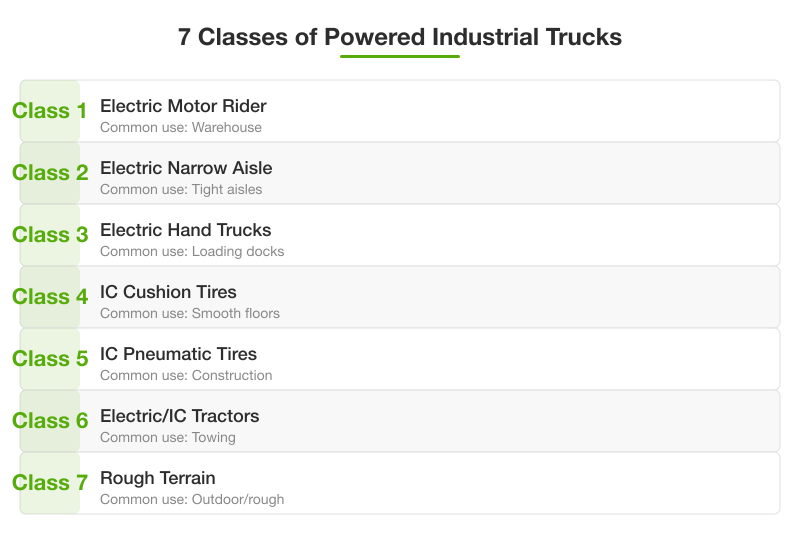
| Class |
Type |
Common Use |
| Class 1 |
Electric motor, sit-down rider, counterbalanced |
Warehouses, manufacturing |
| Class 2 |
Electric motor, narrow aisle |
Warehouses with tight aisles |
| Class 3 |
Electric motor, hand trucks (pallet jacks) |
Shipping, receiving, retail |
| Class 4 |
Internal combustion, solid/cushion tires |
Indoor smooth surfaces |
| Class 5 |
Internal combustion, pneumatic tires |
Construction sites, lumber yards |
| Class 6 |
Electric and IC, tow tractors |
Airports, large facilities |
| Class 7 |
Rough terrain forklifts |
Construction, outdoor yards |
Most construction contractors deal with Class 5 (pneumatic tire, IC engine) and Class 7 (rough terrain) forklifts. If your crew operates multiple classes, each operator needs training and evaluation on every class they use.
What Types of Forklift Training Are Available?
Not all forklift training is the same. Understanding the different types helps you choose what fits your operation and budget.
Initial Operator Training (New Operators)
This is the full training program for someone who has never operated a forklift or is new to a specific class. It covers the complete CSA B335-15 curriculum: theory, practical training, written evaluation, and observed practical test. For most providers, this runs 1 to 2 full days and costs $200 to $500 per operator.
Experienced Operator Training
For operators who have prior forklift experience but are new to your workplace or a different equipment class. The theory portion may be condensed, but the practical evaluation is still comprehensive. This typically runs half a day to one full day and costs $150 to $350.
Refresher/Renewal Training
Required at least every 3 years under CSA B335-15. Refresher training reviews key theory concepts, addresses any changes in regulations or equipment, and includes a practical re-evaluation. This typically takes 4 to 6 hours and costs $100 to $300 per operator.
Train-the-Trainer Programs
If you want to build in-house training capacity, a train-the-trainer program certifies one of your supervisors or experienced operators to deliver forklift training to your crew. These programs are more intensive (2 to 3 days), cover adult learning principles and evaluation techniques, and typically cost $500 to $1,500. The investment pays for itself quickly if you have multiple operators to train each year.
Online Theory Components
Some providers offer the classroom/theory portion online, allowing operators to complete it before the in-person practical session. This can reduce the on-site time needed and lower costs. However, it is important to understand that no Canadian province accepts fully online forklift certification. The practical evaluation must always be done in person, on actual equipment, with a qualified evaluator watching.
Province-by-Province Forklift Training Requirements
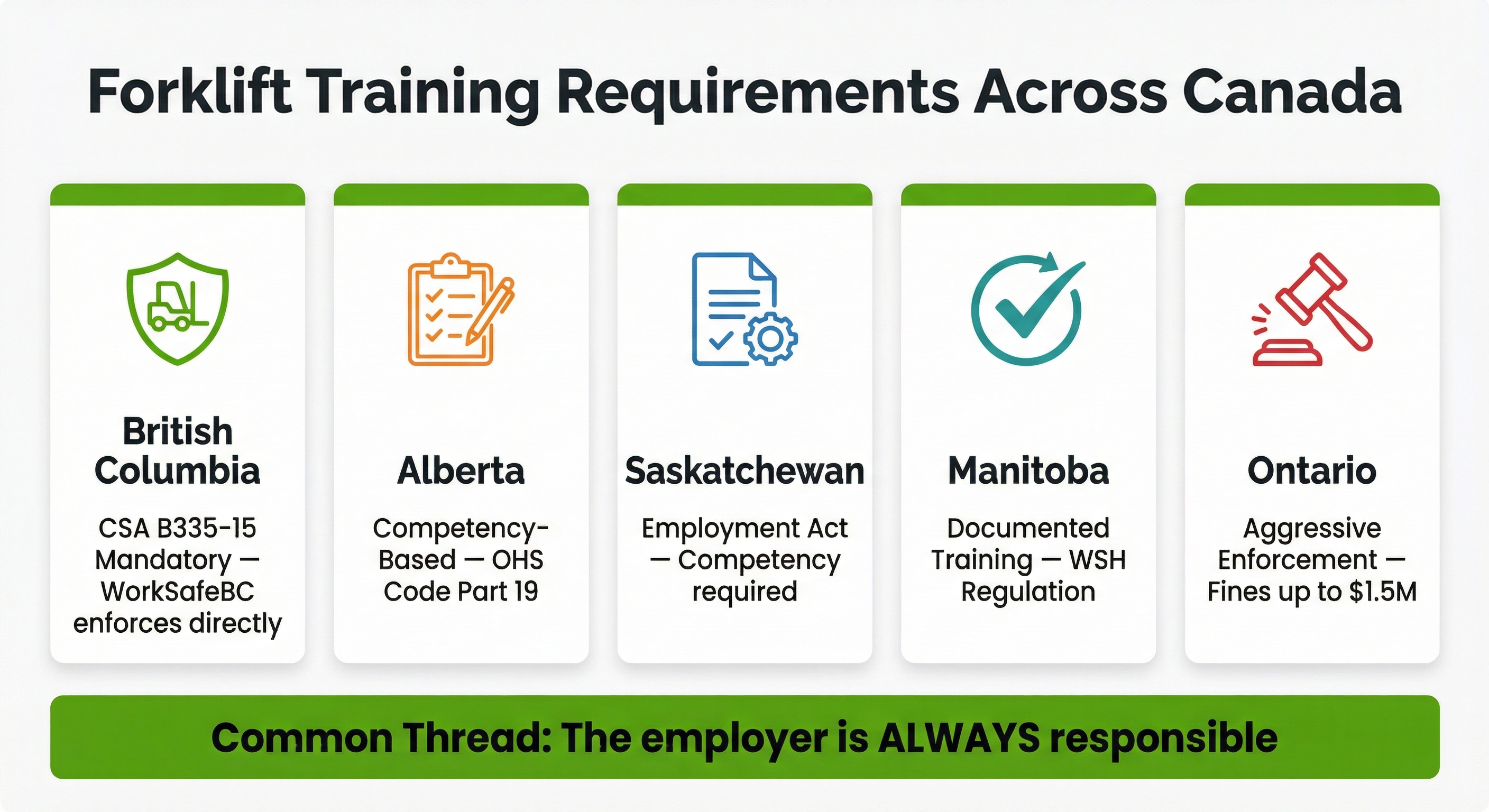
Every Canadian province requires employers to train forklift operators, but the specific legislation and enforcement details vary. Here is what you need to know in the provinces where most of our clients operate.
British Columbia
BC has some of the most explicit forklift training requirements in Canada. Under WorkSafeBC's OHS Regulation Part 16 (Mobile Equipment), Section 16.43, employers must ensure that every lift truck operator is trained to CSA B335-15 and has passed both a written knowledge test and a practical operating test before operating a forklift.
Key BC requirements:
- Training must follow CSA B335-15 specifically (WorkSafeBC names it directly)
- Operators must pass a written and practical evaluation
- Refresher training is required at least every 3 years
- Employers can train in-house or use a third-party provider
- Training records must be maintained and available for inspection
- If a forklift uses propane and the operator transfers propane between containers, they also need a propane handler's certificate
For the complete BC breakdown, see: BC Forklift Certification: CSA B335-15 Requirements for Employers.
Alberta
Alberta's OHS Code Part 19 (Powered Mobile Equipment) requires employers to ensure that workers who operate forklifts are competent. Alberta does not name CSA B335-15 directly in the legislation, but its best practices guideline (published by Alberta Jobs, Economy and Trade) recommends following the CSA standard. Alberta OHS officers will look for:
- Documented proof that the operator was trained (theory and practical)
- Evaluation records showing the operator demonstrated competency
- Training specific to the type of forklift being operated
- Workplace-specific hazard orientation
Alberta's best practices guideline recommends a minimum of 7 hours of actual training time (classroom plus hands-on) for initial certification. The province does not specify an exact renewal period in legislation, but following CSA B335-15's 3-year refresher recommendation is considered due diligence.
Ontario
Ontario's Occupational Health and Safety Act (OHSA) and its regulations for industrial establishments and construction projects require employers to ensure that forklift operators are trained and competent. Ontario references CSA B335 in its guidance materials. The province is known for aggressive enforcement: fines for operating a forklift without proper training can run into tens of thousands of dollars per offence.
- Employers must provide training that includes both classroom instruction and hands-on evaluation
- Training must be specific to the type of equipment
- Records must be kept and available for Ministry of Labour inspectors
- The 3-year refresher cycle is industry standard and strongly recommended
Saskatchewan, Manitoba, and Atlantic Provinces
All remaining provinces have similar requirements under their respective OHS legislation. The common thread across Canada is that the employer is always responsible for ensuring operators are trained, competent, and working under safe conditions. Specific acts include:
- Saskatchewan: Saskatchewan Employment Act and OHS Regulations require competency training for equipment operators
- Manitoba: Workplace Safety and Health Regulation requires documented training and competency verification
- Nova Scotia, New Brunswick, Newfoundland and Labrador, PEI: Each province's OHS Act requires employers to ensure workers are trained and competent on equipment they operate
Regardless of province, the safest approach for any employer is to follow CSA B335-15 as your training standard. It is nationally recognized, referenced by most regulators, and provides the clearest framework for demonstrating due diligence if an incident occurs.
Hard to keep forklift safety consistent across sites?
Different supervisors and paper systems create blind spots. Start a 30-Day Free Trial and standardize training and compliance tracking company-wide.
30-Day Free Trial
How Much Does Forklift Training Cost in Canada?
Most employers think forklift training is expensive. The reality? It is one of the cheapest compliance items on your safety budget. The real expense is what happens when you skip it.
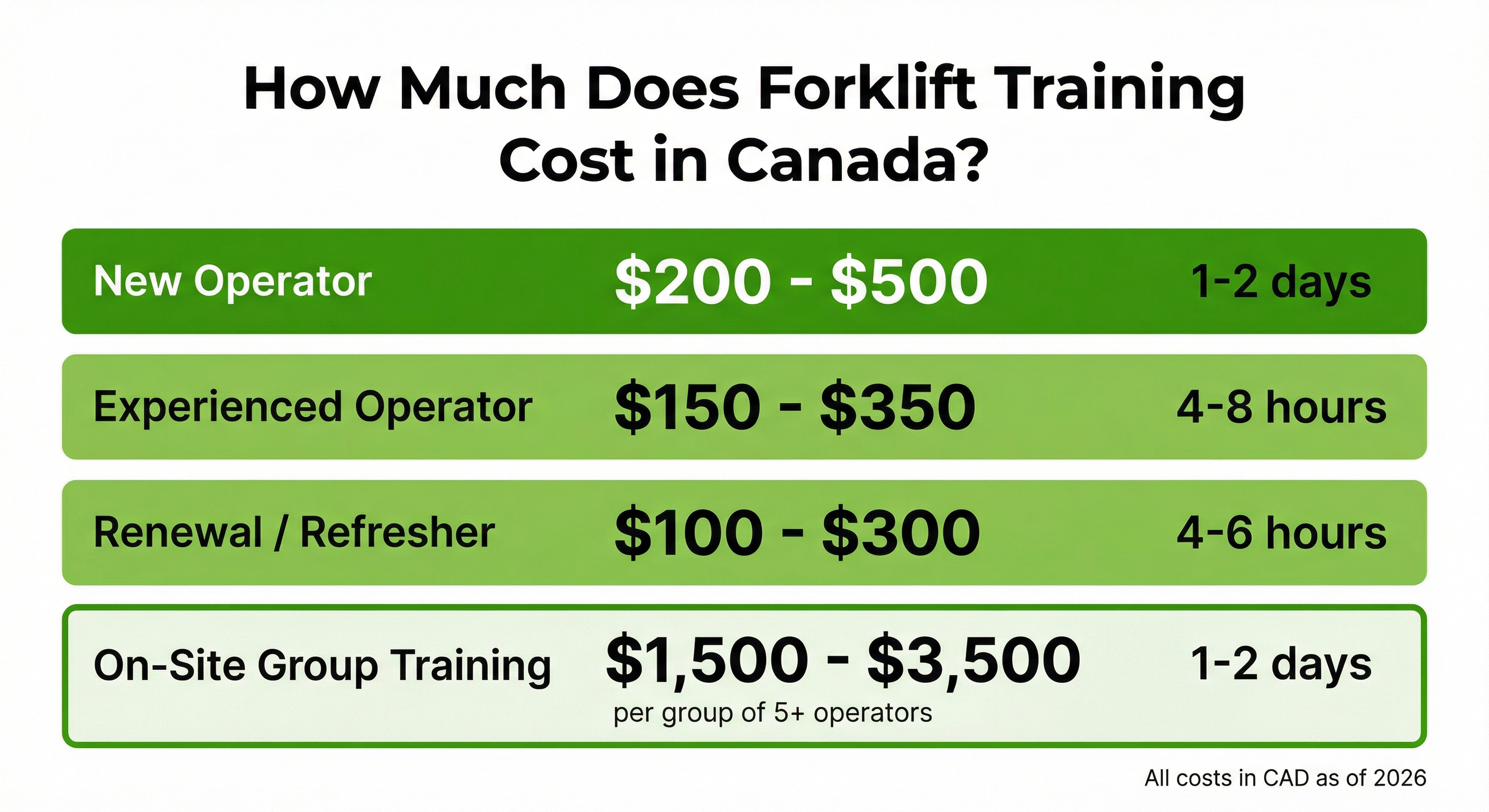
Here are typical cost ranges for third-party forklift training across Canada (per operator, as of 2025/2026):
| Training Type |
Typical Cost Range |
Duration |
| New operator (counterbalance) |
$200 to $500 |
1 to 2 days |
| Experienced operator (single class) |
$150 to $350 |
4 to 8 hours |
| Renewal/refresher |
$100 to $300 |
4 to 6 hours |
| Specialized (reach truck, order picker) |
$300 to $600 |
1 to 2 days |
| On-site group training (per group) |
$1,500 to $3,500 |
1 to 2 days |
Costs vary by province, provider, and whether training happens at a facility or on your site. On-site training is typically cheaper per person when you have 5 or more operators to certify at once. Online theory components can reduce costs further, but every province requires a hands-on practical evaluation. There is no fully online forklift certification in Canada.
For a detailed pricing breakdown by province and training type, see: How Much Does Forklift Training Cost in Canada?
How Long Does Forklift Training Take?
For a new operator with no prior experience, expect a full day to two days of training (7 to 16 hours total), split between classroom theory and hands-on practical training.
For experienced operators switching equipment classes or completing refresher training, a half day (4 to 6 hours) is typical.
The breakdown usually looks like this:
- Theory/classroom: 3 to 4 hours covering load charts, stability triangle, pre-trip inspections, hazard recognition, and regulations
- Practical/hands-on: 4 to 8 hours operating the specific forklift, including stacking, loading, maneuvering in tight spaces, and ramp operations
- Evaluation: Written test (typically 30 to 50 questions) plus observed practical driving test
Rushing this process is how accidents happen. Alberta's best practices guideline specifically calls for a minimum of 7 hours of actual training time. If a provider promises certification in 2 hours, question what you are actually getting.
How Often Does Forklift Certification Need to Be Renewed?
CSA B335-15 recommends refresher training at least every 3 years. In BC, WorkSafeBC enforces this as a requirement, not just a recommendation. Most other provinces follow the 3-year cycle as an industry standard, and OHS inspectors across Canada will flag expired certifications.
Beyond the 3-year cycle, retraining is also required when:
- An operator is involved in an incident or near miss
- An operator is observed operating unsafely
- The operator has not used a forklift for an extended period
- A new type of forklift is introduced to the workplace
- Workplace conditions change significantly (new racking, different surfaces, changed traffic patterns)
As an employer, tracking certification expiry dates is your responsibility. A spreadsheet works until it doesn't. 30-Day Free Trial monitors every operator's certification status across your fleet and alerts you 30, 60, and 90 days before any ticket expires. Many of our clients also use Safety Evolution's training management system to track expiry dates and get automatic renewal alerts.
Can Employers Do In-House Forklift Training?
Yes. In every Canadian province, employers can deliver forklift training in-house rather than using a third-party provider. However, "in-house" does not mean informal. Your in-house training program must still meet CSA B335-15 requirements, including:
- A qualified trainer (CSA B335-15 specifies trainer competency requirements)
- A structured curriculum covering all required theory and practical elements
- Written and practical evaluations
- Documented training records for each operator
- Workplace-specific hazard training
The advantage of in-house training is that it can be tailored to your specific workplace, equipment, and hazards. The risk is that without a qualified trainer, your training may not hold up in an inspection or after an incident. Many employers use a hybrid approach: send a supervisor through a "train-the-trainer" program with an accredited provider, then have that supervisor deliver in-house training going forward.
Train-the-trainer programs typically cost $500 to $1,500 and take 2 to 3 days.
What Happens If an Operator Is Not Properly Certified?
Here is where the paperwork stops being boring and starts being expensive.
If a forklift incident occurs and your operator does not have proper training documentation, the consequences can include:
- OHS fines: In Ontario, fines for employer safety violations can reach $100,000 per offence for individuals and $1,500,000 for corporations. Alberta and BC have similarly steep penalties.
- Stop-work orders: An inspector can shut down your operation until compliance is demonstrated.
- Personal liability: Directors and officers can be held personally liable for safety violations. This is not limited to the company.
- Insurance implications: WCB claims from forklift incidents without proper training documentation can lead to premium surcharges and loss of COR/SECOR certification status.
- Criminal charges: Under Canada's Westray Bill (Criminal Code Section 217.1), officers and directors who fail to take reasonable steps to prevent workplace harm can face criminal prosecution.
In Ontario alone, 633 lost-time injuries involving forklifts or industrial powered vehicles were reported in 2021. That is not a statistic from a safety poster. Those are real workers, on real sites, and the employers behind many of those incidents faced investigations.
Employer Obligations: A Checklist
Regardless of your province, here is what every Canadian employer must do to stay compliant with forklift training requirements:
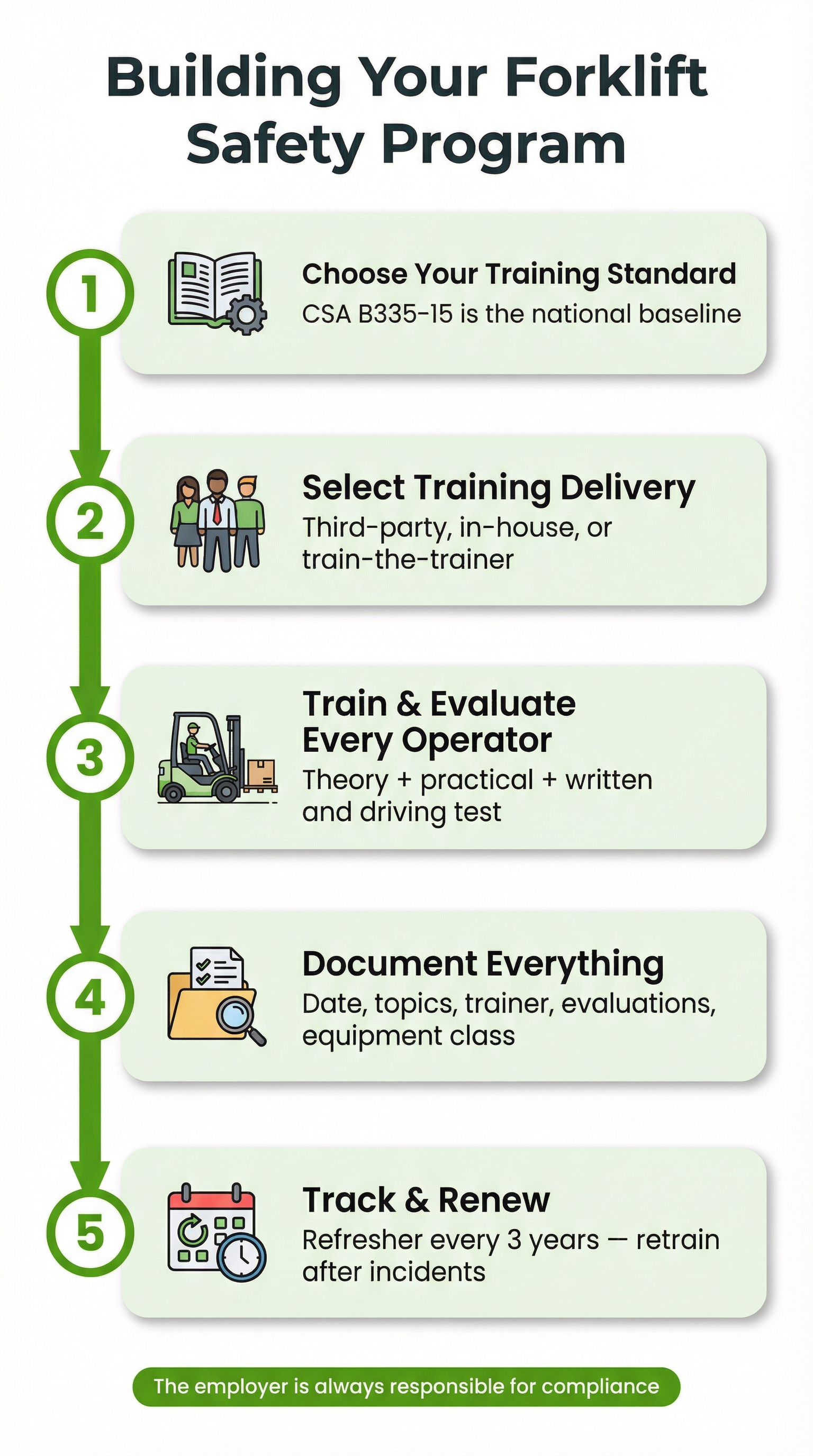
- Train every operator to CSA B335-15 (or your province's referenced standard) before they operate a lift truck
- Evaluate competency through a written knowledge test and a practical driving evaluation
- Train on specific equipment classes. Certification on one class does not cover another
- Provide workplace-specific orientation covering your site's unique hazards, traffic patterns, and procedures
- Maintain training records including: date of training, topics covered, trainer name and qualifications, evaluation results, and equipment class
- Schedule refresher training every 3 years (mandatory in BC; strongly recommended everywhere else)
- Retrain after incidents, near misses, or observed unsafe operation
- Ensure trainers are qualified per CSA B335-15 requirements
- Keep records accessible for inspection by OHS officers
If you are building a safety program from scratch or need to audit your current training compliance, Safety Evolution can help. We work with contractors across Canada to build compliant safety programs that hold up under audit. 30-Day Free Trial can show you exactly where your training records have gaps before your next audit.
Common Mistakes Employers Make With Forklift Training
After years of helping contractors build safety programs, we see the same mistakes repeated across industries. Here are the ones that get employers into trouble:
Mistake 1: Assuming a "forklift license" from a previous employer is enough. A certificate from another company proves the operator received training at some point. It does not prove they are competent on your equipment, at your site, with your hazards. As the current employer, you are responsible for verifying their competency and providing workplace-specific orientation.
Mistake 2: Using a buddy system instead of formal training. "Just have Mike show him the ropes" is not training. It might work for learning where the coffee machine is, but a 10,000-pound machine that can crush someone requires structured training with documented evaluations. If an incident happens and your only training record is "Mike showed him," you have a serious liability problem.
Mistake 3: Certifying on one forklift and assuming it covers all of them. A counterbalance certification does not cover reach trucks. A warehouse forklift certification does not cover rough terrain forklifts. Each class requires separate training and evaluation. This is one of the most common findings in COR audits.
Mistake 4: Letting certifications expire without tracking them. Three years goes by fast. If you are managing 15 operators across two sites, tracking expiry dates in your head is a recipe for non-compliance. 30-Day Free Trial flags these gaps before the auditor does. It is also a recipe for non-compliance. Use a tracking system. Safety Evolution's training management platform handles this automatically, but even a spreadsheet with calendar reminders is better than nothing.
Mistake 5: Choosing the cheapest training provider without checking quality. A $99 certification might get you a card, but if the training did not follow CSA B335-15, that card is worth less than the plastic it is printed on. Ask providers: What standard do you train to? How long is the practical portion? What evaluation methods do you use? Can you provide a course outline?
How Forklift Training Fits Into Your Broader Safety Program
Forklift training is not a standalone item. It connects directly to several other parts of your safety management system:
- COR/SECOR certification: If you are pursuing or maintaining a Certificate of Recognition, your equipment training records are reviewed during the audit. Incomplete forklift training documentation is a common audit finding.
- Toolbox talks: Forklift safety makes an excellent toolbox talk topic. Regular discussions on load handling, pedestrian awareness, and pre-trip inspections reinforce formal training.
- FLHAs: Your field-level hazard assessments should include forklift-specific hazards: uneven ground, overhead obstructions, pedestrian traffic, and load stability.
- Incident investigation: When a forklift incident occurs, the first thing an investigator checks is training records. Having a solid incident investigation process means you can demonstrate due diligence.
- New worker orientation: Every new hire who will operate a forklift needs training before they touch the keys. Integrate this into your onboarding and orientation process.
Forklift Training Documentation for COR and SECOR Audits
If your company holds or is pursuing a Certificate of Recognition (COR) or Small Employer COR (SECOR), your forklift training records will be reviewed during the audit. Auditors look for:
- Documented training records for every operator (date, topics, trainer qualifications, evaluation results)
- Proof that training was specific to the equipment class being operated
- Evidence of refresher training within the 3-year cycle
- Workplace-specific hazard training records
- A system for tracking certification expiry dates
Incomplete forklift training records are one of the most common non-conformances we see in COR audits. 30-Day Free Trial pulls all training records into one searchable system so you can answer an auditor's question in seconds. The fix is straightforward: standardize your training documentation, use consistent record-keeping, and schedule renewals before they expire.
If you are preparing for a COR audit, read our detailed guides: COR Certification Alberta, COR Certification BC, or How to Pass a COR Audit in Canada.
Build a forklift program your whole team can run
Use a 30-Day Free Trial to centralize records, assign actions, and keep every location aligned.
30-Day Free Trial
Frequently Asked Questions
Is there a forklift license in Canada?
No. Canada does not issue government forklift licenses. What people commonly call a "forklift license" is actually an operator training certificate. This certificate is issued by an employer or third-party training provider after the operator completes training and passes written and practical evaluations per CSA B335-15.
How often does forklift certification need to be renewed?
CSA B335-15 recommends refresher training at least every 3 years. In British Columbia, WorkSafeBC enforces this as a mandatory requirement. Other provinces follow the 3-year cycle as industry best practice. Retraining is also required after incidents, extended periods of non-use, or when workplace conditions change significantly.
How much does forklift training cost in Canada?
Third-party forklift training typically costs $150 to $500 per operator for initial certification, depending on the province, equipment class, and whether the operator has prior experience. Renewal training runs $100 to $300 per operator. On-site group training for 5 or more operators typically costs $1,500 to $3,500 total.
Can an employer do forklift training in-house?
Yes. Every Canadian province allows employers to deliver forklift training in-house, provided the training meets CSA B335-15 requirements. This includes having a qualified trainer, a structured curriculum covering theory and practical skills, written and practical evaluations, and documented training records. Many employers send a supervisor through a train-the-trainer program to build internal capacity.
What standard governs forklift training in Canada?
CSA B335-15, published by the Canadian Standards Association, is the primary safety standard for lift trucks in Canada. It specifies requirements for operator training, trainer qualifications, and lift truck safety programs. Most provinces reference this standard directly in their OHS legislation or enforcement guidelines.
Does forklift certification transfer between provinces?
There is no formal interprovincial recognition system for forklift certification. However, if the training was completed to CSA B335-15 standards and you have documentation proving it, most employers and regulators in other provinces will accept it. The receiving employer should still provide workplace-specific orientation and verify the operator's competency on their specific equipment and site conditions.
Get Weekly Safety Insights
Regulation updates, toolbox talk ideas, and compliance tips. One email per week.