Last updated: April 2026
A GC in the Lower Mainland just pulled your company off their approved subs list. No incident, no complaint. You simply didn't have COR. In BC's construction industry, that one missing certification can shut you out of work overnight. And if you're a small contractor with 19 or fewer employees, you don't need the full COR. You need Small COR.
At Safety Evolution, we build safety programs for contractors who need to get certified and stay certified. Here's everything you need to know about Small COR in BC: what it actually is, what it costs, and the mistakes that delay certification by months.
Quick Answer: Small COR in BC
- What: Small COR (often searched as "SECOR") is a COR certification stream for BC employers with 19 or fewer employees, delivered through the BCCSA
- Official name: The BC Construction Safety Alliance (BCCSA) uses "Small COR" as the official term for construction employers
- Cost: Estimated $2,000 to $6,000 CAD total, depending on training and program development needs (some training may be available at no cost through BCCSA)
- Timeline: 6 to 18 months; BCCSA recommends 12 months of supporting documentation
- Why it matters: Required by many GCs for prequalification; earns a WorkSafeBC financial incentive equal to 10% of your base assessment premium
- Behind on compliance actions? Start your 30-day free trial to track owners, due dates, and audit evidence in one place.
What Is Small COR (SECOR) in British Columbia?
Small COR is a Certificate of Recognition (COR) certification stream for BC employers with 19 or fewer employees who have implemented an effective occupational health and safety management system (OHSMS) and passed a certification audit. In BC's construction industry, the program is delivered through the BC Construction Safety Alliance (BCCSA), the COR certifying partner for construction employers.
A quick terminology note: if you searched "SECOR BC," you're in the right place. The official BCCSA term for the construction sector is "Small COR," not "SECOR." Other provinces use "SECOR," which is why you'll see both terms online. For BC construction, Small COR is the correct name.

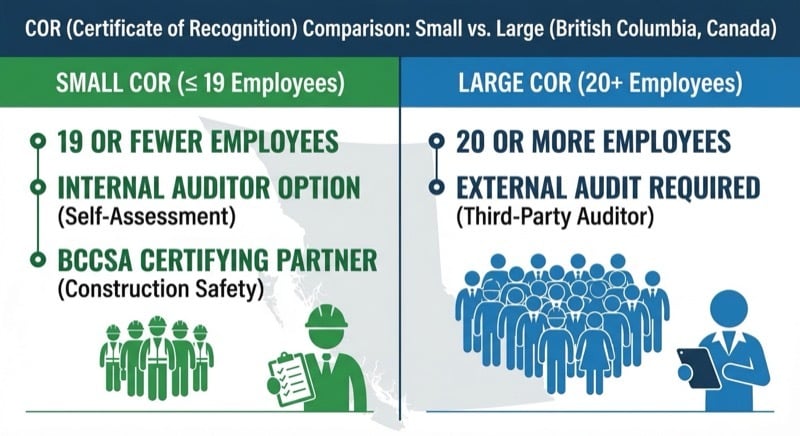
The BCCSA offers two COR program options: Small COR (19 or fewer employees) and Large COR (20 or more employees). Both require a legitimate occupational health and safety management system and both require passing an audit. The difference is in the audit scope and requirements, not in the standard of safety expected.
Most contractors assume Small COR is a shortcut around the full COR process. They're wrong. Small COR is still an audit-based certification. You still need a functioning safety program. You still need documented evidence that your system is running. The streamlined elements reflect the reality of a smaller operation, not a lower bar.
Wondering if Small COR is the right fit for your company? Safety Evolution can check your safety documentation and show you whether SECOR or full COR makes more sense for your crew size and bidding goals.
How Much Does Small COR Cost in BC?
Let's get into the numbers. These are estimated ranges based on industry experience. BCCSA notes that costs vary, and some training may be available at no cost for eligible employers.
| Cost Item |
Estimated Range (CAD) |
| BCCSA Membership |
Included with WorkSafeBC registration (construction) |
| Principles of Health & Safety Management (PHSM) course |
Varies; some no-cost options available through BCCSA |
| COR Internal Auditor Training |
$500 + GST (no-cost eligible for many employers) |
| Safety program development (if hiring help) |
$1,500 to $4,000 |
| Documentation and audit preparation |
$0 to $1,000 (DIY vs. assisted) |
| Estimated Total |
$2,000 to $6,000 CAD |
An important detail: BCCSA offers free, hands-on assistance through their Regional Safety Advisors (RSAs) across BC. RSAs can help with safety program development, materials preparation, and COR readiness at no charge. That support can significantly reduce your out-of-pocket costs if you take advantage of it early.
The real expense, as with any certification, is the time investment. Building a documented safety program while running active jobs is the part that costs small contractors the most. Download our free toolbox talk package with 50+ ready-to-use topics to start building your documented safety meeting history right away.
What Are the Steps to Get Small COR Certified in BC?
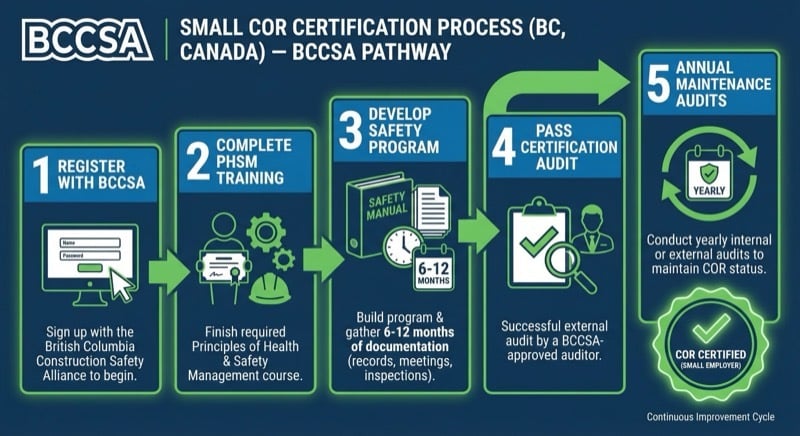
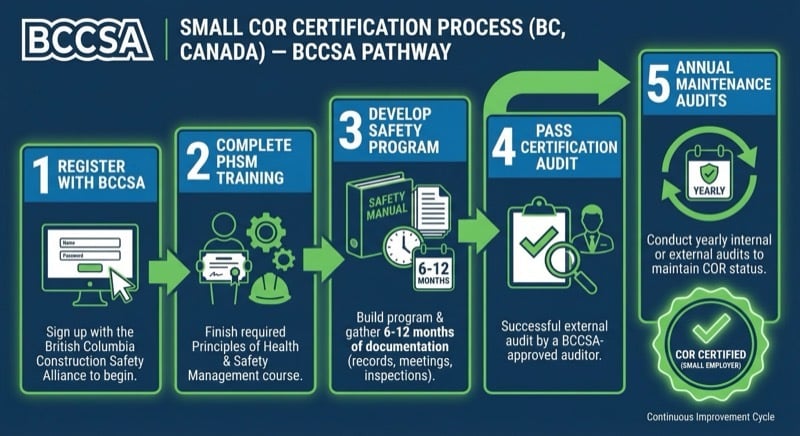
Step 1: Confirm Your Eligibility
To qualify for Small COR through the BCCSA, your company must have 19 or fewer employees. That's the official BCCSA threshold. You must also be registered with WorkSafeBC and have an active account. If you have 20 or more employees, you'll follow the Large COR stream, which requires an external auditor.
Step 2: Complete Required Training
You'll need to complete the Principles of Health and Safety Management (PHSM) course through BCCSA. This eLearning course provides instruction for creating an effective health and safety manual. Additional training requirements include COR Internal Auditor Training ($500 + GST, though many employers are eligible for no-cost enrollment).
BCCSA also offers SiteReadyBC, BC's first comprehensive construction site safety orientation program. While not mandatory for COR, it's a strong foundation for your crew's orientation element. Download our free construction safety orientation package for additional orientation templates you can use immediately.
Step 3: Develop and Implement Your Safety Program
This is where the real work happens. You need to build an occupational health and safety management system that covers all required elements: policies, hazard identification, field-level hazard assessments, safe work procedures, training records, incident reporting, inspections, and emergency response.
BCCSA recommends having 12 months of supporting evidence before attempting certification, with a minimum of 6 months. That means your safety program needs to be running and producing documentation for at least half a year before you can realistically go for the audit. If someone told you "3 months," they were quoting Alberta's SECOR rules, not BC's.
Need help with your incident investigation process? Download our free incident report and investigation kit. It covers exactly what auditors look for in your investigation documentation.
Step 4: Pass Your Certification Audit
Small COR companies still complete a certification audit. The key difference from Large COR: you may be able to use an internal auditor (someone within your company who has completed the COR Internal Auditor Training). Your certifying partner (BCCSA, for construction) verifies the audit results and updates your status with WorkSafeBC.
This is NOT a rubber stamp. Your audit needs to demonstrate that your safety system is functioning, not just that you have binders on a shelf. Auditors look at whether your hazard assessments are current, whether your safety documentation matches what's happening on site, and whether your crew can articulate how the program works.
Step 5: Maintain Your Certification (Annual Cycle)
After initial certification, you enter a three-year cycle. You'll complete maintenance audits (typically annually) to maintain your certification and remain eligible for WorkSafeBC financial incentives. Certification lapses if you miss a maintenance audit, and you'd need to go through the full certification process again.
Feeling overwhelmed by the documentation requirements? Safety Evolution can analyse your current safety documentation and flag exactly which SECOR requirements you already meet and which gaps need closing.
Not sure if your BC Small COR records would pass audit?
Spot documentation gaps early, then fix owners, due dates, and evidence before your next review.
Start Your 30-Day Free Trial →How Does Small COR Save You Money on WorkSafeBC Premiums?
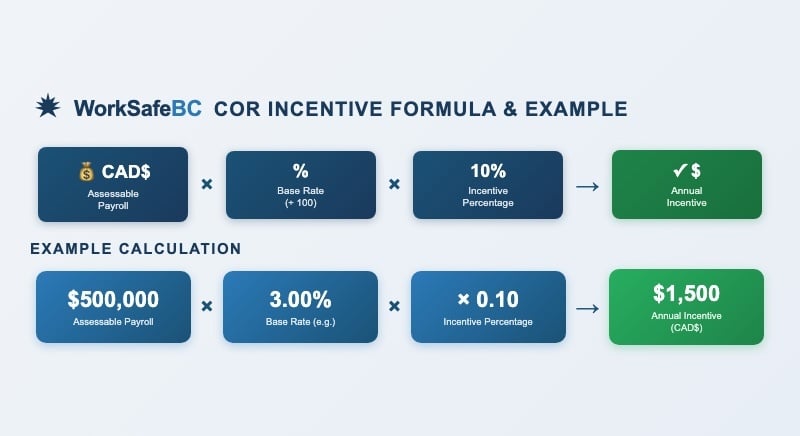
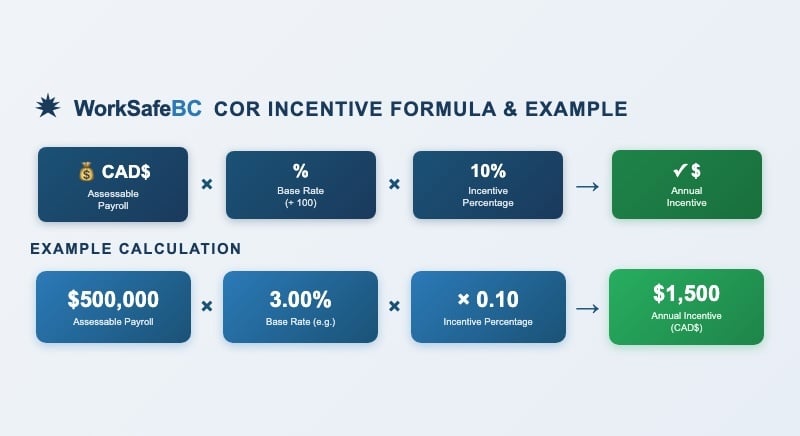
COR holders in BC are eligible for a financial incentive from WorkSafeBC. The formula, directly from WorkSafeBC, is:
WorkSafeBC COR Incentive Formula:
Employer's reported assessable payroll x (CU base rate / 100) x 10%
For example, a small contractor with $500,000 in assessable payroll and a classification unit base rate of 3.00% would receive:
$500,000 x (3.00 / 100) x 10% = $1,500 CAD annual incentive
WorkSafeBC's average base premium rate has been 1.55% of assessable payroll since 2018, but your actual rate depends on your classification unit. Construction trades often have higher rates, which means a larger incentive amount.
The incentive is credited directly to your WorkSafeBC account (no more paper cheques since 2021). You're eligible for the incentive each year you hold valid COR and are in good standing with WorkSafeBC, with no workplace safety convictions or administrative penalties in the previous year.
Where Do BC Contractors Get Stuck?
They assume Small COR is just paperwork. It's not. You need a functioning safety management system with months of documented evidence. The BCCSA Regional Safety Advisors we mentioned earlier? Contact them early. They provide free, hands-on assistance with program development and audit readiness. Their hotline is 1-800-630-2664.
They underestimate the timeline. BCCSA recommends 12 months of supporting evidence, with 6 months as the minimum. If you start today, you're realistically looking at a late 2026 or early 2027 certification date. Plan accordingly, especially if you have bids coming up that require COR.
They confuse BC rules with Alberta rules. Alberta's SECOR has a 10-employee threshold and a 3-month documentation minimum. BC's Small COR uses 19 or fewer employees and recommends 12 months of documentation. Different province, different program, different rules. If you've read a "SECOR guide" that doesn't mention BCCSA, it probably wasn't written for BC. See our Alberta SECOR guide for Alberta-specific information.
They try to build everything alone. Writing a complete OHSMS while running a 15-person crew across multiple sites is a recipe for burnout or a half-built system that fails the audit. Safety Evolution builds audit-ready safety programs for contractors. We handle the system development, document control, compliance verification, and GC submittal packaging. You focus on your crew and your work.
Small COR vs. Large COR in BC
Quick reference for choosing your path:
- 19 or fewer employees? You qualify for Small COR through BCCSA.
- 20 or more employees? You follow the Large COR stream. See our BC COR certification guide for details.
- Growing toward 20 employees? Consider going directly for Large COR. The safety management system requirements are similar, and you won't need to transition programs later.
Both streams result in COR certification issued by WorkSafeBC. Both qualify you for the financial incentive. Both satisfy GC prequalification requirements. The main operational difference is that Small COR may allow an internal auditor, while Large COR requires an external audit.
Get Started with Small COR in BC
Small COR certification is one of the best investments a small BC contractor can make. It opens doors to GC prequalification, earns annual WorkSafeBC incentives, and builds a safety system that protects your crew and your reputation.
The biggest barrier is not the training or the audit. It is building and maintaining a documented safety program while running your business. If you want that done right the first time, Safety Evolution can assess your current documentation, identify the gaps, and show you exactly what needs to be in place for your BC SECOR evaluation.
Still chasing Small COR evidence across files and inboxes?
Centralize corrective actions and audit proof so your BC Small COR review is predictable.
Start Your 30-Day Free Trial →
Frequently Asked Questions
Is it called SECOR or Small COR in BC?
In BC's construction industry, the official term used by the BCCSA is "Small COR." Other provinces (like Alberta) use "SECOR" (Small Employer Certificate of Recognition). Both refer to a COR certification stream for smaller employers, but the name and specific requirements differ by province and certifying partner.
How many employees can I have and still qualify for Small COR in BC?
The BCCSA sets the Small COR threshold at 19 or fewer employees for construction employers in BC. Employers with 20 or more employees follow the Large COR stream, which requires an external audit.
How long does it take to get Small COR in BC?
BCCSA recommends 12 months of supporting evidence for your safety program, with a minimum of 6 months. Total timeline from start to certification is typically 6 to 18 months depending on your existing safety documentation and how quickly you implement required elements.
Does Small COR require an audit in BC?
Yes. Small COR is still an audit-based certification. Small COR companies complete certification, recertification, and maintenance audits (typically once per calendar year in a three-year cycle). Small COR companies may be able to use an internal auditor, but the audit still needs to meet BCCSA verification standards.
How much is the WorkSafeBC financial incentive for COR?
WorkSafeBC calculates the incentive as: employer's assessable payroll x (classification unit base rate / 100) x 10%. The actual amount depends on your payroll and industry rate. Incentives are credited directly to your WorkSafeBC account annually for each year you hold valid COR and meet eligibility criteria.
Can BCCSA Regional Safety Advisors help me get Small COR?
Yes. BCCSA Regional Safety Advisors (RSAs) provide free, hands-on assistance to all BCCSA members across British Columbia. They can help with WorkSafeBC regulations, safety program development, materials preparation, and COR certification readiness. Contact them at 1-800-630-2664 or rsa@bccsa.ca.
Get Weekly Safety Insights
Regulation updates, toolbox talk ideas, and compliance tips. One email per week.