COR
COR Certification Manitoba Guide
COR in Manitoba earns a 15% WCB rebate. Get the CSAM steps, 4 required courses, audit scoring thresholds, and realistic timelines to certification.
COR in Ontario is required for City of Toronto and Metrolinx bids. IHSA steps, 14 audit elements, training costs, and realistic certification timelines.
Last updated: April 2026
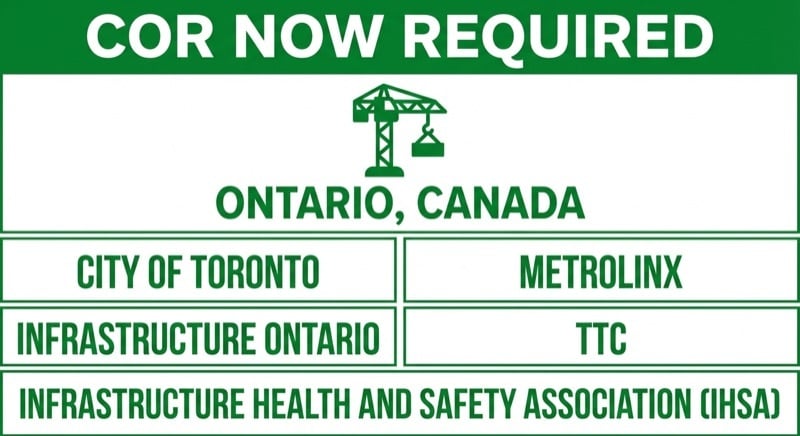
Ontario is changing the rules. The City of Toronto, Metrolinx, Infrastructure Ontario, and the TTC now require COR certification for contractors bidding on their projects. If you're still treating COR as a "nice to have," you're about to lose access to some of the biggest infrastructure contracts in the province.
At Safety Evolution, we help contractors across Canada build safety programs and earn COR certification. Ontario's COR program is administered by the Infrastructure Health and Safety Association (IHSA), and it has its own training requirements, audit structure, and pricing that differ from every other province. This guide covers the actual steps, costs, and timelines so you can make a real plan instead of scrambling when a bid package drops with COR as a pre-qualification.
COR (Certificate of Recognition) is a voluntary safety certification program administered by the Infrastructure Health and Safety Association (IHSA) that formally verifies your health and safety program through a recognized third-party audit. It's nationally recognized across Canada through the Canadian Federation of Construction Safety Associations (CFCSA).
While the Occupational Health and Safety Act (OHSA) requires all Ontario employers to maintain a safe workplace, COR goes further. It's an independent verification that your safety management system is comprehensive, implemented, and effective. Think of OHSA as the legal minimum; COR proves you're operating well above it.
For Ontario contractors, COR is rapidly moving from voluntary to essential. Major public sector organizations are making it a pre-qualification requirement for bids. If you can't show COR, you can't bid. If you can't bid, you can't grow. If you need a clear picture of where your safety program stands, Safety Evolution can check your documentation against Ontario IHSA COR requirements and show you exactly what needs fixing.
The Infrastructure Health and Safety Association (IHSA) is the sole certifying partner for COR in Ontario. IHSA develops the training, manages the audit process, and issues certifications.
IHSA is one of four designated health and safety associations in Ontario, specifically serving the construction, electrical, utilities, transportation, and aggregates sectors. They're the authority on COR in this province, and all COR-related training, audits, and certification decisions flow through them.
Ontario's public sector has been steadily tightening safety requirements for contractors. Here's what's driving the shift:
Most contractors think COR is still optional in Ontario. They're wrong. If you're bidding on any public sector work in the GTA or on provincial infrastructure projects, COR is already a gate you need to pass through. The trend is expanding, not slowing down. Companies that wait until it's explicitly required for their next bid will find themselves 12 months behind their competitors who started early.
Bill 20 (Working for Workers Act) and broader legislative momentum around workplace safety standards in Ontario have created an environment where COR is becoming the expected standard, not just for public sector work but increasingly for private sector GCs who want to reduce their own liability exposure. The right training now positions your company for where Ontario is heading, not just where it is today.
IHSA publishes transparent pricing for COR-related services. Here's the breakdown:
For one senior manager plus one full-time employee completing all requirements, training costs approximately $333.75 total (5 course registrations at $66.75 each). That's remarkably affordable compared to other provinces. The training cost barrier in Ontario is low; the real investment is in the time your people spend in the classroom and the effort to build your program.
The consulting rate covers services like gap analysis, program development support, and audit preparation. Not every company needs consulting, but if your safety program has significant gaps, a day or two of expert guidance can save you months of trial and error.
The blunt truth about COR costs in Ontario: the fees are modest. A total training and audit investment under $1,000 for a small company is realistic. What actually costs money is the internal time to build and implement your safety program, pull people off sites for training, and prepare for audits. Budget for the hours, not just the invoices.
Not sure what will fail your Ontario COR audit?
See where your documentation is weak before the audit, then fix owners, due dates, and evidence fast.
Start Your 30-Day Free Trial →IHSA has a structured four-step process. Here's what each step actually involves:
Submit your COR application through IHSA. This registers your company in the program and gives you access to the training and audit resources you'll need. It also signals to IHSA that you're serious about certification, and they can provide guidance on the specific requirements for your company size and sector.
IHSA requires specific COR training for two roles in your company:
At $66.75 per course, the financial cost is minimal. The time cost is what matters. You're pulling a key employee off the tools for multiple days of training. Plan for this and schedule courses early so training doesn't become the bottleneck in your timeline.
Before IHSA sends their external auditor, you conduct a self-audit using the COR Audit Tool. This is your chance to evaluate your own program honestly, find the gaps, and fix them before the real audit.
The self-audit covers all 14 elements of the COR Audit Tool (detailed below). Treat this as a dress rehearsal, not a formality. The companies that take their self-audit seriously pass their external audit the first time. The ones who rush through it usually don't. If your toolbox talk program is inconsistent or your training records have gaps, the self-audit is where you catch those issues.
IHSA conducts (or arranges) a third-party external audit of your safety management system. The auditor evaluates your program against all 14 elements, reviews documentation, interviews workers and management, and observes site practices.
This is the gate. If you pass, you receive your COR certification. If you don't, you'll receive a report identifying the deficiencies, and you can address them before re-auditing.
Ontario's COR Audit Tool evaluates your safety management system across 14 elements. Each one must be addressed in your program, and the auditor will assess all of them:
If you look at that list and feel overwhelmed, you're not alone. Most contractors have strong practices in some areas (PPE, company rules) and significant gaps in others (management review, statistics and records, procurement safety). The key is building your program systematically so nothing falls through the cracks.
For a structured approach to building out these elements, our safety program template guide covers how to develop a complete program that addresses all the common audit requirements.
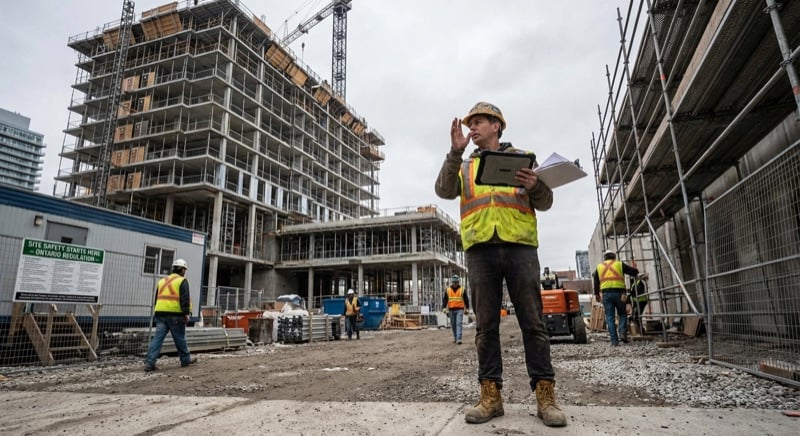
Looking at 14 audit elements on a list is one thing. Actually building processes for each one is another. Here's a realistic view of what the heavy-lift elements require:
This is where your FLHAs, JHAs, and site-specific hazard assessments live. You need a formal process that your crew follows every day, not just a template that sits in a truck glove box. The auditor will interview workers and ask them to describe the process. If they can't, your documentation is irrelevant.
This catches a lot of Ontario contractors off guard. You need documented safety requirements for your suppliers and subcontractors. How do you evaluate a sub's safety performance before hiring them? What safety language is in your contracts? How do you monitor their safety on your sites? If you're a GC managing multiple subs, this element will get scrutinized heavily.
Every worker needs documented orientation training, job-specific training, and ongoing competency verification. Your training matrix needs to show who's been trained, when, on what, and when refresher training is due. This is one of the most documentation-heavy elements, and it's where many companies have the biggest gaps.
You need a formal incident investigation procedure that goes beyond filling out a form. Root cause analysis, corrective actions, follow-up verification, and trend analysis. Near-miss reporting is equally important; it shows your program is proactive, not just reactive.
This is often the weakest element for contractors. Senior management must formally review the safety program at regular intervals, evaluate performance data, identify improvement opportunities, and document decisions. Management of change requires a formal process for evaluating safety impacts when you introduce new equipment, processes, materials, or work methods.
The companies that succeed with Ontario's COR process are the ones that don't treat it as a checkbox exercise. Each of these 14 elements represents a genuine safety management practice. When they're implemented properly, they protect your crew and your business. When they're faked for the audit, the auditor sees through it, and more importantly, your crew is still at risk.
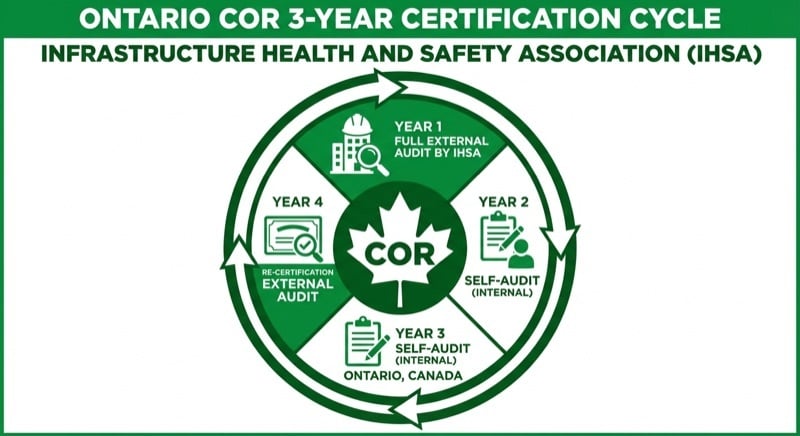
Ontario follows a three-year COR cycle:
Maintaining COR means your safety program must be continuously active, not something you dust off at audit time. Your internal auditor needs to conduct thorough self-audits in Years 2 and 3, and the results must show that your program is being maintained and improved.
The companies that struggle with re-certification are the ones who treated Years 2 and 3 as coasting years. They stopped updating their FLHAs, let their audit preparation lapse, and stopped conducting regular inspections. When Year 4 arrives and the external auditor shows up, they're essentially starting over. Don't be that company.
Realistic timeline from application to certification:
Total realistic timeline: 8 to 18 months for most companies.
Companies with an existing health and safety program, even an informal one, can move faster. Companies with no safety documentation, no formal training records, and no hazard assessment processes should plan for the full 12 to 18 months. The 14 elements in the audit tool are comprehensive, and building meaningful processes for each one takes time.
Preparation for the COR audit doesn't start the month before the auditor arrives. It starts when you begin building your program. Here's what separates the companies that pass on their first attempt from those that don't:
Build your program around the 14 elements from Day 1. Map each element to your actual operations. What does "Procurement and Contractor Management" look like for your company specifically? What does "Management Review" involve for an owner who runs a 30-person crew? Make the elements fit your reality, not a generic template.
Run your self-audit like it's the real thing. Take it seriously. Score yourself honestly. If your trained internal auditor gives every section a perfect score, they're not auditing; they're cheerleading. The self-audit should reveal weaknesses. That's the point. You fix those weaknesses before IHSA's auditor finds them.
Prepare your workers for interviews. The external auditor will interview workers, supervisors, and management. They'll ask about hazard assessment processes, training they've received, how they report safety concerns, what happens after an incident, and whether they know the safety policy. This isn't a pop quiz; it's a measurement of implementation. If your workers know the answers because they actually live the program every day, interviews go smoothly. If they've never seen the safety manual, no amount of coaching fixes that gap.
Document consistently, not just before the audit. Auditors can tell the difference between records that accumulated organically over months and records that were backfilled in a panic the week before the audit. Dates matter. Signatures matter. The progression of records over time tells a story of genuine implementation.
A practical tip: keep a running "audit evidence" folder organized by element number. Every time you complete a toolbox talk, file a copy under Element 8 (Training and Communication). Every inspection report goes under Element 9. Every incident investigation under Element 10. When audit time comes, you've already organized your evidence. No scramble, no panic.
Ontario's construction industry is at an inflection point with COR. Here's the reality:
COR is a national program with province-specific requirements. If you operate in multiple provinces, check our province-specific guides:
For a broader overview of the COR program nationally, see our guide to the Certificate of Recognition (COR).
Still chasing Ontario COR evidence across files and inboxes?
Centralize corrective actions and audit proof so your next review is predictable.
Start Your 30-Day Free Trial →IHSA training courses cost $66.75 per person each. A senior management rep needs 1 course and a full-time employee needs 4 courses, totaling approximately $333.75 in training fees for both. Internal audit review is $360. IHSA consulting is $1,425 per day (members) plus expenses if needed. Total direct costs are relatively low; the bigger investment is the internal time to build and implement your safety program.
COR is technically a voluntary program in Ontario. However, it is a mandatory pre-qualification requirement for contractors bidding on projects with the City of Toronto, Metrolinx, Infrastructure Ontario, TTC, and an increasing number of other public sector organizations. Private sector GCs are also increasingly requiring it. For practical purposes, COR is becoming essential for Ontario construction contractors.
The 14 elements are: Health and Safety Policy, Hazard Assessment/Analysis/Control, Controls, Procurement and Contractor Management, Company Rules, PPE, Preventative Maintenance, Training and Communication, Workplace Inspections, Investigations and Reporting, Emergency Preparedness, Statistics and Records, Legislation and Other Requirements, and Management Review and Management of Change. Each element must be addressed in your safety program.
Most companies need 8 to 18 months from application to certification. The timeline depends on your existing safety program maturity. Training takes 1 to 3 months, program development takes 4 to 10 months, and the audit process adds another 1 to 2 months. Companies with established safety practices complete the process faster.
COR follows a 3-year cycle in Ontario. Year 1 requires a full external audit. Years 2 and 3 require self-audits reviewed by IHSA. Year 4 is re-certification with another full external audit. Your safety program must be continuously maintained throughout the cycle.
No. There is no minimum employee requirement for COR certification in Ontario. Companies of any size can pursue COR through IHSA. However, smaller companies may find the documentation requirements more challenging without professional assistance, and the program investment may be proportionally higher relative to company size.
Get Weekly Safety Insights
Regulation updates, toolbox talk ideas, and compliance tips. One email per week.
COR in Manitoba earns a 15% WCB rebate. Get the CSAM steps, 4 required courses, audit scoring thresholds, and realistic timelines to certification.
COR audits require 80% to pass. Here's what auditors evaluate, where contractors fail, and how to prepare in Alberta and BC.
Small COR in BC costs an estimated $2,000 to $6,000 CAD. Learn the BCCSA process, audit requirements, timeline, and WorkSafeBC incentive formula.