Training
Forklift Training in Canada: Employer Guide
Your complete guide to forklift training, certification, and employer obligations across every Canadian province.
There is no government forklift license in the US or Canada. What OSHA certification means, how Canadian provinces handle it, and what the difference matters.
Last updated: April 2026
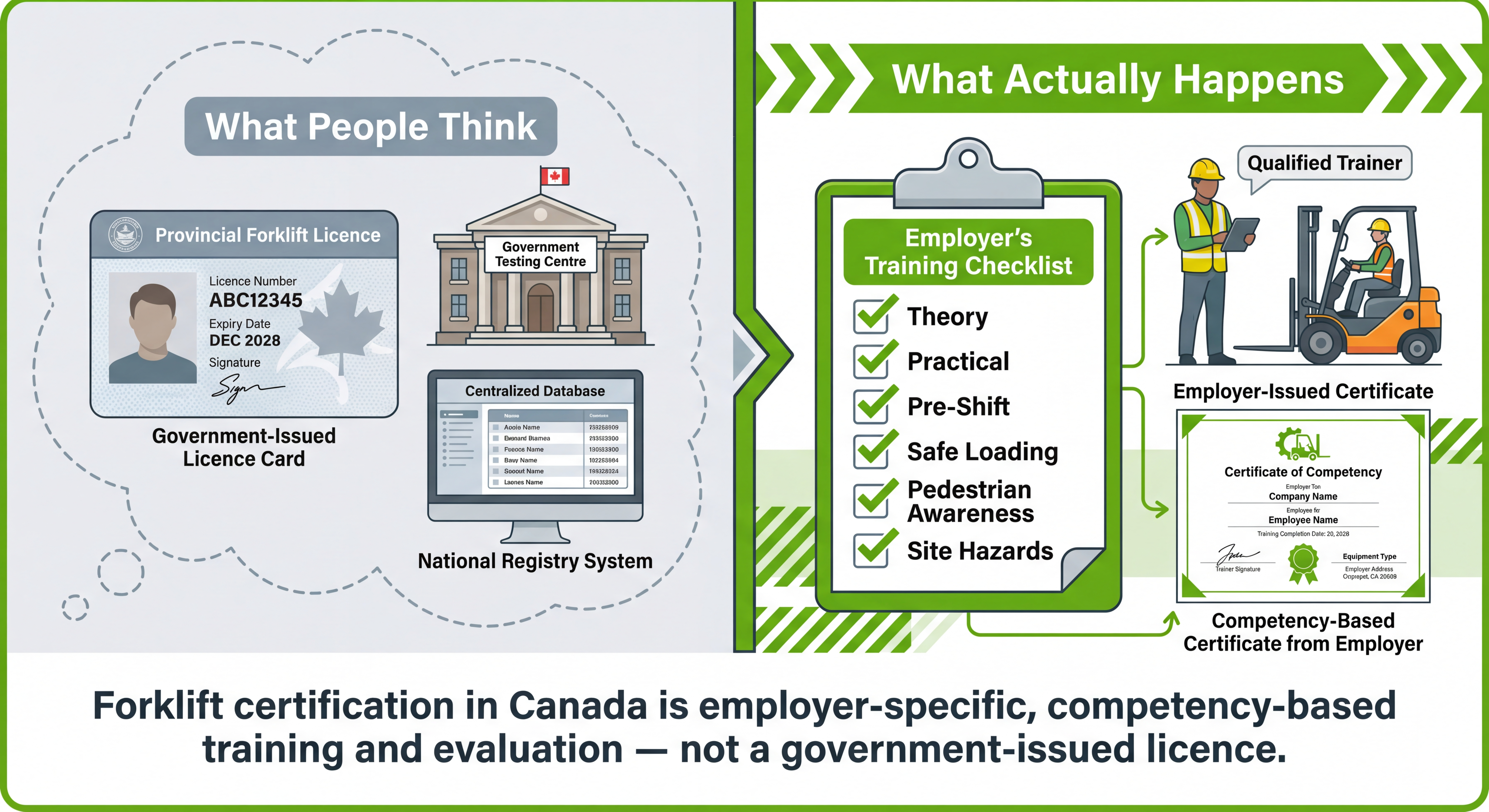
Search "forklift license" in Canada and you will find hundreds of training providers happy to sell you one. There is just one problem: forklift licenses do not exist in Canada. No provincial government, no federal agency, and no regulatory body issues a forklift license. What these providers are actually selling is forklift operator training and certification.
This is not just a terminology issue. The confusion between "license" and "certification" leads employers down the wrong path, creates false confidence in compliance, and costs real money when an OHS inspector asks to see your documentation. At Safety Evolution, we see this confusion regularly with contractors who thought a card in a wallet was the same as a compliant training record.
Below, we explain where the term "forklift license" came from, what certification actually means under Canadian law, what documentation you need to have on file, and why the distinction matters during an inspection.
Quick Answer
Neither the US nor Canada issues a government forklift "license." In the US, OSHA requires employer-provided training and certification (documentation that the operator was trained and evaluated). In Canada, provinces require employer-provided training, with the employer (or an approved training provider) issuing certificates of competency. The word "license" is industry slang, not a legal designation, in both countries.
In the United States, there is no government-issued forklift license, forklift operator's permit, or forklift driver's license. OSHA's 1910.178(l)(6) requires the employer to certify that each operator has been trained and evaluated. That certification must include the operator's name, training date, evaluation date, and trainer identity.
What most people call a "forklift license" in the US is actually one of these:
None of these are a "license." The critical distinction: OSHA holds the employer responsible, not the operator. If an untrained operator causes an accident, the employer gets the citation (up to $16,550 per serious violation), not the operator.
For the full OSHA training requirements, see our OSHA Forklift Training: Complete Employer Guide.
The term "forklift license" stuck because of how we think about operating other vehicles. You need a driver's license to drive a car. You need an endorsement on that license to drive a truck. It makes intuitive sense that you would need a license to operate a forklift.
But forklifts are classified as powered industrial trucks under Canadian safety legislation, not motor vehicles. They do not operate on public roads. They operate in workplaces: warehouses, construction sites, loading docks, and manufacturing floors. Workplace equipment falls under occupational health and safety (OHS) law, not motor vehicle law.
Under OHS legislation in every Canadian province, the employer is responsible for ensuring that workers are competent to operate equipment safely. The government does not test operators, does not issue cards, and does not maintain a registry of certified forklift operators. The employer owns the entire process.
Training providers know that "forklift license" is what people search for, so they use the term in their marketing. There is nothing illegal about this. But it creates a false impression that getting a card from a training centre means you are "licensed" by some authority. You are not.
Still tracking forklift certifications in spreadsheets?
If cards expire and no one catches it, you carry the risk. Start a 30-Day Free Trial and track operator status in one place before your next audit.
30-Day Free TrialForklift certification is documented proof that an operator completed a training program that meets CSA B335-15 standards and demonstrated competency through written and practical evaluations. The CSA (Canadian Standards Association) B335-15 standard is the national safety standard for lift trucks, referenced by most provincial OHS regulators.
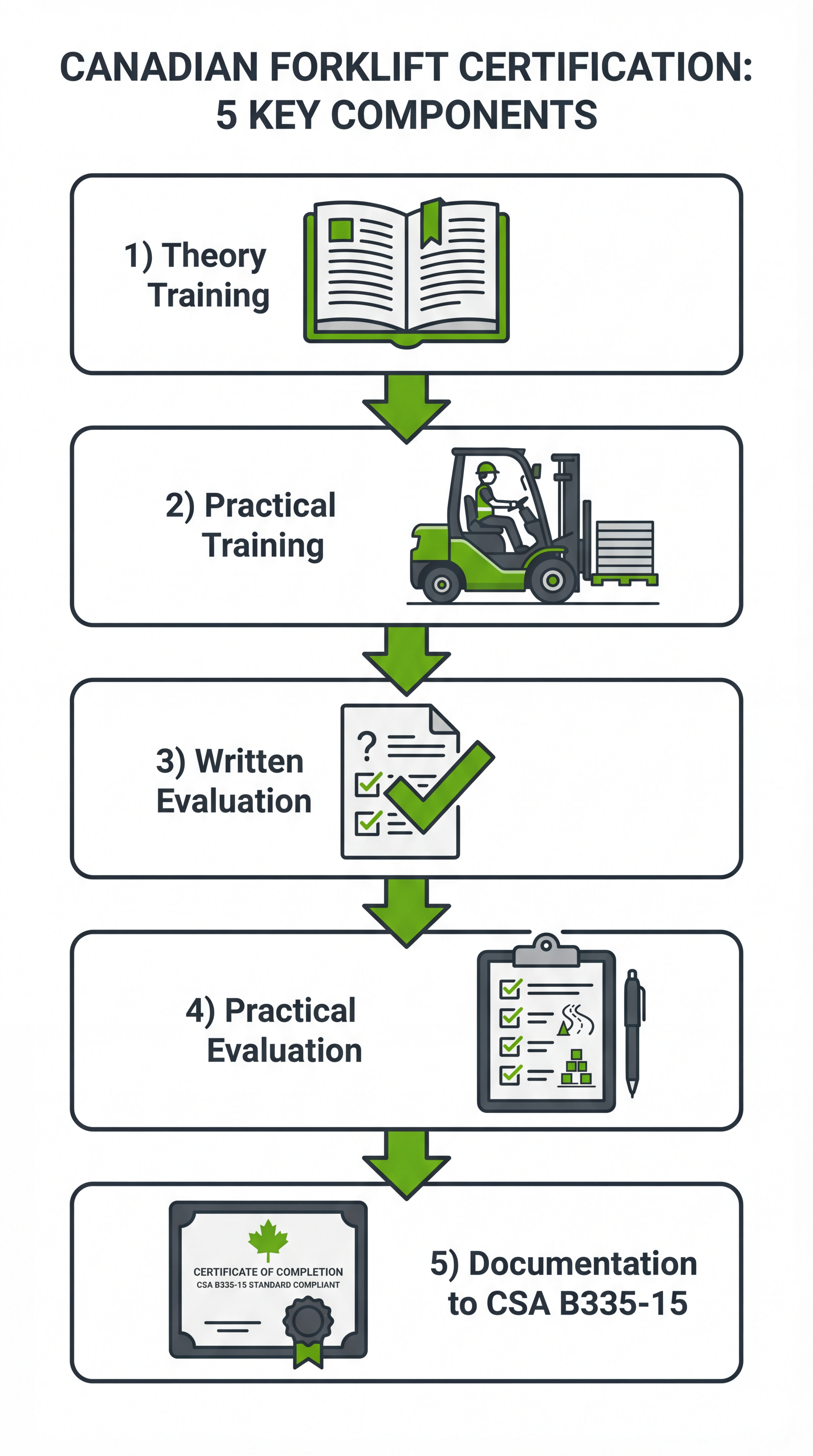
A proper certification record includes:
Notice what is not on that list: a government stamp, a provincial seal, or a registration number. Forklift certification is an employer record, not a government credential.
Two options:
1. Third-party training providers. These are private companies that specialize in equipment operator training. They deliver the classroom instruction, practical training, and evaluations, then issue a certificate (often a wallet card and a detailed training record). Costs typically range from $150 to $500 per operator. The employer should keep the detailed training record on file, not just the wallet card.
2. The employer (in-house training). Every Canadian province allows employers to train their own operators, as long as the training meets CSA B335-15 requirements. This means you need a qualified trainer (someone who meets the trainer competency requirements in the CSA standard), a structured curriculum, proper evaluations, and thorough documentation. Many employers use a train-the-trainer approach: send a supervisor to a provider's train-the-trainer course, then have that supervisor deliver in-house training.
Regardless of who delivers the training, the employer is always responsible for the quality and completeness of the training. If a third-party provider cuts corners, the employer is still liable if an incident occurs and the training record does not hold up to scrutiny.
Most contractors think a forklift card in a wallet means they are covered. They are wrong.
Here is what actually matters and why the license-vs-certification distinction has real consequences:
With a driver's license, the government tested the driver and maintains the record. If something goes wrong, the government's testing process is part of the picture. With forklift certification, there is no government in the middle. If your operator injures someone or damages property, the first question from an OHS investigator, a WCB claims adjuster, or a lawyer is: "Show me the training records."
If all you have is a wallet card from a provider you have never verified, you have a problem. If you have detailed training records showing CSA B335-15 compliance, you have due diligence.
A forklift certification from a previous employer or training provider proves the operator was trained at some point, on some equipment, in some environment. It does not prove they are competent on your specific forklifts, at your specific site, with your specific hazards.
CSA B335-15 requires workplace-specific training. A warehouse operator certified in Toronto who shows up on your construction site in Edmonton still needs orientation to your site conditions, equipment, and procedures before operating a forklift.
Because there is no government registry, there is no automatic renewal notice. The CSA standard recommends refresher training every 3 years. Tracking this is entirely the employer's responsibility. We have seen employers go five or six years without renewing operator certifications simply because nobody was tracking the dates.
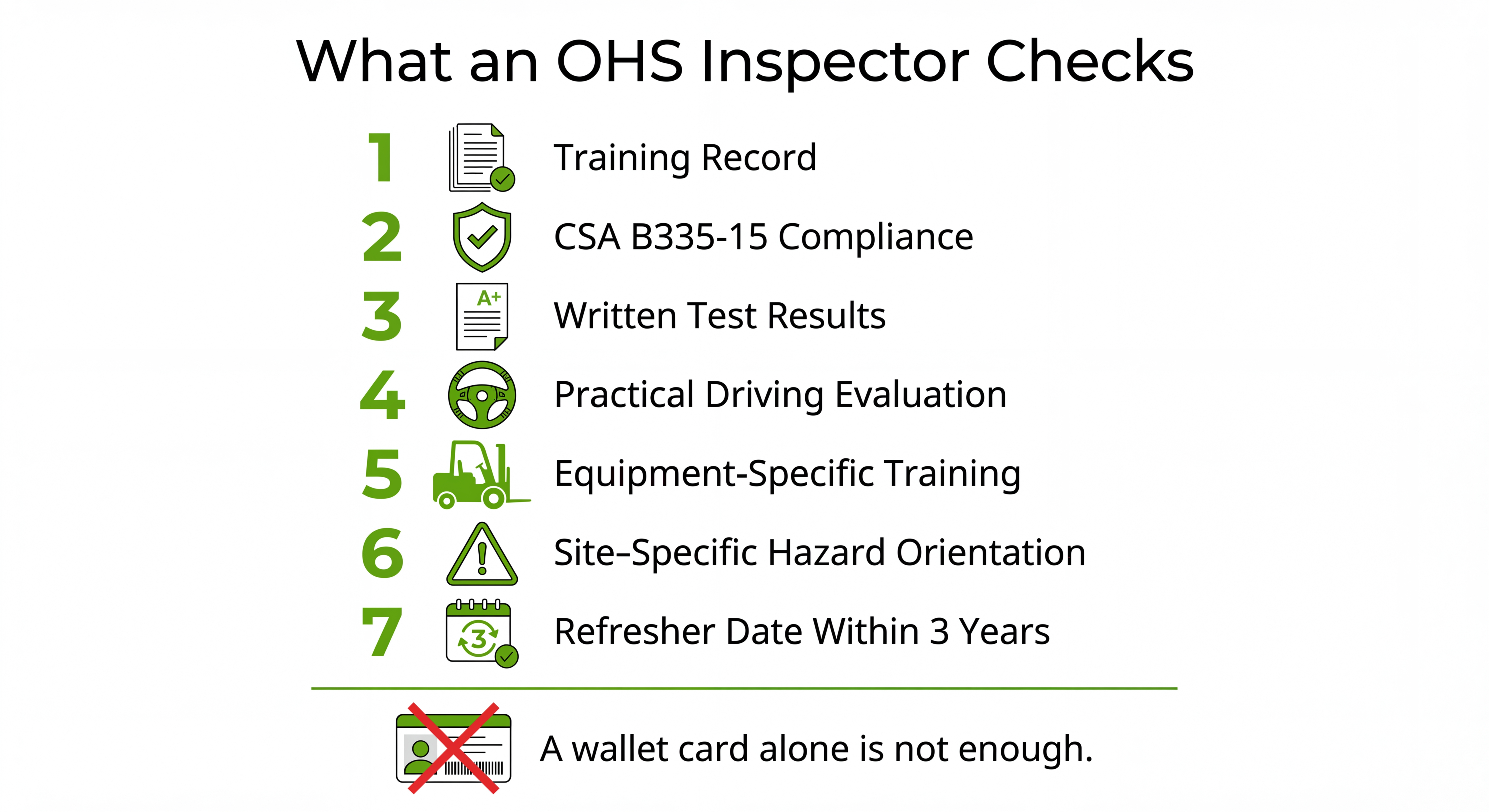
When a WorkSafeBC, Alberta OHS, or Ontario Ministry of Labour inspector walks onto your site and sees someone operating a forklift, they are not asking to see a "license." They are asking:
A wallet card answers maybe one of those questions. A proper training file answers all of them.
Let us be blunt about what happens when employers treat forklift "licensing" casually.
A contractor in the GTA hires a new warehouse worker. The worker says he has forklift experience and pulls a wallet card out of his pocket. The employer puts him on a forklift the same day. No workplace-specific orientation. No verification of what training the card actually represents. No documentation beyond a photocopy of the card.
Two weeks later, the operator clips a pedestrian while backing out of a loading bay. The pedestrian breaks a leg. WCB opens a claim. An OHS inspector shows up and asks for training records. All the employer can produce is a photocopy of a wallet card from a different province, issued by a company the employer never contacted. The card says "forklift license" across the top.
The consequences stack up fast:
Total cost? Easily $50,000 to $200,000, depending on the severity. The cost to have done the training properly? $300 per operator plus a few hours of site-specific orientation.
We are not trying to scare you into buying our services. We are telling you what we see happen to contractors who treat a wallet card as a substitute for a training program. The math does not work in favour of shortcuts.
The good news: the fundamentals are the same across Canada. Every province requires the employer to ensure operator competency. The CSA B335-15 standard is recognized nationally. But the specific legislation and enforcement intensity vary.
| Province | Key Legislation | CSA B335-15 Referenced? | Notes |
|---|---|---|---|
| BC | OHS Reg Part 16, s.16.43 | Yes, directly | 3-year refresher enforced |
| Alberta | OHS Code Part 19 | In guidance, not in law | 7-hour minimum recommended |
| Ontario | OHSA + Industrial Regs | In guidance | Aggressive enforcement, high fines |
| Saskatchewan | OHS Regs | In guidance | Competency requirement |
| Manitoba | WSH Regulation | In guidance | Documented training required |
For a full province-by-province breakdown, see our complete employer guide to forklift training in Canada. For BC-specific requirements, read BC Forklift Certification: CSA B335-15 Requirements for Employers.
Here is a straightforward approach to getting your forklift training right:
For a transparent breakdown of training costs, see How Much Does Forklift Training Cost in Canada?
If you are not sure whether your current forklift training documentation would hold up under inspection, 30-Day Free Trial and show you exactly where the gaps are.
For a complete overview of forklift training requirements in Canada, including costs, renewal timelines, and province-by-province requirements, see our Forklift Training and Certification in Canada: The Complete Employer Guide.
Get ahead of forklift recertification risk
Stop finding gaps after an incident or inspection. Use a 30-Day Free Trial to monitor training, expiries, and compliance actions across your crew.
30-Day Free TrialNo. There is no such thing as a forklift license in Canada. No government body issues one. What people call a "forklift license" is actually an operator training certificate issued by an employer or third-party training provider after the operator completes CSA B335-15 compliant training and passes written and practical evaluations.
The employer. Under OHS legislation in every Canadian province, the employer is responsible for ensuring operators are trained, evaluated, and competent before operating a forklift. This applies whether the employer delivers training in-house or uses a third-party provider. The employer must maintain training records and ensure they are available for inspection.
A certificate from another employer shows the operator has received training, but it does not satisfy all of your obligations as the current employer. You still need to verify the training was CSA B335-15 compliant, provide workplace-specific orientation to your site and equipment, and confirm the certification has not expired (typically valid for 3 years). If the operator will be using a different class of forklift, additional training is required.
You need forklift training and certification, not a license. Every Canadian province requires operators to be trained to CSA B335-15 (or equivalent provincial standard) and to pass written and practical evaluations before operating a forklift. The training is documented by the employer or training provider. There is no government-issued license involved.
Consequences fall primarily on the employer, not the operator. If an OHS inspector finds an untrained operator on a forklift, the employer can face fines (up to $100,000 per offence for individuals and $1,500,000 for corporations in Ontario), stop-work orders, and increased WCB scrutiny. If an incident occurs, the employer may also face personal liability and, in serious cases, criminal charges under Canada's Westray Bill (Criminal Code Section 217.1).
Get Weekly Safety Insights
Regulation updates, toolbox talk ideas, and compliance tips. One email per week.
Your complete guide to forklift training, certification, and employer obligations across every Canadian province.
Forklift training costs $150 to $500 per operator in Canada. Full cost breakdown by province, training type, and renewal.
BC forklift training requirements under CSA B335-15 and WorkSafeBC. What employers must do to stay compliant.