Last updated: March 2026
A 20-person framing crew in Red Deer shows up to a new GC site. The site safety officer walks the line and finds three workers without CSA-approved hard hats, two wearing running shoes instead of steel-toed boots, and nobody carrying hearing protection despite a concrete saw running 30 metres away. Work stops. The sub gets a written warning. The GC questions whether this crew belongs on their site at all.
That scenario costs more than a morning of lost production. It costs relationships with GCs who will not call you back. We have helped hundreds of construction contractors across Canada get their PPE programs in order, and the number one problem is not that people refuse to wear gear. It is that nobody told them exactly what was required, by whom, and under which rules.
This guide covers the actual PPE requirements for Canadian construction sites: the regulations, the provincial differences, and the specific equipment your crew needs to be compliant and protected. If your safety program has PPE gaps, SE-AI can find them in your existing records.
⚡ Quick Answer
- Baseline PPE: CSA-approved hard hat, safety glasses with side shields, high-visibility vest, and CSA green triangle steel-toed boots are required on virtually every Canadian construction site.
- Regulations: Alberta OHS Code Part 18, WorkSafeBC OHS Regulation Part 8, Ontario Construction Regulation O. Reg. 213/91.
- Employer obligation: Conduct hazard assessments, provide or ensure PPE, train workers, enforce compliance.
- Task-specific PPE: Welding, electrical, work at heights, concrete cutting, and demolition each require additional specialized equipment.
What PPE Is Required on Every Construction Site?
Personal protective equipment for construction starts with four non-negotiable items. Every worker stepping onto a Canadian construction site needs these, regardless of trade or task:
- CSA-approved hard hat (CSA Z94.1). Type 1 protects from top impacts. Type 2 protects from top and lateral impacts. Most GC sites now require Type 2.
- Safety eyewear (CSA Z94.3). Safety glasses with side shields at minimum. Goggles or face shields for grinding, cutting, or chemical exposure tasks.
- High-visibility apparel (CSA Z96). Class 2 or Class 3 depending on vehicle traffic exposure. If equipment is moving on your site, everyone visible needs high-vis.
- Protective footwear (CSA Z195). The green triangle on the sole means it meets CSA standards for toe and sole protection. No exceptions.
Beyond these four, the specific PPE requirements depend on the hazards present. That is where most contractors get it wrong: they hand out the basic four and call it done, without assessing the actual risks of each task being performed.
What Does Alberta's OHS Code Say About Construction PPE?
Alberta's Occupational Health and Safety Code, Part 18, covers personal protective equipment requirements. Here is what matters for construction contractors:
- Section 228: Employers must ensure workers use appropriate PPE when a hazard assessment identifies a risk that cannot be eliminated or adequately controlled by other means.
- Section 229: PPE must be approved to applicable CSA standards or other standards recognized by the Director.
- Section 230: Workers must be trained in the correct use, care, and limitations of their PPE.
- Section 233: Employers must provide, and pay for, hearing protection and respiratory protection where required. The legislation is less specific about who pays for other PPE categories.
Alberta also requires fall protection when a worker could fall 3 metres (10 feet) or more, or when falling from any height where the landing area presents unusual risk (near open water, operating machinery, etc.).
The practical takeaway: in Alberta, the hazard assessment is everything. The OHS Code does not hand you a checklist of "every construction worker must wear X." It says you must assess the hazards and provide the appropriate protection. That gives you flexibility, but it also means your assessments need to be thorough and documented.
What Does WorkSafeBC Require for Construction PPE?
British Columbia's OHS Regulation, Part 8 (Personal Protective Clothing and Equipment), is more prescriptive than Alberta's in some areas:
- Section 8.2: Workers are responsible for providing their own safety headgear and safety footwear.
- Section 8.2(2): Employers must provide, at no cost to the worker, all other items of PPE required by the regulation. This includes respiratory protection, hearing protection, fall protection equipment, and specialized gear.
- Section 8.4: Personal clothing must not expose workers to unnecessary hazards. No loose clothing around rotating equipment. No synthetic fabrics where flash fire risks exist.
- Part 11 (Fall Protection): Fall protection is required when a worker could fall 3 metres or more, or when a fall from any height could result in injury.
BC is clearer about cost responsibility: workers buy their own hard hats and boots, employers pay for everything else. This is one of the most common questions we get from BC contractors, and the answer is right in Section 8.2. For a deeper look at BC construction requirements, see our WorkSafeBC construction requirements guide.
What About Ontario, Saskatchewan, and Other Provinces?
Each province has its own OHS legislation that covers PPE. Here is a snapshot of the key differences:
| Province |
Key PPE Regulation |
Who Pays for PPE? |
| Alberta |
OHS Code Part 18 |
Employer pays for hearing, respiratory, emergency PPE. Other categories not specified. |
| British Columbia |
OHS Regulation Part 8 |
Worker pays for headgear and footwear. Employer pays for everything else. |
| Ontario |
Construction Regulation O. Reg. 213/91 |
Employer must "provide" PPE. Interpretation varies. |
| Saskatchewan |
OHS Regulations Part VII |
Employer pays for all required PPE. |
| Manitoba |
Workplace Safety and Health Regulation |
Legislation specifies who is responsible for each type of PPE. |
| Quebec |
Safety Code for the Construction Industry |
Employer pays for all required PPE. |
If you work in multiple provinces (and many contractors do), you need to know the rules for each jurisdiction you operate in. The safest approach: cover the cost of all PPE for your workers and document everything. It eliminates the guesswork and protects you if an inspector asks.
Provincial PPE Requirements Vary and Inspectors Check the Records
SE-AI checks your construction PPE assignments against provincial regulations, CSA standards, and site-specific hazard assessments.
Get Early Access →
What PPE Is Required for Specific Construction Jobs?
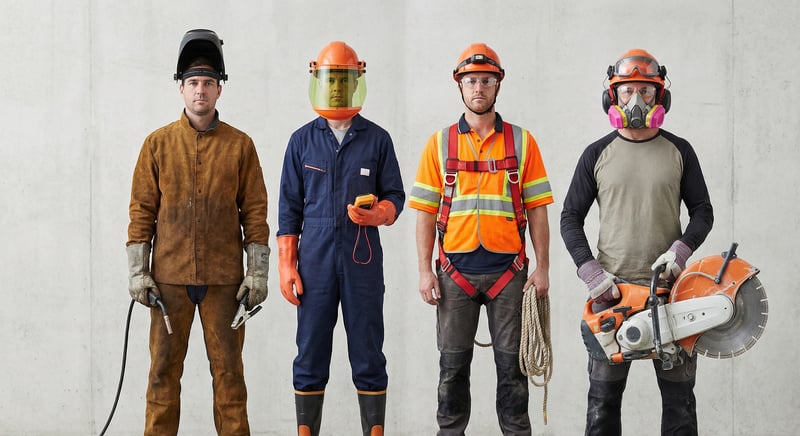
Beyond the baseline four items, different construction tasks trigger different PPE requirements. Here is what you need to know by job type:
Welding and Hot Work
Welding PPE is governed by CSA W117.2 (Safety in Welding, Cutting and Allied Processes). The basics: welding helmet with the correct shade lens for the process, flame-resistant clothing, leather gauntlet gloves, hearing protection, and safety footwear. Contact lenses should not be worn by welders per CSA W117.2. For the full breakdown, see our PPE for welding guide.
Work at Heights
Any work where a fall of 3 metres or more is possible requires fall protection. This means a full-body harness (CSA Z259.10), a connecting device like a shock-absorbing lanyard (CSA Z259.11) or self-retracting lifeline (CSA Z259.2.5), and an adequate anchor point. Workers must be trained in fall protection equipment use and rescue procedures.
Electrical Work
Electrical PPE includes voltage-rated rubber insulating gloves (tested per CSA Z462), arc flash rated clothing, face shields or hoods rated for the incident energy level, and insulated footwear. Arc flash PPE requirements are determined by an arc flash hazard assessment. See our electrical safety guide for more.
Concrete Cutting, Grinding, and Demolition
These tasks generate respirable crystalline silica dust, which is one of the most regulated hazards on construction sites. Workers need a minimum of a half-face respirator with P100 filters (fit tested), plus goggles (not just safety glasses), hearing protection, and gloves. Engineering controls like wet cutting and vacuum extraction should be used first, with respiratory PPE as an additional layer. See our silica exposure guide.
Confined Space Entry
Confined space work requires specialized respiratory protection (often supplied-air respirators), gas detection monitors (worn by each entrant), communication equipment, and rescue equipment. The PPE requirements are dictated by the atmospheric testing and hazard assessment specific to the space.
What Happens if PPE Requirements Are Not Met?
This is the part nobody wants to talk about until they are standing in front of an inspector.
In Alberta, OHS officers can issue stop-work orders on the spot if workers are not wearing required PPE. Administrative penalties can reach $10,000 per violation for an individual and up to $500,000 for a corporation. In BC, WorkSafeBC can issue compliance orders, penalty assessments, and in serious cases, prosecution under the Workers Compensation Act.
But the real cost is not the fine. It is the WCB claim that spikes your premiums for years. It is the GC who drops you from their approved sub list. It is the worker who goes home injured because the right goggles were sitting in a box in the trailer instead of on their face.
Most contractors think PPE enforcement is about catching people. It is not. It is about building habits before someone gets hurt. If your crew is not wearing their PPE, the question is not "how do I punish them?" The question is "why are they not wearing it, and what have I failed to provide?"
For a comprehensive look at how PPE fits into your broader safety obligations, read our pillar guide: What Is PPE? Guide to Personal Protective Equipment. And if building a formal PPE program is on your to-do list, we have a step-by-step guide for that too.
Does Your Construction PPE Program Meet Provincial Requirements?
SE-AI analyses your construction PPE records against provincial OHS requirements. It flags missing equipment for specific trades, expired CSA certifications, and gaps between your hazard assessments and documented PPE assignments.
Get Early Access to SE-AI →
Frequently Asked Questions
What is the minimum PPE required for a construction site in Canada?
At minimum, every worker on a Canadian construction site needs a CSA Z94.1 approved hard hat, CSA Z94.3 safety glasses with side shields, a CSA Z96 high-visibility vest, and CSA Z195 protective footwear with the green triangle. Additional PPE is required based on task-specific hazard assessments.
Does the employer or worker pay for PPE in Alberta?
Under Alberta's OHS Code, employers must provide and pay for hearing protection, respiratory protection, and emergency response PPE. The legislation does not specify who pays for hard hats, boots, or safety glasses. Many Alberta contractors cover all PPE costs as a best practice.
What PPE does a welder need on a construction site?
Welders need a welding helmet with the correct shade filter for their process (per CSA W117.2), flame-resistant clothing, leather gauntlet gloves, hearing protection, safety footwear, and respiratory protection when ventilation is inadequate. Contact lenses should not be worn while welding.
What are the penalties for not having proper PPE on a construction site?
Penalties vary by province. In Alberta, administrative penalties can reach $10,000 per individual and $500,000 per corporation. WorkSafeBC can issue compliance orders and penalty assessments. Beyond fines, PPE violations can trigger stop-work orders, increased WCB premiums, and removal from GC approved subcontractor lists.
How often does construction PPE need to be replaced?
Replacement schedules depend on the equipment type and manufacturer recommendations. Hard hats should be replaced every 5 years from manufacture date or immediately after any impact. Harnesses should be retired after 5 years of service or immediately after arresting a fall. Respirator cartridges follow manufacturer schedules or when breakthrough is detected. All PPE should be replaced when it shows visible damage, degradation, or no longer fits properly.
Get Weekly Safety Insights
Regulation updates, toolbox talk ideas, and compliance tips. One email per week.