Last updated: April 2026
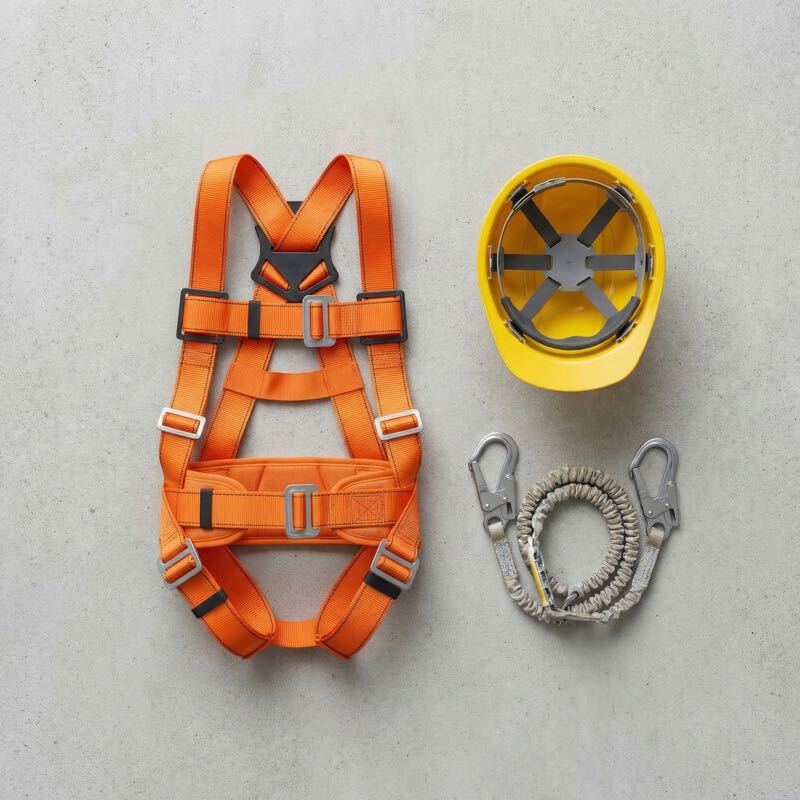
Your crew reaches for harnesses every morning. It is the first thing they grab, the one piece of safety gear they never question. But here is the problem: a harness is level 4 of 6 on the fall protection hierarchy. That means there are three better options your site should be using first, and most contractors skip all of them.
We work with construction contractors across Western Canada who run into the same issue. They buy the gear, send workers to fall protection training, and assume they have covered their bases. Then an inspector asks a simple question: "Why aren't you using guardrails here?" And nobody has a good answer.
Quick Answer: What Is the Fall Protection Hierarchy?
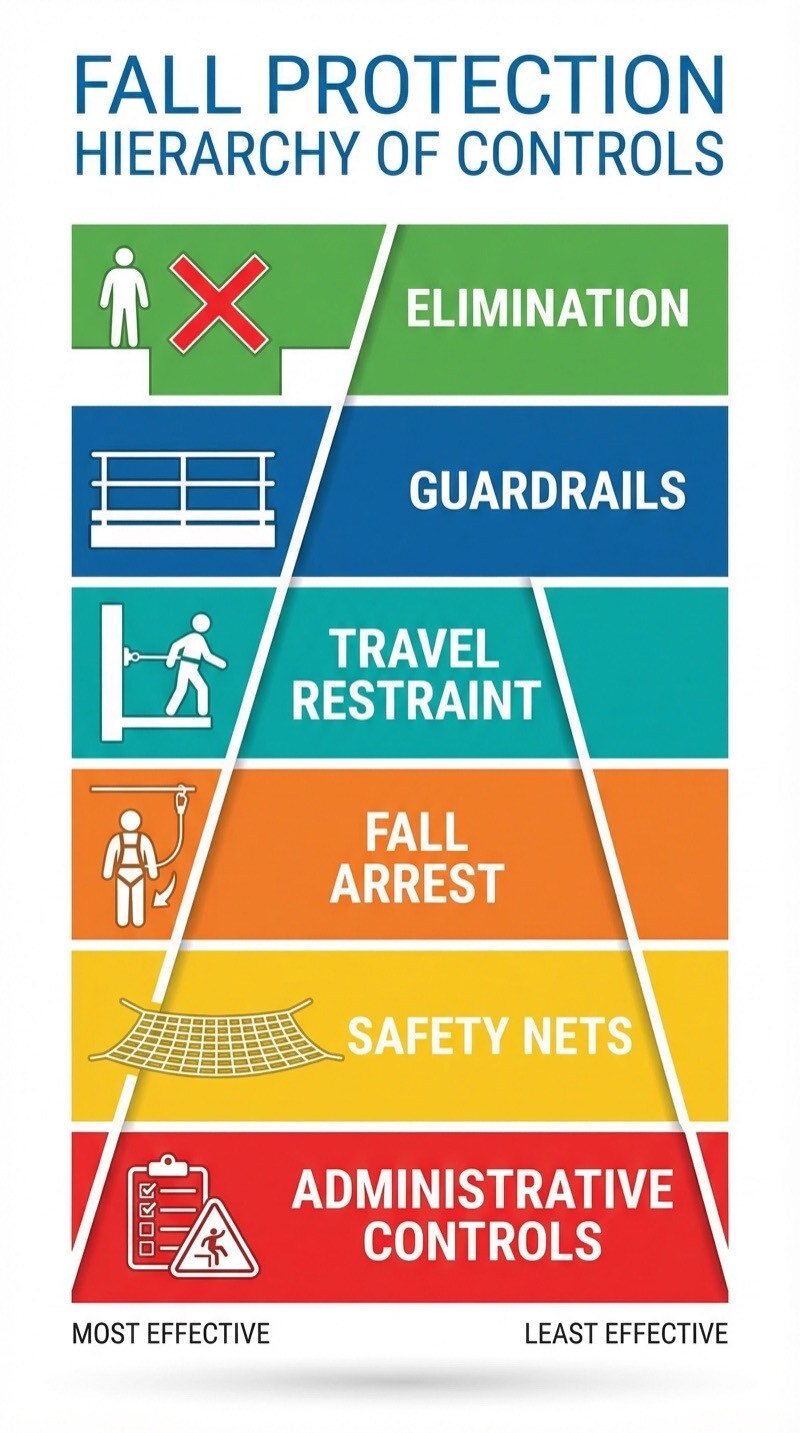
The fall protection hierarchy of controls is the required priority order for protecting workers from falls on Canadian job sites. Employers must start at the top (elimination) and work down, proving each higher level is not reasonably practicable before moving to the next. The six levels: elimination, guardrails, travel restraint, fall arrest, safety nets, and administrative controls. Provincial OHS codes, including Alberta OHS Code Part 9 s.139 and BC WorkSafeBC regulations, mandate this approach.
What Is the Fall Protection Hierarchy of Controls?
The fall protection hierarchy of controls is a ranked system that prioritizes fall protection methods from most effective (elimination) to least effective (administrative controls). It is not a suggestion list. It is the law. Provincial OHS codes across Canada require employers to follow the hierarchy, starting at the top and only moving to the next level when higher controls are not "reasonably practicable."
Think of it like a filter. Before your crew clips into a harness, you need to answer: can we eliminate the height work entirely? If not, can we install guardrails? If not, can we use travel restraint? Only when those options are ruled out should fall arrest enter the picture.
The concept mirrors the general hierarchy of hazard controls used across occupational health and safety, but it is applied specifically to fall hazards. And unlike the general hierarchy, the fall protection version has teeth: Alberta OHS Code Part 9, s.139 spells out the cascade in black and white.
If your site's fall protection program consists entirely of harnesses and lanyards, you are operating at level 4 of 6. That is not a program. That is a gap.
Safety Evolution helps contractors build fall protection programs that start at the top of the hierarchy, not the bottom. If your current approach begins and ends with PPE, Safety Evolution can analyse your fall protection program and show you where the hierarchy is being skipped.
The 6 Levels of Fall Protection Controls
Level 1: Elimination
Elimination means removing the need to work at heights entirely. It is the most effective control because if nobody goes up, nobody falls down.
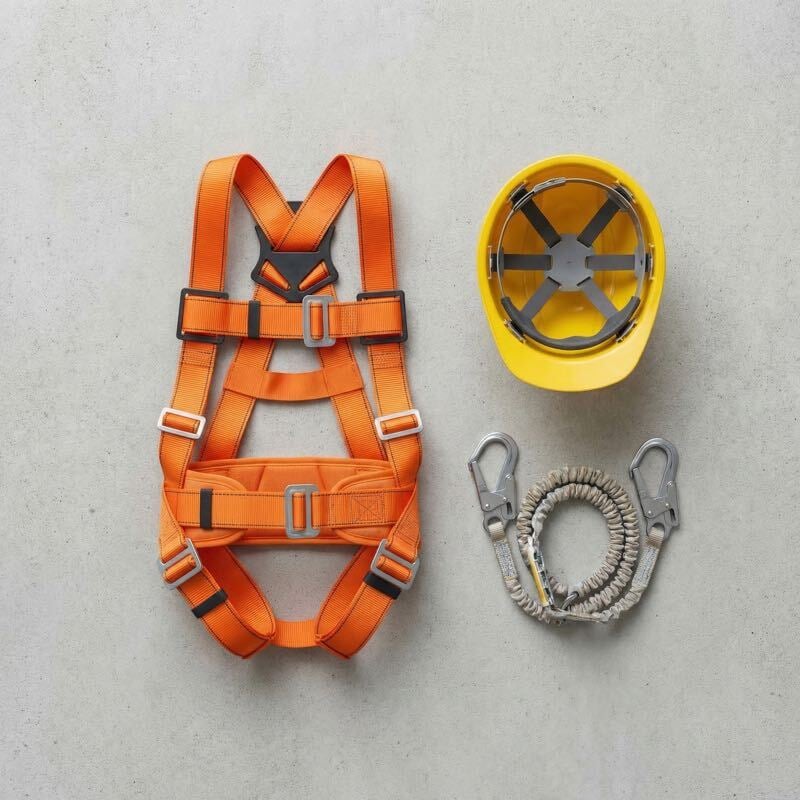
Real examples on Canadian job sites:
- Prefabricate on the ground. Assemble wall panels, trusses, or mechanical assemblies at grade, then crane them into position. The crew that would have spent three days working at height spends one day on the ground and 30 minutes directing a lift.
- Use drones for inspections. Roof condition surveys, structural assessments, and aerial photography that used to require a worker on a boom lift can now be done from the parking lot.
- Design out the hazard. Motorized signage systems that lower signs to ground level for service. HVAC units positioned for ground-level access during design. Roof drains that can be serviced from interior access points.
- Extend your reach. Telescoping tools for light bulb changes, gutter cleaning, and window washing eliminate ladder work entirely.
Elimination requires thinking about fall hazards during the planning stage, not after the scaffolding is up. The GC who builds elimination into the bid scope saves money on equipment, training, and rescue plans downstream. The one who waits until mobilization is stuck buying harnesses.
Level 2: Guardrails (Passive Protection)
When elimination is not feasible, guardrails are the next required control under Alberta OHS Code s.139(3). The employer "must install a guardrail," full stop. Only if guardrails are not reasonably practicable can you move down the hierarchy.
Guardrails are passive protection. They work without any action from the worker. Nobody needs to clip in, inspect a lanyard, or calculate clearance distances. The guardrail just sits there, stopping people from going over the edge.
Under Alberta's OHS Code, a compliant guardrail system must have:
- A horizontal top rail installed between 920 mm and 1,070 mm above the base
- A horizontal intermediate (mid) rail spaced midway between the top rail and the base
- Vertical members at intervals that prevent a person from passing through
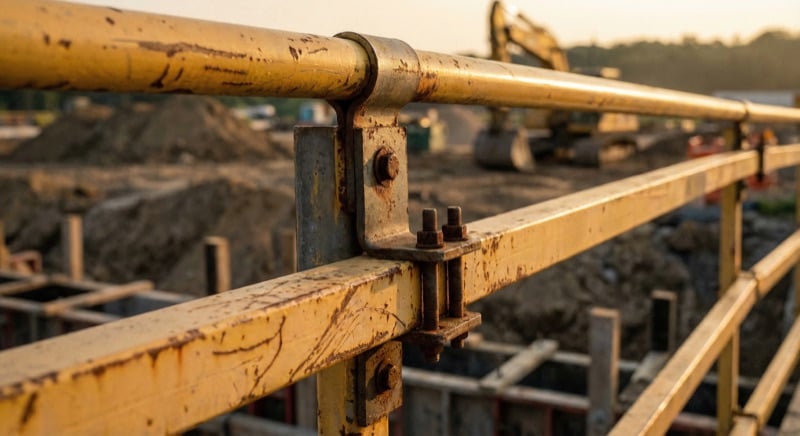
CSA Z259.18 covers the design requirements for counterweighted guardrail systems, the freestanding type commonly used on flat roofs and concrete decks where penetrating the surface is not an option.
Common guardrail applications: roof edges, floor openings, stairwells, mezzanines, loading docks, and scaffold platforms. Temporary guardrails go up during construction; permanent ones stay as part of the building's fall protection infrastructure.
The objection we hear most often: "Guardrails slow us down." The truth: guardrails cost time at setup but eliminate daily harness inspections, anchor point rigging, rescue plan briefings, and the risk that one worker forgets to clip in. Over a two-week phase, guardrails almost always save more time than they cost.
Level 3: Travel Restraint
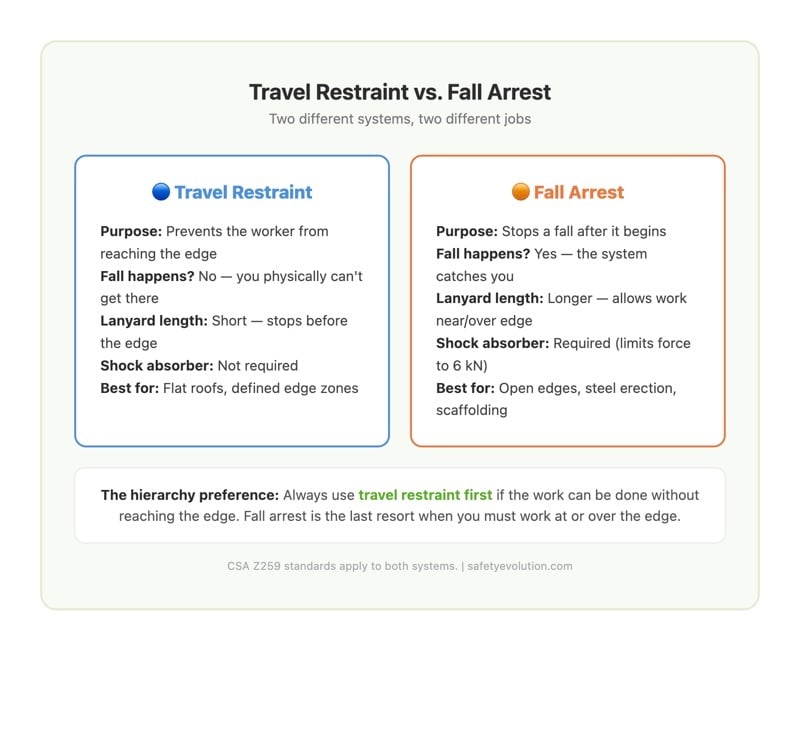
Travel restraint is the most underused level in the hierarchy. A travel restraint system physically prevents the worker from reaching the fall edge. The worker wears a body belt (CSA Z259.1) or full body harness connected to an anchor point by a fixed-length lanyard. The lanyard is short enough that the worker cannot get close enough to fall.
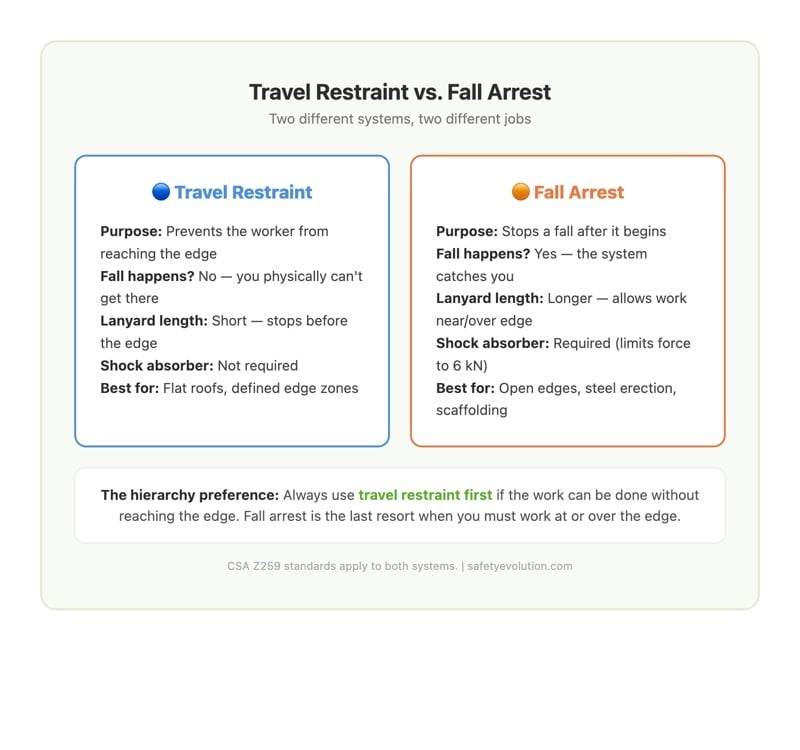
The key difference from fall arrest: travel restraint prevents the fall from ever happening. The worker literally cannot reach the edge. There is no free fall, no impact force, no suspension trauma, and no rescue scenario.
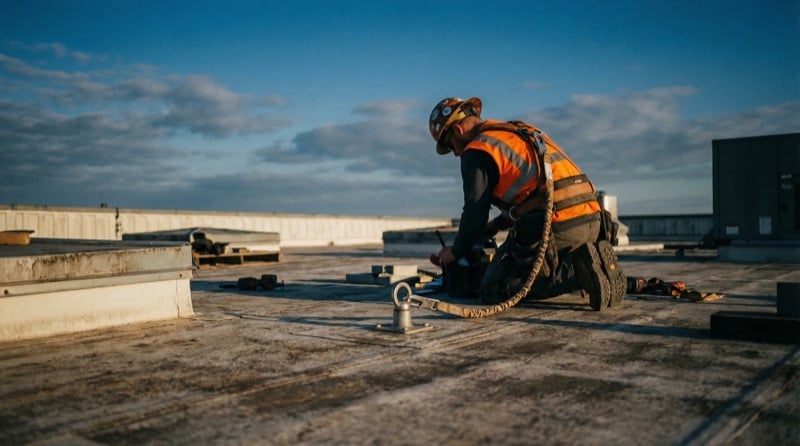
Real example: a roofing crew on a flat commercial roof. The anchor is installed at the centre of the roof. Each worker's lanyard is measured so that at full extension, they stop 2 metres short of any edge. They can work freely across the entire roof interior without ever getting close to a fall hazard.
Why more crews should use travel restraint:
- No rescue plan required. Because the worker cannot fall, there is no need for a suspension rescue procedure. That alone saves hours of planning and equipment.
- Body belts are permitted. Unlike fall arrest (which requires a full body harness), travel restraint allows the use of body belts under CSA Z259.1. Body belts are lighter, more comfortable, and cheaper.
- Simpler training. Workers need to understand anchor placement and lanyard length, but the complex clearance distance calculations required for fall arrest do not apply.
Alberta OHS Code s.139(5): if a guardrail is not reasonably practicable, the employer must ensure the worker uses a travel restraint system. Fall arrest is only permitted when travel restraint is also not reasonably practicable (s.139(6)).
Not sure where your fall protection program is exposed?
See missing training, inspections, and corrective actions before they become stop-work or audit issues.
Start Your 30-Day Free Trial →Level 4: Fall Arrest
Most contractors think a harness equals fall protection. It does not. A harness is fall arrest, and fall arrest is level 4 of 6 on the hierarchy. It does not prevent falls. It stops them after they start.
A personal fall arrest system (PFAS) consists of:
- Full body harness (CSA Z259.10-18): distributes arrest forces across the chest, shoulders, and thighs
- Energy-absorbing lanyard (CSA Z259.11-17) or self-retracting device/SRL (CSA Z259.2.2-17): connects the harness to the anchor and absorbs the shock of a fall
- Anchorage connector (CSA Z259.15-17): the fixed point that holds the entire system
Fall arrest comes with requirements that lower controls do not:
- Clearance distance calculation. You must calculate the total distance needed below the anchor to stop the fall without the worker hitting the ground or a lower level. This includes free fall distance, lanyard deployment, harness stretch, and a safety margin. Get it wrong and the system fails.
- Rescue plan. A worker hanging in a harness after an arrested fall has minutes before suspension trauma becomes life-threatening. Alberta OHS Code s.140(2)(f) requires a rescue procedure. Your crew needs to know exactly how they will get that worker down, and they need to practice it.
- Daily equipment inspection. Harnesses, lanyards, connectors, and anchors require pre-use inspection every shift. Damage, wear, chemical exposure, or a previous fall arrest event means the equipment is pulled from service.
- Maximum arresting force. CSA Z259.16 limits the maximum arresting force to 8 kN (about 1,800 lbs of force). Energy absorbers are designed to keep forces below this threshold.
Fall arrest is a valid control when guardrails and travel restraint are not reasonably practicable. Structural steel erection, tower climbing, and work near open edges where guardrails cannot be installed are legitimate fall arrest scenarios. But if your crew is using fall arrest on a flat roof where guardrails or travel restraint would work, you are not following the hierarchy.
Level 5: Safety Nets
Safety nets are passive catch systems installed below the work area to arrest a falling worker. They are most common in bridge construction, high-rise steel erection, and industrial settings where other systems are not practical.
Safety nets must be:
- Designed and installed by a competent person
- Positioned close enough to the work surface to limit fall distance
- Inspected regularly for damage, debris, and proper tension
- Tested before first use and after any modification
In general commercial and residential construction, safety nets are uncommon. The geometry of most buildings favours guardrails or personal fall protection systems. But on bridge decks, open structural steel, and large industrial projects, nets can protect multiple workers simultaneously without requiring each person to be individually connected to an anchor.
Level 6: Administrative Controls
Administrative controls sit at the bottom of the fall protection hierarchy because they depend entirely on human behaviour. A warning line does not stop a fall. A sign does not catch anyone. A safety monitor cannot grab a worker who trips.
Examples of administrative fall protection controls:
- Warning lines: visual barriers set back from an edge (typically 2 metres) that alert workers they are entering a hazard zone. Not a physical barrier.
- Control zones: demarcated areas near edges where only authorized, trained workers may enter. Everyone else stays behind the line.
- Safety monitors: a designated competent person who watches workers near fall hazards and warns them when they are too close to an edge.
- Signage and restricted access: "DANGER: Fall Hazard" signs, locked access to roof hatches, and restricted work permits.
If your only fall protection is a sign on a door, you do not have fall protection. You have a liability notice. Administrative controls should supplement higher-level controls, not replace them. A warning line 2 metres from a roof edge combined with travel restraint is solid. A warning line 2 metres from a roof edge with nothing else is a gamble on every worker's attention span.
What Types of Fall Protection Systems Are Available?
The hierarchy tells you the priority order, but within each level you need to choose the right system for the job. The main categories are guardrails, travel restraint, fall arrest, safety nets, and control zones — each governed by specific CSA Z259 standards. For a detailed comparison of every system type including when to use each one, see our complete guide to fall protection system types.
Which CSA Z259 Standards Apply?
Every piece of fall protection equipment used on Canadian job sites should be manufactured to a CSA Z259 standard. Here are the key standards and what they cover:
| Standard |
Covers |
| CSA Z259.1-05 |
Body belts and saddles for work positioning and travel restraint |
| CSA Z259.2.2-17 |
Self-retracting devices (SRLs) |
| CSA Z259.10-18 |
Full body harnesses |
| CSA Z259.11-17 |
Personal energy absorbers and lanyards |
| CSA Z259.12-16 |
Connecting components for personal fall arrest systems |
| CSA Z259.13-16 |
Manufactured horizontal lifeline systems |
| CSA Z259.15-17 |
Anchorage connectors |
| CSA Z259.16-21 |
Design of active fall protection systems |
| CSA Z259.17-16 |
Selection and use of active fall protection equipment |
| CSA Z259.18-19 |
Counterweighted guardrail systems |
Check the manufacturing date on your equipment. Alberta OHS Code specifies that equipment manufactured on or after March 31, 2023, must be approved to the current CSA standard editions listed above. Older equipment manufactured to previous editions may still be compliant if it met the standard in effect at the time of manufacture, but verify with the manufacturer.
For a deeper look at fall protection equipment inspection requirements, Safety Evolution's training courses cover harness inspection, lanyard care, and anchor point assessment.
Why Do Most Contractors Skip the Hierarchy?
Here is the blunt truth: most contractors default to harnesses because harnesses are visible, familiar, and easy to demonstrate to an inspector.
An inspector walks onto your site and sees 12 workers in harnesses. That looks like compliance. But it might also mean you skipped three levels of the hierarchy that would have protected those workers better.
The real reasons contractors jump straight to PPE:
- "Guardrails cost too much." They cost money upfront, yes. But they eliminate the daily cost of harness inspections, anchor rigging, rescue plan briefings, and the risk that someone forgets to clip in. On a project lasting more than a week, guardrails often break even.
- "We have always used harnesses." Habit is not a hazard assessment. The hierarchy requires you to document why higher controls are not reasonably practicable. "We did not think about it" does not qualify.
- "Elimination is not realistic." Sometimes it is not. But sometimes it is, and nobody asked the question during planning. Can the ductwork be assembled on the ground? Can the signage be designed for ground-level service? These questions cost nothing to ask.
- "Our workers are trained." Trained workers still fall. Training reduces risk; it does not eliminate it. Guardrails work whether the worker is experienced or on their first day.
The cost of skipping the hierarchy is not just regulatory. In Alberta, fines for OHS violations can exceed $10,000 per offence under the OHS Act. A fall resulting in serious injury triggers a mandatory investigation and can lead to stop-work orders that shut down your entire project. Your WCB premiums increase. Your ability to bid on prime contracts with safety-conscious owners takes a hit. And a worker goes home hurt, which is the cost that matters most.
How to Apply the Hierarchy on Your Next Project
Following the fall protection hierarchy is not complicated. It just requires asking the right questions at the right time.
- During planning and bid preparation: review the scope of work for any tasks at height. For each one, ask: can this be done at ground level? If your estimator builds elimination into the bid, the cost is planned, not reactive.
- During site setup: identify every edge, opening, and elevated work area. Install guardrails wherever feasible. Document where guardrails are used and where they are not, with the reason why.
- For remaining exposed areas: evaluate travel restraint first. Calculate lanyard lengths to keep workers away from edges. Only move to fall arrest where travel restraint geometry does not work (e.g., worker needs to access the edge itself).
- Write it into your fall protection plan. Alberta OHS Code s.140 requires a written fall protection plan when workers may fall 3 metres or more and guardrails are not in place. The plan must specify what system you are using and why. The hierarchy gives you the framework; the plan documents the decisions.
- Train your crew on the hierarchy, not just the equipment. Workers who understand why they are using a specific system make better decisions in the field. Include the hierarchy in your toolbox talks and site orientations.
The GC who builds the hierarchy into their safety program does not just avoid fines. They reduce incidents, simplify daily operations, and demonstrate to prime contractors and owners that their safety program has substance behind it. If you are not sure where your program stands, start with an honest assessment.
Still chasing fall protection evidence across files and inboxes?
Centralize corrective actions and proof so your next review is predictable.
Start Your 30-Day Free Trial →
Fall Protection Hierarchy: Frequently Asked Questions
What are the 6 levels of the fall protection hierarchy?
The six levels of the fall protection hierarchy, from most to least effective, are: (1) elimination, (2) guardrails/passive protection, (3) travel restraint, (4) fall arrest, (5) safety nets, and (6) administrative controls such as warning lines and safety monitors. Canadian provincial OHS codes require employers to start at the top and prove each higher level is not reasonably practicable before using a lower one.
What is the difference between fall restraint and fall arrest?
Fall restraint (travel restraint) prevents a fall by tethering the worker so they cannot reach the edge. Fall arrest allows the worker to reach the edge but stops the fall after it begins, using a harness, energy absorber, and anchor. Restraint is ranked higher on the hierarchy because preventing the fall is always better than stopping one in progress. Restraint also eliminates the need for rescue plans and clearance distance calculations.
When is fall protection required in Canada?
In most Canadian provinces, fall protection is required when a worker could fall 3 metres (10 feet) or more. Alberta OHS Code s.139 also requires protection at heights below 3 metres if there is an unusual possibility of injury (e.g., falling onto sharp objects or into hazardous substances) and at permanent work areas above 1.2 metres. Ontario requires fall protection at 3 metres on construction projects under O. Reg. 213/91.
What CSA standards apply to fall protection equipment?
The CSA Z259 series covers fall protection equipment in Canada. Key standards include: Z259.10-18 (full body harnesses), Z259.11-17 (energy absorbers and lanyards), Z259.2.2-17 (self-retracting devices), Z259.15-17 (anchorage connectors), Z259.1-05 (body belts for travel restraint), Z259.16-21 (design of active fall protection systems), and Z259.18-19 (counterweighted guardrail systems). Equipment manufactured on or after March 31, 2023, must meet the current editions of these standards.
Why is elimination the best form of fall protection?
Elimination is the most effective fall protection control because it removes the hazard entirely. If the work can be done at ground level, there is zero risk of a fall. No equipment to inspect, no training required, no rescue plans needed, and no reliance on worker compliance. Every other control on the hierarchy manages the fall risk; elimination removes it. That is why provincial OHS codes place it at the top.
Get Weekly Safety Insights
Regulation updates, toolbox talk ideas, and compliance tips. One email per week.