Last updated: April 2026
In 2024, 389 construction workers in the United States died from falls. That is one fall death every single working day. In Canada, falls from height cause 18% of all workplace fatalities and injure more than 40,000 workers per year. Fall protection is any system, device, or procedure designed to prevent workers from falling from height or to stop a fall before the worker hits the surface below. It is the single most important safety measure on any elevated work surface. This guide covers requirements for both Canada and the United States, including trigger heights, equipment standards, training, and the penalties you face if your program has gaps.
⚡ Quick Answer
- What it is: Systems and procedures that prevent or arrest falls from height on the job site
- When required (US): 6 ft in construction (OSHA 1926.501), 4 ft in general industry (1910.28)
- When required (Canada): 3 m (10 ft) in most provinces; 1.2 m for permanent work areas in Alberta
- #1 violation: Fall protection has been OSHA's most-cited violation for 15 consecutive years (5,914 citations in FY 2025)
- Maximum penalty: Up to $165,514 per willful violation (OSHA 2025 penalty schedule)
When Is Fall Protection Required?
The trigger height for fall protection depends on where you work. Most contractors get this wrong: they assume 10 feet is universal. It is not. The US has different thresholds depending on the type of work, and Canadian provinces each set their own rules.
United States: OSHA Requirements
OSHA requires fall protection at different heights depending on the industry:
- Construction (29 CFR 1926.501): 6 feet (1.8 m) above a lower level
- General industry (29 CFR 1910.28): 4 feet (1.2 m) above a lower level
- Shipyards: 5 feet
Construction has specific rules beyond the 6-foot trigger. OSHA requires fall protection for workers near holes, on formwork and reinforcing steel, on ramps, runways, and near dangerous equipment regardless of height. If there is a risk of falling onto or into hazardous material, equipment, or impalement hazards, height thresholds do not apply.
Canada: Provincial Requirements
In Canada, fall protection is governed by provincial occupational health and safety regulations, with most provinces setting the general trigger at 3 metres (10 feet). But the exceptions matter.
| Jurisdiction |
General Trigger |
Key Regulation |
Notes |
| Alberta |
3 m (10 ft) |
OHS Code Part 9, s.139 |
1.2 m for permanent work areas; any height if hazardous surface below |
| British Columbia |
3 m (10 ft) |
OHS Reg Part 11, s.11.2 |
Any height if risk of injury greater than flat surface fall |
| Ontario |
3 m (10 ft) |
Reg 213/91, s.26 |
Mandatory WAH training since 2015 (approved provider only) |
| Saskatchewan |
3 m (10 ft) |
OHS Regulations, Part 9 |
|
| Manitoba |
3 m (10 ft) |
WSH Reg, Part 14, s.14.1 |
1.2 m for wheelbarrow paths |
| Federal (Canada) |
3 m |
COHSR, s.12.07 |
Federal workplaces; references CSA Z259.16 and Z259.17 |
| OSHA (US Construction) |
6 ft (1.8 m) |
29 CFR 1926.501 |
General industry: 4 ft (1910.28) |
For a deeper dive into height triggers by province and state, read our fall protection height requirements guide.
The Fall Protection Hierarchy
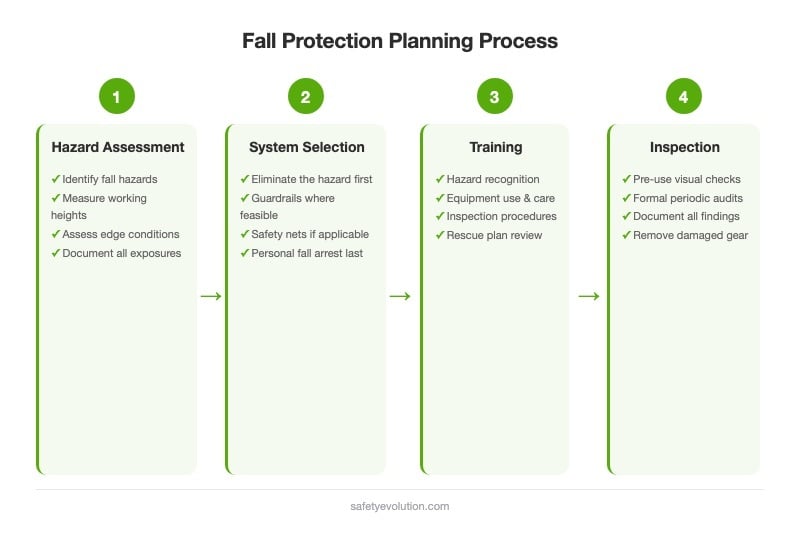
Most people think fall protection means harnesses and lanyards. That is the last option, not the first one. Fall protection follows a hierarchy of controls, from most effective (eliminate the hazard) to least effective (personal protective equipment). A contractor who jumps straight to harnesses without considering guardrails or design changes is both less safe and more expensive.
The hierarchy, from most to least effective:
- Elimination: Redesign the work so nobody needs to be at height. Prefabricate components at ground level. Use drones for inspections. This is the best solution and the one most contractors skip.
- Passive protection (guardrails, barriers): Physical barriers that require no action from the worker. Once installed, they protect everyone on the platform. OSHA requires a 42-inch top rail that withstands 200 pounds of force (1926.502(b)).
- Fall restraint: A system that prevents the worker from reaching the edge. A body belt or harness connected to a short tether keeps the worker within a safe zone. Lower risk than fall arrest because the worker never actually falls.
- Fall arrest: A system that stops a fall after it starts. Full-body harness, shock-absorbing lanyard or self-retracting device (SRL), and a rated anchor point. This is what most people picture when they hear "fall protection."
- Safety nets: Catches a falling worker. Used in bridge construction, steel erection, and other situations where personal fall arrest is impractical. OSHA requires nets with 6-by-6-inch maximum mesh openings and 5,000-pound border ropes (1926.502(c)).
- Administrative controls: Warning lines, safety monitors, controlled access zones. These are the weakest form of protection and only allowed in limited situations, primarily low-slope roofing work (1926.502(f)(g)).
Here is the blunt truth: if a worker falls and they are wearing a harness, the system worked. But a guardrail would have prevented the fall entirely. The hierarchy exists because preventing the fall is always better than catching it.
Types of Fall Protection Systems
Understanding the different system types helps you match the right protection to the specific hazard on your site. Each system has its place, and using the wrong one creates a false sense of security.
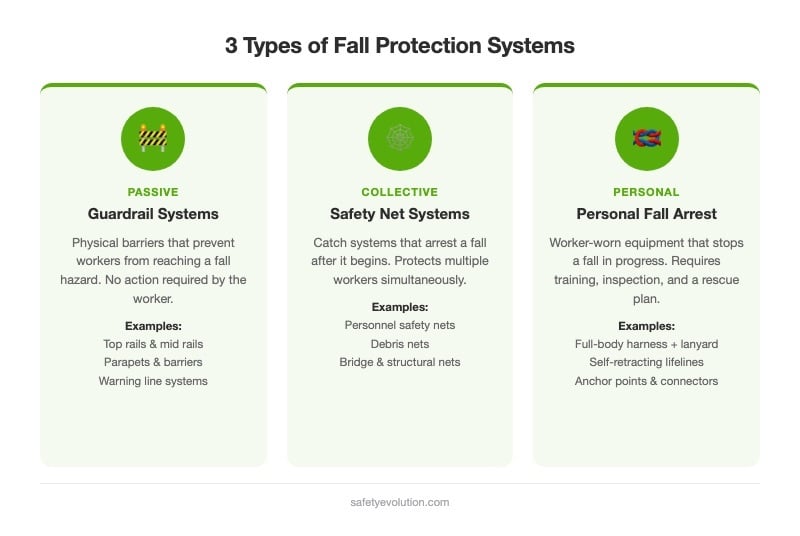
Guardrails (Passive Protection)
Guardrails are the most reliable fall protection system because they require no action from the worker. OSHA construction standards (1926.502(b)) require a 42-inch (+/- 3 inches) top rail, a mid-rail at roughly 21 inches, and the ability to withstand a 200-pound force applied in any direction. In Canada, CSA Z259.18 covers counterweighted guardrail systems. Guardrails work best on permanent edges, open-sided floors, elevated platforms, and scaffolding.
Fall Restraint Systems
Fall restraint keeps the worker from reaching the fall hazard. A body belt or harness connected to a short lanyard and anchor point prevents the worker from getting close enough to the edge to fall. The advantage: the worker never actually falls, so there is no impact force, no suspension trauma risk, and no rescue situation. Fall restraint is often overlooked because contractors default to fall arrest, but for tasks near a defined edge, restraint is simpler and safer.
Personal Fall Arrest Systems (PFAS)
A PFAS stops a fall after it begins. The system has three components: a full-body harness (CSA Z259.10 in Canada, ANSI Z359.11 in the US), a connecting device (shock-absorbing lanyard or self-retracting lifeline/SRL), and a rated anchor point capable of supporting 5,000 pounds per person (OSHA) or designed by a qualified engineer.
Self-retracting devices (SRLs, certified to CSA Z259.2.2 or ANSI Z359.14) are increasingly standard because they limit free-fall distance to less than 2 feet. A shock-absorbing lanyard allows up to 6 feet of free fall. Both must limit maximum arresting force to 8 kN (1,800 lbf).
Critical point: fall clearance calculation. You need enough clearance below the worker for the system to deploy fully before the worker hits the lower surface. On a scaffold 12 feet up with a 6-foot lanyard and 3.5-foot deceleration distance, the math barely works. For detailed calculations, see our types of fall protection systems guide.
Safety Nets
Safety nets catch falling workers before they hit a lower surface. OSHA requires nets to be installed within 30 feet below the working surface, with mesh openings no larger than 6 by 6 inches and border ropes rated for 5,000 pounds (1926.502(c)). Nets must be tested with a 400-pound sandbag drop before use. They are most common in bridge construction and steel erection.
Warning Line Systems and Controlled Access Zones
Warning lines and controlled access zones are the weakest form of fall protection. OSHA limits their use to specific situations: primarily low-slope roofing work where other methods are infeasible. Warning lines must be erected no closer than 6 feet from the roof edge, with flags at 6-foot intervals. A safety monitor must be designated. These systems depend entirely on human behaviour, which is why they sit at the bottom of the hierarchy.
Not sure where your fall protection program is exposed?
See missing training, inspections, and corrective actions before they become stop-work or audit issues.
Start Your 30-Day Free Trial →
Fall Protection Equipment Standards
Every piece of fall protection equipment must be certified to the applicable standard. In Canada, that is the CSA Z259 series. In the United States, it is the ANSI Z359 series. Using non-certified equipment is a violation in both countries, and in the event of a fall, it exposes you to both regulatory penalties and civil liability.
| Equipment |
CSA Standard (Canada) |
ANSI Standard (US) |
| Full-body harness |
CSA Z259.10 |
ANSI Z359.11 |
| Self-retracting device (SRL) |
CSA Z259.2.2-17 (R2022) |
ANSI Z359.14 |
| Energy absorber / lanyard |
CSA Z259.11 |
ANSI Z359.13 |
| Vertical lifeline |
CSA Z259.2.5-17 |
ANSI Z359.2 |
| Anchor connector |
CSA Z259.15 |
ANSI Z359.18 |
| Fall arrester (vertical rail) |
CSA Z259.2.4:15 (R2020) |
ANSI Z359.2 |
Before every shift, a competent person must visually inspect all fall protection equipment for cuts, abrasion, corrosion, deformed hardware, and UV degradation. Any equipment involved in a fall arrest event must be removed from service immediately and inspected by a qualified person before reuse. For a detailed inspection process, see our fall protection inspection checklist.
Fall Protection Training Requirements
Equipment only works if workers know how to use it. A harness hanging by the wrong D-ring, a lanyard connected to an unrated anchor, or a worker who does not know how to adjust their chest strap are all scenarios that turn a fall arrest system into a failure.
US: OSHA Training Requirements
Under 29 CFR 1926.503, employers must provide training for each worker exposed to fall hazards. A designated competent person must conduct the training, covering: recognition of fall hazards, procedures for erecting and disassembling fall protection systems, proper use and inspection of equipment, and the rescue procedure if a fall occurs.
Retraining is required when a worker does not demonstrate understanding, when changes in the workplace make previous training obsolete, or when new fall protection systems are introduced. OSHA does not mandate a specific recertification interval, but annual refresher training is industry best practice.
Safety Evolution offers fall protection training through our learning management system, including Click Safety's OSHA-aligned fall protection course with instant certification and automatic expiry tracking.
Canada: Provincial Training Requirements
Every Canadian province requires workers to be trained before using fall protection equipment, but the specifics vary. Alberta's OHS Code, Section 140, requires that workers are trained in the specific fall protection system they will use, including proper fitting, inspection, and emergency procedures. Training must be site-specific.
Ontario stands alone with a mandatory Working at Heights (WAH) training requirement. Since 2015, any construction worker who may use a fall protection system must complete a WAH course delivered by a Chief Prevention Officer-approved training provider. This is a legal requirement, not a recommendation.
For a complete breakdown of training requirements by province and state, read our fall protection training guide.
Fall Protection Penalties
The financial consequences of fall protection violations are steep in both countries. But here is what most contractors miss: the penalties are per violation, not per inspection. A site with 10 workers at height without proper fall protection is 10 violations, not one.
US: OSHA Penalties (2025)
As of January 15, 2025, OSHA's penalty schedule sets the following maximum fines:
| Violation Type |
Maximum Penalty |
| Serious |
$16,550 per violation |
| Willful or repeated |
$165,514 per violation |
| Failure to abate |
$16,550 per day |
Fall protection has been the #1 most-cited OSHA violation for 15 consecutive years. In FY 2025, OSHA issued 5,914 fall protection citations. A multi-site contractor with the same violation across three projects can face six-figure penalties before the willful multiplier even applies.
Canada: Provincial Penalties
Canadian provinces enforce fall protection violations through stop-work orders, administrative penalties, and prosecution. Alberta imposes fines of up to $500,000 per count for individuals and $1,000,000 for corporations under the OHS Act. British Columbia issues stop-work orders immediately upon discovering unprotected workers at height, and administrative penalties can reach $721,736 for repeat violations. Ontario combines fines with the possibility of imprisonment for directors and officers who fail to ensure compliance.
Still chasing fall protection evidence across files and inboxes?
Centralize corrective actions and proof so your next review is predictable.
Start Your 30-Day Free Trial →
Frequently Asked Questions
What is the OSHA fall protection height requirement?
OSHA requires fall protection at 6 feet (1.8 m) in construction under 29 CFR 1926.501, at 4 feet (1.2 m) in general industry under 29 CFR 1910.28, and at 5 feet in shipyards. Fall protection is also required regardless of height when workers are exposed to impalement hazards, hazardous substances, or dangerous equipment.
What are the main types of fall protection?
The main types of fall protection are guardrails (passive protection), fall restraint systems, personal fall arrest systems (harness, lanyard, anchor), safety nets, and administrative controls (warning lines, safety monitors). These follow a hierarchy from most effective (guardrails) to least effective (administrative controls).
How often does fall protection equipment need to be inspected?
Fall protection equipment must be visually inspected by a competent person before each use. OSHA and CSA standards require that any equipment involved in a fall arrest event be immediately removed from service and inspected by a qualified person. Annual formal inspections by a trained inspector are industry best practice and required by many employers and site owners.
Do I need a written fall protection plan?
In the US, OSHA requires a written fall protection plan when conventional fall protection methods are infeasible or create a greater hazard (29 CFR 1926.502(k)). In Alberta, a written fall protection plan is required whenever a worker may fall 3 metres or more and is not protected by guardrails. Most provinces and good safety practice require documented plans for any elevated work. See our fall protection plan guide for templates and requirements.
What happens if a worker falls while wearing a harness?
If the fall arrest system works correctly, the harness stops the fall and the worker hangs suspended. The immediate risk shifts to suspension trauma (also called harness hang syndrome), which can be fatal within minutes if the worker is not rescued. OSHA requires employers to have a rescue plan in place before any work at height begins. Time to rescue must be minimized. For rescue planning, see our fall protection rescue plan guide.
Get Weekly Safety Insights
Regulation updates, toolbox talk ideas, and compliance tips. One email per week.