Last updated: March 2026
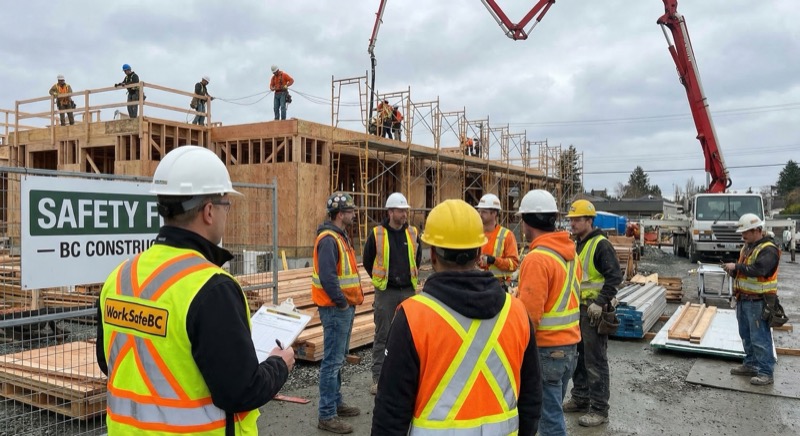
You won the contract. You brought in two subs, a crane operator, and an electrical crew. Three weeks later, a WorkSafeBC officer walks on site, finds gaps in hazard communication between your trades, and names you as the responsible party. Not the sub who missed the briefing. You.
That's what it means to be the prime contractor in British Columbia. We work with contractors across BC who land in this exact situation every month: they signed a contract, took on the prime contractor role, and didn't fully understand what WorkSafeBC expected them to coordinate. The penalties are real, the liability is personal, and the rules aren't optional.
⚡ Quick Answer: Prime Contractor in BC
- What: The person or company responsible for coordinating health and safety across all employers on a multi-employer worksite
- Who decides: A written agreement with the owner designates the prime contractor. No agreement? The owner is automatically the prime contractor.
- Legal basis: BC Workers Compensation Act, Section 24
- Maximum penalty: Up to $816,148 per violation (as of January 2026)
- Why it matters: You are personally accountable for OHS coordination across every employer and worker on site
What Is a Prime Contractor Under WorkSafeBC Rules?
A prime contractor is the employer, directing contractor, or other person who enters into a written agreement with a worksite owner to coordinate occupational health and safety across all employers working at the same location at the same time. Under BC's Workers Compensation Act (Section 13), this applies to any "multiple-employer workplace," which simply means a site where workers from two or more employers are present simultaneously.
The key word is written. If there's a signed agreement designating you as the prime contractor, you hold the role. If there's no written agreement at all, the owner of the worksite defaults into the prime contractor role whether they realize it or not.
This catches more people than you'd expect. A property developer hires a general contractor but never puts the prime contractor designation in writing. As far as WorkSafeBC is concerned, the developer just inherited full OHS coordination responsibility for every trade on that site.
What Does a Prime Contractor Actually Have to Do?
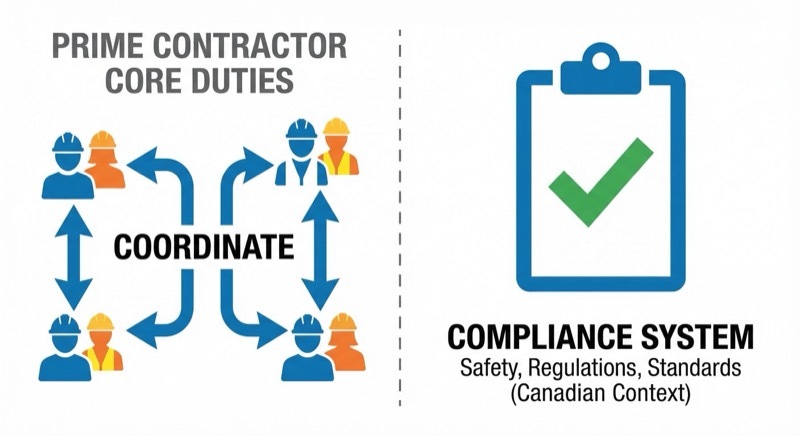
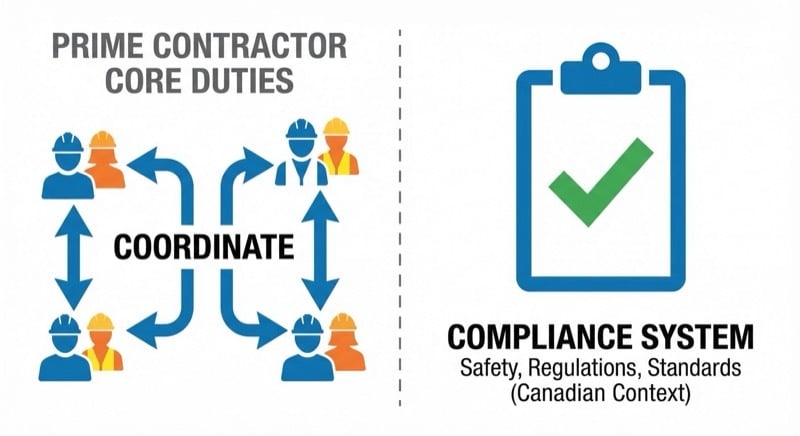
Section 24 of BC's Workers Compensation Act lays out two core duties. They sound simple on paper. In practice, they're the reason prime contractors get fined.
Duty 1: Coordinate all OHS activities on site. Every employer, every worker, every visitor. If two trades are working near each other and neither knows what the other is doing, that's your problem. If a sub brings untrained workers and nobody catches it, that's your problem. The coordination piece means you need active oversight, not a binder on a shelf.
Duty 2: Establish and maintain a system that ensures compliance. You need a documented process that ensures every employer and worker on your site follows the OHS Regulation and the Workers Compensation Act. This isn't just posting rules in the lunchroom. It means orientation procedures for every sub, regular site inspections, hazard communication between trades, and a paper trail that proves it all happened.
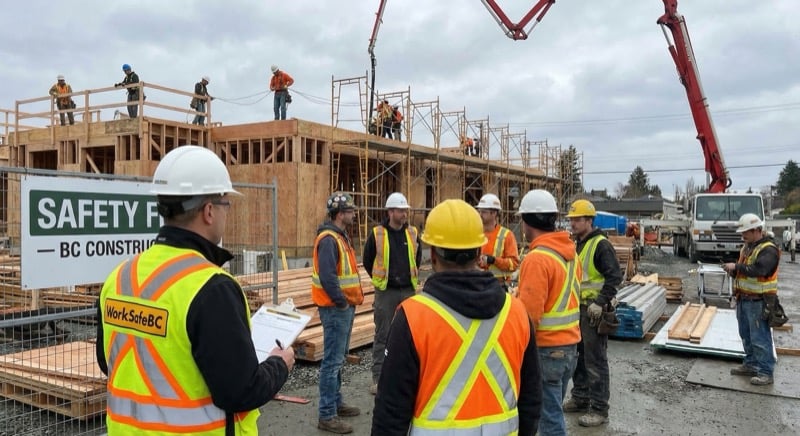
Here's what that looks like on a real site. A 40-unit residential build in Surrey with a framing crew, plumbers, electricians, and a roofing sub, all overlapping. The prime contractor needs:
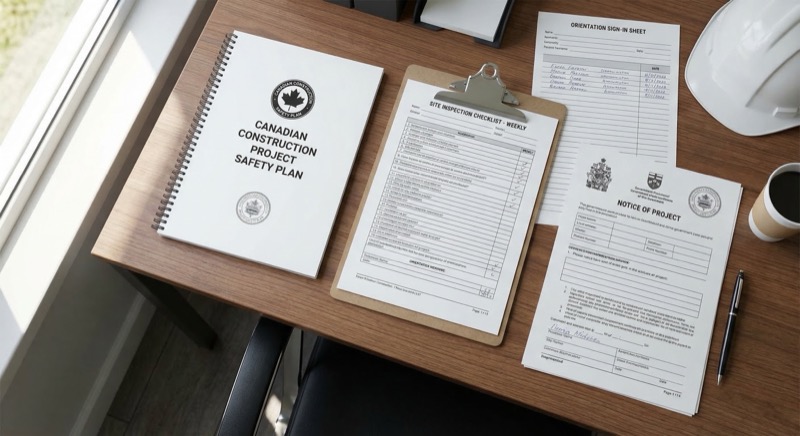
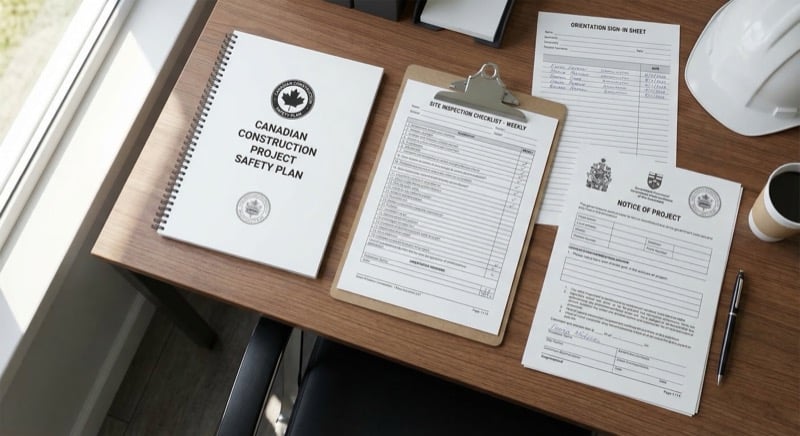
- A site-specific safety plan covering all trades
- Documented orientations for every sub and every worker who steps on site
- Regular safety meetings coordinating work between overlapping trades
- A system for tracking hazard reports, corrective actions, and inspection results
- First aid coverage that accounts for the total number of workers from all employers (OHS Regulation Section 3.20)
- A Notice of Project (NOP) filed with WorkSafeBC at least 24 hours before construction begins
Most contractors handle the first two. It's the ongoing coordination, the daily overlap management between trades, where things break down.
Not sure if your current setup would hold up under a WorkSafeBC inspection? SE-AI analyses your existing records and tells you exactly where your coordination system has gaps.
Who Gets Designated as Prime Contractor?
Most contractors think the GC is automatically the prime contractor. They're wrong.
The prime contractor role isn't assigned by default based on project hierarchy. It's assigned by a written agreement between the owner and the party taking on coordination responsibility. In many construction contracts, yes, the general contractor ends up as prime contractor. But that designation has to be explicit and documented.
Without that written agreement, here's what happens:
- The owner is the prime contractor by default under Section 13 of the Act
- The owner can designate a GC, project manager, or another employer as prime contractor through a written agreement
- The designation must be clear, specific, and ideally referenced in the contract
- Subcontractors are almost never prime contractors, but they retain responsibility for their own workers' health and safety
A common mistake: a developer verbally tells the GC "you're handling safety" but never puts it in writing. When WorkSafeBC shows up and asks for the prime contractor agreement, nobody can produce one. The developer just became the prime contractor, with all the liability that comes with it. For a full breakdown of how safety responsibility is distributed across the chain, see our guide on who is responsible for worker safety.
What If Your Site Coordination Records Were Always Inspection-Ready?
SE-AI tracks orientations, inspection reports, and trade coordination records across your entire site. Ask “are all trades current on orientation?” and get the answer instantly.
Be the First to Try It →
What Happens When a Prime Contractor Fails?
Here's the blunt truth: WorkSafeBC doesn't care about your intentions. They care about your system and whether it was working.
In December 2025, WorkSafeBC fined EllisDon over $1.2 million for crane safety violations at the Oakridge Park construction site in Vancouver. EllisDon was the prime contractor. A worker died in February 2024 after a concrete forming incident. The investigation found multiple high-risk violations, including failure to establish adequate exclusion zones and failure to coordinate health and safety activities across the multi-employer site.
That's not an isolated case. In 2024 alone, WorkSafeBC imposed 361 administrative penalties totalling $7.6 million across the province. The maximum penalty per violation is now $816,148 (as of January 2026), and penalties scale based on the severity of the violation, your company's payroll, and whether you've been cited for similar issues before.
Prime contractor failures that trigger penalties include:
- Failing to coordinate OHS activities between multiple employers
- No documented system for ensuring compliance on a multi-employer site
- Inadequate site orientations for subcontractor workers
- Missing or incomplete Notice of Project
- Failure to ensure first aid coverage reflects the total workforce on site
- Not investigating and reporting incidents involving workers from any employer on site
The due diligence defense exists. If you can prove you took all reasonable care to prevent the violation, a penalty may be overturned. SE-AI helps you verify whether that documented evidence trail actually exists. But "reasonable care" means you had a system, it was documented, it was active, and you can prove all of that. A binder in the trailer that nobody opened since 2019 doesn't qualify.
How Do You Build a Prime Contractor Compliance System?
This is where most contractors stall. They know they need a system. They don't know what that actually looks like in practice. Here's the framework that holds up under WorkSafeBC scrutiny.
1. Get the Written Designation Right
Before the first shovel hits dirt, make sure the prime contractor designation is in writing, signed by the owner, and referenced in your contract. If you're the GC taking on the role, your contract should explicitly state your prime contractor responsibilities. If you're the owner and you want someone else to handle it, get that agreement signed before work begins.
2. Build a Site-Specific Safety Plan
Your health and safety management system needs to address the specific hazards and trade overlaps on your project. A generic company safety manual isn't enough. The plan should cover hazard identification, emergency procedures, communication protocols between trades, and escalation procedures when somebody isn't following the rules.
3. Mandate Sub Orientations
Every subcontractor, every worker, every time. No exceptions. SE-AI shows you which workers have completed orientation and which still need it. Your site orientation should cover site-specific hazards, emergency procedures, reporting requirements, and the coordination rules that apply to everyone on the project. Document who attended, when, and what was covered.

4. Run Coordinated Safety Meetings
Weekly at minimum. When trades overlap, daily pre-task meetings covering shared hazards, exclusion zones, and sequencing. These meetings are where coordination actually happens, not in a document. But document the meetings too, because WorkSafeBC will ask for those records.
5. Inspect and Correct Continuously
Regular site inspections covering all trades, all areas, all hazards. SE-AI surfaces inspection findings and flags corrective actions that are still open. When you find something wrong, fix it and document the correction. OHS Regulation Section 3.9 requires unsafe conditions found during inspections to be remedied without delay. "We flagged it" isn't the same as "we fixed it."
6. File Your Notice of Project
For construction projects, the owner or prime contractor must submit a Notice of Project (NOP) to WorkSafeBC at least 24 hours before work begins. You can submit it online through WorkSafeBC's NOP portal. This is a simple step that gets missed more often than it should.
If all of this feels like a second full-time job on top of running the actual project, you're not wrong. That's exactly why contractors bring in Safety Evolution. We build and manage your safety program so your coordination system is audit-ready from day one: documented orientations, inspection schedules, meeting templates, and a paper trail that proves compliance. sign up for SE-AI early access and see how your current setup measures up against WorkSafeBC requirements.
What's the Difference Between Prime Contractor and Employer Responsibilities?
This trips people up constantly. Being the prime contractor does not make you responsible for every individual employer's safety program. Each employer on your site still has to maintain their own health and safety program, train their own workers, and comply with the OHS Regulation for their own operations.
Your job as prime contractor is the layer on top: coordination, communication, and a system that ensures everyone is following the rules. Think of it as traffic control for safety. You're not driving every truck, but you're making sure no one crashes into each other.
Where it gets complicated is when a sub's failure creates a hazard that affects other workers on site. If a framing crew leaves unsecured materials on an upper floor and a plumber on the floor below gets hit, WorkSafeBC may look at both the framing sub (for creating the hazard) and the prime contractor (for failing to coordinate and inspect). You can't just say "that's their problem."
The BCCSA Training Option
The BC Construction Safety Alliance (BCCSA) offers a dedicated Prime Contractor Responsibilities course. It's an interactive, video-based course covering regulatory requirements, coordination practices in multi-employer settings, and the OHS systems needed for compliance. If you're new to the prime contractor role or want your project managers trained up, it's worth looking into at bccsa.ca.
What If You Could Just Ask?
“Which trades haven't submitted their pre-task plan today?” “When was the last joint safety meeting documented?” Get answers from your own site records in seconds.
Be the First to Try It →
Frequently Asked Questions
Who is the prime contractor on a BC construction site?
The prime contractor is the person or company designated by a written agreement with the worksite owner to coordinate occupational health and safety across all employers on a multi-employer site. If no written agreement exists, the owner is the prime contractor by default under BC's Workers Compensation Act, Section 13.
What are the main responsibilities of a prime contractor in BC?
Under Section 24 of the Workers Compensation Act, a prime contractor must (1) ensure that all OHS activities of employers, workers, and other persons at the workplace are coordinated, and (2) establish and maintain a system or process to ensure compliance with the OHS Regulation and the Act.
What is the maximum fine for a prime contractor violation in BC?
As of January 2026, the maximum administrative penalty WorkSafeBC can impose is $816,148 per violation. Penalty amounts are based on the severity of the violation, the employer's payroll, and their violation history. High-risk violations and repeat offences result in higher penalties.
Does the prime contractor need to file a Notice of Project with WorkSafeBC?
Yes. For construction projects, the owner or prime contractor must submit a Notice of Project (NOP) to WorkSafeBC at least 24 hours before construction work begins. The NOP can be filed online through WorkSafeBC's portal and must include details about the owner, prime contractor, and the nature of the project.
Can a subcontractor be designated as the prime contractor?
Technically, any employer or directing contractor can be designated as prime contractor through a written agreement with the owner. In practice, subcontractors are rarely designated as prime contractors because they typically don't have authority over the entire site. The role usually falls to the general contractor or the owner.
Stop Guessing, Start Coordinating
Prime contractor responsibilities in BC aren't something you figure out after WorkSafeBC shows up. The written designation, the coordination system, the documented orientations, the inspection records: all of it needs to be in place before your trades start overlapping on site.
Safety Evolution builds audit-ready safety programs for contractors across BC. We set up your prime contractor coordination system, build your site-specific safety plans, create your orientation and inspection templates, and give you a system that proves compliance when it matters. Your first step is signing up for SE-AI early access to see where your current setup stands.
Sign up for SE-AI early access and let your safety data tell you exactly where you stand. Compliance gaps, training status, inspection records: answered in seconds.
Get Weekly Safety Insights
Regulation updates, toolbox talk ideas, and compliance tips. One email per week.