Last updated: March 2026
You send a crew to a commercial demolition job. Halfway through the morning, a chunk of concrete kicks off the breaker and catches your newest guy in the face. He was wearing safety glasses, not goggles. Three days off work, a WCB claim, and a conversation with an OHS inspector you did not want to have.
That is what a PPE gap looks like in real life. Not a training video. Not a poster in the lunchroom. A 22-year-old holding a bandage to his eye while your foreman fills out paperwork.
We help contractors across Canada build safety programs that hold up under pressure. We have seen what happens when PPE decisions get made by habit instead of hazard assessment, and it is never pretty. This guide breaks down what PPE actually is, the categories that matter on a construction site, who is responsible for what, and how to stop treating PPE like an afterthought. If you need expert help setting up your safety program, Safety Evolution is a done-for-you safety department built for contractors like you.
⚡ Quick Answer
- What: PPE (personal protective equipment) is any device or clothing worn by a worker to minimize exposure to workplace hazards that cannot be fully eliminated through engineering or administrative controls.
- Categories: Head, eye/face, hearing, respiratory, hand, foot, body, and fall protection.
- Who pays: Varies by province. In most Canadian jurisdictions, employers must provide or pay for required PPE.
- Key rule: PPE is the last line of defense in the hierarchy of controls, not the first.
- Why it matters: Proper PPE reduces injury severity. Improper PPE creates liability, WCB claims, and OHS enforcement actions.
What Is PPE and Why Does It Matter on a Construction Site?
Personal protective equipment (PPE) is any device, clothing, or barrier worn by a worker to reduce exposure to hazards that could cause injury or illness. On a construction site, that means everything from the hard hat on your head to the steel-toed boots on your feet.
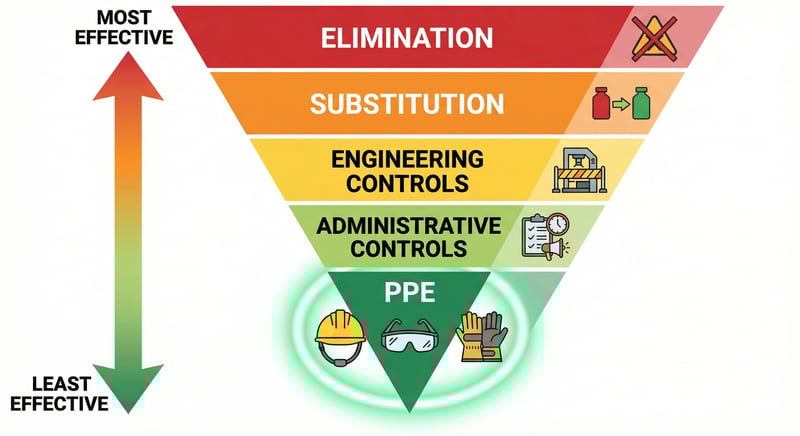
Here is the part most contractors get wrong: PPE is not your safety program. It is the last layer. The Canadian Centre for Occupational Health and Safety (CCOHS) places PPE at the bottom of the hierarchy of controls, below elimination, substitution, engineering controls, and administrative controls. That means if you can remove the hazard or engineer it away, you do that first. PPE is what protects your crew when those other controls are not enough.
Think about it this way. A guardrail on a rooftop edge (engineering control) prevents falls. A harness and lanyard (PPE) catches a worker after they fall. One prevents the event. The other reduces the consequence. Both matter, but the order matters more.
That distinction is not academic. OHS inspectors in Alberta and BC will ask about your hierarchy of controls during a site visit. If the only answer you have is "we gave everyone hard hats," you are going to have a bad day.
What Are the 8 Categories of PPE for Construction?
PPE breaks down into eight categories. Every construction site will need some combination of these, depending on the work being done.
| Category |
Equipment Examples |
Common Construction Hazards |
| Head Protection |
Hard hats (Type 1, Type 2), bump caps |
Falling objects, overhead hazards, electrical contact |
| Eye and Face Protection |
Safety glasses, goggles, face shields, welding helmets |
Flying debris, dust, chemical splash, welding arc, UV radiation |
| Hearing Protection |
Earplugs, earmuffs |
Power tools, heavy equipment, impact drivers, concrete saws |
| Respiratory Protection |
N95 respirators, half-face respirators, full-face PAPR |
Silica dust, welding fumes, asbestos, spray paint, confined spaces |
| Hand Protection |
Leather gloves, cut-resistant gloves, chemical-resistant gloves, insulated gloves |
Sharp materials, chemicals, vibration, electrical, heat/cold |
| Foot Protection |
Steel-toed boots, metatarsal guards, puncture-resistant soles |
Falling objects, puncture hazards, electrical, slippery surfaces |
| Body Protection |
High-visibility vests, flame-resistant clothing, coveralls |
Vehicle traffic, flash fire, chemical splash, weather exposure |
| Fall Protection |
Full-body harnesses, lanyards, self-retracting lifelines, anchor points |
Work at heights above 3 metres (10 feet) in most provinces |
Not every worker needs every category every day. A concrete finisher at grade level has different PPE needs than a structural ironworker 20 storeys up. That is why the hazard assessment drives the PPE selection, not the other way around. Your daily field-level hazard assessment (FLHA) should identify which PPE categories apply to each task.
Who Is Responsible for PPE in Canada?
Most contractors think PPE responsibility is simple: buy the gear, hand it out, done. They are wrong.
In Canada, PPE obligations are split between employers and workers, and the specifics depend on your province. Here is the general breakdown according to CCOHS and provincial OHS legislation:
Employer responsibilities:
- Conduct hazard assessments to determine what PPE is needed
- Provide or ensure workers have the required PPE
- Train workers on proper use, care, and limitations of each type of PPE
- Ensure PPE meets applicable CSA or other recognized standards
- Replace damaged or worn-out PPE
- Enforce PPE use on site
Worker responsibilities:
- Wear all required PPE properly
- Inspect PPE before each use
- Report damaged or defective equipment immediately
- Participate in PPE training
- Not modify PPE in any way that reduces its effectiveness
Who Pays for PPE? Province-by-Province Rules
This is where it gets messy, and where a lot of contractors make expensive assumptions.
According to CCOHS, the rules on who pays for PPE vary by province:
- Alberta: Employers must provide and pay for PPE required for emergency response, hearing protection, and respiratory protection. The legislation does not specify who pays for other PPE categories like boots or hard hats.
- British Columbia: Workers are responsible for providing their own safety headgear and safety footwear. The employer must provide, at no cost to the worker, all other items of PPE required by WorkSafeBC regulation.
- Saskatchewan, Quebec, Northwest Territories, Nunavut: Employers must provide all required PPE at no cost to the worker.
- Ontario, New Brunswick, Nova Scotia, PEI, Newfoundland: The legislation says employers must "provide" PPE, but the term is not always clearly defined. Check with your jurisdiction for the exact interpretation.
The blunt truth: if you are a contractor running a crew, do not be the company that nickels and dimes workers over safety boots. Even where the law does not explicitly require you to pay, the best contractors cover basic PPE. It costs less than one WCB claim, and your workers will respect you for it.
A PPE Program Is Only as Good as Its Documentation
SE-AI checks your PPE hazard assessments, training records, and inspection logs to find where your documentation does not match your program requirements.
Get Early Access →
How Does PPE Fit Into the Hierarchy of Controls?
Every safety professional, regulator, and COR auditor talks about the hierarchy of controls. Here is how it works in practice:
- Elimination: Remove the hazard entirely. Example: use a crane instead of manual lifting.
- Substitution: Replace the hazard with something less dangerous. Example: use a water-based solvent instead of a petroleum-based one.
- Engineering Controls: Isolate people from the hazard. Example: install guardrails, ventilation systems, machine guarding.
- Administrative Controls: Change the way people work. Example: rotate crews to limit exposure time, post warning signs, conduct toolbox talks.
- PPE: Protect the individual worker. Example: respirators, harnesses, gloves, hard hats.
PPE is at the bottom because it does not eliminate the hazard. It only protects the worker if the equipment is worn correctly, maintained properly, and appropriate for the specific hazard. A respirator only works if it fits, the cartridges are current, and the worker actually wears it.
That said, PPE is essential. In construction, you cannot engineer away every hazard. Falling objects, noise, dust, and height work are inherent to the industry. PPE is what stands between your crew and those hazards every single shift.
What CSA Standards Apply to PPE in Canada?
In Canada, PPE must meet standards published by the Canadian Standards Association (CSA Group). GCs and OHS inspectors will check for CSA markings. Here are the key standards for construction PPE:
| PPE Category |
CSA Standard |
| Head Protection |
CSA Z94.1 (Industrial Protective Headwear) |
| Eye and Face Protection |
CSA Z94.3 (Eye and Face Protectors) |
| Hearing Protection |
CSA Z94.2 (Hearing Protection Devices) |
| Foot Protection |
CSA Z195 (Protective Footwear) |
| Hand Protection |
Various (CSA does not have a single glove standard; selection is hazard-based) |
| Respiratory Protection |
CSA Z94.4 (Selection, Use, and Care of Respirators) |
| Fall Protection |
CSA Z259 series (Fall Protection) |
| High-Visibility Clothing |
CSA Z96 (High-Visibility Safety Apparel) |
If a worker shows up to your site with a hard hat that does not have a CSA Z94.1 marking, it does not count. Same goes for boots without the CSA green triangle. This is not optional. Provincial OHS legislation in Alberta (Part 18) and BC (Part 8) references these standards directly.
How Do You Select the Right PPE for Each Job?
PPE selection should never be based on what is cheapest in the supply catalog. It starts with a hazard assessment and ends with a worker who understands exactly why they are wearing each piece of equipment.
Here is the practical process:
- Identify the hazards. Walk the site. Review the scope of work. Check your FLHAs. What are the physical, chemical, biological, and ergonomic hazards present?
- Assess the risk. How likely is exposure? How severe could the outcome be? A grinder throwing sparks is not the same risk as a worker 50 feet in the air.
- Match PPE to the hazard. Choose equipment rated for the specific risk. Do not use safety glasses where goggles are needed. Do not use a dust mask where a half-face respirator is required.
- Ensure proper fit. PPE that does not fit does not protect. Respirators need fit testing. Hard hats need adjustable suspensions. Gloves that are too large create snag hazards.
- Train your crew. Every worker needs to know how to put on, adjust, use, and inspect their PPE. If they have never done a PPE training course, send them.
We see this go sideways all the time: a contractor buys a bulk order of one-size gloves because the price was right, then wonders why nobody wears them. Fit and comfort are not luxuries. They are the difference between PPE that gets worn and PPE that sits in the gang box.
What Are Common PPE Mistakes Contractors Make?
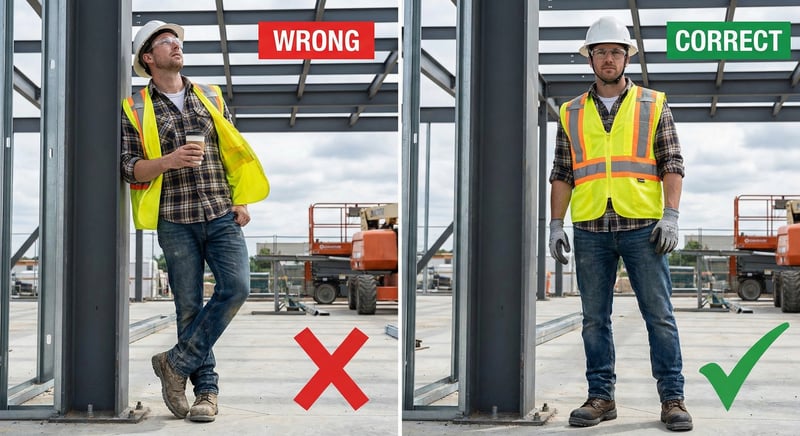
After years of helping contractors build and audit their safety programs, here are the PPE mistakes we see over and over:
- Using the same PPE for every task. A guy doing finish carpentry does not need the same respiratory protection as the crew doing concrete cutting. Match the PPE to the task, not the trade.
- Ignoring inspection and replacement cycles. Hard hats degrade in UV light. Harness webbing frays. Respirator cartridges expire. If you do not have a system for inspecting and replacing PPE, the gear your crew is wearing right now might not protect them.
- No fit testing for respirators. This is a regulatory requirement, not a suggestion. A respirator that does not seal to the face is just a dust collector hanging around someone's neck.
- Treating PPE as the entire safety program. PPE does not replace guardrails, ventilation, or proper procedures. If your only answer to every hazard is "wear a mask" or "put on a harness," your program has a structural problem.
- No training beyond "here is your gear." Handing someone a harness without showing them how to do a pre-use inspection is negligent. Full stop.
If any of these sound familiar, you are not alone. Most contractors know they need PPE. Fewer know how to manage it as a program. That is exactly the gap SE-AI is designed to close: it analyses your existing PPE records and shows you exactly where documentation, training, and inspection gaps are.
How Do You Build a PPE Program That Works?
A PPE program is not a binder on a shelf. It is a living system that connects hazard assessments, equipment selection, training, inspection, and enforcement. According to CCOHS, an effective PPE program includes:
- Hazard identification and risk assessment for every job and task
- PPE selection matched to the identified hazards and meeting applicable CSA standards
- Proper fitting of all PPE, with fit testing where required (respirators)
- Worker training on use, care, maintenance, and limitations
- Inspection and maintenance schedules with documented records
- Enforcement of PPE requirements with clear consequences for non-compliance
- Regular program review and updates as conditions, tasks, or regulations change
If you are a contractor owner who knows your PPE program needs work but does not know where to start, read our detailed guide: How to Build a PPE Program for Your Construction Company.
For a deeper dive into training requirements, see PPE Training Requirements: What Canadian Employers Must Know.
What PPE Do You Need for Specific Construction Tasks?
Different tasks demand different protection. Here is a practical reference for common construction work:
| Task |
Minimum PPE Required |
| General site access |
Hard hat, safety glasses, high-vis vest, steel-toed boots |
| Concrete cutting/grinding |
All basic PPE + half-face respirator (silica), hearing protection, face shield |
| Welding |
Welding helmet with proper shade lens, flame-resistant clothing, leather gloves, steel-toed boots, hearing protection |
| Work at heights (above 3m) |
All basic PPE + full-body harness, lanyard, anchor point connection |
| Electrical work |
Voltage-rated gloves, arc-flash rated clothing, face shield, insulated boots |
| Demolition |
All basic PPE + goggles (not just glasses), hearing protection, respirator if dust/asbestos present |
| Painting/coating |
Respirator (organic vapour cartridge), chemical-resistant gloves, eye protection, coveralls |
This table is a starting point, not a substitute for a proper hazard assessment. Site conditions, weather, confined spaces, and overlapping work activities can all change what is needed. Run your toolbox talk before each shift and review PPE requirements as part of that conversation.
For a complete breakdown by PPE type, see our guide: Types of PPE: Head-to-Toe Protection Guide.
For construction-specific regulatory requirements, read: PPE Requirements for Construction Sites in Canada.
Is Your PPE Program Documented Well Enough for an Audit?
SE-AI analyses your PPE program documentation: hazard assessments, equipment assignments, training records, and inspection logs. It flags the gaps between what your program says and what your records actually show.
Get Early Access to SE-AI →
Frequently Asked Questions
What does PPE stand for?
PPE stands for personal protective equipment. It refers to any wearable device or clothing designed to protect workers from workplace hazards, including hard hats, safety glasses, gloves, respirators, harnesses, and protective footwear.
Is an employer required to pay for PPE in Canada?
It depends on the province. In Saskatchewan, Quebec, and the territories, employers must provide all required PPE at no cost. In BC, workers are responsible for their own hard hats and boots, but employers pay for everything else. Alberta requires employers to pay for emergency, hearing, and respiratory PPE. Check your provincial OHS legislation for exact requirements.
What is the minimum PPE required on a construction site?
The absolute minimum for most Canadian construction sites is a CSA-approved hard hat, safety glasses with side shields, high-visibility vest, and CSA-approved steel-toed boots (green triangle). Additional PPE is required based on the specific hazards identified in the job hazard assessment. Work at heights, welding, concrete cutting, and electrical work all require specialized PPE beyond the basic four.
How often should PPE be inspected?
Workers should visually inspect all PPE before every use. More thorough inspections should follow manufacturer guidelines: hard hats every 5 years or after any impact, harnesses annually by a competent person, and respirators before every use with cartridge changes per the schedule. Document all inspections.
Where does PPE fit in the hierarchy of controls?
PPE is the last line of defense in the hierarchy of controls, below elimination, substitution, engineering controls, and administrative controls. It should only be used when higher-level controls cannot adequately reduce the risk, or as an interim measure while other controls are being implemented. In construction, PPE is almost always needed alongside other controls because many hazards cannot be fully eliminated.
What PPE training must employers provide?
Employers must train workers on the proper selection, use, care, maintenance, and limitations of each type of PPE they are required to wear. This includes hands-on instruction for donning and doffing, pre-use inspection procedures, and fit testing for respirators. Training must be documented and refreshed when equipment or hazards change. For detailed training requirements, see our guide to PPE training requirements in Canada.
Get Weekly Safety Insights
Regulation updates, toolbox talk ideas, and compliance tips. One email per week.