Last updated: March 2026
You run a 30-person excavation company in Calgary. Your crew wears hard hats and steel toes because every GC requires it. But last month, an OHS inspector walked your site and asked to see your PPE program. Not your PPE. Your program. The documented system that shows how you select, assign, train, inspect, and replace protective equipment. You did not have one. Now you have a compliance order and 30 days to fix it.
This is the story we hear from contractors every week. They have PPE. They do not have a program. And in Canada, there is a legal and practical difference between the two that matters during audits, inspections, and incidents. The CCOHS is clear: a PPE program must include hazard identification, equipment selection, fitting, training, maintenance, and regular review.
We build safety programs for contractors who need them done right. This guide walks you through building a PPE program step by step, whether you are starting from scratch or formalizing what you already do.
⚡ Quick Answer
- What: A PPE program is a documented system for identifying hazards, selecting appropriate PPE, training workers, inspecting equipment, and enforcing compliance.
- Why: Required by provincial OHS legislation across Canada. Also a scored element in COR and SECOR audits.
- 7 steps: Hazard assessment, PPE selection, procurement, fitting, training, inspection/maintenance, enforcement and review.
- Common gap: Most contractors have PPE but no documented program. This fails audits and exposes you during incident investigations.
- Free Resource: Download our Construction Health & Safety Manual.
Why Do You Need a Formal PPE Program?
Most contractors think buying PPE is the same as having a PPE program. They are wrong, and the distinction has real consequences.
A PPE program is required because:
- Provincial OHS legislation demands it. Alberta's OHS Code and WorkSafeBC's OHS Regulation both require employers to have systematic processes for PPE selection, training, and maintenance. Having gear on a shelf is not compliance.
- COR and SECOR audits score it. If you hold or pursue a Certificate of Recognition (COR), your PPE program is a scored audit element. A weak program costs you audit points, which can cost you your certification.
- Incident investigations look at it. When a worker gets injured and the investigation asks "was the worker wearing appropriate PPE?" the next question is "how do you determine what is appropriate?" Without a program, you have no defensible answer.
- GCs require it. Major general contractors in Alberta and BC will ask to review your PPE program as part of prequalification. No program, no bid package review.
The bottom line: a PPE program is not paperwork for the sake of paperwork. It is the documented evidence that you take PPE seriously, and it protects your company when things go wrong.
Step 1: Conduct Hazard Assessments for Every Job
Everything starts here. You cannot select the right PPE if you do not know what hazards your workers face.
For a construction company, hazard assessments happen at three levels:
- Company-wide assessment: What hazards are common across all your projects? For an excavation company, that might be struck-by hazards (equipment, trench walls), noise, dust, and fall-from-height risks. This determines your baseline PPE requirements.
- Project-specific assessment: Each new site has unique hazards. A hospital renovation has asbestos risks. A pipeline job has confined space and H2S risks. Review the scope before your crew arrives.
- Daily task assessment (FLHA): The field-level hazard assessment your crew fills out before every shift. This is where task-specific PPE gets identified. Grinding today? Add goggles and hearing protection to the baseline. Working near an excavation edge? Add a harness. Use digital FLHA forms so this data feeds back into your program.
Document every assessment. This is the foundation your entire PPE program sits on. When an auditor asks "how did you determine your crew needs cut-resistant gloves for rebar work?" the answer is in the hazard assessment.
Step 2: Select PPE That Matches the Hazards
With hazards identified, select PPE that specifically addresses each one. This sounds obvious, but here is where we see contractors cut corners:
- Buying one type of glove for all tasks instead of matching glove type to hazard (cut-resistant for rebar, chemical-resistant for solvents, insulated for electrical)
- Using dust masks (non-rated) where respirators (NIOSH-approved) are required
- Providing Type 1 hard hats where Type 2 (lateral impact protection) is needed or required by the GC
Your PPE selection must reference applicable CSA standards. For a construction company, the core standards include CSA Z94.1 (head), Z94.3 (eye/face), Z94.2 (hearing), Z94.4 (respiratory), Z195 (foot), Z259 series (fall protection), and Z96 (high-visibility). Document which standard applies to each PPE category in your program.
Need a Complete Safety Program?
Stop starting from scratch. Download our Free Construction Health & Safety Manual to get compliant fast.
Download the Free Manual →
Step 3: Procure and Distribute PPE
Once you know what you need, set up a procurement system that actually works in the field:
- Maintain an approved PPE list with specific products, sizes, and suppliers. Do not let workers buy random gear that may not meet standards.
- Track distribution. Record who received what PPE and when. This is audit documentation and also helps with replacement scheduling. A simple sign-out sheet works. A safety management platform works better.
- Stock adequate sizes. PPE that does not fit does not protect. If your crew includes a range of body sizes, stock a range of PPE sizes. This is especially critical for respirators, gloves, and harnesses.
- Budget for replacement. PPE wears out, gets damaged, and expires. Budget for ongoing replacement, not just initial purchase.
Step 4: Train Every Worker on Their PPE
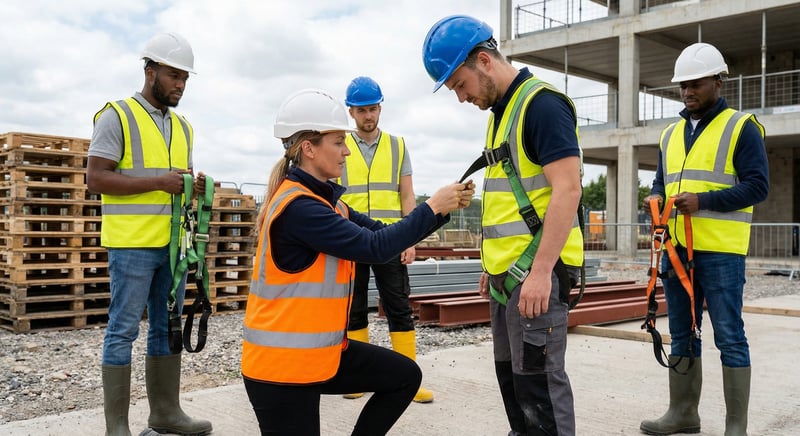
Training is the step most contractors rush through. A five-minute demo during orientation is not PPE training. According to CCOHS, effective PPE training must cover:
- Why the specific PPE is required (what hazard it protects against)
- How to properly put on, adjust, and take off each piece of equipment
- How to inspect PPE before each use and identify damage
- The limitations of the PPE (what it does not protect against)
- How to clean, store, and maintain the equipment
- When to request replacement
Training must be documented with the date, topics covered, and worker signatures. Retraining is required when equipment changes, new hazards are introduced, or a worker is observed using PPE incorrectly. For formal PPE training, Safety Evolution offers a course specifically built for construction workers.
For a full breakdown of what training is legally required, see our guide: PPE Training Requirements: What Canadian Employers Must Know.
Step 5: Establish Inspection and Maintenance Schedules
PPE degrades. UV exposure weakens hard hat shells. Harness webbing frays. Respirator elastics lose their seal. If you are not inspecting and maintaining PPE on a schedule, you are trusting equipment that may not work when it matters.
Your program should define:
- Pre-use inspections by workers: Every shift, before putting on PPE. Visual check for cracks, tears, missing parts, expiry dates.
- Periodic formal inspections: Monthly or quarterly by a competent person. Document the results.
- Manufacturer-specific schedules: Hard hats replaced per manufacturer guidelines (typically every 5 years from date of manufacture). Harnesses retired after a fall arrest event. Respirator cartridges replaced per schedule or when breakthrough is detected.
- Removal from service criteria: Define exactly when PPE must be taken out of service. Cracks, discoloration, fraying, failed fit test, or any impact event that could have compromised the equipment.
Keep records of all inspections. A documented inspection system is audit-ready and demonstrates due diligence.
Step 6: Enforce PPE Compliance
A program without enforcement is a suggestion. And suggestions do not prevent injuries.
Your PPE program needs a progressive discipline process for non-compliance:
- Verbal warning with on-the-spot correction
- Written warning documented in the worker's file
- Temporary removal from the work area until compliance is achieved
- Suspension or termination for repeated violations
But enforcement is not just punishment. The best contractors we work with pair enforcement with investigation. If a worker is not wearing their goggles, the question is not just "why are you not wearing them?" It is also "are the goggles comfortable? Do they fog up? Did you receive training on when they are required?" Sometimes non-compliance is a training gap or an equipment gap, not a discipline problem.
Supervisors must lead by example. A foreman who walks the site without his hard hat has just told every worker on that crew that PPE is optional. Set the standard from the top.
Step 7: Review and Update the Program Regularly
A PPE program is not a write-it-and-forget-it document. Review it:
- Annually as part of your overall safety program review
- After any serious incident involving PPE failure or non-use
- When new work activities are introduced that create new hazards
- When regulations change (provincial OHS codes are updated periodically)
- Before COR/SECOR audits to ensure documentation is current
Document every review with the date, who participated, and what changes were made. This creates an audit trail that shows your program is alive, not collecting dust.
For the broader PPE fundamentals, see our pillar guide: What Is PPE? Guide to Personal Protective Equipment. For province-specific regulatory requirements, read: PPE Requirements for Construction Sites in Canada.
Frequently Asked Questions
Ditch the Paper PPE Logs
Tracking PPE issuance, inspections, and expiry dates on paper is a nightmare. Move your entire PPE inventory and inspection program to Safety Evolution to ensure your crew is always protected and compliant.
30-Day Free Trial
What should a PPE program include?
A PPE program must include hazard identification and risk assessment, PPE selection procedures, procurement and distribution tracking, worker training (with documentation), inspection and maintenance schedules, enforcement procedures, and a regular review process. The program should be documented in writing and accessible to all workers and supervisors.
Is a PPE program required for COR certification?
Yes. A documented PPE program is a scored element in COR and SECOR audits across Canadian provinces. The audit evaluates whether you have written PPE procedures, conduct hazard assessments, provide training, maintain inspection records, and enforce compliance. A weak or missing PPE program will cost you audit points and could jeopardize your certification.
How often should a PPE program be reviewed?
At minimum, review your PPE program annually. Additional reviews should occur after any serious incident involving PPE, when new work activities or hazards are introduced, when provincial regulations change, and before COR or SECOR audits. Document every review with the date, participants, and changes made.
Who is responsible for enforcing PPE on a construction site?
The employer is ultimately responsible for enforcing PPE compliance. In practice, supervisors and foremen enforce PPE requirements daily on site. Workers are responsible for wearing required PPE and reporting defective equipment. On multi-employer sites, the prime contractor has overall responsibility for coordinating PPE requirements.
Can I use a PPE checklist instead of a full program?
A checklist is a useful tool within a PPE program, but it is not a substitute for one. Provincial OHS legislation requires a systematic approach that includes hazard assessment, selection criteria, training, inspection schedules, and enforcement. A checklist alone does not demonstrate that you have a program, and will not satisfy an OHS inspector or COR auditor.
Get Weekly Safety Insights
Regulation updates, toolbox talk ideas, and compliance tips. One email per week.