Last updated: March 2026
A safety coordinator at a mid-size GC in Vancouver is putting together a PPE matrix for her company. She knows the basics: hard hats, safety glasses, steel toes. But when she starts listing the actual types of PPE needed across all their project types (high-rise, residential, industrial), the list gets long fast. Cut-resistant gloves versus chemical-resistant gloves. Type 1 versus Type 2 hard hats. N95 versus P100 versus supplied-air respirators. Nobody handed her a cheat sheet.
This is that cheat sheet. A head-to-toe breakdown of every type of personal protective equipment used on Canadian construction sites, with the CSA standards that apply, the hazards each type addresses, and the selection criteria that matter. If you are building a safety program or updating your PPE matrix, SE-AI can check your current PPE records against CSA standards and flag what is missing.
⚡ Quick Answer
- 8 categories: Head, eye/face, hearing, respiratory, hand, foot, body, and fall protection.
- Each category has subtypes designed for specific hazards. One type of glove does not cover all hand hazards.
- CSA standards apply to most PPE categories in Canada. Look for the CSA marking before using any equipment on site.
- Selection is hazard-driven. The FLHA and hazard assessment determine which types of PPE are required for each task.
Head Protection: Hard Hats and Beyond
Protective headwear is the most visible piece of PPE on any construction site, and the one most people take for granted. In Canada, hard hats must meet CSA Z94.1 (Industrial Protective Headwear).
There are two types:
- Type 1: Protects against impacts from the top of the head only. The traditional "dome" hard hat.
- Type 2: Protects against both top and lateral (side) impacts. Increasingly required on major construction sites and by many GCs in Alberta and BC.
Within each type, classes define electrical protection:
- Class E (Electrical): Rated for voltage protection up to 20,000V phase to ground. Required for electrical work.
- Class G (General): Rated for voltage protection up to 2,200V phase to ground. Standard for most construction work.
Common mistakes: wearing a hard hat past its expiry date (check the manufacture date stamp inside), wearing it backwards unless the manufacturer specifically rates it for reverse wear, and using a hard hat with a cracked shell or damaged suspension. UV exposure degrades the shell over time. Replace hard hats every 5 years from the date of manufacture, or immediately after any impact.
Eye and Face Protection: Matching the Hazard
Eye injuries are one of the most common and most preventable injuries on construction sites. CSA Z94.3 (Eye and Face Protectors) covers this category, and the right choice depends entirely on the hazard.
- Safety glasses with side shields: The baseline for general construction. Protects against flying particles and low-energy impacts. Not sufficient for chemical splash, grinding, or welding.
- Safety goggles: Seal around the eyes for splash protection and fine particle hazards. Required for concrete cutting, chemical handling, and demolition. Non-vented goggles for chemical splash; vented for dust/particle hazards.
- Face shields: Protect the entire face from splashes, grinding debris, and thermal hazards. Must be worn over safety glasses or goggles (a face shield alone is not sufficient eye protection).
- Welding helmets and hand shields: Contain filter lenses rated by shade number for the specific welding process. CSA Z94.3 and CSA W117.2 define shade requirements. For detailed welding PPE, see our welding PPE guide.
The number one mistake: using safety glasses where goggles are needed. Safety glasses have gaps above, below, and at the sides that let fine particles and splashes through. If the hazard assessment says "splash" or "dust," it means goggles.
Hearing Protection: More Than Just Ear Plugs
Noise exposure above 85 dBA (averaged over 8 hours) requires hearing protection under most Canadian provincial OHS codes. On construction sites, power tools, concrete saws, pneumatic equipment, and pile driving routinely exceed this threshold.
CSA Z94.2 (Hearing Protection Devices) covers this category. Two main types:
- Ear plugs (insert type): Foam, silicone, or custom-molded. Noise Reduction Rating (NRR) typically 20-33 dB. Lightweight and good for extended wear. Must be inserted properly for rated protection. Not ideal where sparks or hot spatter could enter the ear canal.
- Earmuffs (over-ear): Cup-style protectors that seal around the ear. NRR typically 20-30 dB. Easier to put on and take off correctly. Better for intermittent noise exposure. Flame-resistant earmuffs are recommended for welding and hot work environments.
- Dual protection (plugs + muffs): For extreme noise environments. The combined NRR is not additive; use the NIOSH formula: add 5 dB to the higher-rated device's NRR.
Hearing damage is cumulative and permanent. There is no surgery or treatment that restores noise-induced hearing loss. The workers who skip hearing protection "just for a minute" while using the cut-off saw are the ones filing WCB claims 10 years later.
The Right PPE Starts With Documented Hazard Matching
SE-AI checks your PPE assignments against identified hazards, CSA standards, and inspection records to flag gaps in your head-to-toe protection program.
Get Early Access →
Respiratory Protection: Matching the Contaminant
Respiratory protection is arguably the most complex PPE category because the wrong respirator for the hazard provides zero protection. CSA Z94.4 (Selection, Use, and Care of Respirators) governs this category. For a deeper look at respiratory protection standards, see our dedicated guide.
Key types for construction:
- Filtering facepiece respirators (N95, P100): Disposable masks that filter particulates. N95 filters 95% of airborne particles. P100 filters 99.97%. Suitable for dust, mist, and non-oil-based particulates. Not suitable for gases or vapours.
- Half-face respirators with cartridges: Reusable rubber facepiece with interchangeable cartridges. P100 cartridges for particulates (silica dust, welding fumes). Combination cartridges for particulates plus organic vapours or acid gases. The workhorse for construction respiratory protection.
- Full-face respirators: Provide both respiratory and eye protection. Used for higher concentrations of contaminants or when eye exposure is a concern (chemical splash, high dust levels).
- Powered air-purifying respirators (PAPR): Battery-powered units that push filtered air into a hood or facepiece. Higher protection factor than half-face. Used for prolonged exposure, workers who cannot achieve fit with tight-fitting masks, or abrasive blasting.
- Supplied-air respirators (SAR) and SCBA: Provide clean air from an external source. Required for IDLH (immediately dangerous to life or health) environments, confined spaces with unknown atmospheres, and some asbestos abatement work.
Every tight-fitting respirator (N95 through full-face) requires fit testing. This is not optional. An unfitted respirator is, at best, a false sense of security. See our PPE training guide for fit testing requirements.
Hand Protection: One Glove Does Not Fit All Hazards
Hands are the most frequently injured body part in construction. Unlike other PPE categories, Canada does not have a single CSA standard for gloves. Selection is entirely hazard-based.
- Leather work gloves: General-purpose protection from abrasion, minor punctures, and heat. The default for many construction tasks but not rated for specific hazards.
- Cut-resistant gloves (ANSI/ISEA 105 rated): Rated on a scale from A1 (light cut) to A9 (extreme cut). Rebar work, sheet metal handling, and glass installation require A4 or higher.
- Chemical-resistant gloves: Nitrile, neoprene, or PVC depending on the chemical. The glove must be rated for the specific chemical being handled. A nitrile glove that resists one solvent may dissolve in another.
- Insulated electrical gloves: Voltage-rated rubber gloves tested and certified for specific voltage classes (Class 00 through Class 4). Required for live electrical work and tested per CSA Z462.
- Welding gloves: Leather gauntlet-style gloves providing heat, spark, and electrical shock protection. Must cover the wrist and extend up the forearm.
- Impact-resistant gloves: Padded or reinforced backs for protection from crushing hazards. Common for heavy equipment operators and pipe-laying crews.
- Winter/thermal gloves: Insulated for cold weather work while maintaining dexterity. Critical for winter construction in Canada.
The mistake we see constantly: buying one type of glove for the entire crew regardless of task. Your rebar crew and your painters have completely different hand hazards and need completely different gloves.
Foot Protection: More Than Steel Toes
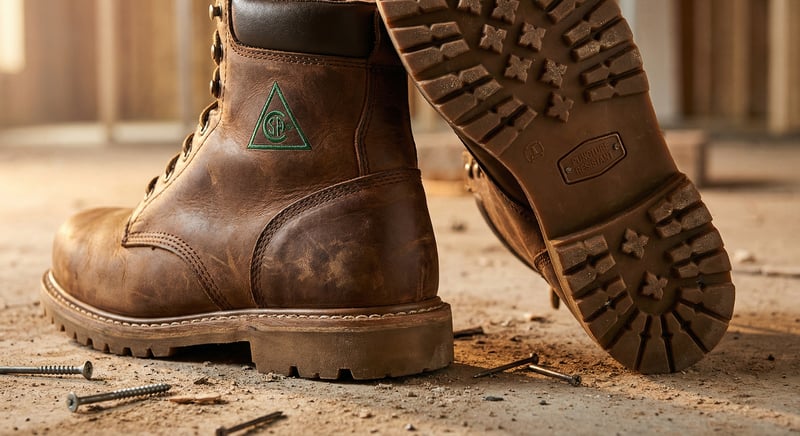
Construction footwear in Canada must meet CSA Z195 (Protective Footwear). Look for the green triangle symbol on the boot, which indicates CSA-approved toe and sole protection.
CSA Z195 uses a colour-coded system:
- Green triangle: Grade 1 toe and sole protection. Puncture-resistant sole. The standard for construction sites.
- Yellow triangle: Grade 2 toe protection. Lower level of protection than green. Rarely sufficient for construction.
- White rectangle (omega symbol): Electrical shock resistant. Rated for resistance to electrical hazards. For electrical workers.
- Green rectangle: Puncture-resistant sole. Usually combined with the green triangle for construction.
- Yellow rectangle: Anti-static protection. For environments with static discharge hazards.
Additional features for specific construction work:
- Metatarsal guards for heavy material handling and demolition
- Waterproof construction for wet site conditions
- Insulated boots for winter work
- Chainsaw-resistant boots for tree clearing and land development
The running shoes at the job site are an instant red flag for every GC safety officer in the country. CSA green triangle boots are the minimum. Period.
Body Protection: High-Vis, FR, and Coveralls
Body protection covers everything between your hard hat and your boots:
- High-visibility apparel (CSA Z96): Required where workers are exposed to vehicular traffic or mobile equipment. Class 1 is the lowest visibility (vest only). Class 2 provides more coverage. Class 3 is the highest (vest or jacket with pants or coveralls). Most construction sites require Class 2 or higher.
- Flame-resistant (FR) clothing: Required for hot work (welding, cutting), oil and gas sites, and any environment with flash fire or arc flash hazards. FR clothing self-extinguishes when the ignition source is removed. It does not make you fireproof.
- Coveralls: Full-body protection from dust, dirt, paint, and minor chemical exposure. Disposable coveralls for asbestos and lead abatement work. Reusable FR coveralls for ongoing hot work.
- Rain gear: Waterproof outer layers for wet weather work. Must not compromise high-visibility requirements (hi-vis rain jackets are available).
One detail that catches contractors: synthetic base layers under FR clothing are a serious burn risk. If a spark penetrates the FR outer layer, synthetic fabric melts onto skin. Base layers should be natural fibre (cotton, wool) or FR-rated.
Fall Protection: Harnesses, Lanyards, and Anchors
Fall protection is governed by the CSA Z259 series of standards and is required in all Canadian provinces when a worker could fall 3 metres or more (some conditions trigger fall protection at lower heights).
The three components of a personal fall arrest system:
- Full-body harness (CSA Z259.10): Distributes fall arrest forces across the shoulders, chest, and thighs. The only acceptable body support for fall arrest. Safety belts are not permitted for fall arrest.
- Connecting device: Shock-absorbing lanyard (CSA Z259.11), self-retracting lifeline (CSA Z259.2.5), or rope grab on a vertical lifeline (CSA Z259.2.4). The connecting device absorbs energy during a fall to keep arrest forces below the human tolerance threshold.
- Anchor point (CSA Z259.15): The point of attachment to the structure. Must be capable of supporting 22.2 kN (5,000 lbs) per worker or be engineered for the specific application.
Fall protection is the most technical PPE category and the one where mistakes are most likely to be fatal. Workers must be trained on pre-use inspection, proper donning, fall clearance calculations, and rescue procedures. For more on fall protection, see our fall protection guide and fall protection hierarchy.
For a comprehensive overview of PPE requirements, see our pillar: What Is PPE? Guide to Personal Protective Equipment. For Canadian construction-specific rules, read PPE Requirements for Construction Sites in Canada.
Is Your PPE Matrix Covering Every Hazard on Site?
SE-AI analyses your PPE assignment records, hazard assessments, and CSA certification documentation. It flags jobs with identified hazards but no documented PPE selection, expired certifications, and gaps between your PPE matrix and actual site conditions.
Get Early Access to SE-AI →
Frequently Asked Questions
What are the main types of personal protective equipment?
The eight main types of PPE are: head protection (hard hats), eye and face protection (safety glasses, goggles, face shields, welding helmets), hearing protection (ear plugs, earmuffs), respiratory protection (respirators, masks), hand protection (gloves), foot protection (safety boots), body protection (high-visibility clothing, FR clothing, coveralls), and fall protection (harnesses, lanyards, anchor systems).
What is the difference between Type 1 and Type 2 hard hats?
Type 1 hard hats protect against impacts from the top of the head only. Type 2 hard hats protect against both top and lateral (side) impacts. Many major GCs and construction sites now require Type 2 hard hats. Both types must meet CSA Z94.1 standards in Canada.
What does the green triangle on safety boots mean?
The green triangle on safety boots indicates Grade 1 toe and sole protection under CSA Z195. This means the boot has a protective toe cap that withstands a defined impact and compression test, plus a puncture-resistant sole plate. The green triangle is the standard requirement for Canadian construction sites.
What is the difference between N95 and P100 respirators?
N95 respirators filter at least 95% of airborne particles and are not resistant to oil-based aerosols. P100 respirators filter at least 99.97% of airborne particles and are oil-proof. For construction tasks like silica dust exposure, P100 is the recommended minimum. N95 is suitable for general dust but may not provide adequate protection for regulated substances like crystalline silica.
How do you choose the right type of PPE for a job?
PPE selection starts with a hazard assessment. Identify the physical, chemical, biological, and ergonomic hazards present for each task. Match each hazard to the PPE type specifically designed for that risk. Verify the PPE meets the applicable CSA standard. Ensure proper fit for each worker. When in doubt, consult your safety program documentation or a qualified safety professional.
Get Weekly Safety Insights
Regulation updates, toolbox talk ideas, and compliance tips. One email per week.