Last updated: March 2026
You're running a crew in BC. You've got bids to chase, projects to finish, and a foreman who just told you one of your guys nearly walked off a roof edge yesterday. Now someone's asking if your safety program is "WorkSafeBC compliant," and you're not even sure what that means in practical terms.
You're not alone. We work with BC contractors every week who are doing good work on site but have no idea how exposed they are on the compliance side. The regulations exist to protect your crew, but the way they're written, you'd need a law degree to figure out what actually applies to your job.
This guide breaks it all down in plain English. No legalese, no filler. Just what you need to know to keep your crew safe, stay on the right side of WorkSafeBC, and avoid penalties that can run as high as $816,148.
⚡ Quick Answer: WorkSafeBC Construction Requirements
- What: BC's OHS Regulation sets out legal safety requirements for all construction workplaces, enforced by WorkSafeBC
- Key Parts: Part 3 (Rights & Responsibilities), Part 4 (General Conditions), Part 20 (Construction, Excavation & Demolition)
- Who's responsible: Employers, supervisors, workers, and prime contractors all have specific legal duties
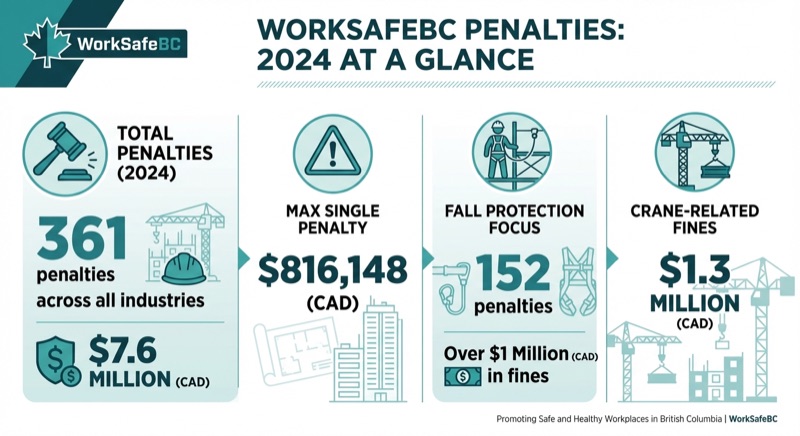
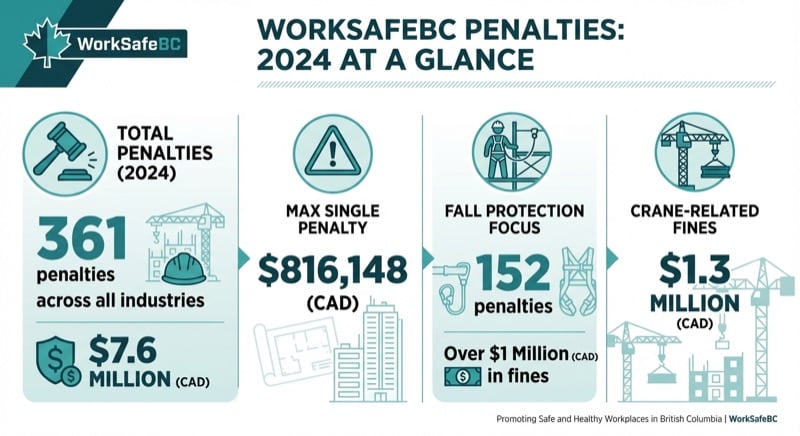
- Penalties: Up to $816,148 per violation (as of January 2026); 361 penalties totalling $7.6 million imposed in 2024
- COR connection: COR certification through BCCSA demonstrates compliance and earns WCB premium discounts
What Are WorkSafeBC Construction Requirements?
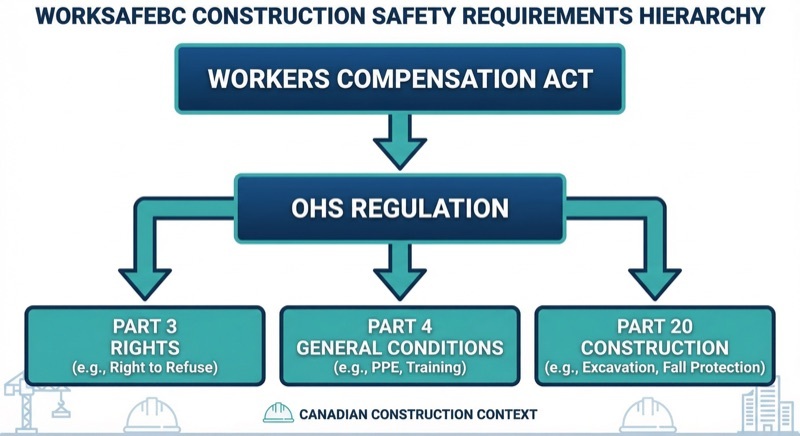
WorkSafeBC construction requirements are the legal health and safety obligations set out in British Columbia's Workers Compensation Act and the Occupational Health and Safety (OHS) Regulation that apply to every construction workplace in the province. These requirements cover everything from fall protection and scaffolding to emergency planning and incident reporting. WorkSafeBC enforces them through inspections, orders, and administrative penalties.
The OHS Regulation is divided into 33 parts. As a construction contractor, you need to care about three parts more than any others:
- Part 3: Rights and Responsibilities covers who is responsible for what, including employer duties, worker rights (like the right to refuse unsafe work), and prime contractor obligations.
- Part 4: General Conditions covers workplace safety fundamentals that apply to every jobsite: emergency preparedness, first aid, violence prevention, working alone, washroom facilities, and equipment safety.
- Part 20: Construction, Excavation and Demolition is the construction-specific section. It covers excavation safety, scaffolding, formwork, concrete work, demolition procedures, and everything else that makes construction uniquely hazardous.
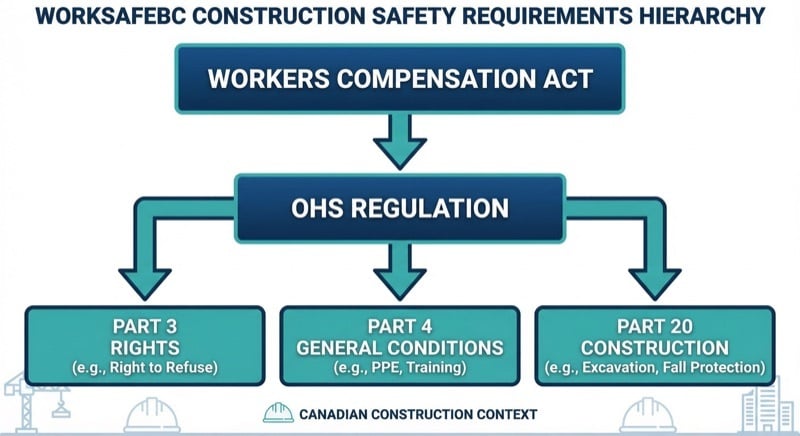
Most contractors think they only need to worry about Part 20. That's the first mistake. A WorkSafeBC officer showing up to your site doesn't just check your excavation shoring. They look at your first aid kit, your emergency plan, your JOHS committee records, your training documentation, and whether your workers actually know their rights. Part 4 violations are some of the most common penalties issued to construction employers.
Not sure if your current safety program covers all three parts? SE-AI can check your safety documentation against all three WorkSafeBC requirement areas and tell you exactly where the gaps are.
What Does Part 4 (General Conditions) Require on a Construction Site?
Part 4 is the foundation. It applies to every workplace in BC, but construction sites have a way of failing these requirements more often than offices or warehouses. Here's what matters most for your crew:
Emergency Preparedness
You need a written emergency response plan that covers your specific site hazards. This includes fire, structural collapse, hazardous substance releases, and medical emergencies. Your crew needs to know the plan, and you need to run drills. A binder on a shelf doesn't count.
First Aid
The first aid requirements depend on your crew size, how far you are from a hospital, and the hazard level of your work. Construction is classified as a high-hazard environment, which means stricter first aid attendant and equipment requirements. If you're running a crew of 15 on a site that's more than 20 minutes from a hospital, you need a Level 2 first aid attendant and a properly stocked first aid room.
Violence Prevention
Yes, this applies to construction. If your workers interact with the public or there's a risk of workplace violence, you need a violence prevention program. This comes up more often than you'd expect on mixed-use sites and renovation projects.
Working Alone
If any of your workers are alone on site, even for short periods, you need a written working-alone procedure that includes check-in intervals. One worker doing a walkthrough on a Sunday afternoon counts.
Washroom Facilities
As of October 2024, WorkSafeBC updated the OHS Regulation with new washroom requirements for construction sites. This is not optional. Your site needs adequate, clean, and accessible washroom facilities for your crew.
Equipment Safety
Every piece of equipment on site must be maintained, inspected, and used according to manufacturer specifications. This includes everything from ladders to excavators. If a piece of equipment has a defect, it has to be taken out of service immediately.
These Part 4 requirements don't get the attention that fall protection and scaffolding do, but they generate a significant number of WorkSafeBC orders and penalties every year. Get them right, and you've eliminated a whole category of compliance risk. Safety Evolution builds complete health and safety management systems that cover all of these requirements for construction contractors.
WorkSafeBC Penalties Start at $1,000 Per Violation
SE-AI checks your safety program against WorkSafeBC construction requirements and flags compliance gaps before an inspection.
Get Early Access →
What Does Part 20 Cover for Construction?
Part 20 is where the construction-specific rules live. The OHS Regulation defines "construction project" broadly: any erection, alteration, repair, dismantling, demolition, structural or routine maintenance, painting, land clearing, earth moving, grading, excavating, trenching, digging, boring, drilling, blasting, concreting, or the installation of machinery.
If you do any of that work, Part 20 applies to you. Here are the sections that generate the most inspections and penalties:
Fall Protection (Part 11, referenced heavily in Part 20)
Fall protection is the single biggest enforcement area in BC construction. In 2024, WorkSafeBC issued 152 penalties related to inadequate fall protection, totalling over $1 million in fines. Over the past five years, they accepted 22,044 claims for falls from heights, including 5,703 serious injuries and 88 fatalities.
The rule is straightforward: any work at a height of 3 metres (10 feet) or more requires a written fall protection plan. But the failures are usually in the details. Workers not trained on their specific fall arrest system. Guardrails missing from open edges. No rescue plan in place if someone actually falls.
Excavation and Trenching
Trenches deeper than 1.2 metres (4 feet) must be shored, sloped, or shielded. You need a qualified person to inspect the excavation daily and after any event that could affect stability (rain, vibration, adjacent work). Cave-ins kill quickly and without warning.
Scaffolding
Scaffolds must be erected, altered, and dismantled under the supervision of a qualified person. They need to be inspected before each work shift. Guardrails on all open sides and ends. Access ladders properly secured. These seem basic, but scaffold violations are a constant in WorkSafeBC penalty databases.
Demolition
Before any demolition work starts, you need an engineering survey of the structure by a qualified person. This survey identifies hazardous materials (asbestos, lead paint), structural concerns, and utility disconnection requirements. Demolition without a survey is one of the fastest ways to get shut down.
Concrete and Formwork
Formwork and shoring must be designed to support the loads imposed on them, and they must be inspected before concrete is placed. Premature stripping of formwork has caused collapses on BC sites.
Who Is the Prime Contractor, and Why Does It Matter?
Here's where a lot of contractors get tripped up. Under BC's Workers Compensation Act, when there are multiple employers working at the same construction site, someone has to be the prime contractor. If the property owner doesn't designate one in writing, the owner becomes the prime contractor by default.
The prime contractor is legally responsible for coordinating health and safety activities at the entire worksite. That means:
- Establishing and maintaining a system for ensuring compliance with the Workers Compensation Act and the OHS Regulation
- Coordinating the safety activities of all employers on the worksite
- Doing everything reasonably practicable to establish and maintain a safe workplace
Most GCs assume that being the prime contractor just means having a safety binder on site. It doesn't. It means you're on the hook for what every sub on that site does or doesn't do. If a sub's worker gets hurt because of a hazard you should have addressed, WorkSafeBC comes to you first.
We have a detailed guide to prime contractor responsibilities in BC if you want the full picture. But the short version: if you're the prime contractor, you need a site-specific safety plan, regular safety meetings with all subs, hazard communication procedures, and documentation that proves you're actually coordinating safety activities across the site.
What Are the JOHS Committee Requirements?
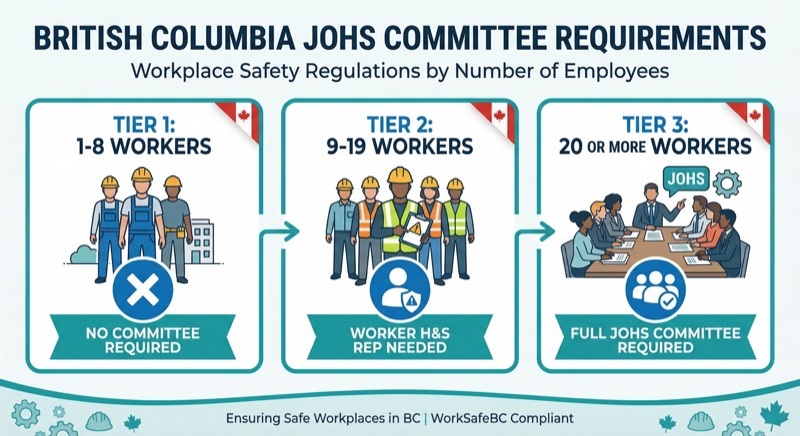
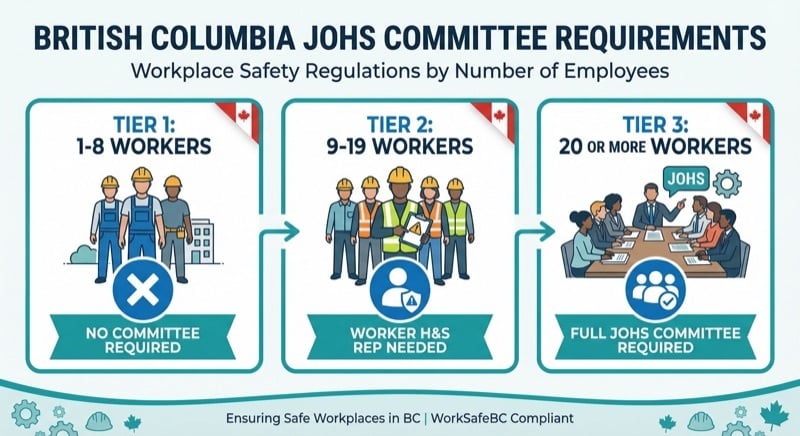
A Joint Occupational Health and Safety (JOHS) committee is a group of worker and employer representatives who meet regularly to identify and resolve workplace health and safety issues. In BC, the requirements depend on your headcount:
- 20 or more workers employed at the workplace for longer than a month: you must establish a full JOHS committee
- 9 to 19 workers: you need a designated worker health and safety representative
- Fewer than 9 workers: no formal committee or representative required, but employers still have general duties to consult with workers on safety matters
Here's the blunt truth most contractors don't want to hear: your JOHS committee can't just be a box you check. WorkSafeBC inspectors ask for meeting minutes. They ask committee members what they discussed last month. If your committee hasn't met, or if the meetings are just "sign the sheet and go back to work," that's a violation. And it signals to the inspector that your safety program is probably paper-thin everywhere else.
The JOHS committee must include at least two members, with worker representatives making up at least half. Members need to be trained in their committee duties. The committee must meet at least monthly, conduct regular workplace inspections, and keep records of their meetings and recommendations.
On construction sites, this gets complicated when your headcount fluctuates project to project. If you bring 25 workers onto a site for three months, you need a committee for that site. If you're typically at 12 workers, you need a worker representative. Plan for this before the project starts, not after a WorkSafeBC inspection.
What Are the Incident Reporting Requirements?
This is non-negotiable, and the timelines are tight. Here's what BC law requires:
Immediate Reporting (call WorkSafeBC right away)
You must immediately report the following to WorkSafeBC by calling the Prevention Information Line at 1-888-621-7233 (available 24/7):
- A worker is killed on the job
- A worker suffers a serious injury (fracture, amputation, loss of consciousness, injury requiring hospital admission)
- A major structural failure or collapse of a building, bridge, tower, crane, hoist, temporary construction support system, or excavation
- A major release of a hazardous substance
- A blasting incident that injures a worker or goes beyond the blast area
72-Hour Employer Report (Form 7)
For any workplace injury or illness, the employer must submit a report to WorkSafeBC within 72 hours of becoming aware of it. This is done through the Safety Incident Reporting Portal (Form 7). Missing this deadline isn't just a regulatory violation; it can delay your worker's claim and create problems down the road.
Scene Preservation
After a serious incident, you must preserve the scene. Do not move equipment, clean up, or resume work in the area until WorkSafeBC gives you clearance. Disturbing an incident scene is a separate violation that can result in additional penalties.
Proper incident investigation isn't just about filling out forms. It's about figuring out what actually went wrong so it doesn't happen again. Download our free Incident Report and Investigation Kit for templates and step-by-step guidance. Follow our incident report and investigation kit for the full process.
Can a Worker Refuse Unsafe Work in BC?
Yes. And as an employer, you need to understand exactly how this works, because handling a work refusal wrong can turn a simple safety concern into a WorkSafeBC investigation and a potential penalty.
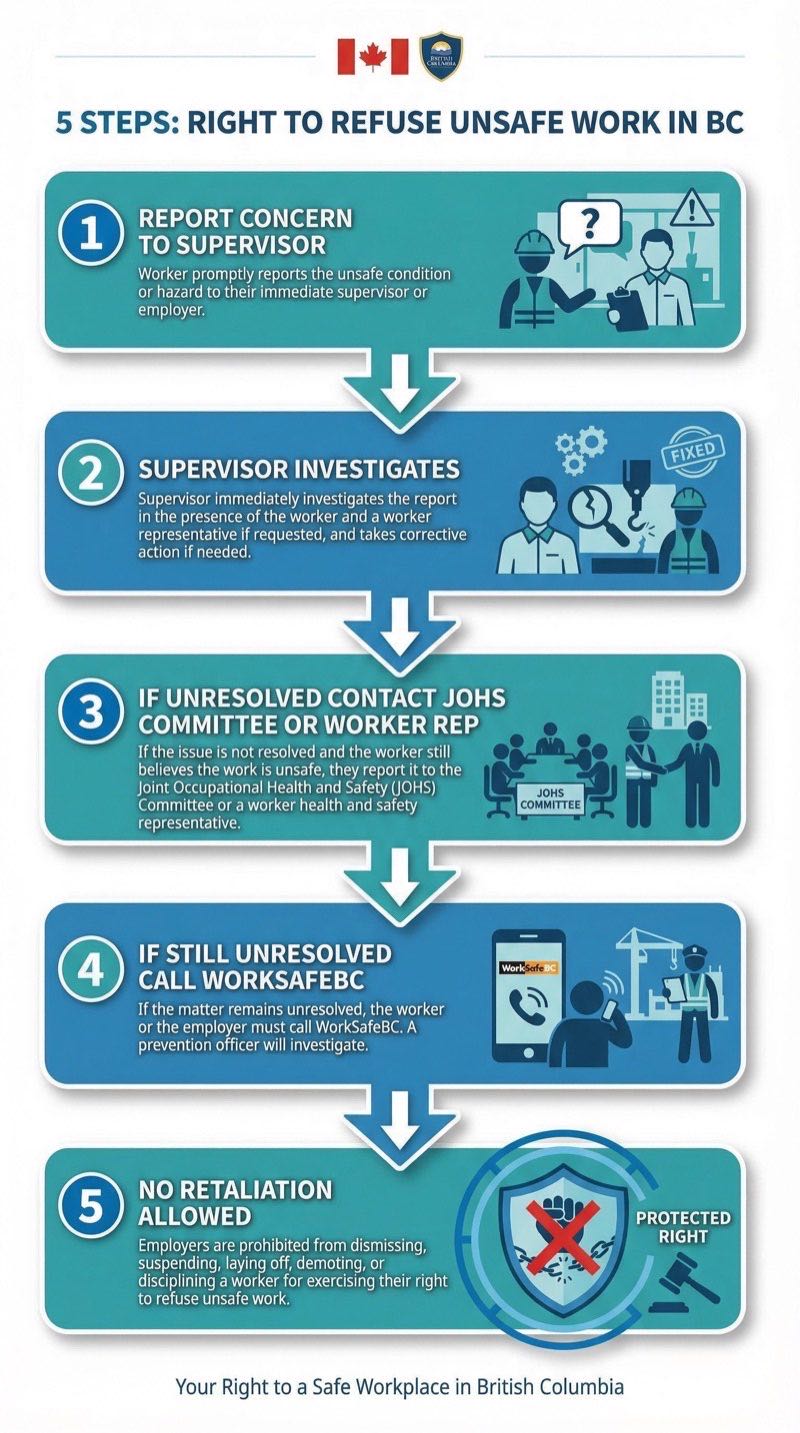
Under Section 3.12 of the OHS Regulation, a worker must not carry out any work process or operate any equipment if they have reasonable cause to believe it would create an undue hazard to themselves or anyone else. This is a legal right, and workers are protected from retaliation for exercising it (Section 47 of the Workers Compensation Act).
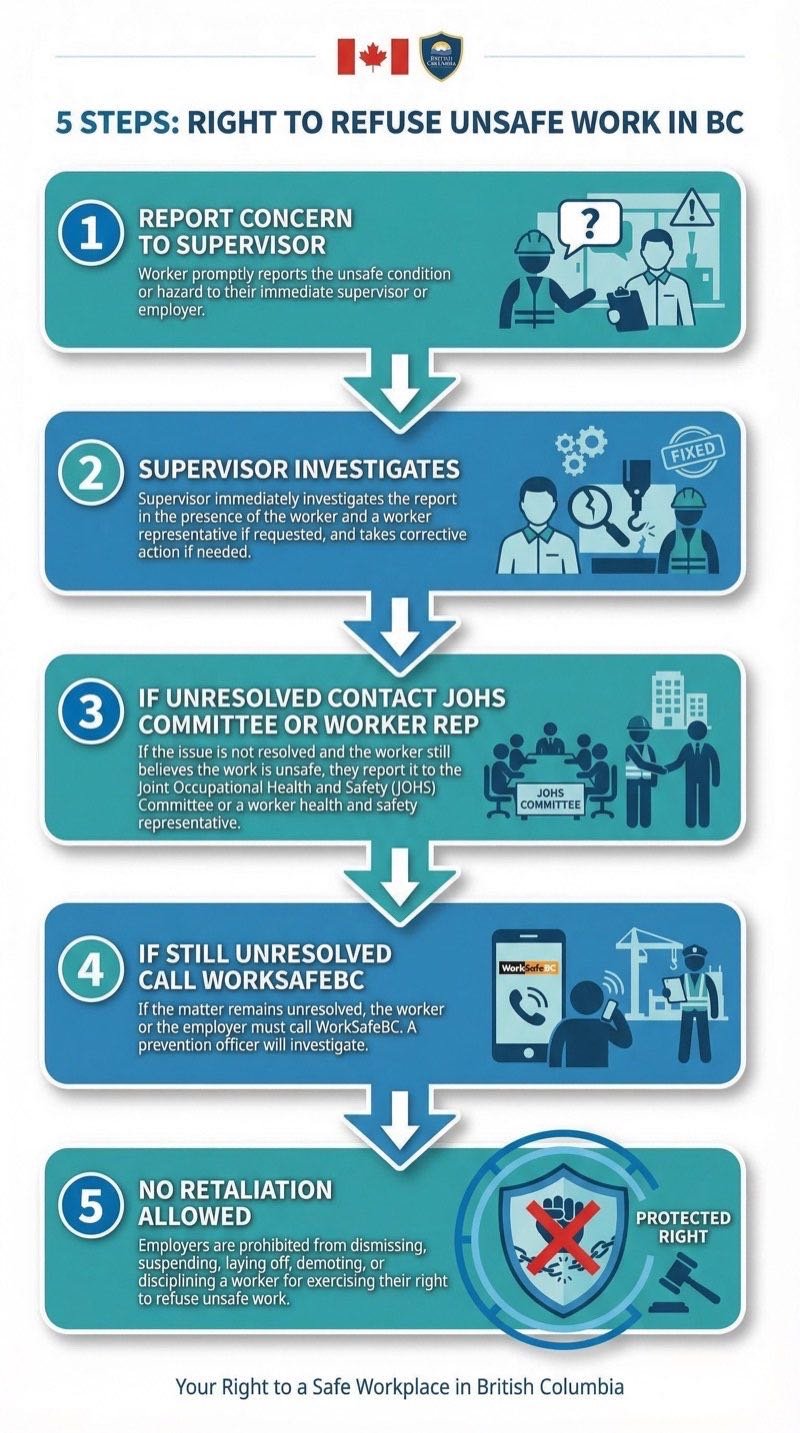
Here's how the process works:
- Worker reports the concern to their supervisor or employer and explains why they believe the work is unsafe.
- Supervisor investigates immediately. The supervisor must look into the concern without delay. If the concern is valid, fix the hazard before work resumes.
- If the worker is not satisfied with the supervisor's response, the matter goes to the JOHS committee or worker health and safety representative.
- If the issue is still unresolved, either party can contact WorkSafeBC. An officer will investigate and make a determination.
- No retaliation. You cannot discipline, demote, terminate, or penalize a worker for refusing unsafe work. If WorkSafeBC finds that you did, the consequences are severe.
The biggest mistake we see contractors make: treating a work refusal as insubordination instead of a safety concern. Even if you think the worker is wrong, you still have to follow the process. Document everything. Investigate genuinely. If the work is safe, explain why and document your reasoning. If the worker still refuses, call WorkSafeBC and let them decide. Trying to pressure a worker into doing work they believe is unsafe is one of the fastest ways to generate a penalty and destroy crew trust.
What Are the Common Violations and Penalties?
WorkSafeBC penalties are administrative fines, not criminal charges. They're calculated based on the employer's payroll, the severity of the violation, and whether it's a repeat offense. The current maximum penalty is $816,148.69 per violation (as of January 2026, under Section 95(2) of the Workers Compensation Act).
That number is not theoretical. In December 2025, WorkSafeBC issued $1.3 million in penalties to two companies involved in crane-related safety violations, including incidents connected to a worker fatality. In 2024 alone, WorkSafeBC imposed 361 administrative penalties totalling $7.6 million across all industries.
The most common construction violations that result in penalties include:
- Fall protection failures: 152 penalties in 2024 totalling over $1 million. Missing fall protection plans, untrained workers, inadequate guardrails.
- Crane and hoisting violations: $1.3 million in penalties issued in late 2025 for crane safety failures.
- Excavation and trenching: Unshored trenches, missing inspections, workers entering excavations without proper protection.
- Scaffolding deficiencies: Missing guardrails, untrained workers, uninspected scaffolds.
- Failure to report incidents: Not calling WorkSafeBC immediately for serious injuries or structural failures.
- No safety program or safety program gaps: Missing training records, outdated emergency plans, no JOHS committee when one is required.
WorkSafeBC publishes penalty summaries regularly, and construction companies appear frequently. A first-time violation might result in a fine of 50% of the base penalty amount ($1,010.33 base as of current calculations). But repeat violations, serious injuries, or deaths drive penalties into the hundreds of thousands.
If you've been through a WorkSafeBC inspection or penalty and want to strengthen your program before the next one, read our guide on strategies to pass your next safety audit.
How Does COR Connect to WorkSafeBC Requirements?
The Certificate of Recognition (COR) is a voluntary employer certification program in BC that demonstrates you have an effective occupational health and safety management system (OHSMS) in place. COR certification is issued by WorkSafeBC to employers who pass a certification audit conducted through a certifying partner.
For construction contractors, the certifying partner is the BC Construction Safety Alliance (BCCSA).
Here's why COR matters beyond the certificate itself:
- GC requirements: Many general contractors in BC now require COR certification as a prequalification to bid on work. No COR, no bid package.
- WCB premium discounts: COR-certified employers are eligible for rebates on their WorkSafeBC premiums. This can add up to significant savings, especially for larger payrolls.
- Demonstrated compliance: A COR-certified safety program covers all the requirements discussed in this guide: emergency preparedness, hazard assessments, training, incident investigation, JOHS committees, and more. It's a structured way to make sure nothing falls through the cracks.
- Regulatory goodwill: While COR doesn't make you immune to penalties, having a genuine, functioning safety management system works in your favour during inspections and enforcement decisions.
Getting COR certified in BC takes time and commitment. You need to build or upgrade your safety management system, train your team, implement the system on the ground, and then pass an external audit. We've written a complete guide to COR certification in BC that walks through every step. If you want the broader Canadian picture, check our COR certification Canada hub page (coming soon).
COR isn't just a piece of paper. It's the system that keeps your crew safe, keeps you winning bids, and keeps WorkSafeBC from becoming a problem you can't afford. But building that system from scratch while running a construction company is a lot to take on.
How Safety Evolution Can Help
Safety Evolution is not a consultant who shows up, hands you a binder, and disappears. We're a done-for-you safety department for contractors. That means we build your safety program, control your documents, verify daily forms, and package everything for GC submittals and COR audits.
Here's what that looks like for a BC construction contractor dealing with WorkSafeBC requirements:
- Safety program development: We build an OHS management system that meets WorkSafeBC requirements and COR audit standards from day one.
- Documentation and forms: FLHAs, toolbox talks, inspection checklists, incident reports. All built for your specific work, not generic templates. Access our free construction toolbox talks package to see the kind of practical, ready-to-use content we provide.
- Training: Worker orientation, supervisor safety training, JOHS committee member training. All delivered through our platform with tracking and certificates.
- COR preparation: We build the system, prepare your documentation, and guide you through the BCCSA audit process.
- Ongoing compliance: We don't disappear after certification. We maintain your program, keep it current with regulation changes, and make sure you're always audit-ready.
If you're a new hire who just stepped into a safety coordinator role, download our free Construction Safety Orientation Package to get started with site-specific orientations your crew will actually complete.
We work with contractors across BC and Alberta every week. We know what WorkSafeBC inspectors look for, what trips up contractors during COR audits, and what actually keeps crews safe on the ground.
Get early access to SE-AI and find out exactly where your program stands. SE-AI analyses your safety documentation and shows you what needs to change to meet WorkSafeBC requirements.
Does Your Safety Program Meet All Three WorkSafeBC Requirements?
SE-AI analyses your safety documentation against WorkSafeBC OHS Regulation requirements for construction. It flags missing JOHS committee documentation, incomplete workplace inspection records, and gaps in your incident investigation procedures.
Get Early Access to SE-AI →
Frequently Asked Questions
What is the maximum WorkSafeBC penalty for a safety violation?
As of January 2026, the maximum OHS penalty WorkSafeBC can impose is $816,148.69 per violation, under Section 95(2) of the Workers Compensation Act. The actual penalty amount depends on your payroll, the nature and severity of the violation, and your compliance history.
When do I need a JOHS committee on my construction site?
You need a Joint Occupational Health and Safety (JOHS) committee when you have 20 or more workers employed at the workplace for longer than one month. If you have 9 to 19 workers, you need a designated worker health and safety representative instead. WorkSafeBC may also order a JOHS committee for smaller workplaces in certain situations.
What incidents must be reported to WorkSafeBC immediately?
You must immediately call WorkSafeBC's Prevention Information Line (1-888-621-7233) for: worker fatalities, serious injuries (fractures, amputations, loss of consciousness, hospital admissions), major structural failures or collapses, major releases of hazardous substances, and blasting incidents. All other workplace injuries must be reported via Form 7 within 72 hours.
Can a worker refuse unsafe work on a construction site in BC?
Yes. Under Section 3.12 of the OHS Regulation, workers have the legal right to refuse work they reasonably believe creates an undue hazard. Employers must investigate the concern, involve the JOHS committee or worker representative if needed, and cannot retaliate against the worker. If the issue remains unresolved, WorkSafeBC can be called in to make a determination.
Do I need COR certification to do construction work in BC?
COR is not a legal requirement to operate in BC, but many general contractors require it as a prequalification for bidding on work. COR certification, administered through the BC Construction Safety Alliance (BCCSA) for construction employers, demonstrates that your safety management system meets recognized standards. It also makes you eligible for WCB premium discounts.
What is the prime contractor responsible for on a construction site?
The prime contractor at a multi-employer construction site is responsible for coordinating health and safety activities across all employers, establishing a system for ensuring compliance with the Workers Compensation Act and OHS Regulation, and doing everything reasonably practicable to maintain a safe workplace. If no prime contractor is designated in writing, the property owner becomes the prime contractor by default.
Get Weekly Safety Insights
Regulation updates, toolbox talk ideas, and compliance tips. One email per week.