Last updated: March 2026
A journeyman welder on a pipeline fabrication job in northern Alberta starts his shift with a cracked lens in his welding helmet. He knows it is cracked. He figures he will replace it at the end of the week when the supply truck comes through. By Wednesday, he has a flash burn in his left eye and three days off work. The lens was a $12 part.
Welding injuries are almost always preventable, and they almost always come down to PPE that is missing, damaged, or wrong for the process. We work with construction contractors across Canada who run welding crews, and the gap is rarely that people do not know they need protection. It is that they do not know exactly what protection is required for their specific welding process, or they are wearing gear that is not rated for the job.
This guide covers every piece of PPE a welder needs, the CSA standards that apply in Canada, and the mistakes we see over and over on jobsites. SE-AI can check your welding PPE records against CSA requirements for each process type.
⚡ Quick Answer
- Key standard: CSA W117.2 (Safety in Welding, Cutting and Allied Processes) governs welding PPE requirements in Canada.
- Essential PPE: Welding helmet with correct shade filter, flame-resistant clothing, leather gauntlet gloves, safety footwear, hearing protection, and respiratory protection.
- No contact lenses: CSA W117.2 states contact lenses should not be worn by welders.
- Shade selection matters: Wrong shade number for the welding process is one of the most common mistakes.
What PPE Does a Welder Need?
Welding personal protective equipment protects workers from five primary hazards: optical radiation (UV and infrared), flying metal and slag, fumes and gases, burns from heat and sparks, and electrical shock. Every piece of welding PPE addresses one or more of these hazards.
Here is the complete list, based on CCOHS guidance and CSA W117.2:
| Body Area |
Equipment |
Protects Against |
| Eyes and Face |
Welding helmet or hand shield with correct shade filter lens; safety glasses underneath |
UV/IR radiation, flying particles, hot slag, intense visible light |
| Head |
Flame-resistant head covering (skull cap or balaclava) under helmet |
Sparks, spatter, and burns to exposed scalp and neck |
| Lungs |
Respirator appropriate for the fume type (particulate, metal fume, gas) |
Welding fumes, metal oxides, ozone, nitrogen dioxide |
| Body |
Flame-resistant (FR) clothing, leather apron or jacket |
Heat, sparks, slag, radiation burns. No cuffs on pants; pockets taped or flapped closed. |
| Hands |
Flame-resistant leather gauntlet gloves |
Burns, electrical shock, metal splatter |
| Feet |
Leather safety boots (CSA Z195), electric shock resistant |
Sparks, hot metal, electrical shock, falling objects |
| Hearing |
Flame-resistant earmuffs (preferred over plugs where sparks or spatter may enter the ear) |
Noise from arc processes, grinding, plasma cutting |
Notice the detail about ear protection: CCOHS specifically recommends flame-resistant earmuffs over ear plugs when sparks or spatter could enter the ear canal. A small detail that prevents a horrifying injury.
How Do You Choose the Right Welding Helmet Shade?
This is where most PPE mistakes happen in welding. The shade number on the filter lens determines how much light passes through to your eyes. Too light, and you get radiation burns. Too dark, and you cannot see the weld pool, which leads to poor welds and awkward positioning that causes other injuries.
CSA W117.2 and CSA Z94.3 provide shade number recommendations based on the welding process and amperage. Here are the common ones for construction welding:
| Process |
Current Range (Amps) |
Minimum Shade |
Recommended Shade |
| SMAW (Stick) |
Less than 60A |
7 |
10 |
| SMAW (Stick) |
60-160A |
8 |
10 |
| SMAW (Stick) |
160-250A |
10 |
12 |
| GMAW (MIG) |
Less than 60A |
7 |
10 |
| GMAW (MIG) |
60-160A |
10 |
11 |
| GTAW (TIG) |
Less than 50A |
8 |
10 |
| Plasma Arc Cutting |
Less than 20A |
4 |
6-8 |
| Oxygen Cutting (Light) |
Less than 25mm |
3 |
4-5 |
Always use the recommended shade, not the minimum. The minimum is the bare legal threshold. The recommended shade is what actually protects your eyes comfortably over a full shift. Auto-darkening helmets are common now and can adjust shade automatically, but they still need to be set to the correct range for the process.
Why Is Flame-Resistant Clothing Non-Negotiable?
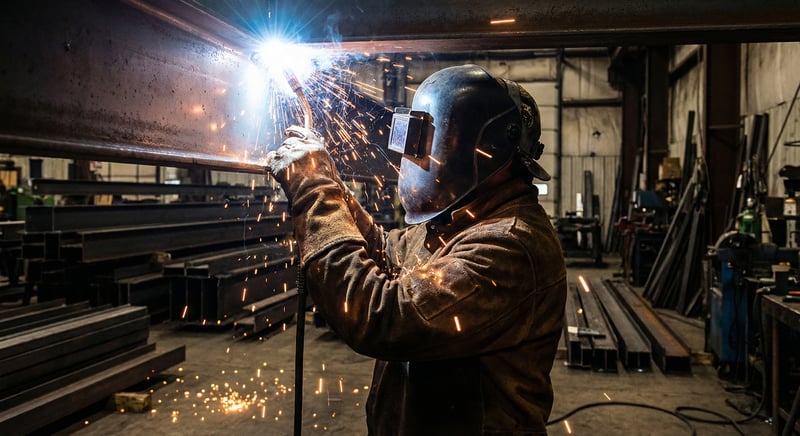
Standard cotton or polyester clothing is a fire hazard around welding. Synthetic fabrics can melt onto skin, making a burn exponentially worse. Even untreated cotton can ignite from sparks and continue burning.
FR clothing for welding must:
- Be rated as flame-resistant, not just "fire-retardant" treated cotton that loses protection after repeated washing
- Cover all exposed skin. No rolled-up sleeves, no gaps between gloves and sleeves
- Have no cuffs on pants (sparks collect in cuffs)
- Have pockets either flapped closed or taped shut (same reason)
- Be clean. Grease-soaked FR clothing can still catch fire
A leather welding jacket or apron over FR clothing provides an extra layer for heavy-duty arc welding. For tack welding or light MIG work, properly rated FR clothing alone may be sufficient. The hazard assessment determines the level of protection.
The Wrong Welding PPE for the Process Can Be Fatal
SE-AI checks your welding PPE assignments against CSA standards for each welding process and flags where protection ratings do not match the hazard.
Get Early Access →
What Respiratory Protection Do Welders Need?
Most contractors think welding fumes are just a nuisance. They are wrong. Chronic exposure to welding fumes causes lung disease, neurological damage, and cancer. The International Agency for Research on Cancer (IARC) classifies welding fumes as Group 1 carcinogenic to humans.
The type of respiratory protection depends on the welding process and ventilation:
- Well-ventilated or outdoor welding: A minimum of a P100 particulate respirator (half-face). This catches metal fume particulates but not gases.
- Enclosed spaces or poor ventilation: A half-face or full-face respirator with combination cartridges (P100 + organic vapour/acid gas) or a supplied-air respirator.
- Stainless steel or galvanized metal welding: These produce hexavalent chromium or zinc oxide fumes. Minimum half-face with P100 filters; supplied-air preferred for prolonged exposure.
- Confined spaces: Supplied-air respirators (SAR) or self-contained breathing apparatus (SCBA). Half-face respirators are not sufficient.
Every respirator must be fit tested. An unfitted respirator does not protect against fumes regardless of the cartridge type. Provincial OHS codes in Alberta and BC both require fit testing, and the respiratory protection program must include written procedures for selection, use, and maintenance.
What Are the Most Common Welding PPE Mistakes?
After working with construction welding crews across Alberta and BC, here are the mistakes we see repeatedly:
- Using the wrong shade lens. A shade 10 lens for a process that needs shade 12 gives the welder a false sense of protection while UV radiation damages their eyes.
- No safety glasses under the welding helmet. The helmet protects from arc radiation. Safety glasses protect from grinding debris, chipping slag, and impacts. Both are required, always.
- Wearing ear plugs instead of earmuffs where spatter is present. A hot spark in the ear canal is exactly as painful as it sounds. Flame-resistant earmuffs prevent this.
- No respiratory protection for "just a few tack welds." Fume exposure is cumulative. There is no safe minimum. If you are striking an arc, you need respiratory protection.
- Synthetic clothing under FR gear. If a spark gets through, the synthetic layer melts onto skin. Base layers should be natural fibre (cotton, wool) or FR-rated.
- Wearing contact lenses while welding. CSA W117.2 states that contact lenses should not be worn by welders and welding personnel. Foreign bodies cause excessive irritation, and contacts provide zero protection from UV.
Every one of these mistakes results in a preventable injury. Most of them result in a WCB claim that your company pays for through increased premiums for years afterward.
For a complete overview of PPE basics, read our pillar guide: What Is PPE? Guide to Personal Protective Equipment. For construction-specific requirements, see PPE Requirements for Construction Sites in Canada. If your crew needs formal training, Safety Evolution offers a PPE training course built for construction workers.
Is Your Welding PPE Meeting CSA Standards for Every Process?
SE-AI analyses your welding PPE records, CSA certification documentation, and hazard assessments by welding process. It flags mismatches between the welding type and the rated protection level, expired certifications, and missing fit documentation.
Get Early Access to SE-AI →
Frequently Asked Questions
Can you wear contact lenses while welding?
No. CSA W117.2 states that contact lenses should not be worn by welders and welding personnel. Foreign bodies in the eye cause excessive irritation when combined with contact lenses, and contacts provide no protection from ultraviolet radiation. Prescription safety glasses with side shields under a welding helmet are the correct alternative.
What shade lens do I need for MIG welding?
For GMAW (MIG) welding at 60-160 amps, the minimum shade is 10 and the recommended shade is 11 per CSA standards. At less than 60 amps, minimum shade 7 with recommended shade 10. Always use the recommended shade, not the minimum, for comfortable protection over a full shift.
Do welders need respiratory protection for outdoor welding?
Yes. Even outdoors, welding fumes are a health hazard. The IARC classifies welding fumes as Group 1 carcinogenic. A minimum of a P100 half-face respirator is recommended for outdoor welding. For stainless steel or galvanized metals, supplied-air respiratory protection is preferred due to hexavalent chromium and zinc oxide fume exposure.
What is CSA W117.2?
CSA W117.2 (Safety in Welding, Cutting and Allied Processes) is the Canadian national standard that provides minimum requirements and recommendations to protect workers from illness and injury related to welding operations. It covers PPE requirements, ventilation, fire prevention, electrical safety, and the elements of a welding health and safety program. The current version is CSA W117.2:19 (R2023).
Get Weekly Safety Insights
Regulation updates, toolbox talk ideas, and compliance tips. One email per week.