Last updated: April 2026
If you run a crew in British Columbia, your first aid program probably changed on November 1, 2024, and nobody sent you a memo. WorkSafeBC overhauled the entire first aid framework: new certification names, new training hours, new kit standards, and a mandatory written assessment that many employers didn't know about until an inspector asked for it.
We help BC contractors build compliant safety programs every month at Safety Evolution, and the November 2024 changes are the number one source of confusion right now. Here's what actually changed and what you need to do about it.
Quick Answer: What Changed in BC First Aid?
- OFA Level 1, 2, 3 are gone. Replaced by Basic (7 hrs), Intermediate (14 hrs), and Advanced (70 hrs).
- Intermediate training dropped from 35 hours to 14 hours. That's 5 days to 2 days, saving employers significant training time and cost.
- Existing OFA certificates remain valid until their expiry date, up to November 2027.
- Written first aid assessment is mandatory. Use WorkSafeBC's worksheet.
- Kit standards now align with CSA with BC-specific additions.
- Effective date: November 1, 2024 (B.C. Reg. 132/2023).
- Behind on first aid actions? Start your 30-day free trial to track training, records, and corrective actions in one place.
BC's workplace first aid requirements are governed by the Workers Compensation Act and OHS Regulation Part 3, which were amended by B.C. Reg. 132/2023 effective November 1, 2024. The changes align BC's first aid standards with CSA national standards, replacing the old OFA (Occupational First Aid) certification system with three new levels: Basic, Intermediate, and Advanced.
For an overview of first aid requirements across all provinces, see our complete employer guide to workplace first aid requirements.
What Are the New Certification Levels?
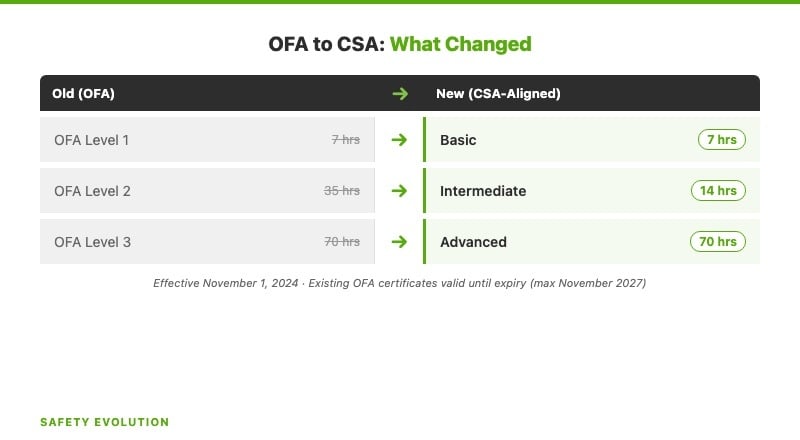
The old three-tier OFA system has been replaced by CSA-aligned certifications. Here's what changed:
Basic first aid (formerly OFA Level 1): 7 hours of training. Covers scene assessment, CPR, AED use, bleeding control, and basic wound care. The duration is unchanged from OFA Level 1. Most low-hazard workplaces with smaller crews need this level at minimum.
Intermediate first aid (formerly OFA Level 2): 14 hours of training. This is the big win for employers. The old OFA Level 2 required 35 hours of training over 5 days. The new Intermediate certification covers equivalent scope in just 14 hours over 2 days. If you've been paying workers for a full week of training to get Level 2, you just saved 3 days of wages and lost productivity per attendant.
Advanced first aid (formerly OFA Level 3): 70 hours of training. Comprehensive emergency medical care including spinal management, oxygen therapy, and advanced splinting. Duration unchanged from OFA Level 3. Required at large, high-hazard, or remote worksites.
Transportation endorsement: Unchanged in name and scope. Still required when injured workers may need to be transported by the employer (common on remote or less accessible sites).
Most contractors think the name change is just paperwork. They're wrong. The Intermediate certification reduction from 35 hours to 14 hours is a real operational win. For a 25-person construction crew that needs two Intermediate attendants, that's six fewer days of paid training time per certification cycle.
Are Your OFA Certificates Still Valid?
Yes. WorkSafeBC has confirmed that active OFA Level 1, 2, and 3 certificates are recognized as equivalent to the new Basic, Intermediate, and Advanced levels. Your existing certificates remain valid until their expiry date.
The latest possible expiry for grandfathered OFA certificates is November 2027 (three years from the November 1, 2024 effective date). After that, all attendants must hold the new CSA-aligned certifications.
CSA-aligned courses became available from approved providers starting in July 2024. If your attendants' certificates are expiring soon, they should recertify under the new system.
Not sure if your first aid readiness would hold up in a real emergency?
See training gaps, expiring certificates, and missing documentation before they become incidents.
Start Your 30-Day Free Trial →How Do You Complete the Written First Aid Assessment?
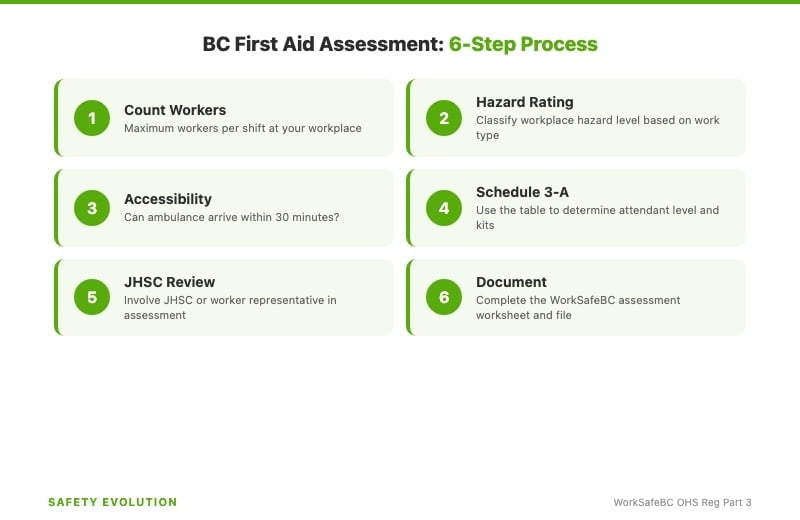
Employers in BC must complete a written first aid assessment per OHS Regulation s.3.16. This determines the certification level, number of attendants, kit type, and equipment your workplace needs.
The assessment considers three factors:
- Number of workers per shift. Count the maximum number of workers present at your workplace during any single shift. This is per location, not per company.
- Workplace hazard rating. WorkSafeBC assigns a hazard rating to your classification unit. You can find your rating on the classification unit description sent to you annually. Construction typically carries a higher hazard rating.
- Accessibility. If a BC Emergency Health Services ambulance would normally take more than 30 minutes to reach your workplace, it's classified as "less accessible." This triggers higher first aid coverage requirements.
Once you have these three inputs, you consult Schedule 3-A of the OHS Regulation to determine your minimum required first aid services.
Your joint health and safety committee (JHSC) or worker health and safety representative must be involved in the assessment process. If you don't have a JHSC (required at 20+ workers in BC), your worker representative fulfills this role.
The assessment must be reviewed annually or when significant operational changes occur. A new project at a different site, a crew size increase, or a change in work type all trigger a reassessment.
For a step-by-step walkthrough with both BC and Alberta processes, see our first aid assessment guide.
What Goes in Your First Aid Kit?
BC uses four kit categories, each matching a certification level:
- Personal kit: For individual workers in low-risk situations
- Basic kit: Matches Basic first aid attendant level
- Intermediate kit: Matches Intermediate first aid attendant level
- Advanced kit: Matches Advanced first aid attendant level
All kits must meet CSA standards with BC-specific additions. WorkSafeBC published an updated equipment information sheet in October 2024 detailing the exact contents for each kit type.
The common mistake: buying a generic "workplace first aid kit" from a retail store and assuming it's compliant. Those kits rarely meet CSA standards. Check the label for CSA Z1220-17 compliance, then add any BC-specific items listed in WorkSafeBC's equipment sheet.
For complete kit contents and purchasing guidance, read our first aid kit requirements guide.
What Are Your Employer Obligations Beyond Kits and Attendants?
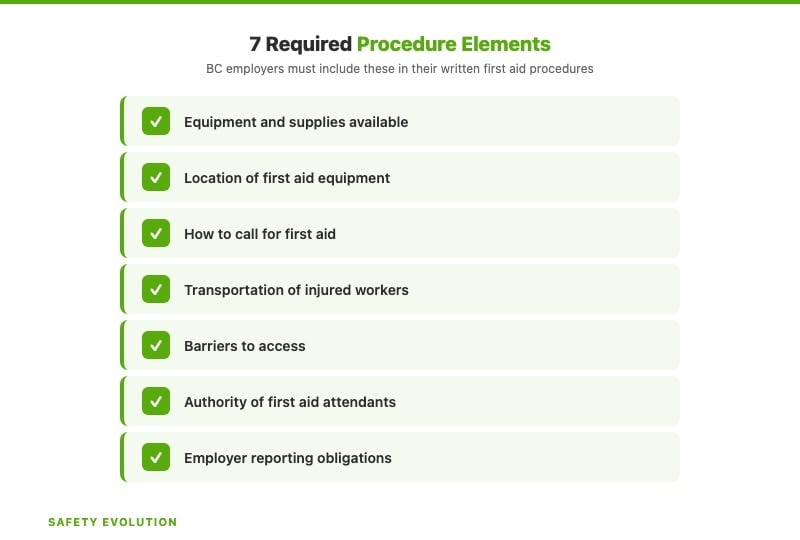
Having trained attendants and stocked kits is the start, not the finish. BC employers must also maintain:
Written first aid procedures covering seven required elements:
- Equipment and supplies available at the workplace
- Location of first aid equipment and facilities
- How workers call for first aid assistance
- Transportation plan for injured workers
- Barriers to accessing first aid services
- Authority and responsibilities of first aid attendants
- Employer reporting obligations for injuries
Annual drills: At least once per year or when procedures change significantly (OHS Regulation s.3.17(4)). The drill tests whether your procedures work in practice, not just on paper.
First aid records: Retained for at least 3 years (OHS Regulation s.3.19). Records must document every first aid treatment provided, and access must be restricted to authorized personnel.
Assessment documentation: Your written first aid assessment must be available for inspection at all times. If WorkSafeBC visits your site, this is one of the first documents they'll ask for.
For more on what records to keep and how, see our first aid records guide.
What Happens If You're Not Compliant?
WorkSafeBC issues penalties based on the nature of the violation, your violation history, and your payroll size. Penalties can be increased for high-risk or repeat violations.
Specific dollar amounts for first aid violations are not published as a fixed schedule. They vary case by case. But the financial penalty is often the least of your concerns. A stop-work order on a construction site can cost you tens of thousands per day in lost productivity and contract delays.
First aid non-compliance also weakens your position in any WorkSafeBC investigation following a workplace injury. If a worker is hurt and your first aid assessment is missing or your attendant's certificate is expired, that's a significant liability exposure.
For contractors pursuing COR certification, first aid is an auditable element. A compliant first aid program demonstrates safety management system maturity during certification audits. An incomplete program drags your score down.
Common Employer Mistakes in BC First Aid Compliance
After working with hundreds of BC contractors on their safety programs, we see the same first aid mistakes come up again and again. These are the gaps that generate the most compliance orders, audit deductions, and post-incident headaches.
- Never completing the written assessment in the first place. This is the single most common gap. Many contractors assume that having a first aid kit and a trained attendant is enough. It's not. WorkSafeBC requires a documented assessment per OHS Regulation s.3.16 that shows how you determined your first aid needs. The assessment must be available on site for inspection at all times. Without it, even a fully stocked kit and a certified attendant won't satisfy an inspector.
- Using the old OFA terminology on new documentation. If you're creating or updating safety documents after November 2024, use the new certification names: Basic, Intermediate, and Advanced. Referencing "OFA Level 1" on current documentation signals that your program hasn't been updated. Inspectors notice.
- Not reassessing when moving between job sites. Construction crews move. Every new site has a different distance to the nearest hospital, which may change your accessibility classification and your entire first aid requirement. A crew that's adequately covered at a downtown Vancouver site may be under-covered at a site in Squamish if the travel time pushes past 30 minutes.
- Forgetting to include the JHSC or worker rep in the assessment. In BC, the joint health and safety committee or worker health and safety representative must participate in the first aid assessment. This is not optional. If an inspector asks who was involved in your assessment and the answer is "just me," that's a problem. Document their participation with names and dates.
- Letting kit inspections slide. Kits get used and don't get restocked. Items expire. Seals break. The best practice is a monthly inspection with a signed checklist, plus immediate replenishment after any use. If your monthly inspection log is blank for the last six months, you have a documentation gap that any auditor will catch.
- Ignoring the annual drill requirement. OHS Regulation s.3.17(4) requires employers to practice their first aid procedures at least annually. Many contractors have never run a drill. The drill doesn't need to be elaborate. Simulate an injury, test whether your attendant responds correctly, check whether workers know how to call for help, and document the results. A 15-minute exercise once a year can prevent a compliance order and, more importantly, save a life when something actually goes wrong.
Every one of these mistakes is fixable in a day or less. The real cost isn't fixing them. It's finding out they exist during an inspection or after an incident, when the consequences are orders of magnitude higher.
How to Get Your BC First Aid Program Up to Standard
If you're starting from scratch or updating after the November 2024 changes, here's the sequence:
- Complete your written first aid assessment. Download WorkSafeBC's assessment worksheet. Involve your JHSC or worker rep. Determine your worker count, hazard rating, and accessibility.
- Look up Schedule 3-A. Match your inputs to the table. It tells you exactly what attendant level, kit type, and equipment you need.
- Check your attendants' certificates. If they hold valid OFA certificates, they're covered until expiry. If certificates are expiring within the next year, schedule CSA-aligned recertification.
- Audit your kits. Compare contents against CSA Z1220-17 requirements plus the BC-specific additions from WorkSafeBC's October 2024 equipment sheet.
- Write your procedures. Cover all seven required elements. Keep them accessible to all workers.
- Schedule your annual drill. Actually practice the response. Document the results.
- Set up record keeping. Create a first aid treatment log and keep it for at least 3 years.
If this feels like a lot to sort out on your own, that's because it is. Safety Evolution builds first aid programs as part of our done-for-you safety department. You get the assessment, procedures, record templates, and training coordination handled, so you can focus on running your crew.
For Alberta-specific requirements, see our Alberta first aid requirements guide. For first aid training and certification guidance for contractors, we have that covered too.
Still chasing first aid records across files and inboxes?
Centralize corrective actions and proof so your next review is predictable.
Start Your 30-Day Free Trial →Frequently Asked Questions
What is the difference between OFA and the new first aid levels in BC?
OFA Level 1 is now Basic first aid (7 hours, unchanged). OFA Level 2 is now Intermediate first aid (reduced from 35 hours to 14 hours). OFA Level 3 is now Advanced first aid (70 hours, unchanged). The new system aligns with CSA national standards. Existing OFA certificates remain valid until they expire, up to November 2027.
Do I need to replace my OFA certificates right away?
No. Active OFA certificates are recognized as equivalent until their expiry date. When it's time to recertify, you'll take the new CSA-aligned course instead. CSA-aligned courses have been available from approved providers since July 2024.
How often must the first aid assessment be reviewed?
Annually, or whenever a significant operational change occurs. This includes moving to a new worksite, adding workers, changing the type of work, or any change that could affect your workplace's hazard rating or accessibility.
What makes a worksite "less accessible" under WorkSafeBC rules?
A workplace is classified as less accessible if a BC Emergency Health Services ambulance would normally take more than 30 minutes to reach it. This is common for remote construction sites, forestry operations, and rural industrial facilities. Less accessible worksites require higher first aid coverage.
How often must first aid kits be inspected?
WorkSafeBC requires kits to be inspected regularly and replenished after use. While the regulation doesn't specify an exact inspection frequency, best practice is monthly inspection plus immediate replenishment after any use. Document your inspections.
Get Weekly Safety Insights
Regulation updates, toolbox talk ideas, and compliance tips. One email per week.