Last updated: March 2026
You know the drill. A GC sends over a prequalification package, and buried on page three is the question: "How many certified first aiders do you have on staff?" You check with your foreman. He shrugs. The last guy who had his ticket left six months ago, and nobody renewed.
Now you're scrambling to get people trained before the bid deadline. We see this every week at Safety Evolution, helping contractors build safety programs that actually hold up when a GC or auditor comes knocking.
⚡ Quick Answer: First Aid Training & Certification for Contractors
- What: Workplace first aid certification ensures your crew can respond to injuries on site and meets provincial OHS requirements
- Cost: $80-$260 per person for basic to standard/intermediate courses (CAD)
- Duration: 1 day (basic/emergency) or 2 days (standard/intermediate)
- Valid for: 3 years, with annual CPR refresher recommended
- Why it matters: Required by OHS legislation in every province, checked during COR audits, and demanded by most GCs before you set foot on site
What Is Workplace First Aid Certification?
Workplace first aid certification is a provincially regulated credential that proves a worker can provide emergency medical care on a job site until professional help arrives. It covers CPR, wound management, fracture stabilization, choking response, and AED (automated external defibrillator) use.
Across Canada, first aid training standards follow the CSA Z1210-17 framework, which sets three certification levels:
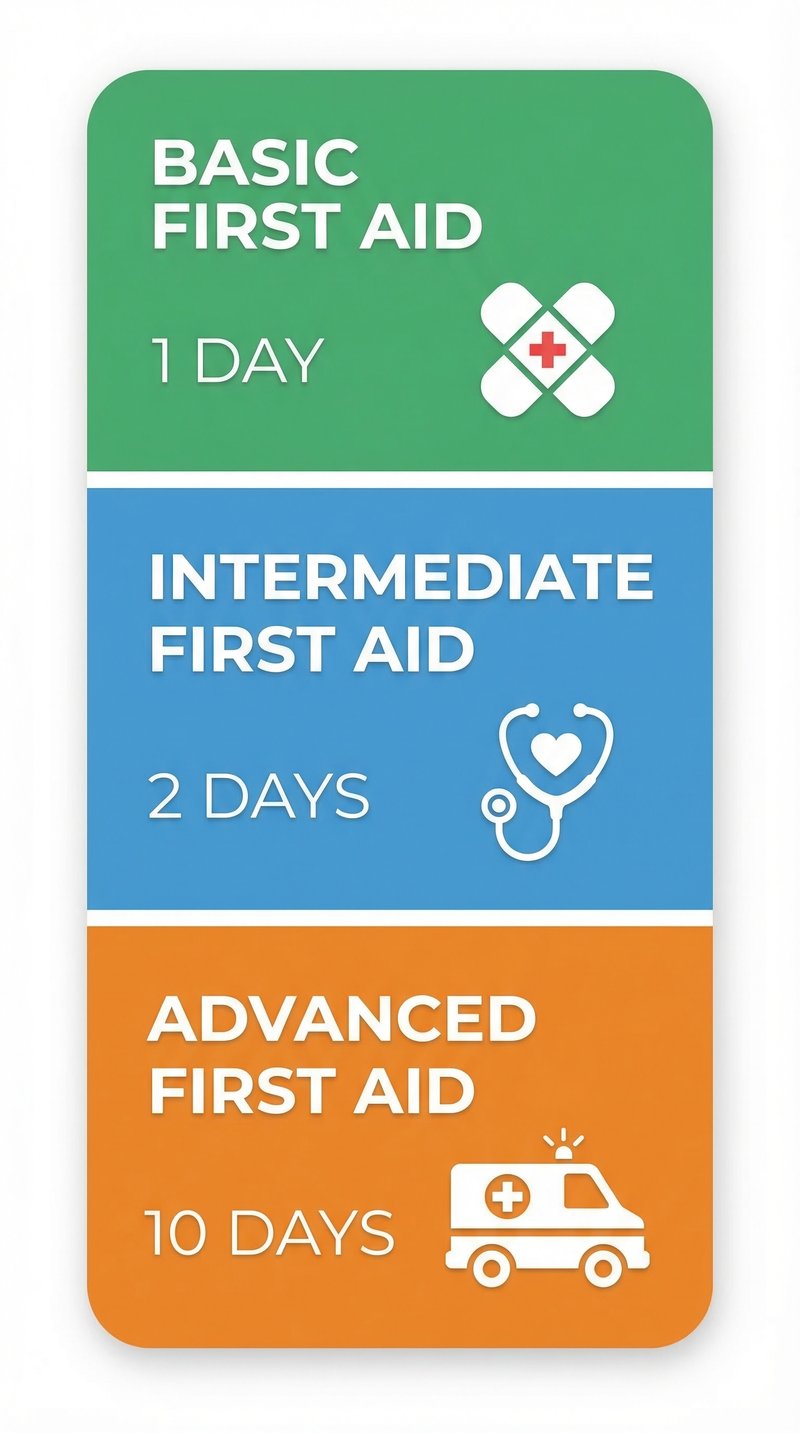
- Basic First Aid (formerly called Emergency First Aid): a 1-day course covering life-threatening emergencies. This is the minimum for most low-hazard workplaces.
- Intermediate First Aid (formerly called Standard First Aid): a 2-day course with broader injury and illness management. This is what most construction sites need.
- Advanced First Aid: a 10-day course for high-risk, remote, or isolated work sites where paramedic response times are long.
All three levels include CPR and AED training. Certificates are valid for 3 years across Canada, though annual CPR refreshers are strongly recommended and sometimes required by GCs.
If your crew works in construction, oil and gas, or any trade where people use tools, climb heights, or work near heavy equipment, this is not optional. It is the law, and it is checked. If you are building out your health and safety management system, first aid training is one of the foundational pieces. It connects directly to your worker orientation and onboarding process, because every new hire needs to know who the first aiders are and where the kits are located.
How Many First Aiders Does Your Site Actually Need?
Most contractors think they need one first aider on site and they are covered. They are wrong.
The number of certified first aiders you need depends on three factors that interact with each other: your hazard level, the number of workers per shift, and how far your site is from a hospital or ambulance service.
Here is where it gets real. A 15-person electrical sub working a commercial build in Edmonton (close to a hospital, medium hazard) might need 1 basic and 1 intermediate first aider per shift. That same crew working a pipeline shutdown 40 minutes from the nearest town? You might need 2 intermediate first aiders and an advanced first aider, plus a dedicated first aid room.
The requirements are laid out in Schedule 2 of the Alberta OHS Code (Tables 5-7) and Schedule 3-A of the BC OHS Regulation. If you have not looked at these tables recently, do it now. They changed.
Alberta: What the OHS Code Requires
Alberta updated its first aid requirements under OHS Code Part 11, effective March 31, 2023, aligning with CSA standards. Your requirements depend on:
- Hazard classification: Low, medium, or high (construction is typically medium or high)
- Workers per shift: The maximum number of workers on site at any given time
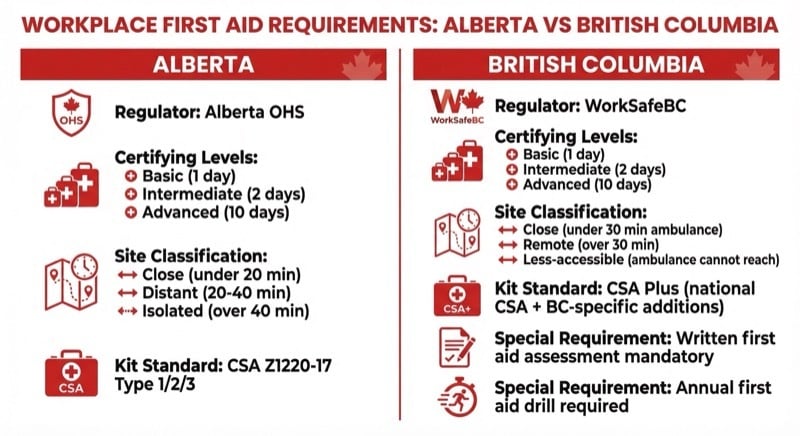
- Distance to medical facility: Close (under 20 minutes), distant (20-40 minutes), or isolated (over 40 minutes)
For a typical medium-hazard construction site with 10-19 workers per shift that is close to a hospital, you need at minimum: 1 basic (emergency) first aider, 1 intermediate (standard) first aider, and a Type 2 first aid kit. Training must come from an Alberta OHS-approved training agency.
And here is the part that catches contractors off guard during COR audits: first aid falls under Element 8 of the audit. If your first aid certificates are expired, your kits are not stocked to CSA Z1220-17 standards, or you do not have the right number of first aiders for your crew size, you lose points. Those points add up fast. If you are working toward your COR certification, get your first aid program sorted first.
British Columbia: The New WorkSafeBC Rules
If you work in BC, pay attention. WorkSafeBC rolled out the most significant changes to first aid regulations in two decades on November 1, 2024.
The old OFA Level 1, 2, and 3 system is gone. It has been replaced with Basic, Intermediate, and Advanced, aligning with the national CSA standards. But BC did not just copy the federal rules. They added province-specific requirements on top.
Key changes BC contractors need to know:
- Written first aid assessment is now mandatory for every workplace. You cannot just guess what level of first aid you need based on headcount. You must document your assessment.
- Kit requirements follow a "CSA Plus" standard. A standard national CSA kit will not cut it in BC. WorkSafeBC requires additional items like windlass-style tourniquets and specific PPE.
- Site classification uses BCEHS response time: Close (under 30 minutes for an ambulance), remote (over 30 minutes), or less-accessible (ambulance physically cannot reach the worker).
- Annual documented first aid drill is now required. Having the equipment is not enough. You need to prove your team can actually use it.
If your staff hold valid OFA Level 1, 2, or 3 certificates issued before November 1, 2024, those remain valid until their natural expiration date (3 years from issuance). But any new training must follow the updated curriculum.
Not sure if your current program meets the new requirements? Book a free safety assessment and we will walk through your first aid compliance alongside your full safety program.
How Much Does First Aid Training Cost?
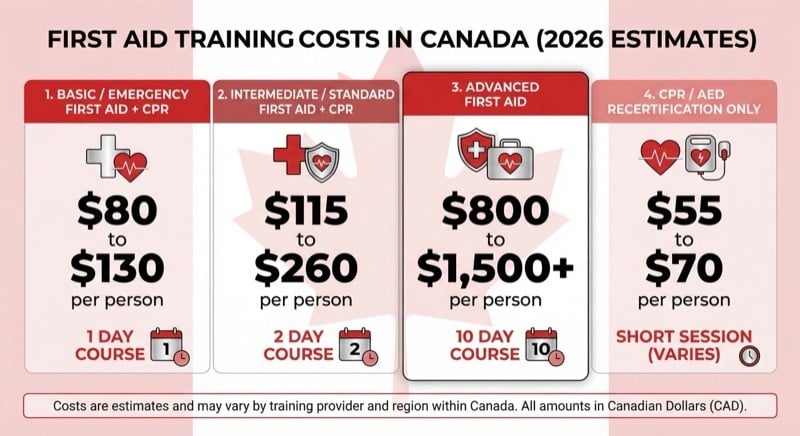
Here are the typical cost ranges you can expect in 2026 (CAD). These are estimates based on current market rates from approved training providers across Alberta and BC:
- Basic/Emergency First Aid + CPR Level C: $80-$130 per person (1 day)
- Intermediate/Standard First Aid + CPR Level C: $115-$260 per person (2 days)
- Advanced First Aid: $800-$1,500+ per person (10 days, varies significantly by provider)
- CPR/AED recertification only: $55-$70 per person
For a 15-person crew where you need 3 people trained in intermediate first aid and 2 in basic, you are looking at roughly $900-$1,040 for the whole group. That is less than one day of downtime from an OHS stop-work order.
On-site group training from approved providers like the Canadian Red Cross or St. John Ambulance often costs less per person than sending people to public courses. If you have 6 or more people to train, ask about on-site options.
One blunt truth: the contractors who complain loudest about the cost of first aid training are the same ones who will spend $50,000 on a new truck without blinking. Training your crew to keep each other alive is not a line item you cut. It is insurance you hope you never need, and the one expense that will absolutely pay for itself the first time someone goes down on your site.
How Do You Get Your Crew Certified?
The process is straightforward, but there is friction in every step if you do not plan ahead.
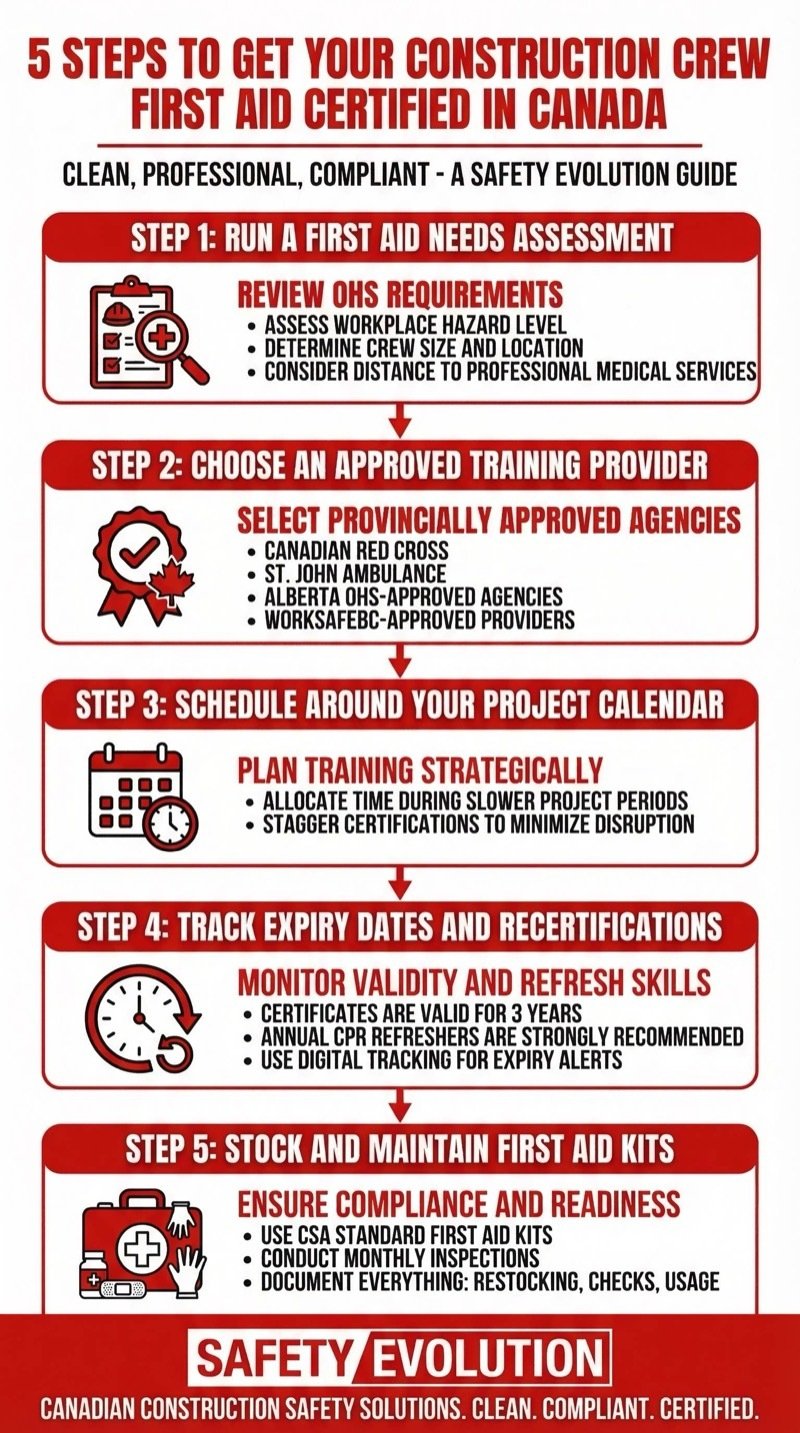
Step 1: Run a First Aid Needs Assessment
Before you book a single course, figure out what you actually need. Review your provincial OHS requirements (Schedule 2 in Alberta, Schedule 3-A in BC) based on your hazard level, crew size per shift, and distance to medical services. In BC, this written assessment is now legally required.
This is the step most contractors skip. They send everyone to a basic course because it is the cheapest and fastest. Then they show up to a site 45 minutes from the nearest hospital and realize they needed intermediate or advanced first aiders. Now they are pulling people off the job for a second round of training.
Step 2: Choose an Approved Training Provider
Your training must come from a provincially approved agency. In Alberta, the Government publishes a list of approved first aid training agencies. In BC, WorkSafeBC maintains its own list of approved providers. The Canadian Red Cross and St. John Ambulance are approved in both provinces.
Look for providers that offer flexible scheduling, on-site delivery for groups, and blended learning options (online theory plus in-person practical). Some providers offer blended courses starting around $85-$115 per person, which can save your crew time off the job.
Step 3: Schedule Around Your Project Calendar
This is where planning breaks down. You cannot pull 3 people off a job site for 2 days during a shutdown without a plan. Schedule safety training during slower periods or between projects. Some contractors stagger certifications so that not everyone expires at the same time.
Step 4: Track Expiry Dates and Recertifications
Every first aid certificate expires after 3 years. CPR skills degrade faster, which is why annual refreshers are recommended. If you are tracking expiry dates on a spreadsheet (or worse, not tracking them at all), you are one audit away from a compliance gap. If you are pursuing COR certification, expired first aid tickets are one of the fastest ways to lose audit points.
Safety Evolution's training platform tracks certifications, sends expiry reminders, and gives you a dashboard showing exactly who is current and who is not. No more scrambling before an audit.
Step 5: Stock and Maintain Your First Aid Kits
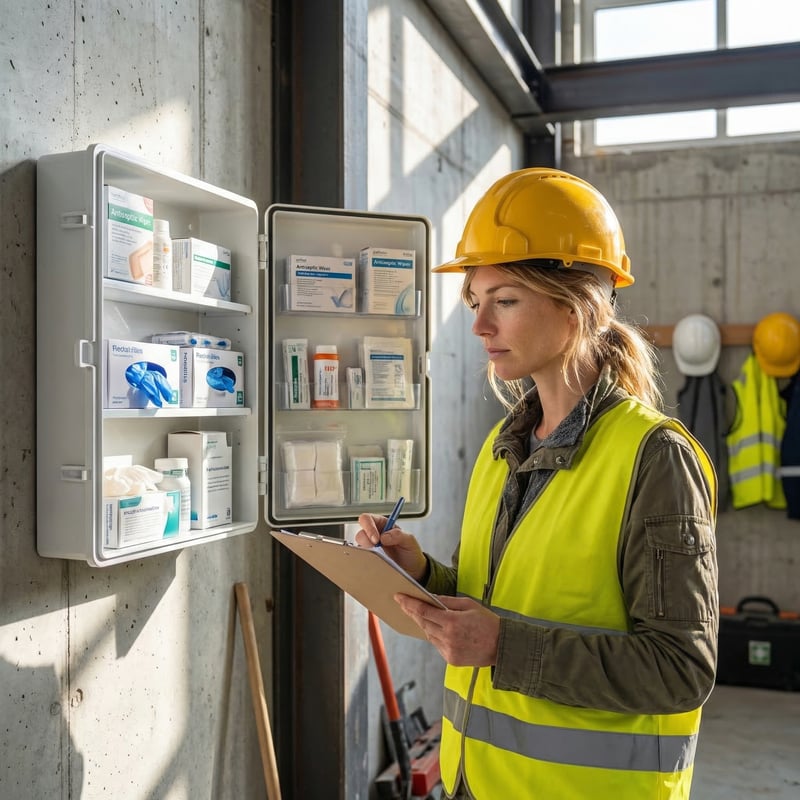
Getting people trained is half the battle. Your kits need to match your provincial requirements too. Alberta uses CSA Type 1 (personal), Type 2 (basic), and Type 3 (intermediate) kits based on your assessment. BC requires the same CSA kits plus additional province-specific items.
Assign someone to inspect kits monthly. Restock used or expired items immediately. Document every inspection. Auditors love documentation, and a first aid kit with expired supplies is an easy write-up. First aid kit maintenance should be integrated into your broader health and safety management system as a recurring inspection item. Make first aid kit checks part of your regular toolbox talks rotation so your crew actually knows where the kits are and what is in them.
What Happens If You Ignore First Aid Requirements?
Three things, and none of them are good:
- OHS penalties. Provincial regulators can issue stop-work orders and fines for inadequate first aid provisions. In Alberta, OHS officers check first aid during inspections. In BC, WorkSafeBC can issue compliance orders and administrative penalties.
- Lost bids. GCs include first aid compliance in prequalification packages. If you cannot demonstrate current certifications and proper kits, you do not make the shortlist. We have seen contractors lose six-figure contracts over expired first aid tickets.
- Failed audits. First aid is a scoreable element in COR and SECOR audits. Gaps here drag down your overall audit score and can jeopardize your certification, which means jeopardizing your WCB premium discount.
And that is just the regulatory side. On the human side, an untrained response to a serious injury can mean the difference between a full recovery and a permanent disability. Your crew deserves better than "somebody call 911 and hope they get here fast."
First Aid as Part of Your Bigger Safety Program
First aid training does not live in isolation. It connects to your emergency response plan, your overall safety program, your training matrix, and your COR/SECOR audit readiness.
The contractors who treat first aid as a checkbox (get the cheapest ticket, forget about it for 3 years) are the same ones who panic before every audit. The ones who build it into their safety management system, track it properly, and actually run drills? They pass audits without breaking a sweat.
If building a complete, audit-ready safety program sounds like a lot, that is because it is. Safety Evolution builds these programs for contractors every week. We handle the documentation, track your training, verify daily forms, and package everything for GC submittals and audits. Book your free safety assessment and get a 30-minute consultation plus a 90-day action plan, free of charge.
Frequently Asked Questions
How much does workplace first aid training cost in Canada?
Basic (emergency) first aid with CPR typically costs $80-$130 per person for a 1-day course. Intermediate (standard) first aid with CPR runs $115-$260 per person for a 2-day course. Advanced first aid can cost $800-$1,500+ for a 10-day program. Prices vary by province and training provider. On-site group training for 6+ people often reduces the per-person cost.
How long is a first aid certificate valid in Canada?
First aid certificates are valid for 3 years across all Canadian provinces. CPR/AED refresher training is recommended annually, and some employers and GCs require it. When your certificate expires, you must retake the full course (recertification courses are shorter and cheaper for intermediate/standard level in some provinces).
How many first aiders do I need on a construction site?
The number depends on your province, hazard level, crew size per shift, and distance to medical services. In Alberta, a typical medium-hazard construction site with 10-19 workers close to a hospital needs at least 1 basic and 1 intermediate first aider. Remote sites and larger crews require more. Check Schedule 2 of the Alberta OHS Code or Schedule 3-A of the BC OHS Regulation for your specific requirements.
What changed with BC first aid requirements in 2024?
On November 1, 2024, WorkSafeBC replaced the old OFA Level 1, 2, and 3 system with Basic, Intermediate, and Advanced certifications aligned to CSA standards. Key changes include: a mandatory written first aid assessment for every workplace, "CSA Plus" kit requirements with BC-specific additions, a new site classification system based on BCEHS response time, and a mandatory annual first aid drill. Existing OFA certificates remain valid until their natural expiry date.
Is first aid training required for COR certification?
Yes. First aid falls under Element 8 of the COR audit in Alberta. Auditors check that you have the correct number of certified first aiders for your crew size, that certificates are current, that first aid kits are stocked to CSA standards, and that you maintain proper documentation. Gaps in first aid compliance can significantly reduce your audit score.