Training
Workplace First Aid Requirements in Canada
What employers must provide for first aid at work in Canada. Assessment steps, attendant levels, kit rules, and records by province.
What first aid records must employers keep? Retention periods, required fields, confidentiality rules, and how records connect to incident reporting.
Last updated: April 2026
Someone on your crew cuts their hand. Your first aider cleans and bandages it. Everyone goes back to work. Three months later, an OHS officer asks to see your first aid records for the past year. You open a drawer and find nothing. No log, no form, no documentation that the treatment ever happened.
At Safety Evolution, we see this gap constantly when onboarding new clients. The first aid treatment happens. The record doesn't. It's the simplest documentation requirement in your entire safety program, and it's the one most contractors forget because nobody teaches them what to write down.
Quick Answer: First Aid Record-Keeping Rules
First aid records are written documentation of every first aid treatment provided to a worker at your workplace. Both BC (OHS Regulation s.3.19) and Alberta (OHS Code Part 11) require employers to maintain these records, keep them for at least 3 years, and restrict access to protect worker privacy. These records are not just a compliance checkbox; they're the starting point for incident reporting, trend analysis, and COR audit documentation.
For the full picture of employer first aid obligations, see our workplace first aid requirements guide.
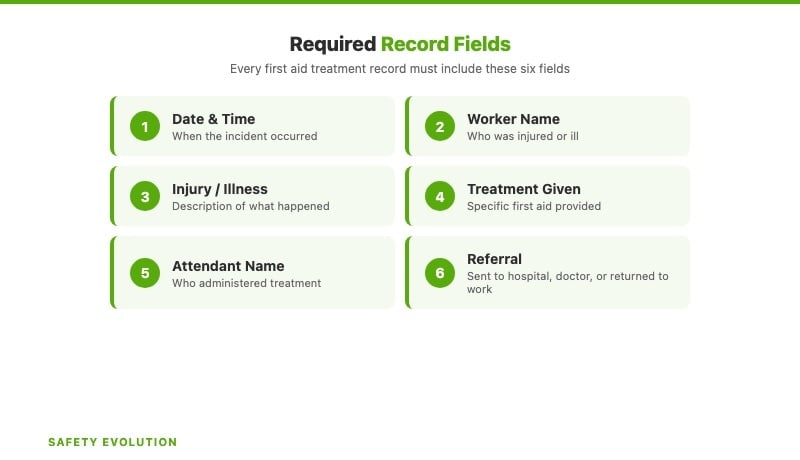
Every first aid treatment provided at your workplace needs a record that captures the following:
The record doesn't need to be fancy. A dedicated logbook at the first aid station, a standard form, or a digital entry all work. What matters is consistency: every treatment, every time, same information captured.
Most contractors think a first aid record means writing "John cut his finger" on a piece of paper. They're wrong. That's not a record; that's a sticky note. A proper record documents enough detail that someone reviewing it months later can understand what happened, what care was provided, and whether follow-up was needed.
Both BC and Alberta require first aid records to be retained for at least 3 years from the date of the injury or illness.
In BC, OHS Regulation s.3.19 specifies this retention period. In Alberta, the OHS Code requires records to be kept for at least 3 years from the reported date of injury or illness.
Three years is the legal minimum. Many safety professionals recommend keeping records longer, especially if:
When in doubt, keep records longer than required. Storage is cheap. Producing a record from three years ago during an investigation is valuable. Not having it is costly.
Not sure if your first aid readiness would hold up in a real emergency?
See training gaps, expiring certificates, and missing documentation before they become incidents.
Start Your 30-Day Free Trial →First aid records contain personal health information. Access must be restricted to:
Do not post first aid records in common areas. Do not discuss specific injuries with other workers unless there's a safety reason (like alerting the crew to a new hazard). Treat these records like the medical information they are.
A 30-person plumbing contractor in Calgary made this mistake: they kept their first aid log open on a clipboard in the lunchroom. Every worker could see who got treated, for what, and when. An OHS inspection flagged it as a privacy violation. The fix was simple: move the log to a locked file in the foreman's office. But the citation could have been avoided entirely.
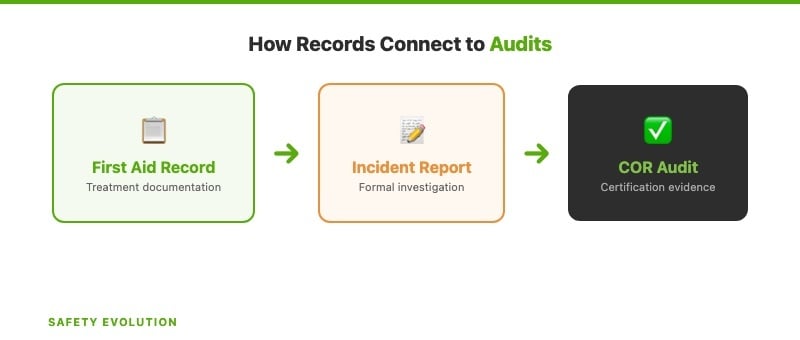
First aid records are not the same as incident reports, but they're closely connected. Here's how they fit together:
Not every first aid treatment triggers a full incident report. A minor cut that's cleaned and bandaged may only require a first aid record. But any treatment that involves:
should also trigger your incident report and investigation process.
The first aid record becomes the starting document for the investigation. It captures the "what happened" and "what care was given" that the investigation builds on.
If you're pursuing or maintaining COR certification, auditors will review your first aid records as part of the health and safety management system evaluation. They're checking for:
The last point catches contractors off guard. Auditors don't just want to see that you keep records. They want to see that you use them. If your first aid log shows five hand lacerations in six months on the same crew, and you never investigated why, that's a gap in your safety management system.
You don't need software to start. Here's a practical system that works for most contractors:
If you want to go digital, Safety Evolution's training and compliance platform tracks first aid records alongside certifications, inspections, and incident reports in one system.
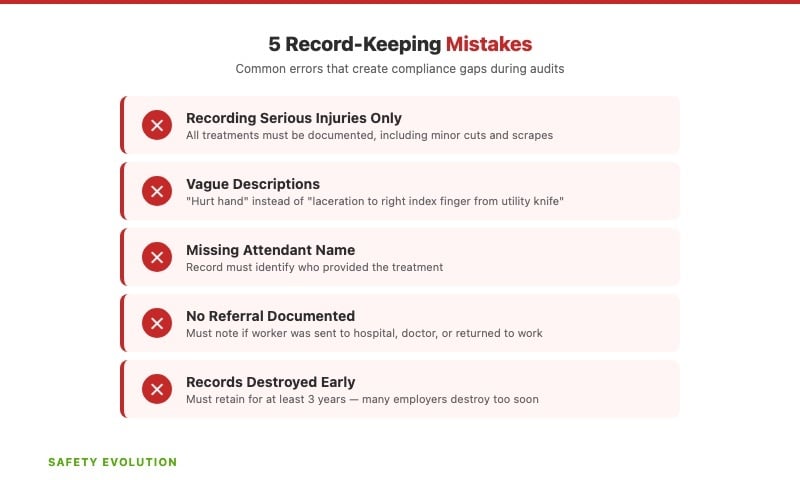
These are the patterns we see during safety program audits that cost contractors audit points and compliance citations:
The blunt truth: most first aid record problems aren't about having the wrong form. They're about not using any form at all. Start with a basic template and improve it over time. Any record is better than no record.
For more on building first aid into your broader safety program, see our guides on BC first aid requirements and Alberta first aid requirements. For training your crew on first aid certification, we have a dedicated guide.
Keeping records is the legal minimum. Using them is what separates contractors who pass audits from contractors who actually reduce injuries.
Once a quarter, pull your first aid records and look for patterns. You do not need software for this. A spreadsheet or even a manual count on paper works. Ask these questions:
Document your findings. Write a short summary each quarter noting what you found and what action you took. This is exactly the kind of evidence COR auditors want to see: proof that your safety program is not just collecting paper but acting on information.
Still chasing first aid records across files and inboxes?
Centralize corrective actions and proof so your next review is predictable.
Start Your 30-Day Free Trial →A written record of every first aid treatment provided at your workplace. Each record must include the date and time, injured worker's name, nature of the injury, treatment provided, name and certification of the first aider, and whether the worker was referred for medical attention. Both BC and Alberta require records to be kept for at least 3 years.
No. A first aid record documents the treatment provided by a first aider. An incident report documents the broader event, root causes, and corrective actions. Not all first aid treatments require a full incident report, but serious injuries, lost-time events, and near-misses should trigger both a first aid record and an incident investigation.
Access is restricted to the employer, the injured worker (their own records), joint health and safety committee members (typically in de-identified form for trend analysis), and provincial regulators during inspections. First aid records contain personal health information and must be stored securely with restricted access.
Yes. COR auditors review first aid records as part of the health and safety management system evaluation. They check for completeness, consistency, proper retention, and whether records are being used for trend analysis and connected to your incident reporting process.
Yes. Digital records are acceptable as long as they capture all required fields, are retained for the required period (at least 3 years), have appropriate access controls, and can be produced for regulators or auditors on request. Many safety management platforms, including Safety Evolution's system, allow digital first aid record-keeping alongside certification tracking and incident reporting.
Get Weekly Safety Insights
Regulation updates, toolbox talk ideas, and compliance tips. One email per week.
What employers must provide for first aid at work in Canada. Assessment steps, attendant levels, kit rules, and records by province.
Province-by-province first aid kit checklist for BC, Alberta, and Ontario. Exact contents required, kit types by crew size, and a printable audit...
Construction ergonomics controls that work on a job site. Trade-specific risks, practical fixes, and what Canadian regulations require from...