Training
Workplace First Aid Requirements in Canada
What employers must provide for first aid at work in Canada. Assessment steps, attendant levels, kit rules, and records by province.
Alberta first aid requirements for employers: hazard levels, worksite categories, attendant counts, kit types, and OHS Code Schedule 2 explained.
Last updated: April 2026
You're running a construction crew in Alberta and an OHS officer shows up asking about your first aid setup. You've got a kit in the truck and one guy who took a course three years ago. Is that enough? Probably not, and the answer depends on factors most contractors haven't checked: your hazard level, how far you are from a hospital, and how many workers are on site at any given time.
At Safety Evolution, we build safety programs for Alberta contractors every week. First aid is one of the most commonly under-managed parts of the program, usually because the OHS Code tables look intimidating. They're not, once you know how to read them.
Quick Answer: Alberta First Aid Requirements
Alberta's workplace first aid requirements are set out in Part 11 of the OHS Code and its Schedule 2, which specifies the minimum number of first aiders, their certification levels, and the type of first aid kit required based on your worksite's hazard level, distance from medical services, and number of workers per shift.
For an overview of first aid requirements across all provinces, see our complete employer guide to workplace first aid requirements.
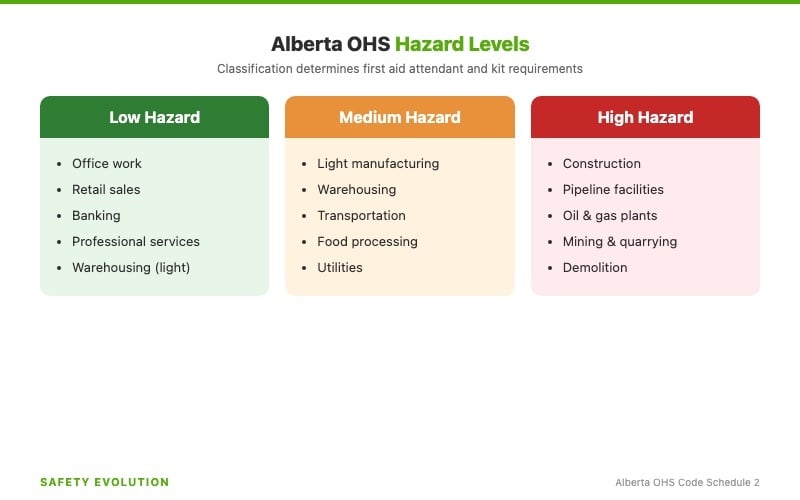
Alberta OHS Code Schedule 2 divides all work into three hazard categories. Your category determines the baseline for everything else: how many first aiders you need, what level of training they require, and what kit you must have.
Low hazard work: Office and clerical work, retail, banking, education, light assembly. Work where the primary risks are slips, trips, and minor cuts.
Medium hazard work: Warehousing, transportation, food processing, light manufacturing, agriculture. Higher physical risk than office work but not heavy industrial.
High hazard work: This is where most SE clients land. The OHS Code specifically lists these as high hazard:
If you're a contractor reading this, you're almost certainly high hazard. That matters because high hazard workplaces need more first aiders, higher certification levels, and larger first aid kits at every worker count threshold.
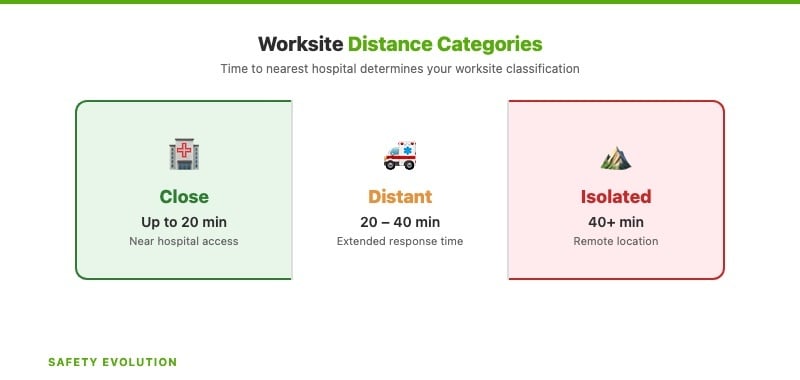
Alberta adds a second dimension to the calculation: how far your worksite is from emergency medical services. This accounts for the reality that an oil sands camp 200 km north of Fort McMurray needs very different first aid coverage than a commercial build in downtown Edmonton.
Close worksite: Up to 20 minutes from a hospital or medical facility.
Distant worksite: 20 to 40 minutes from a hospital or medical facility.
Isolated worksite: More than 40 minutes from a hospital or medical facility.
The travel time is measured under normal conditions, not best-case. If your site is 25 minutes from the hospital in summer but 45 minutes in winter road conditions, you need to plan for the worst case.
Most contractors think they know how far they are from the hospital. They're wrong. They estimate drive time in their truck, not ambulance response time. Ambulance dispatch, response, and travel rarely match your personal best time. When in doubt, classify one category higher.
Not sure if your first aid readiness would hold up in a real emergency?
See training gaps, expiring certificates, and missing documentation before they become incidents.
Start Your 30-Day Free Trial →OHS Code Schedule 2 has three tables (one per hazard level) that cross-reference the number of workers per shift against the worksite distance category. Each cell tells you the minimum number of first aiders and their required certification level.
Here are the key thresholds for high hazard, close worksites (the most common scenario for Alberta construction contractors):
For distant and isolated worksites, the requirements increase. An isolated, high-hazard worksite with 100+ workers may require an Advanced Care Paramedic and a dedicated first aid room.
The numbers indicated in Schedule 2 are for a work shift at all times. If you run two shifts, you need the required number of first aiders on each shift, not split across shifts.
A 12-person electrical sub in northern Alberta found this out during a site audit. They had one Advanced First Aider on day shift and nobody qualified on nights. The OHS officer issued a compliance order on the spot. They had to pull a worker off tools and send them to an emergency first aid course before nights could resume.
Alberta references the CSA Z1220-17 standard for first aid kit contents. The required kit type depends on your hazard level and worker count:
The kit size (small, medium, large) scales with your worker count. Don't guess: check Schedule 2 for your specific combination of hazard level, distance category, and worker count.
Kits must be accessible to all workers, clearly marked, and replenished after use. For multi-floor or multi-building sites, you may need kits at multiple locations.
For complete kit contents and selection guidance by province, read our first aid kit requirements guide.
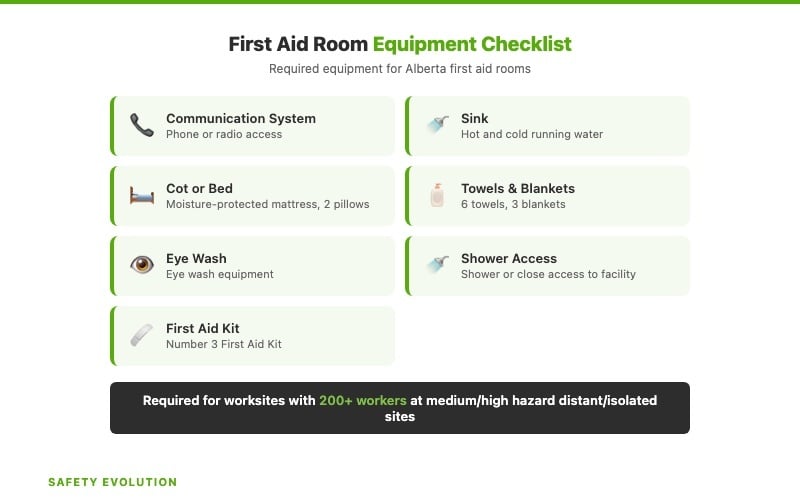
Alberta OHS Code requires a dedicated first aid room when you have 200 or more workers at a medium or high hazard worksite that's classified as distant or isolated.
A first aid room must include:
The room must be accessible by stretcher and located near bathrooms. Most large construction projects in remote Alberta (oil sands, pipeline, heavy civil) need to plan for this.
Alberta employers must keep a written record every time a first aid attendant provides treatment. Records must be retained for at least 3 years from the reported date of injury or illness and kept confidential.
Your first aid records should document:
These records feed into your incident reporting and investigation process. For detailed record-keeping guidance, see our first aid records guide.
If you're pursuing or maintaining COR certification through ACSA (Alberta Construction Safety Association) or another certifying partner, first aid is an auditable element of your health and safety management system.
During a COR audit, the auditor checks whether you have:
A solid first aid program is one of the easier elements to get right in a COR audit. It's specific, measurable, and mostly about documentation and certificates. Don't leave easy audit points on the table.
If you're building your entire safety management system, Safety Evolution can help you get first aid and every other element audit-ready as part of our done-for-you safety services.
For first aid training and certification guidance for contractors, we have a dedicated guide.
After auditing hundreds of Alberta contractor safety programs, these are the first aid gaps we see most often. Every one of them is avoidable.
The pattern behind most of these mistakes is the same: contractors set up first aid once and never revisit it. Your crew size changes. Your site location changes. Certificates expire. A first aid program that matched your requirements six months ago may not match today. Build a quarterly review into your safety calendar.
Knowing what an OHS officer actually looks for during a worksite visit removes the mystery and helps you prepare. Here is a typical inspection sequence for first aid compliance on an Alberta construction site.
The officer arrives and asks for your first aid needs assessment. This is the document showing your hazard classification, distance category, worker count, and the resulting Schedule 2 requirements. If you cannot produce it on the spot, that's the first finding. The officer won't take "it's at the office" as an answer for a document that should be available at the worksite.
Next, they ask to see your first aiders' certificates. The officer checks names, certification levels, and expiry dates against what Schedule 2 requires for your site. They also confirm that the certified workers are actually present on shift, not on days off or at a different location. A certificate pinned to the trailer wall for a worker who's on vacation does not count.
Then they inspect your first aid kit. The officer opens the kit and checks contents against the CSA Z1220-17 standard for your required kit type. Common findings include expired items, missing components that were used and never restocked, and kits that are the wrong type entirely (a Type 2 small where a Type 3 medium is required).
Finally, they may ask workers questions. An officer might ask a random crew member where the first aid kit is located, who the designated first aider is on this shift, and how to call for help if someone gets hurt. If workers don't know the answers, that indicates your first aid procedures aren't being communicated effectively.
A clean inspection typically takes 15 to 20 minutes for the first aid portion. A messy one can lead to compliance orders, follow-up inspections, and administrative penalties that scale with your payroll. The preparation required to pass is minimal compared to the cost of failing.
Run through this list before any OHS officer could possibly visit your site:
Still chasing first aid records across files and inboxes?
Centralize corrective actions and proof so your next review is predictable.
Start Your 30-Day Free Trial →Yes. Alberta OHS Code Schedule 2 specifically lists construction and demolition as high hazard work. This means construction worksites need more first aiders, higher certification levels, and larger first aid kits compared to low or medium hazard workplaces at the same worker count.
Measure the travel time from your worksite to the nearest hospital or medical facility under normal conditions. Close is up to 20 minutes. Distant is 20 to 40 minutes. Isolated is more than 40 minutes. Plan for worst-case conditions (winter roads, construction traffic) rather than best-case estimates.
Yes. The number of first aiders in OHS Code Schedule 2 is per work shift at all times. If you run day and night shifts, each shift needs its own qualified first aiders meeting the minimum requirements for your hazard level, distance category, and worker count.
Alberta requires first aid kits to meet CSA Z1220-17. Kit types range from Type 1 (personal) to Type 3 (intermediate) in small, medium, and large sizes. Your required kit type and size depend on your hazard level, distance category, and the number of workers per shift.
At least 3 years from the reported date of injury or illness. Records must be kept confidential, with access restricted to the employer, the injured worker, and authorized personnel.
Get Weekly Safety Insights
Regulation updates, toolbox talk ideas, and compliance tips. One email per week.
What employers must provide for first aid at work in Canada. Assessment steps, attendant levels, kit rules, and records by province.
BC first aid requirements changed November 2024. New certification levels, assessment steps, kit rules, and what your OFA certificates mean now.
Province-by-province first aid kit checklist for BC, Alberta, and Ontario. Exact contents required, kit types by crew size, and a printable audit...