Training
Workplace First Aid Requirements in Canada
What employers must provide for first aid at work in Canada. Assessment steps, attendant levels, kit rules, and records by province.
Step-by-step guide to completing your workplace first aid assessment. BC and Alberta processes, assessment factors, and free worksheet resources.
Last updated: April 2026
A WorkSafeBC inspector asks to see your first aid assessment. You pause. You didn't know you needed one in writing. You figured having a first aid kit and someone with a certificate was the assessment. It's not, and that gap just became the most expensive thing you skipped.
Safety Evolution can check your first aid documentation across all your sites. The first aid assessment is one of the simplest documents in your safety program, but it is also one of the most commonly missing. Here is exactly how to do it in both BC and Alberta.
Quick Answer: What Is a First Aid Assessment?
A workplace first aid assessment is a written evaluation that employers must complete to determine the type and level of first aid services required at their workplace. The assessment uses objective inputs: how many workers are on shift, what hazards they face, and how far you are from emergency medical services. The output tells you exactly what attendant certifications, kit types, and procedures you need. It is not optional. It is the legal foundation of your entire first aid program.
For the full picture of employer first aid obligations, see our workplace first aid requirements guide.
Most contractors think they already know what first aid they need. They have a guy with a certificate and a kit in the truck. What's to assess?
Here's what they're getting wrong: the assessment isn't about confirming what you already have. It's about proving that what you have matches what the regulations require for your specific situation. The number of workers, the type of work, and the distance from a hospital all change the answer. A 5-person crew doing commercial renovation in Edmonton has different requirements than a 30-person crew doing pipeline work near Slave Lake.
Without a written assessment, you can't prove your first aid program is adequate. During a COR audit, the auditor asks for your assessment document. During an OHS inspection, the officer asks for it. After an incident, the investigation team reviews it. If it doesn't exist, you fail all three.
A 20-person concrete sub in the Okanagan got cited for this during a routine WorkSafeBC visit. They had two OFA Level 1 attendants, which was actually the right number for their crew size. But they couldn't produce a written assessment documenting how they determined that. The citation wasn't for having the wrong coverage; it was for not having the documentation to prove their coverage was intentional. That's the part that stings.
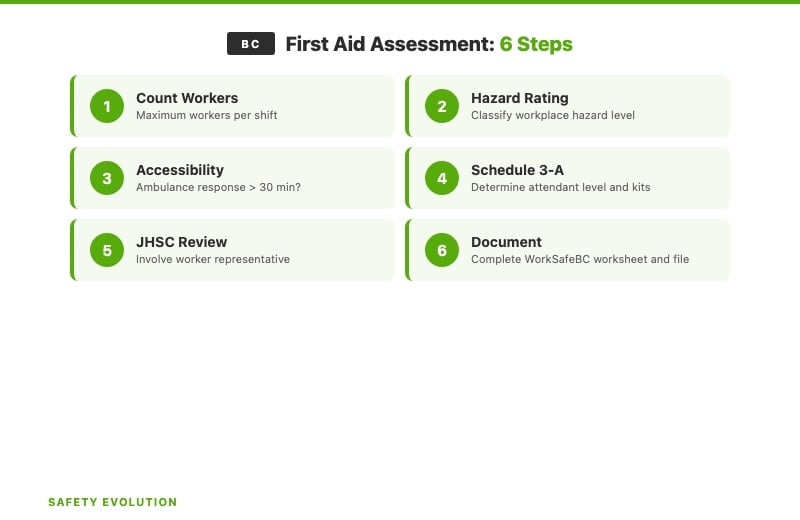
In BC, employers must complete a written first aid assessment per OHS Regulation s.3.16. WorkSafeBC provides a standardized worksheet. Here are the steps:
Count the maximum number of workers physically present at your workplace during any single shift. This is per location, not per company. If you have workers at three different sites, each site gets its own assessment.
WorkSafeBC assigns a hazard rating to your classification unit. Find your rating on the classification unit description sent to you annually, or look it up through WorkSafeBC's online tools. Construction classification units typically carry higher hazard ratings.
If workers will perform work at a separate location that poses greater risk than your assigned rating, you may need to use a higher hazard rating for that location. See OHS Guideline G3.16 for details.
Determine whether a BC Emergency Health Services ambulance would normally take more than 30 minutes to reach your workplace. If yes, your workplace is classified as "less accessible," which triggers higher first aid coverage requirements.
For construction sites that change location regularly, you need to reassess accessibility each time you move to a new site.
With your worker count, hazard rating, and accessibility status, look up Schedule 3-A of the OHS Regulation. It tells you the minimum required:
Your joint health and safety committee or worker representative must participate in the assessment process. Document their involvement. If you don't have a JHSC (required at 20+ workers in BC), your worker health and safety representative fills this role.
Complete the written assessment and keep it accessible for inspection. WorkSafeBC's first aid assessment worksheet is the standard format. Store it with your safety program documentation.
Not sure if your first aid readiness would hold up in a real emergency?
See training gaps, expiring certificates, and missing documentation before they become incidents.
Start Your 30-Day Free Trial →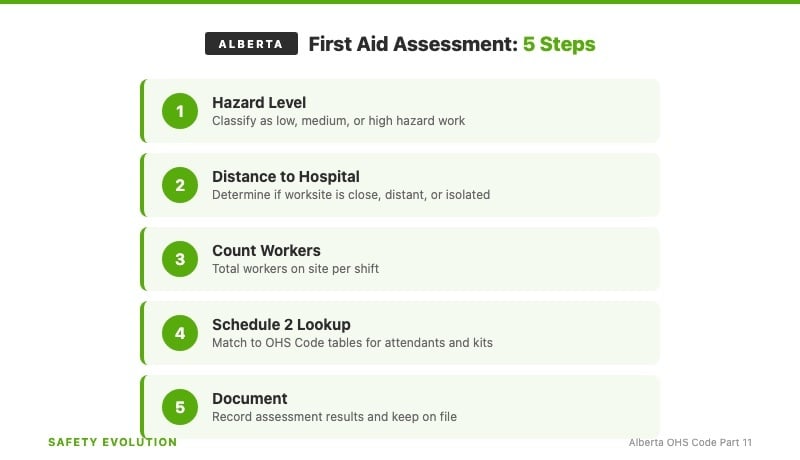
Alberta's process uses a different structure but follows the same logic. The OHS Code Part 11 and Schedule 2 govern first aid requirements.
Alberta uses three categories: low, medium, and high hazard. Construction and demolition are always classified as high hazard in OHS Code Schedule 2. Check the schedule for your specific work type if you're unsure.
Measure travel time from your worksite to the nearest hospital or medical facility under normal conditions:
Use worst-case travel conditions (winter roads, not summer highway driving).
Count the maximum number of workers present during any single shift at that worksite.
Schedule 2 contains three tables (one per hazard level). Find the row matching your worker count and the column matching your distance category. The cell tells you the minimum number of first aiders, their required certification level, and the kit type needed.
Write down your findings: the hazard classification, distance category, worker count, and the resulting requirements from Schedule 2. While Alberta doesn't provide a standardized worksheet like BC, the documentation must demonstrate how you determined your requirements.
For detailed Alberta requirements and Schedule 2 breakdowns, see our Alberta first aid requirements guide.
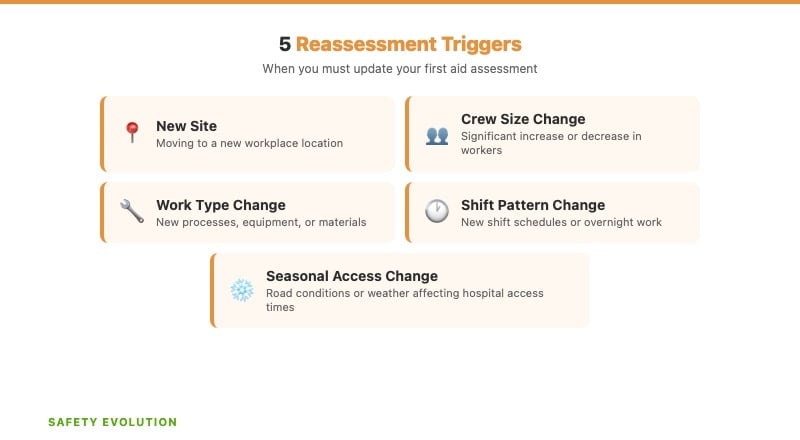
Both BC and Alberta require the assessment to be reviewed when significant changes occur. In BC, the regulation specifies annual review or when operations change significantly.
Triggers for reassessment include:
For construction contractors who move between sites regularly, this means your assessment isn't a one-time exercise. Every significant project move should trigger at least a quick review of the three inputs: worker count, hazard level, and distance to hospital.
Set a calendar reminder for your annual review. Many contractors we work with bundle the first aid assessment review with their annual safety program review and COR maintenance activities.
The assessment itself is only useful if the documentation is clear enough for someone else to understand your reasoning. An inspector, auditor, or new safety coordinator should be able to pick up your assessment document and immediately see what you determined and why.
Every completed first aid assessment should include these elements:
Keep the document straightforward. A single page is usually enough for a standard worksite. For multi-phase projects where conditions change (e.g., excavation phase vs. structural phase), document the highest-requirement phase and note when conditions will change.
Store a copy at the worksite where it can be produced within minutes if requested. Keep a backup copy at your main office or in your digital safety management system. If you use Safety Evolution's done-for-you safety services, your assessment is stored digitally and updated as part of your ongoing program management.
The minimum review frequency is annual in both BC and Alberta, but annual reviews are the floor, not the ceiling. Construction contractors should treat the assessment as a living document that gets revisited whenever conditions shift.
Here is a practical review schedule that works for most contractors:
Document every review, even if nothing changed. A one-line note saying "Reviewed March 2026, no changes required" proves the review happened. Undocumented reviews are the same as no review at all from an audit perspective.
The assessment is a regulatory requirement, not a suggestion. Without one:
The blunt truth: the assessment itself takes 20 minutes to complete once you know the process. It's not the documentation that's hard; it's knowing you need to do it in the first place. Now you know.
The assessment shouldn't be a standalone document that lives in a drawer. Integrate it into your safety management system:
If building this into a larger safety program feels overwhelming, that's what we do. Safety Evolution manages the entire program as your done-for-you safety department, including first aid assessments, attendant tracking, and kit inspections.
Still chasing first aid records across files and inboxes?
Centralize corrective actions and proof so your next review is predictable.
Start Your 30-Day Free Trial →Yes. The employer is responsible for completing the assessment. You don't need to hire a consultant. In BC, you must involve your joint health and safety committee or worker representative in the process. The assessment requires factual inputs (worker count, hazard level, distance to hospital) that you as the employer are best positioned to determine.
Yes. Each worksite may have different worker counts, hazard levels, and distances to medical services. A separate assessment for each location ensures the first aid coverage matches the specific conditions at that site. For construction contractors who move between sites, reassess when you mobilize to a new location.
Reassess whenever a significant change occurs. This includes worker count increases, changes to the type of work being performed, and seasonal changes that affect travel time to medical services. A quick review of the three assessment inputs takes minutes and ensures your coverage stays current.
BC provides a standardized first aid assessment worksheet through WorkSafeBC. Alberta doesn't provide a standardized form, but your documentation must clearly show the hazard classification, distance category, worker count, and resulting requirements from OHS Code Schedule 2. Any format that captures these elements is acceptable.
Yes. The first aid assessment is one of the documents COR auditors review when evaluating your health and safety management system. Having a current, documented assessment that matches your actual first aid coverage demonstrates systematic safety management and contributes to your audit score.
Get Weekly Safety Insights
Regulation updates, toolbox talk ideas, and compliance tips. One email per week.
What employers must provide for first aid at work in Canada. Assessment steps, attendant levels, kit rules, and records by province.
BC first aid requirements changed November 2024. New certification levels, assessment steps, kit rules, and what your OFA certificates mean now.
JSA vs risk assessment is not either-or. Use JSA for task steps, risk assessment for risk ranking, and both when site conditions change.