Last updated: April 2026
You found out your first aid setup doesn't meet provincial standards when a WorkSafeBC inspector walked your site. Or an Alberta OHS officer flagged your crew for not having enough trained first aiders on shift. Either way, you're scrambling to figure out what you actually need, and every source you find reads like a regulation textbook.
At Safety Evolution, we build safety programs for contractors every week, and first aid compliance is one of the most common gaps we see, especially for companies with 10 to 50 workers who've outgrown their original setup.
Quick Answer: What Do Employers Need for First Aid?
- Written first aid assessment based on worker count, hazard level, and distance to hospital
- Trained first aid attendants on every shift (certification level depends on assessment results)
- CSA-compliant first aid kits matching your workplace risk level
- Written first aid procedures covering how to call for help, transport injured workers, and report incidents
- Records retained for at least 3 years in both BC and Alberta
- BC employers: new certification levels (Basic, Intermediate, Advanced) replaced OFA as of November 1, 2024
- Behind on first aid actions? Start your 30-day free trial to track training, records, and corrective actions in one place.
Workplace first aid requirements are the legal obligations every Canadian employer must meet to ensure injured or ill workers receive immediate care on the job. These requirements vary by province, but every jurisdiction requires employers to assess their workplace, provide trained attendants, stock proper first aid supplies, maintain written procedures, and keep records. Getting this wrong means fines, stop-work orders, and the very real risk that someone on your crew doesn't get help fast enough.
Why First Aid Compliance Matters More Than You Think
Most contractors think first aid means tossing a kit under the trailer and calling it done. They're wrong.
Provincial regulators in BC and Alberta treat first aid as a core employer obligation, not a suggestion. WorkSafeBC issues penalties based on your payroll size and violation history. Alberta OHS can issue stop-work orders on the spot. And here's what catches contractors off guard: first aid is an auditable element in COR and SECOR certification programs. If your first aid program has gaps, it shows up in your audit score.
A 15-person drywall sub in Edmonton learned this the hard way. They had one guy with an expired first aid certificate covering three rotating shifts. During a COR maintenance audit, the auditor flagged the gap. Their score dropped below the maintenance threshold, and they had to redo their full certification audit, costing months and thousands of dollars.
The rules aren't complicated once you understand the framework. Here's what you actually need to know.
How Do You Assess Your Workplace First Aid Needs?
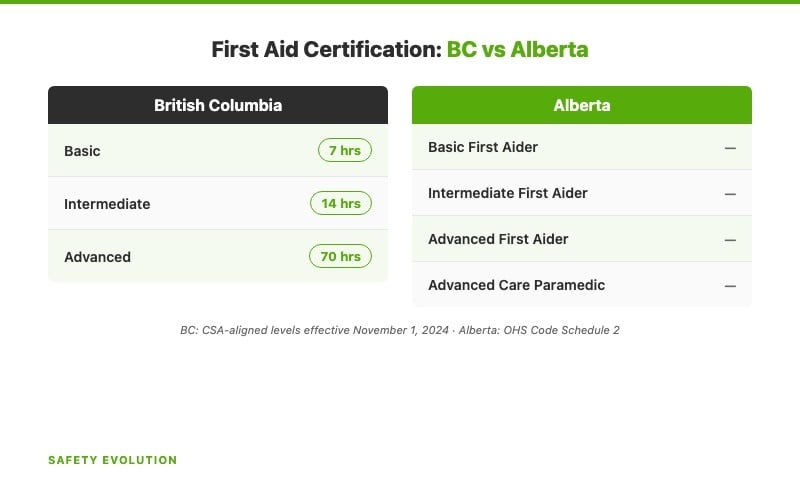
Every province requires employers to conduct a first aid needs assessment before determining what supplies, attendants, and procedures they need. The assessment is not optional and must be documented in writing. Safety Evolution can check whether your first aid assessments are current for every site.
The assessment considers three main factors:
- Number of workers per shift. Not total employees on payroll; the number physically present at one time. More workers means higher first aid service levels.
- Hazard level of the work. Construction, demolition, mining, and oil and gas operations are classified as high hazard in Alberta and receive elevated hazard ratings in BC. Office work and retail are low hazard.
- Distance to emergency medical services. In BC, if an ambulance would take more than 30 minutes to reach your site, it's classified as "less accessible" and requires higher first aid coverage. Alberta uses three categories: close (up to 20 minutes), distant (20 to 40 minutes), and isolated (more than 40 minutes).
In BC, employers must use WorkSafeBC's first aid assessment worksheet and involve their joint health and safety committee (JHSC) or worker representative. In Alberta, the employer determines the hazard category using OHS Code Schedule 2 tables.
The assessment must be reviewed annually or whenever there's a significant operational change, like moving to a new site, adding workers, or changing the type of work.
For a detailed walkthrough of the assessment process, see our guide on how to complete a workplace first aid assessment.
Not sure if your first aid readiness would hold up in a real emergency?
See training gaps, expiring certificates, and missing documentation before they become incidents.
Start Your 30-Day Free Trial →What Certification Levels Do Your First Aiders Need?
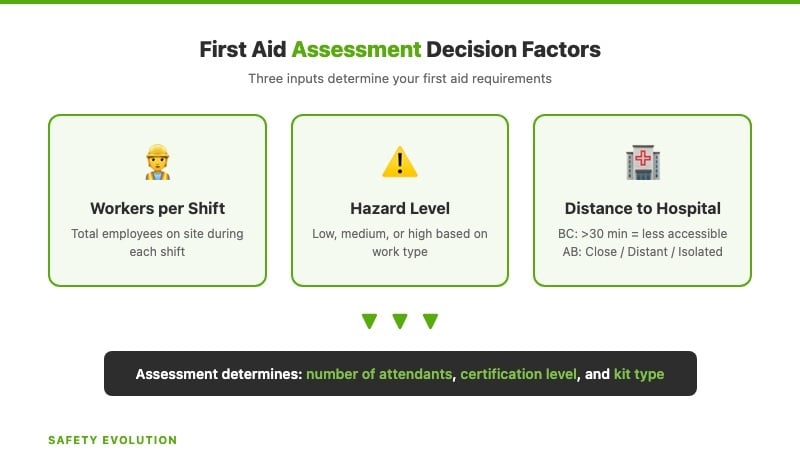
The certification level your first aid attendants need depends on your assessment results. Both BC and Alberta have tiered systems, but they use different names and training hours.
British Columbia
As of November 1, 2024, BC replaced the old OFA (Occupational First Aid) system with CSA-aligned certification levels:
- Basic first aid (formerly OFA Level 1): 7 hours of training. Covers scene assessment, CPR, AED, bleeding control, and basic wound care.
- Intermediate first aid (formerly OFA Level 2): 14 hours of training. This is the biggest change: the old Level 2 required 35 hours (5 days). The new Intermediate covers the same scope in 14 hours (2 days), a significant reduction in training time and cost for employers.
- Advanced first aid (formerly OFA Level 3): 70 hours of training. Comprehensive emergency care including spinal management, oxygen therapy, and advanced splinting.
Existing OFA certificates remain valid until their expiry date, up to November 2027. CSA-aligned courses have been available from approved training providers since July 2024.
For the full breakdown of BC's changes, read our BC first aid requirements guide.
Alberta
Alberta's OHS Code Schedule 2 defines four first aider levels:
- Basic First Aider: Emergency first aid and CPR training (typically 8 hours).
- Intermediate First Aider: Standard first aid training (typically 16 hours).
- Advanced First Aider: Advanced first aid training (40+ hours).
- Advanced Care Paramedic: Required only at isolated, high-hazard worksites with 100+ workers.
The required level depends on the hazard category (low, medium, or high) and the worksite distance category (close, distant, or isolated). Construction and demolition are always classified as high hazard work.
For Alberta-specific details, see our Alberta first aid requirements guide.
What First Aid Kits Does Your Workplace Need?
First aid kits in Canadian workplaces must meet CSA Z1220-17 standards. The type and size of kit depends on your assessment results.
BC uses four kit categories: Personal, Basic, Intermediate, and Advanced. Each must meet CSA standards plus BC-specific additions outlined in WorkSafeBC's equipment information sheet.
Alberta's OHS Code references CSA Z1220-17 directly, with kit types ranging from Type 1 (personal) through Type 3 (intermediate) in small, medium, and large sizes.
Key rules that apply across both provinces:
- Kits must be accessible to all workers during every shift
- Contents must be inspected regularly and replenished after use
- Kits must be clearly marked and easy to locate
- Multi-floor or multi-building sites may need kits at each location
For complete kit contents and selection guidance, read our first aid kit requirements guide.
What Procedures Must Employers Have in Writing?
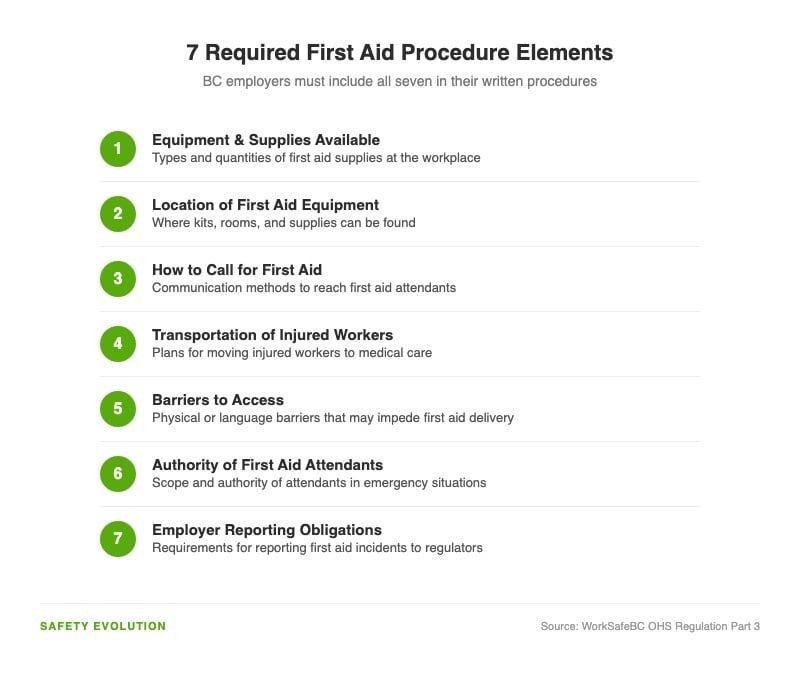
Having trained people and stocked kits is not enough. Both BC and Alberta require employers to maintain written first aid procedures that workers can access at all times.
In BC, your written first aid procedures must cover seven required elements:
- Equipment and supplies available
- Location of first aid equipment
- How to call for first aid
- Transportation of injured workers
- Barriers to access
- Authority of first aid attendants
- Employer reporting obligations
Alberta requires similar written procedures and adds that employers must have a plan for transporting injured workers to a medical facility, especially at distant and isolated worksites.
Here's the blunt truth: most small contractors have none of this written down. They have a general understanding of "call 911 and drive them to the hospital." That's not a procedure, and it won't hold up during an audit or an incident investigation.
If you're building a safety program that includes first aid procedures, our orientation and onboarding package includes templates you can customize.
How Do You Handle First Aid Records?
Every time a first aid attendant treats someone at your workplace, you need a record. Both BC and Alberta require records to be retained for at least 3 years.
Your first aid records should include:
- Date and time of the injury or illness
- Name of the injured worker
- Nature of the injury or illness
- First aid treatment provided
- Name of the first aid attendant
- Whether the worker was referred for further medical treatment
These records must be kept confidential. Only the employer, the injured worker, and authorized personnel (like safety committee members or regulators) should have access.
First aid records also feed into your incident reporting system. If an injury triggers a reporting threshold under your provincial regulations, the first aid record is often the starting document. Having a solid incident reporting process that connects first aid records to investigation files is a COR audit strength.
For detailed record-keeping guidance, see our first aid records guide.
What About Annual Drills and Reviews?
BC requires employers to conduct a first aid drill at least once per year or whenever procedures change significantly (OHS Regulation s.3.17(4)). Alberta has similar expectations for emergency response practice.
Annual drills test whether your procedures actually work. Can your crew locate the first aid kit in under a minute? Does everyone know how to call for help? Can you transport an injured worker from the most remote part of your site to an ambulance access point?
If you've never done one, the first drill usually reveals that half your crew doesn't know where the kit is and nobody remembers the attendant's name. That's normal. That's exactly why you do the drill.
Your annual assessment review is also the time to check whether your first aid attendants' certificates are still valid, whether your kit contents are current, and whether any operational changes (new site, more workers, different work type) require a reassessment.
How Does First Aid Connect to COR and SECOR?
First aid is an auditable element under COR and SECOR certification programs. During a COR audit, the auditor evaluates whether your first aid program demonstrates safety management system maturity. They look at:
- Documented first aid assessment
- Current first aid attendant certificates
- Properly stocked and inspected kits
- Written procedures that workers know about
- First aid records and drill documentation
A weak first aid program pulls your overall audit score down. A strong one shows the auditor that you manage safety systematically, not just reactively.
If you're working toward COR certification or preparing for a safety audit, getting your first aid program right is low-hanging fruit that boosts your score.
Still chasing first aid records across files and inboxes?
Centralize corrective actions and proof so your next review is predictable.
Start Your 30-Day Free Trial →Frequently Asked Questions
What first aid do I need at my workplace?
Your requirements depend on three factors: how many workers are on shift, your workplace hazard level, and how far you are from emergency medical services. You must complete a written first aid assessment to determine the specific attendant levels, kit types, and procedures your site needs. Both BC and Alberta have assessment tools to help.
How many first aiders does my company need?
The number depends on your first aid assessment results. In general, you need at least one trained first aid attendant on every shift. Larger crews, higher hazard levels, and remote locations require more attendants and higher certification levels. Complete your first aid assessment to determine your exact requirements.
What happens if my workplace doesn't have proper first aid?
Penalties vary by province. WorkSafeBC issues fines based on your payroll size and violation history. Alberta OHS can issue orders requiring immediate compliance and levy fines for non-compliance. Beyond fines, inadequate first aid can result in stop-work orders, failed COR audits, and serious consequences if a worker is injured without proper first aid available.
Does first aid count toward COR audits?
Yes. First aid is an auditable element in COR and SECOR programs. Auditors review your first aid assessment, attendant certifications, kit inspections, written procedures, and records. A compliant first aid program demonstrates safety management maturity and contributes to your overall audit score.
How long do I need to keep first aid records?
Both BC and Alberta require employers to retain first aid records for at least 3 years. Records must be kept confidential, with access limited to the employer, the injured worker, and authorized personnel such as safety committee members or regulators.
Are OFA certificates still valid in BC?
Yes. Existing OFA Level 1, 2, and 3 certificates are recognized as equivalent to the new Basic, Intermediate, and Advanced levels until they expire. The latest possible expiry for grandfathered certificates is November 2027 (3 years from the November 1, 2024 effective date).
Get Weekly Safety Insights
Regulation updates, toolbox talk ideas, and compliance tips. One email per week.