Last updated: March 2026
Your crew drops into a manhole on a Tuesday morning. No gas detector. No standby person topside. No entry permit. Nothing goes wrong, so nobody thinks twice about it. Until the day something does go wrong, and two people are dead before lunch.
That is not a hypothetical. Confined space fatalities follow a devastating pattern across Canada and the U.S.: would-be rescuers account for roughly 60% of the deaths. The person who dies is often the one who jumped in to save a coworker without proper equipment or training. At Safety Evolution, we help construction contractors build safety programs that actually hold up on site, and confined space is one of the areas where the gap between "we have a program" and "the program actually works" gets people killed.
⚡ Quick Answer: Confined Space Safety for Canadian Contractors
- What counts: Any space large enough to enter, with limited entry/exit, and not designed for continuous occupancy (manholes, vaults, tanks, pits, trenches)
- Key regulations: Provincial OHS codes govern confined space in Canada. Alberta: Part 5 of the OHS Code. BC: WorkSafeBC OHS Regulation Part 9. Ontario: O. Reg. 632/05. National standard: CSA Z1006:16 (R2020).
- Requirements: Written code of practice (Alberta) or confined space entry program, entry permits for permit-required spaces, atmospheric testing before and during entry, trained attendant, rescue plan
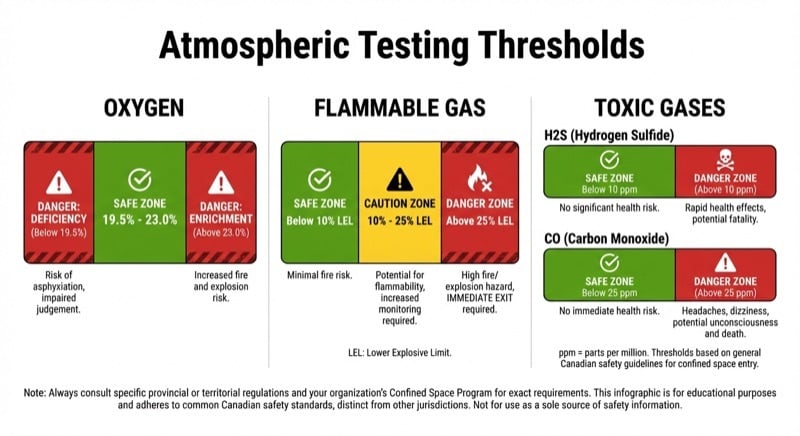
- Atmospheric testing: Oxygen 19.5% to 23.0% (Alberta standard). Flammable gas below 10% LEL. Toxic gases below applicable exposure limits.
- Bottom line: If your crew enters confined spaces without a written program, permits, and trained personnel, you are one bad day away from a fatality or a stop-work order
What Counts as a Confined Space on a Construction Site?
A confined space is any enclosed or partially enclosed area that is not designed or intended for continuous human occupancy, has restricted means of entry and exit, and may become hazardous to a person entering it. On construction sites, that includes manholes, utility vaults, storm drains, storage tanks, silos, crawl spaces, and pipe runs. If your crew works around any of these, you have confined spaces on your site, whether you have formally identified them or not.
Here is where most contractors get tripped up: not every confined space requires a permit. But every confined space needs to be evaluated. A permit-required confined space is one that contains or has the potential to contain a hazardous atmosphere, engulfment hazard, a configuration that could trap a worker, or any other recognized serious safety hazard.
Alberta's OHS Code also distinguishes between "confined spaces" and "restricted spaces." A restricted space is one where the primary hazard is difficulty of entry or exit, but it does not have hazardous atmosphere or engulfment risks. Different requirements apply: restricted spaces need a hazard assessment and safe work procedures, but not the full confined space code of practice with atmospheric testing and rescue plans.
Most contractors think a trench is not a confined space. They are wrong. A trench with limited egress points can qualify as a confined space. The moment that trench has the potential for atmospheric hazards (from adjacent gas lines, chemical storage, or organic decomposition), it can become a permit-required confined space. Misclassifying it does not make it safer. It just means nobody planned for what to do when a worker collapses at the bottom.
If your safety program does not include a confined space entry procedure, you need to fix that before your crew picks up a shovel. Safety Evolution's training courses cover confined space entry requirements with instant certificates and expiry tracking. For a full breakdown of what confined space training looks like in Canada, including costs and provider options, see our dedicated guide.
What Do Canadian Regulations Require for Confined Spaces?
Confined space regulations in Canada are set at the provincial level, with CSA Z1006:16 (R2020) serving as the national management standard. Here is what you need to know for the jurisdictions where most SE clients operate.
Alberta (OHS Code Part 5)
Alberta's requirements are among the most detailed in Canada:
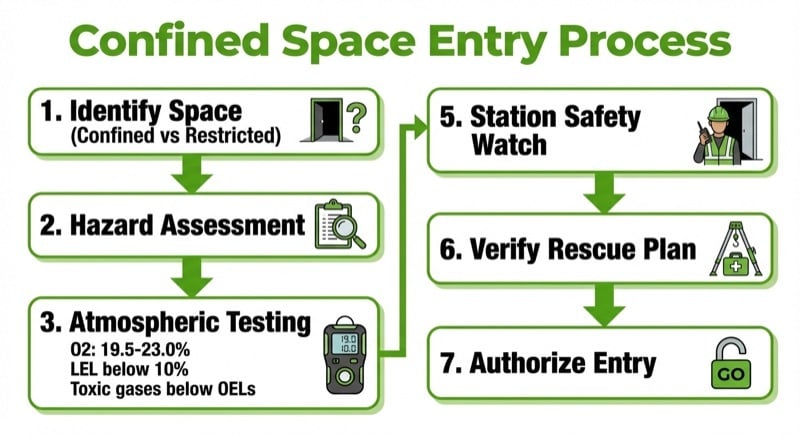
- Identify all confined and restricted spaces at the worksite and determine which are confined vs. restricted
- Develop a written code of practice for confined space entry. This is mandatory for any employer whose workers enter confined spaces.
- Conduct a hazard assessment before entry, identifying all potential hazards in the space
- Perform atmospheric testing before entry: verify oxygen content is between 19.5% and 23.0% by volume, and identify concentrations of flammable, explosive, or toxic substances
- Issue an entry permit before workers enter, documenting the space, hazards, controls, atmospheric test results, authorized entrants, and safety watch
- Station a safety watch (attendant) outside the space at all times during entry, with the training and authority to order evacuation
- Have rescue procedures in place before entry begins, including either trained on-site rescue capability or a pre-arranged agreement with an emergency response service
If you are working toward COR certification in Alberta, your confined space code of practice will be reviewed during the audit. A generic template pulled from the internet will not pass. Auditors look for site-specific procedures that match how your crew actually works.
British Columbia (WorkSafeBC OHS Regulation Part 9)
BC's requirements include a written confined space entry program, pre-entry hazard assessment, atmospheric testing, and rescue provisions. For the full breakdown of WorkSafeBC confined space requirements, see our BC-specific guide. WorkSafeBC takes enforcement seriously: administrative penalties for confined space violations can reach six figures based on company payroll and violation severity.
Ontario (O. Reg. 632/05)
Ontario's confined space regulation under the Occupational Health and Safety Act sets out mandatory written entry plans, atmospheric testing, and on-site rescue arrangements. Ontario also requires that a "competent person" assess the space before each entry. Our Ontario confined space regulations guide covers the full requirements for contractors working in the province.
CSA Z1006:16 (R2020)
The national standard for confined space management covers worker participation, change management, hazard identification and control, and emergency situations. While not directly enforceable legislation, CSA Z1006 represents best practice and is referenced by several provincial regulators. Following it demonstrates due diligence and aligns with COR/SECOR audit expectations.
Take the Guesswork Out of Confined Spaces
Are you struggling to keep track of which rules apply to which spaces? Build your baseline safety program digitally, standardize your hazard assessments, and ensure every entry is compliant.
30-Day Free Trial
What Does Atmospheric Testing Actually Involve?
Atmospheric testing is the single most critical control in confined space entry. A space that looks safe can kill in minutes if the atmosphere is wrong. Oxygen-deficient environments cause unconsciousness and death before most people even realize something is off.
Before any worker enters a confined space, the atmosphere must be tested. In Alberta, the OHS Code specifies testing to:
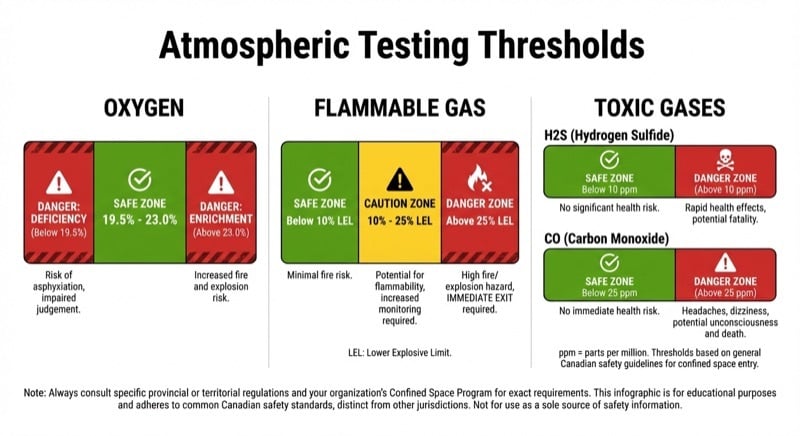
- Oxygen: Verify the oxygen content is between 19.5% and 23.0% by volume. Below 19.5% is oxygen-deficient (risk of asphyxiation). Above 23.0% is oxygen-enriched (fire and explosion risk).
- Flammable/explosive gases: Must be below 10% of the Lower Explosive Limit (LEL). At 10% LEL, the space is approaching conditions where an ignition source could cause an explosion.
- Toxic gases: Hydrogen sulfide (H2S) and carbon monoxide (CO) are the most common concerns on construction sites. Concentrations must be below the applicable Occupational Exposure Limits (OELs) set by your provincial regulations.
The order matters. Oxygen is tested first because most gas detectors need adequate oxygen to give accurate readings for combustibles and toxics. Testing at multiple levels within the space is also critical, because gases stratify. Heavier gases like H2S (common in sewer lines and storm drains) sink to the bottom, while lighter gases rise. A reading taken at the entry point might show clean air while a pocket of lethal gas sits at the working level.
Your 4-gas monitor is not optional. It is the minimum standard. And it needs to be calibrated regularly, bump-tested before each use, and operated by someone trained to interpret the readings. If your crew is running atmospheric testing with expired calibration on your gas detectors, or if nobody knows what an LEL reading of 8% means, your testing program is theater. It exists on paper but will not save anyone.
Safety Evolution builds audit-ready safety programs that include confined space procedures your crew can actually execute in the field, not binder-filler that collects dust in the trailer.
Why Is the Rescue Plan the Part Most Contractors Skip?
Here is the blunt truth: the rescue plan is the most commonly missing piece in contractor confined space programs, and it is also the piece that determines whether someone lives or dies when things go sideways.
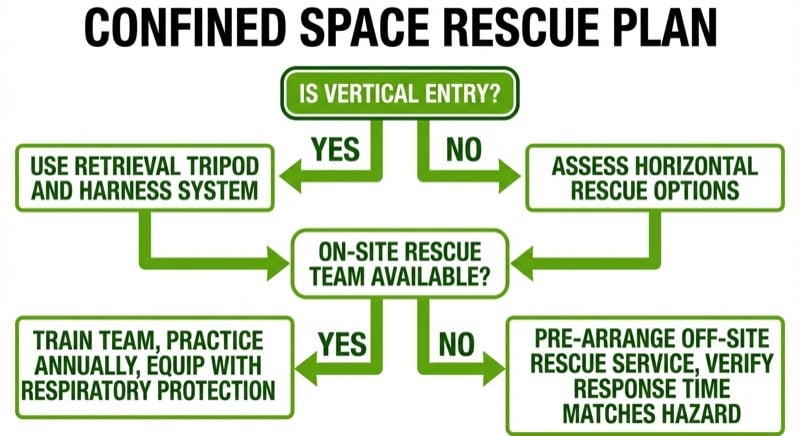
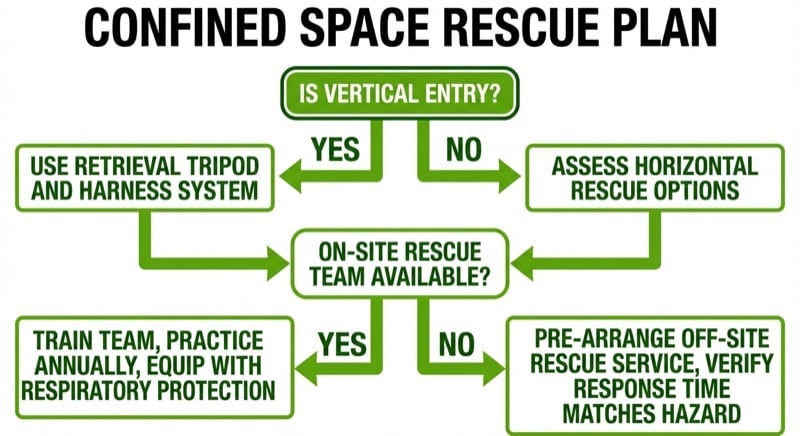
Canadian provincial regulations require that before any entry into a confined space, the employer must have rescue procedures in place. That means one of two things:
- On-site rescue capability: Your own trained personnel with the right equipment (retrieval systems, respiratory protection, first aid) standing by during every entry. They need to practice making rescues from the types of spaces your crew enters.
- Off-site rescue service: A pre-arranged agreement with fire/rescue or a private confined space rescue provider. But here is the catch: you have to evaluate whether they can actually respond in time. If the nearest rescue team is 45 minutes away and the hazard is H2S exposure (which can kill in minutes), that plan does not meet the standard.
Non-entry retrieval systems (mechanical retrieval devices like tripods with winches) must be used whenever feasible. That means for most vertical entries, like manholes and vaults, you need a rescue tripod and harness system in place before the first person goes down. If something goes wrong, the attendant can initiate retrieval from topside without entering the space themselves.
This is where the 60% fatality statistic gets real. When there is no retrieval system and no trained rescue team, the attendant's instinct is to jump in and help. And now you have two people in a lethal atmosphere instead of one. Proper fall protection and rescue planning exist specifically to prevent that cascade.
What Are the Penalties for Getting This Wrong?
In Alberta, OHS administrative penalties for confined space violations can reach $10,000 per violation per day the violation continues. A single confined space inspection can generate multiple citations: no written code of practice, no entry permits, no atmospheric testing, no safety watch, no rescue plan. Stack those up and you are looking at $50,000 or more from a single site visit.
If a violation results in prosecution under Alberta's OHS Act, fines for a first offence can reach up to $500,000 for a corporation. For individuals, fines can reach $100,000 and/or six months imprisonment.
In BC, WorkSafeBC administrative penalties are based on company payroll and violation severity. Penalties for confined space violations, particularly where incidents occur, regularly reach six figures.
Beyond fines, a stop-work order alone can cost you more than the penalty itself, because the project is sitting idle while your crew waits and the GC starts making phone calls to your competition. And GCs check safety records. A stop-work order or OHS citation shows up in contractor prequalification databases. That is not just a fine. That is lost bids.
How Do You Build a Confined Space Program That Actually Works?
Here is where the difference between a real program and a paper program shows up. A lot of contractors have something called a "confined space program" in their safety manual. It was written years ago, nobody has read it since, and it does not match what happens on site.
A program that actually works includes:
- A site-specific hazard assessment that identifies every confined and restricted space on the project, classifies each correctly, and documents the assessment with the date, assessor, and rationale. A proper field level hazard assessment (FLHA) before each entry adds another layer of protection.
- A written code of practice (Alberta) or confined space entry program that covers hazard assessment, atmospheric testing protocols, entry procedures, communication methods, ventilation requirements, energy isolation (lockout/tagout), and emergency response.
- Entry permits that are filled out completely, reviewed by the entry supervisor, and posted at the space entry point for the duration of the entry.
- Trained personnel in every role: authorized entrants who know the hazards, safety watch (attendant) who knows their duties and will not leave the space unattended, and entry supervisors who can cancel a permit if conditions change. Training records must be documented.
- Rescue provisions that match the actual spaces and hazards on your site, with equipment inspected and rescue team practice sessions logged.
- Annual review of the program, plus review after any incident or change in site conditions.
This is not a weekend project. Building a compliant, field-ready confined space program from scratch takes time, and maintaining it takes discipline. Safety Evolution builds these programs for contractors every week. We know what auditors look for, what GCs require in prequalification packages, and what actually keeps crews safe in the field.
Download our free construction toolbox talk package for ready-made confined space discussion topics you can use with your crew this week. Or grab our incident investigation kit to make sure you have proper reporting procedures if something does go wrong.
Take the Guesswork Out of Confined Spaces
Are you struggling to keep track of which rules apply to which spaces? Build your baseline safety program digitally, standardize your hazard assessments, and ensure every entry is compliant.
30-Day Free Trial
Frequently Asked Questions
What is considered a confined space on a construction site?
A confined space on a construction site is any enclosed or partially enclosed area not designed for continuous human occupancy, with restricted means of entry or exit, that may become hazardous. Common examples include manholes, utility vaults, storm drains, storage tanks, pits, and trenches. In Alberta, the OHS Code also distinguishes "restricted spaces" where the only hazard is entry/exit difficulty, which have different (less stringent) requirements than confined spaces.
What are the atmospheric testing requirements for confined space entry in Alberta?
Under Alberta's OHS Code Part 5, atmospheric testing must verify oxygen content is between 19.5% and 23.0% by volume, and identify concentrations of flammable, explosive, or toxic substances. Testing must occur before entry and monitoring should continue during entry. A calibrated 4-gas monitor is the minimum standard, and testing at multiple levels within the space is critical because gases stratify.
Does Alberta require a written confined space code of practice?
Yes. Under Part 5 of the Alberta OHS Code, employers must have a written code of practice governing the procedures for confined space entry. This must cover hazard assessment, atmospheric testing, entry procedures, communication, ventilation, and emergency response. Alberta also distinguishes between confined spaces and restricted spaces, with different requirements for each. For COR audits, your code of practice will be reviewed, so it needs to be site-specific, not a generic template.
Do I need a rescue plan for confined space entry?
Yes. Canadian provincial regulations require rescue procedures before any confined space entry. You need either an on-site rescue team with appropriate equipment and training, or a pre-arranged agreement with an off-site rescue service that can respond in time. Non-entry retrieval systems (such as rescue tripods with mechanical winches) must be used whenever feasible, particularly for vertical entries.
What is CSA Z1006 and how does it apply to confined space work?
CSA Z1006:16 (R2020) is the Canadian national standard for management of work in confined spaces. It covers establishing a confined space management program, roles and responsibilities, hazard identification and control, and emergency response. While not directly enforceable legislation on its own, it is referenced by provincial regulators and represents best practice. Following CSA Z1006 demonstrates due diligence and supports COR/SECOR audit compliance.
What are the penalties for confined space violations in Alberta?
Alberta OHS administrative penalties can reach $10,000 per violation per day. Multiple citations from a single inspection can stack rapidly: no written code of practice, no entry permits, no atmospheric testing, no safety watch, and no rescue plan are each separate violations. If prosecuted under the OHS Act, fines can reach $500,000 for corporations on a first offence. Beyond financial penalties, stop-work orders shut down your project and OHS citations appear in contractor prequalification databases.
Get Weekly Safety Insights
Regulation updates, toolbox talk ideas, and compliance tips. One email per week.