Last updated: March 2026
British Columbia takes confined space safety seriously, and WorkSafeBC enforces it with some of the heaviest penalties in the country. If your company runs crews in BC that enter tanks, vaults, manholes, or any enclosed space, you need to know Part 9 of the OHS Regulation, because getting it wrong can cost you six figures or shut down your project.
WorkSafeBC's confined space requirements are found in Part 9 of the Occupational Health and Safety Regulation (B.C. Reg. 296/97). Part 9 covers everything from definitions and hazard assessments to entry permits, atmospheric testing, standby persons, rescue, and equipment standards. BC uses a unique atmosphere classification system, low, moderate, and high hazard, that determines the level of precaution required for each entry.
This guide explains what BC contractors must do to comply with Part 9, how BC's approach differs from Alberta and Ontario, and what the penalties look like when WorkSafeBC shows up and finds problems.
⚡ Quick Answer
- Regulation: OHS Regulation Part 9 (B.C. Reg. 296/97), enforced by WorkSafeBC
- Key feature: BC classifies atmospheres as low, moderate, or high hazard, each level triggers different standby, rescue, and monitoring requirements
- Pre-entry testing: Must be completed within 20 minutes of entry (stricter than most provinces)
- Penalties: Administrative penalties can exceed $100,000. The Metro Vancouver Regional District was fined $637,415 for confined space violations.
- Program required: Written confined space entry program mandatory before any worker enters any confined space
For a national overview, see our complete Canadian confined space guide.
How Does BC Define a Confined Space?
Under WorkSafeBC's OHS Regulation, Section 9.1, a confined space is an area (other than an underground working) that:
- Is enclosed or partially enclosed
- Is not designed or intended for continuous human occupancy
- Has limited or restricted means for entry or exit that may complicate first aid, evacuation, rescue, or other emergency response
- Is large enough and so configured that a worker could enter to perform assigned work
Note that BC's definition has four elements, while Ontario's has three (and includes "may pose a hazard" as a criterion). BC does not require the space to be hazardous to meet the definition, even a space with clean air and no obvious hazards is still a confined space if it meets the four physical criteria above. The hazard level determines the precautions required, not whether the space qualifies as confined.
Common confined spaces on BC construction sites include utility vaults, catch basins, storage tanks, large-diameter pipes, pits, and marine vessel compartments (particularly relevant for BC's marine and shipyard industries).
BC's Unique Atmosphere Classification System
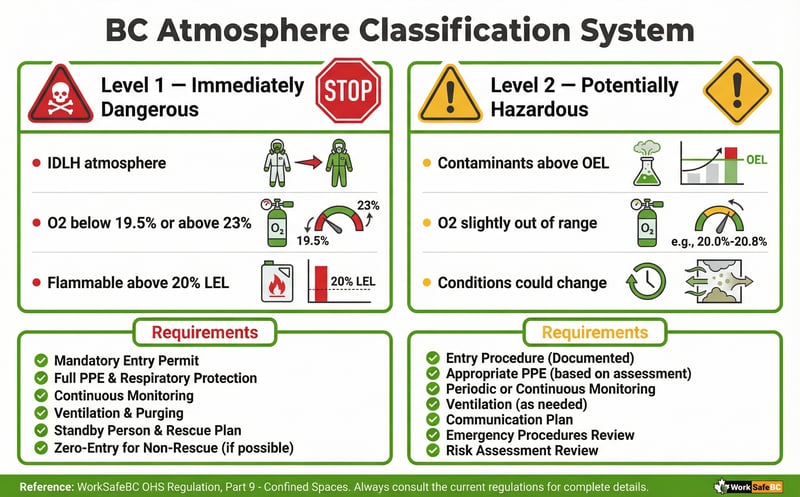
This is where BC's approach stands out from the rest of Canada. Instead of treating all confined spaces the same, Part 9 classifies the atmosphere into three categories that drive escalating requirements:
| Classification |
Definition |
Standby / Rescue Requirement |
| Low Hazard |
Clean respirable air confirmed by pre-entry testing, not likely to change during work |
Standby person must be in the immediate area and have a means to summon rescue (Section 9.34) |
| Moderate Hazard |
Atmosphere is not clean respirable air but is not likely to impair a worker's ability to escape unaided |
Standby person must be at the point of entry at all times, equipped with effective communication and able to summon rescue immediately (Section 9.35) |
| High Hazard |
Atmosphere may cause death, incapacitation, or inability to escape unaided if ventilation or respirator fails |
Standby person at entry point + rescue team immediately available. Workers must use lifelines, harnesses, and lifting equipment unless impractical (Section 9.36) |
The classification must be determined by a qualified person as part of the hazard assessment. This is not a one-time decision, if conditions change during work (e.g., a worker starts welding and the atmosphere shifts from low to moderate hazard), the classification must be updated and additional precautions implemented.
What Must a BC Contractor Do? Step-by-Step Compliance
1. Identify All Confined Spaces (Section 9.2)
The employer must identify every confined space in the workplace and determine whether worker entry will be required, either for planned work or in response to foreseeable emergencies.
2. Secure or Mark Spaces That Do Not Require Entry (Section 9.3)
If a confined space exists but no entry is needed, secure each access point against entry or mark it with a sign indicating the nature of the hazard and the prohibition of entry. Instruct workers not to enter.
3. Develop a Written Confined Space Entry Program (Section 9.5)
Before any worker enters any confined space, the employer must prepare and implement a written program that includes:
- Assignment of responsibilities
- A list of each confined space (or group of similar spaces) with hazard assessments
- Written safe work procedures covering identification, entry permits, lockout, isolation, testing, ventilation, standby persons, rescue, lifelines, PPE, and coordination of work activities
4. Conduct a Hazard Assessment (Section 9.9)
A qualified person must assess the hazards of each confined space. This assessment drives the atmosphere classification and all subsequent precautions.
5. Prepare Written Procedures (Section 9.10)
Written procedures specifying how to eliminate or minimize all hazards must be developed based on the hazard assessment.
6. Issue Entry Permits (Sections 9.13–9.16)
Entry permits are required when the hazard assessment identifies atmospheric or other hazards requiring documented controls. The permit must include the date and time of entry, names of entrants, hazards identified, precautions taken, atmospheric test results, and rescue provisions. Permits must be kept up to date and retained as records.
For details on what must be on the permit, see our confined space entry permit guide.
7. Test the Atmosphere (Sections 9.25–9.26)
This is where BC gets specific. Pre-entry atmospheric testing must be:
- Completed not more than 20 minutes before a worker enters, if all workers leave for more than 20 minutes, testing must be repeated
- Done by a qualified person using calibrated instruments
- Recorded with specific data for each test
For moderate and high hazard atmospheres, additional testing must be conducted while workers are in the space. Continuous monitoring is mandatory if a flammable or explosive atmosphere of more than 20% LEL may develop.
BC defines "clean respirable air" with precise thresholds:
- Approximately 20.9% oxygen by volume
- No measurable flammable gas or vapour
- No air contaminant exceeding 10% of its applicable exposure limit under Part 5 (Chemical Agents and Biological Agents)
For specific gas thresholds and testing procedures, see our guide to confined space hazards and atmospheric testing.
8. Implement Lockout and Isolation (Sections 9.17–9.22)
All energy sources must be locked out per LOTO procedures. Adjacent piping must be controlled through blanking/blinding, disconnecting, double block and bleed, or equivalent alternative measures approved by WorkSafeBC.
9. Establish Rescue Capability (Sections 9.37–9.41)
Rescue services must be provided and available for immediate deployment. The employer must ensure:
- Adequate rescue equipment is available
- Rescue personnel are trained and have practiced the rescue procedures
- WorkSafeBC and emergency services are notified when required
- Rescue procedures are specific to the confined space, generic rescue plans are not acceptable
Bulletproof Your Provincial Compliance
Stop worrying about your next OHS audit. Build provincial compliance directly into your daily workflows and prove your hazard assessments and entry logs meet regional regulations with a single click.
30-Day Free Trial
How BC Differs from Alberta and Ontario
| Feature |
BC (WorkSafeBC) |
Alberta (OHS Code) |
Ontario (O. Reg. 632/05) |
| Atmosphere classification |
Low / Moderate / High |
Not formally categorized |
Not formally categorized |
| Restricted space concept |
No, uses atmosphere categories instead |
Yes, separate "restricted space" definition |
No |
| Pre-entry test timing |
Within 20 minutes of entry |
Before entry (no specific time limit) |
Before entry (no specific time limit) |
| Continuous monitoring trigger |
Mandatory if >20% LEL may develop |
When atmosphere may change unpredictably |
When conditions may change |
| Definition elements |
4 physical criteria (no hazard requirement) |
3 criteria (includes hazard potential) |
3 criteria (includes "may pose a hazard") |
| Penalty range |
Administrative penalties $100K–$600K+ |
Administrative penalties up to $100K+ |
$25K individual / $500K corporate |
The practical takeaway for contractors working across provinces: BC's 20-minute pre-entry testing rule is the strictest in Canada, and the atmosphere classification system means your procedures must explicitly address which hazard category the space falls into. A program that passes audit in Alberta may not meet WorkSafeBC's requirements without modification.
If you also operate in Ontario, see our Ontario confined space regulations guide.
WorkSafeBC Penalties for Confined Space Violations
WorkSafeBC does not issue warnings for confined space violations. They issue administrative penalties, and they are substantial:
- Metro Vancouver Regional District: $637,415 penalty for confined space violations in a sewer line, including failure to properly assess the space, inadequate controls, and allowing workers to enter without following required procedures
- Arc Resources: $140,615 penalty following a WorkSafeBC inspection of a Fort St. John work site
- Typical range: Administrative penalties for confined space violations commonly range from $10,000 to $200,000+, depending on the severity of the violation, the employer's compliance history, and whether a worker was harmed
Beyond administrative penalties, WorkSafeBC can issue stop-work orders, compliance orders, and refer cases for prosecution under the Workers Compensation Act. In cases involving worker death or serious injury, criminal charges under the Criminal Code of Canada are also possible.
The financial math is simple: the cost of a proper confined space entry program, training, equipment, permits, rescue capability, is a fraction of a single penalty. And the penalty is a fraction of the cost if someone gets hurt.
Practical Compliance Summary for BC Contractors
- Identify every confined space on your site. Mark or secure those that do not require entry.
- Write your confined space entry program, responsibilities, hazard assessments, and safe work procedures for each space.
- Classify the atmosphere, low, moderate, or high hazard, determined by a qualified person.
- Test the atmosphere within 20 minutes of entry. Re-test if all workers leave for more than 20 minutes.
- Assign standby persons appropriate to the hazard level, immediate area for low, entry point for moderate, entry point plus rescue team for high.
- Set up rescue capability, equipment, trained personnel, and practiced procedures specific to each space.
- Issue entry permits when hazards require documented controls.
- Lock out all energy sources and isolate adjacent piping.
- Monitor continuously when the atmosphere may change or when >20% LEL may develop.
- Keep records. Permits, test results, hazard assessments, training records, all required for audit and inspection.
For more on WorkSafeBC construction requirements beyond confined spaces, see our WorkSafeBC construction requirements guide.
Bulletproof Your Provincial Compliance
Stop worrying about your next OHS audit. Build provincial compliance directly into your daily workflows and prove your hazard assessments and entry logs meet regional regulations with a single click.
30-Day Free Trial
Frequently Asked Questions
WorkSafeBC Confined Space FAQ
What Part of the BC OHS Regulation covers confined spaces?
Part 9 of the Occupational Health and Safety Regulation (B.C. Reg. 296/97) covers all confined space requirements in British Columbia. It includes 51 sections covering definitions, general requirements, responsibilities, hazard assessment, entry permits, lockout, atmospheric testing, ventilation, standby persons, rescue, lifelines, and personal protective equipment.
What are the three atmosphere classifications in BC?
WorkSafeBC classifies confined space atmospheres as low hazard (clean respirable air, not likely to change), moderate hazard (not clean air but not likely to prevent unaided escape), and high hazard (may cause death, incapacitation, or inability to escape unaided). Each classification triggers escalating standby, monitoring, and rescue requirements. A qualified person must determine the classification as part of the hazard assessment.
How long before entry must atmospheric testing be done in BC?
In BC, pre-entry atmospheric testing must be completed not more than 20 minutes before a worker enters a confined space. If all workers vacate the space for more than 20 minutes, pre-entry testing must be repeated before anyone re-enters. This is stricter than Alberta and Ontario, which require testing "before entry" without a specific time limit.
What is the largest confined space penalty WorkSafeBC has issued?
One of the largest known confined space-related penalties was $637,415 issued to the Metro Vancouver Regional District in December 2019 for violations in a sewer line classified as a confined space. WorkSafeBC regularly issues penalties exceeding $100,000 for serious confined space violations, particularly when workers are exposed to risk due to inadequate procedures or controls.
Does BC use the terms "confined space" and "restricted space" differently?
No. Unlike Alberta, which uses separate definitions for "confined space" (hazardous) and "restricted space" (limited entry but lower hazard), BC does not use the term "restricted space." Instead, BC uses its atmosphere classification system, low, moderate, and high hazard, to determine the level of precaution required within the single category of confined space.
Get Weekly Safety Insights
Regulation updates, toolbox talk ideas, and compliance tips. One email per week.