Last updated: March 2026
Your crew is about to enter a manhole, a tank, or a vault. The space has been assessed. The gas detector is calibrated. But if there is no entry permit signed and posted, that entry is illegal in every province in Canada.
A confined space entry permit is a written document that confirms every hazard has been identified, every control is in place, and the space is safe for workers to enter. It is not optional paperwork. It is a legal requirement under federal and provincial OHS legislation, and skipping it is one of the fastest ways to get a stop-work order, a fine, or a fatality.
This guide covers what a confined space entry permit must include, the step-by-step entry procedure, atmospheric testing requirements, who signs the permit, and a practical checklist you can use on site. If you are a contractor running crews that enter tanks, manholes, silos, pits, or any other confined space, this is the document that keeps your people alive and your company compliant.
⚡ Quick Answer
- What: A confined space entry permit is a legal document confirming hazards are assessed and controls are in place before any worker enters a confined space
- Required: Every Canadian province requires entry permits for hazardous confined spaces, no exceptions
- Must include: Location, hazard description, atmospheric test results, control measures, worker names, attendant name, entry/exit times, emergency plan, and supervisor authorization
- New permit every time: A separate permit is required for each entry or each shift, not one permit per week
- Who signs: A competent person verifies the permit, and the supervisor authorizes entry
For the full picture of confined space safety in Canada, see our complete Canadian confined space guide.
What Is a Confined Space Entry Permit?
A confined space entry permit is an administrative document that records the results of the hazard assessment, confirms that all controls are in place, and authorizes workers to enter a specific confined space for a defined period. Think of it as a pre-flight checklist for high-risk entry work.
The permit is not a one-time form you file away. It is a living document for that specific entry. It must be completed before any worker crosses the plane of the opening, it must be available at the entry point during the work, and it must be closed out when the job is done.
According to the Canadian Centre for Occupational Health and Safety (CCOHS), the entry permit system exists to document that a hazard and risk assessment has been completed for each confined space entry. Someone who is fully trained and experienced in confined space work must complete the permit.
Is an Entry Permit Legally Required?
Yes. Every Canadian province and the federal government require entry permits for confined spaces that contain or may contain hazards requiring controls. Here is how the requirement breaks down:
| Jurisdiction |
Legislation |
Permit Requirement |
| Ontario |
O. Reg. 632/05, Section 10 |
Separate permit for every entry, before any worker enters |
| British Columbia |
OHS Regulation Part 9, Section 9.13 |
Permit required when hazard assessment identifies atmospheric or other hazards |
| Alberta |
OHS Code Part 5, Section 47 |
Entry permit required before any worker enters a confined space or restricted space |
| Federal |
Canada OHS Regulations, Part XI |
Entry permit system required for hazardous confined spaces |
The specifics differ by province, but the principle is universal: no permit, no entry. For Ontario-specific details, see our guide to Ontario confined space regulations. For BC requirements, see our WorkSafeBC confined space guide.
What Must Be on a Confined Space Entry Permit?
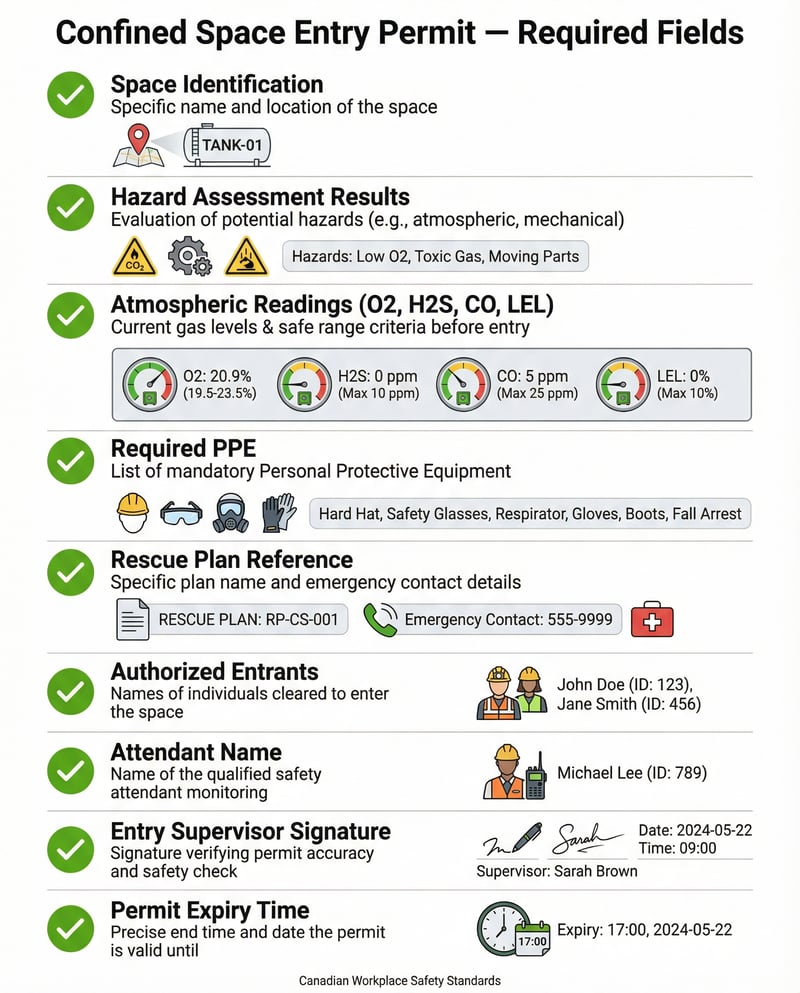
While each province has slightly different wording, the CCOHS and most provincial regulations require these elements as a minimum. If your permit is missing any of these, it will not pass an audit:
- Location and description of the confined space, identify exactly which space (e.g., "Tank 3, west side of plant" not just "the tank")
- Description of the work to be performed, what the crew is doing inside
- Identified hazards and corresponding control measures, atmospheric hazards, physical hazards, and what you are doing about each one
- Time period the permit is valid for, start time, anticipated end time, and the shift or work window
- Name of the attendant (safety watch), the person stationed outside the entry point
- Names of authorized entrants, every worker who will enter the space
- Record of each worker's entry and exit times, know who is in the space at all times
- Atmospheric test results. O₂, LEL, H₂S, CO readings with times recorded. See our guide to confined space hazards and atmospheric testing for threshold details.
- Date of last instrument calibration, and ideally a pre-use bump test
- List of required equipment, and verification that each piece is in working order
- Communication method, how workers inside communicate with the attendant
- Emergency and rescue plan, procedures, equipment, and contact numbers
- Hot work provisions, if welding, cutting, or grinding will occur inside the space
- Supervisor authorization signature, confirming the space has been properly evaluated and is safe for entry
Ontario's Regulation 632/05 also requires that a competent person verify the permit complies with the relevant plan before each shift. Even though Ontario does not technically require a signature, the Ministry of Labour's own guideline recommends documented verification by signature as a good due diligence practice.
Step-by-Step Confined Space Entry Procedure
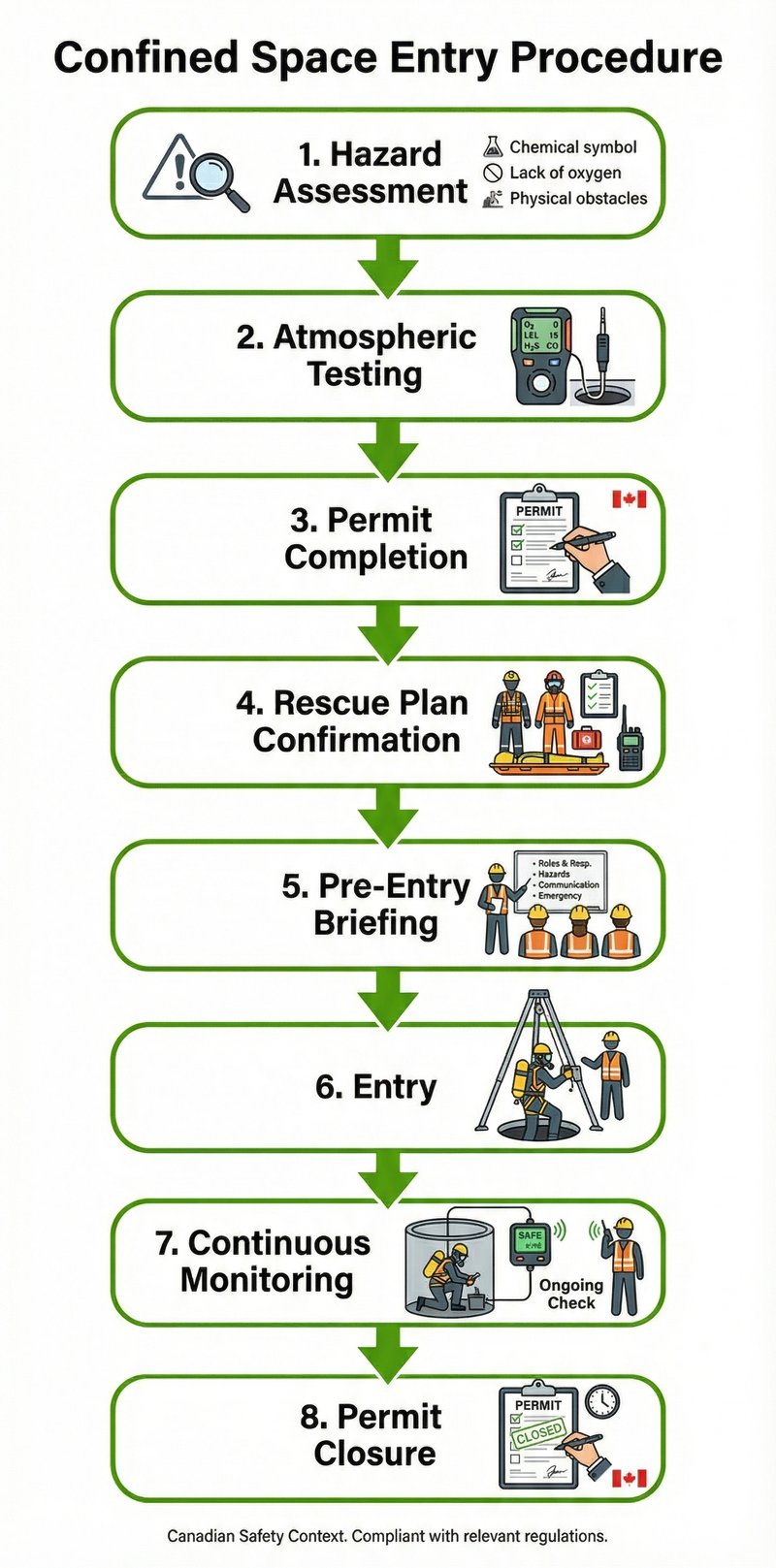
The entry permit does not exist in a vacuum. It is the final check in a sequence that must happen in order. Skip a step and the permit is worthless.
Step 1: Identify and Assess the Space
Confirm the space meets the legal definition of a confined space in your province. Conduct or review the hazard assessment. Identify atmospheric hazards, physical hazards (engulfment, entrapment), energy sources, and any residual chemicals or substances.
Step 2: Implement Controls
Before anyone goes near the opening, put controls in place:
- Lockout/tagout all energy sources, electrical, mechanical, hydraulic, pneumatic. See our LOTO guide for construction.
- Isolate adjacent piping, blank, blind, double block and bleed, or physically disconnect
- Set up ventilation, mechanical ventilation to maintain safe atmosphere
- Stage rescue equipment, tripod, harness, lifeline, retrieval system at the entry point
Step 3: Test the Atmosphere
Before any worker enters, a competent person must test the atmosphere using a calibrated 4-gas monitor. Test in this order:
- Oxygen (O₂): Must be between 19.5% and 23.0%
- Flammable gases (LEL): Must be below 10% of the lower explosive limit. No hot work above 5% LEL.
- Toxic gases (H₂S, CO): Must be below applicable occupational exposure limits
Test at multiple levels, top, middle, and bottom of the space. Gases stratify. If you only test at the opening, you could miss a pocket of H₂S sitting at the bottom. For more on gas monitors and detection equipment, see our H₂S cluster.
Step 4: Complete and Sign the Entry Permit
Fill in every field. Record all atmospheric test results with times. Have the competent person verify the permit matches the plan. Get the supervisor's authorization signature. Post the permit at the entry point or ensure it is readily available to all workers and the attendant.
Step 5: Brief the Crew
Every entrant and the attendant must understand:
- What hazards were identified and how they are controlled
- The emergency and rescue procedure
- The communication method
- When to evacuate immediately (alarm, attendant order, any sign of danger)
Step 6: Enter, Monitor, and Maintain
The attendant stays at the opening at all times. Continuous atmospheric monitoring runs inside the space. If any reading goes outside safe limits, evacuate immediately. If a worker leaves the space for more than 20 minutes and continuous monitoring was not running, re-test before re-entry.
Step 7: Close Out the Permit
Record exit times. Verify all workers are out. Close and file the permit. Most provinces require you to keep completed permits on file, check your provincial requirements for retention periods.
Stop Chasing Paper Permits & Lost Gas Logs
Ditch the clipboard. Digitize your confined space entry permits, mandate real-time atmospheric testing logs before entry is allowed, and make rescue plans instantly accessible to everyone on site.
30-Day Free Trial
Atmospheric Testing Requirements for Entry Permits
Atmospheric testing is the most critical piece of any confined space entry permit. Get it wrong and people die, not in a theoretical sense, but in a "three workers found unconscious at the bottom of a tank" sense.
Here are the key thresholds used across Canadian jurisdictions:
| Gas/Condition |
Safe Range for Entry |
Action Level |
| Oxygen (O₂) |
19.5% – 23.0% |
Below 19.5% = oxygen deficient. Above 23.0% = enriched (fire risk). |
| Flammable gases (LEL) |
Below 10% LEL |
No entry above 10% LEL. No hot work above 5% LEL. |
| Hydrogen Sulphide (H₂S) |
Below 10 ppm (8-hr OEL) |
Evacuate at 10 ppm. Immediately dangerous at 100 ppm. |
| Carbon Monoxide (CO) |
Below 25 ppm (8-hr OEL) |
Evacuate at 25 ppm. IDLH at 1,200 ppm. |
Record every reading on the permit with the time it was taken, the location within the space (top, middle, bottom), and who performed the test. The gas monitor must be calibrated per the manufacturer's instructions, and a bump test before each use is best practice. For a deep dive on H₂S specifically, see our H₂S exposure limits in Canada guide.
Who Signs the Confined Space Entry Permit?
This trips up a lot of contractors. The permit involves several roles, and mixing them up can create liability:
- Competent person (verifier): Reviews the permit before each shift to confirm it matches the hazard assessment and plan. This person must have training and experience specific to confined space work. In Ontario, this verification must happen before every shift.
- Supervisor (authorizer): Signs to confirm the space has been evaluated, controls are in place, and entry is authorized. The supervisor takes responsibility for the permit's accuracy.
- Atmospheric tester: Signs to confirm they personally performed the atmospheric tests and the results are accurately recorded.
- Attendant (safety watch): Named on the permit. Must be stationed outside the space for the duration of the entry. Cannot be assigned other duties that would pull them away from the entry point.
In practice, on a small crew, the supervisor and verifier may be the same person, but only if that person meets the competency requirements. The attendant must always be a separate person who is not entering the space.
Confined Space Entry Permit Checklist
Use this checklist to verify your permit is complete before authorizing entry. Every item must be confirmed:
Pre-Entry Checks
- ☐ Confined space identified and hazard assessment completed
- ☐ Written work procedures in place for this specific space
- ☐ All energy sources locked out and tagged, see our LOTO procedures guide
- ☐ Adjacent piping isolated (blanked, blinded, or double block and bleed)
- ☐ Mechanical ventilation set up and running
- ☐ Atmospheric testing completed at all levels (top, middle, bottom)
- ☐ O₂ between 19.5% and 23.0%
- ☐ LEL below 10% (below 5% if hot work planned)
- ☐ H₂S below 10 ppm
- ☐ CO below 25 ppm
- ☐ Gas monitor calibrated and bump tested
- ☐ All test results recorded on permit with times and locations
Personnel and Equipment
- ☐ Attendant (safety watch) assigned and stationed at entry point
- ☐ Attendant understands hazards, signs/symptoms, and emergency procedures
- ☐ Communication system established between entrants and attendant
- ☐ All entrants named on permit and briefed on hazards and emergency procedures
- ☐ Rescue equipment staged at entry point (tripod, harness, lifeline, retrieval device)
- ☐ All rescue equipment inspected and in working order
- ☐ Emergency contact numbers on the permit
- ☐ Rescue team identified and on standby (or self-rescue procedures confirmed)
Authorization
- ☐ Permit verified by competent person
- ☐ Supervisor authorization obtained
- ☐ Permit posted at entry point or readily available to all workers
- ☐ All workers briefed before first entry
During Entry
- ☐ Continuous atmospheric monitoring running
- ☐ Entry and exit times recorded for each worker
- ☐ Attendant maintaining constant visual/verbal contact
- ☐ No unauthorized entry by anyone not listed on permit
Close-Out
- ☐ All workers confirmed out of the space
- ☐ Exit times recorded
- ☐ Permit closed and filed per retention requirements
Common Entry Permit Mistakes That Get Contractors Fined
After reviewing hundreds of confined space programs, these are the mistakes that show up most often during audits and inspections:
- Using one permit for multiple spaces. Each confined space needs its own permit. Two manholes on the same street are two separate permits, unless the hazard assessment determines they are separate entrances to the same space.
- Not updating the permit when conditions change. A permit is valid for the conditions that existed when it was issued. If work activities change the atmosphere (welding, painting, using solvents), the permit needs to be updated or a new one issued.
- Missing atmospheric test results. Checking the box that says "atmosphere tested" without recording the actual numbers, times, and locations is a compliance failure.
- No attendant named, or the attendant left their post. The attendant cannot do other work while monitoring the space. Not even "just for a minute."
- Permit not available at the entry point. Ontario does not require the permit to be physically posted, but it must be "readily available" to every person involved. Most other provinces have similar requirements. If an inspector asks to see it and you have to go back to the trailer, that is a problem.
- Treating the permit as a one-time event. The permit must be verified before each shift. If your crew works morning and afternoon shifts on the same space, you need verification before each shift starts.
Stop Chasing Paper Permits & Lost Gas Logs
Ditch the clipboard. Digitize your confined space entry permits, mandate real-time atmospheric testing logs before entry is allowed, and make rescue plans instantly accessible to everyone on site.
30-Day Free Trial
Frequently Asked Questions
Confined Space Entry Permit FAQ
Do I need a new confined space entry permit every day?
You need a separate entry permit each time work is to be performed in a confined space. If work continues over multiple days, check your provincial regulations. Ontario requires a new permit for each entry and verification before each shift. The permit duration should be defined in your confined space plan based on the hazard assessment.
Does a confined space entry permit need to be signed?
Most provinces require supervisor authorization, though Ontario technically does not require a signature. However, Ontario's Ministry of Labour guideline recommends documented verification by signature as a due diligence practice. Alberta and BC both require documented authorization. As a best practice, always get signatures from the verifier, supervisor, and atmospheric tester.
Who is qualified to complete a confined space entry permit?
A person who is fully trained and experienced in confined space work should complete the entry permit. In Ontario, a "competent person" must verify the permit before each shift. In BC, a "qualified person" must prepare the hazard assessment and work procedures. The specific competency requirements vary by province, but all require documented training and demonstrated knowledge of confined space hazards and controls.
Can one entry permit cover multiple confined spaces?
No. Each confined space must have its own separate entry permit. Even if two spaces are identical in construction and present the same hazards, they require individual permits. The only exception is when multiple access points lead into the same single confined space (e.g., multiple manholes entering the same sewer section), in that case, they may share a permit if the hazard assessment determines it is one space with multiple entrances.
What happens if I enter a confined space without a permit?
Entering a confined space without a valid entry permit is a violation of OHS legislation in every Canadian province. Penalties vary: Ontario fines can reach $25,000 per individual and $500,000 per corporation per offence. Alberta and BC impose administrative penalties that can exceed $100,000. Beyond fines, an unpermitted entry that results in a worker injury or death can lead to criminal charges under the Westray Bill (Criminal Code Section 217.1).
Get Weekly Safety Insights
Regulation updates, toolbox talk ideas, and compliance tips. One email per week.