Last updated: March 2026
A worker collapses at the bottom of a 4-metre tank. His partner at the top panics, rips off his harness, and climbs in after him. Now you have two people down, no retrieval system deployed, and the attendant is calling 911 instead of activating the rescue plan. Except there is no rescue plan, because nobody wrote one. This scenario has killed more people in Canada than most contractors realize. According to CCOHS, an estimated 60% of confined space fatalities are would-be rescuers.
At Safety Evolution, we build rescue plans for contractors who realize "call 911" is not a rescue plan. A real plan is the difference between a near miss and a fatality, and every Canadian province requires one before anyone enters a confined space.
⚡ Quick Answer
- Legal requirement: Every Canadian province requires a written rescue plan before any confined space entry
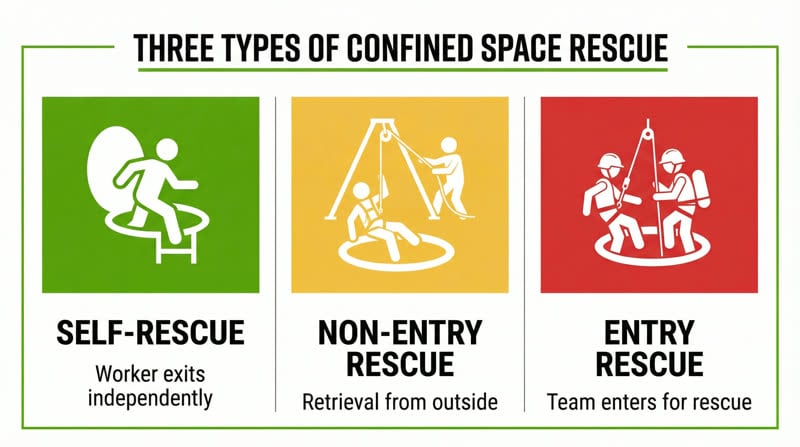
- Three types of rescue: Self-rescue, non-entry rescue (mechanical retrieval), and entry rescue (trained team enters the space)
- Key equipment: Tripod and winch, full-body harness, SCBA, communication devices, stretcher
- Training: Rescue personnel need specialized training beyond standard confined space entry certification
- Critical rule: Never enter a confined space to rescue someone unless you are trained, equipped, and following the plan
Why Is a Confined Space Rescue Plan Required?
A confined space rescue plan is a written document that outlines the procedures, personnel, equipment, and communication protocols for rescuing a worker who becomes incapacitated inside a confined space. Every Canadian province requires employers to have this plan in place before anyone enters a confined space. It is not a recommendation; it is a legal obligation.
The regulations exist because confined space rescues are fundamentally different from other workplace emergencies. In open air, you grab someone and pull them out. In a confined space, the opening might be 600mm wide, 10 metres below grade, and filled with an atmosphere that will knock you unconscious in seconds. Without a plan that accounts for these conditions, people die trying to save people.
Alberta's OHS Code Part 5 requires an "effective rescue" plan. BC's WorkSafeBC OHS Regulation Part 9 requires written rescue procedures with equipment available on site. Ontario's O. Reg. 632/05 requires on-site rescue procedures and an adequate number of trained rescue personnel. The language varies, but the requirement is universal: plan the rescue before the entry.
For the full context on confined space regulations, hazards, and entry requirements across Canada, start with our complete confined space guide.
What Are the Three Types of Confined Space Rescue?
Not every rescue requires a team of people climbing into a dangerous space. The best rescue plans prioritize getting the worker out without putting additional people at risk. There are three levels, and you should plan for the simplest method that works for your specific space.
Self-Rescue
The worker recognizes a hazard (alarm on the gas detector, feeling dizzy, change in conditions) and exits the space under their own power. This only works when the worker is conscious, mobile, and the exit is accessible. A good confined space program makes self-rescue the first line of defence through continuous atmospheric monitoring, clear communication with the attendant, and training that teaches workers to leave at the first sign of trouble, not to "tough it out."
Non-Entry Rescue
The worker is extracted from outside the space using a mechanical retrieval system without anyone else entering. This typically involves a tripod and winch system positioned over the entry point, connected to the worker's harness via a retrieval line. The attendant or rescue team operates the winch to lift the worker out. Non-entry rescue is the preferred method for vertical entries (tanks, manholes, vaults) because it does not expose additional workers to the hazardous atmosphere.
For non-entry rescue to work, the worker must be wearing a full-body harness with a properly attached retrieval line before entering the space. The retrieval system must be set up and tested before entry begins. This is where planning matters: if the tripod is in the truck and the harness has no retrieval attachment, non-entry rescue is not actually available.
Entry Rescue
A trained rescue team enters the confined space to reach and extract the incapacitated worker. This is the last resort because it puts additional people at risk in the same hazardous environment. Entry rescue requires:
- A rescue team trained specifically in confined space entry rescue (beyond standard confined space entry training)
- SCBA (Self-Contained Breathing Apparatus) or supplied air respirators for the rescue team
- Communication equipment between the rescue team, attendant, and surface team
- A stretcher or rescue basket that fits through the confined space opening
- A second retrieval system for the rescue team members
If you are relying on entry rescue as your plan, you need people on site who are trained, equipped, and practiced. This is not something you improvise in the moment.
What Equipment Does a Rescue Plan Require?
Your rescue equipment must be on site, inspected, and ready before anyone enters the space. "We have a tripod in the shop" is not rescue-ready.
| Equipment |
Purpose |
Rescue Type |
| Tripod and winch system | Mechanical retrieval from vertical openings | Non-entry |
| Full-body harness with dorsal D-ring | Retrieval attachment point | Non-entry / Entry |
| Retrieval line | Connects harness to winch | Non-entry |
| SCBA or SAR (supplied air respirator) | Respiratory protection for rescue team | Entry |
| Communication devices | Contact between entrant, attendant, rescue team | All types |
| Rescue stretcher/basket | Extracting an unconscious worker through openings | Entry |
| First aid kit (Class 1 minimum) | Immediate medical response at surface | All types |
| Multi-gas detector (spare) | Monitor atmosphere during rescue | Entry |
Equipment must be inspected before each shift. Harnesses must meet CSA Z259.10 standards. Tripods and winches must be rated for the worker's weight plus equipment. Gas detectors must be calibrated and bump-tested. If any equipment fails inspection, the entry does not proceed.
If your crew also does work at heights, you will notice overlap between confined space rescue equipment and fall protection rescue equipment. The harnesses, retrieval systems, and tripods serve similar functions. Building your rescue plans together can save money and reduce confusion on site.
Stop Chasing Paper Permits & Lost Gas Logs
Ditch the clipboard. Digitize your confined space entry permits, mandate real-time atmospheric testing logs before entry is allowed, and make rescue plans instantly accessible to everyone on site.
30-Day Free Trial
How to Write a Confined Space Rescue Plan
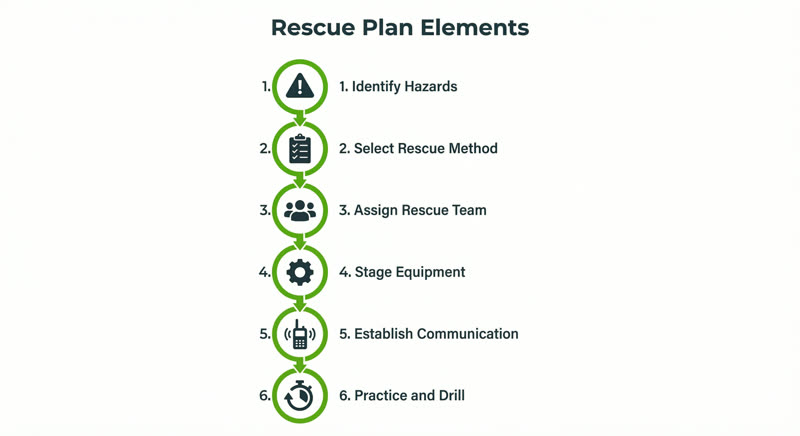
A rescue plan does not need to be 30 pages long. It needs to be specific, practical, and written for the people who will actually execute it under stress. Here is what to include:
Rescue Plan Checklist
- Space identification: Which confined space does this plan cover? Location, type, dimensions, entry/exit points.
- Hazards identified: What atmospheric, physical, or process hazards are present or possible? Reference the pre-entry hazard assessment.
- Rescue method: Which type(s) of rescue are feasible for this space? If non-entry rescue is possible, it should be the primary method. Specify when entry rescue would be triggered.
- Rescue personnel: Names and roles. Who activates the plan? Who operates the retrieval system? Who enters (if entry rescue)? Who calls EMS? What training does each person have?
- Equipment list: Every piece of rescue equipment required, its location on site, and the date of last inspection.
- Communication plan: How does the attendant alert rescue personnel? What signals are used between the entrant and the attendant? What is the EMS call procedure (number, site address, directions)?
- Retrieval procedure: Step-by-step instructions for mechanical retrieval or entry rescue, including how to package the victim for extraction.
- Medical response: First aid procedures for likely injuries (oxygen deprivation, H2S exposure, fall injuries). Where is the nearest hospital? How long is the ambulance response time?
- Practice schedule: When was the rescue procedure last practiced? How often will drills occur? Document every drill.
Write the plan so that someone who has never been to your site could pick it up and understand the procedure. Under stress, people do not think creatively. They follow steps.
What Training Do Rescue Personnel Need?
Standard confined space entry training is not sufficient for rescue personnel. Rescue teams need additional training that covers:
- Rescue-specific confined space entry procedures
- SCBA donning, use, and emergency procedures
- Mechanical retrieval system operation (tripod, winch)
- Patient packaging and extraction through restricted openings
- Rescue-specific first aid (oxygen therapy, CPR in confined environments)
- Practice drills in realistic conditions
ESC offers a dedicated Confined Space Rescue course in addition to the Entry and Monitor course. If you need clarity on the difference between a training certificate and a confined space certification, see our certification guide. NFPA 1006 (Standard for Technical Rescue Personnel) provides a recognized framework for rescue team qualifications. Rescue training typically costs $250 to $500+ per worker and takes 1 to 2 days of hands-on instruction.
If maintaining an in-house rescue team is not practical for your operation (many smaller contractors cannot justify the training costs and equipment for a team that may never be needed), consider contracting with a standby rescue service. These companies provide trained rescue teams on site during your confined space work. Costs vary by province and availability, but it is a legitimate alternative to building in-house capability. Just make sure the rescue service is written into your plan and their response time meets your needs.
Provincial Rescue Plan Requirements
The core requirement is the same everywhere: you need a written rescue plan before entry. The details vary.
Alberta
Alberta OHS Code Part 5 requires an "effective rescue" from a confined space. The plan must include trained rescue personnel, appropriate rescue equipment on site, and procedures for rescue. Employers must ensure emergency response procedures are rehearsed. Workers responding to confined space emergencies must receive specific emergency response training, documented and maintained.
British Columbia
WorkSafeBC OHS Regulation Part 9 requires written rescue procedures. Rescue equipment must be available at the site. An adequate number of persons trained in rescue must be available to implement procedures before a worker enters. BC also requires that the rescue plan account for the specific characteristics of each confined space (dimensions, configuration, entry points).
Ontario
Ontario O. Reg. 632/05 requires on-site rescue procedures and equipment adequate to rescue a worker. An adequate number of persons trained in the rescue procedures must be available for immediate implementation. The employer must ensure rescue equipment is appropriate for the specific confined space.
Across all three provinces, "adequate" is the operative word. Your plan, equipment, training, and personnel must be adequate for the specific space and hazards involved. A generic rescue plan template is a starting point, not a finished product.
Confined Space Rescue Plan Template
Use this template as a starting point for developing site-specific rescue plans. Customize it for each confined space your crew enters.
| Section |
Details to Include |
| Space Description | Name, location, type, dimensions, entry points, internal configuration |
| Identified Hazards | Atmospheric (O2, LEL, H2S, CO), physical (engulfment, fall), process, biological |
| Primary Rescue Method | Non-entry retrieval / Entry rescue (specify triggers for each) |
| Rescue Team | Names, roles, training certificates, contact numbers |
| Equipment On Site | List with inspection dates: tripod, winch, harness, SCBA, comms, stretcher |
| Communication Protocol | Signals, radio channels, emergency numbers, EMS directions to site |
| Step-by-Step Rescue Procedure | Numbered steps for non-entry rescue and entry rescue scenarios |
| Medical Response | First aid, hospital address, ambulance response time, specific hazard first aid |
| Drill Schedule | Last drill date, next drill date, drill records |
| Plan Review | Date of last review, reviewed by, next review date |
Download a printable version by saving this page or contact Safety Evolution for a customizable rescue plan template as part of your safety program build.
If your crew also works at heights, your confined space rescue plan shares significant overlap with your fall protection rescue plan. Consider developing them together so your rescue procedures are consistent and your crew is not learning two completely separate systems.
Stop Chasing Paper Permits & Lost Gas Logs
Ditch the clipboard. Digitize your confined space entry permits, mandate real-time atmospheric testing logs before entry is allowed, and make rescue plans instantly accessible to everyone on site.
30-Day Free Trial
Frequently Asked Questions
Is a confined space rescue plan legally required in Canada?
Yes. Every Canadian province requires a written rescue plan (or equivalent rescue procedures) before any worker enters a confined space. Alberta OHS Code Part 5, BC OHS Regulation Part 9, and Ontario O. Reg. 632/05 all mandate rescue provisions. The plan must be specific to the confined space, include trained personnel and appropriate equipment, and be available on site before entry.
What is the difference between non-entry rescue and entry rescue?
Non-entry rescue extracts the worker from outside the confined space using a mechanical retrieval system (tripod and winch connected to the worker's harness). No one enters the hazardous atmosphere. Entry rescue involves a trained team physically entering the confined space to reach and extract the incapacitated worker. Non-entry rescue is always preferred when the space configuration allows it because it does not put additional workers at risk.
Can I use "call 911" as my rescue plan?
No. Calling 911 is a component of a rescue plan, not the plan itself. Municipal fire departments may not have confined space rescue capability, and even if they do, response times of 15 to 30 minutes are common. A worker in an oxygen-deficient atmosphere can suffer brain damage in 3 to 4 minutes. Your rescue plan must include personnel and equipment on site that can initiate rescue immediately.
How often should we practice confined space rescue drills?
Most safety professionals recommend quarterly rescue drills for teams that regularly perform confined space work. Provincial regulations require that rescue procedures be "rehearsed" but do not specify exact frequencies. At minimum, conduct a drill whenever there is a change in rescue personnel, equipment, or the confined space configuration. Document every drill including the date, participants, scenario, time to rescue, and lessons learned.
Do I need a separate rescue plan for each confined space?
Yes. Each confined space has different dimensions, hazards, entry points, and internal configurations that affect the rescue approach. A plan for a vertical tank does not work for a horizontal pipe. Your overall confined space program can include a standard rescue plan template, but each specific space needs a site-specific plan that addresses its unique characteristics.
Get Weekly Safety Insights
Regulation updates, toolbox talk ideas, and compliance tips. One email per week.