Last updated: March 2026
If you run a contracting company in Ontario and your crews enter tanks, manholes, silos, vaults, or any other enclosed space, you need to know one regulation inside and out: Ontario Regulation 632/05. Confined Spaces.
O. Reg. 632/05 is the single regulation governing all confined space work in Ontario. It applies to every workplace covered by the Occupational Health and Safety Act (OHSA), across all sectors, construction, industrial, municipal, oil and gas, utilities. Since July 1, 2011, it replaced the four sector-specific confined space regulations that existed before, consolidating everything into one set of rules.
This guide breaks down what the regulation actually requires you to do as a contractor. Not legal theory, practical compliance steps that keep your crew safe and your company out of trouble. If you are bidding on work that involves confined space entry in Ontario, this is the baseline you must meet.
⚡ Quick Answer
- Regulation: O. Reg. 632/05 under the Occupational Health and Safety Act (OHSA)
- Applies to: All Ontario workplaces, construction, industrial, municipal, utilities
- Key requirements: Hazard assessment, written plan, entry permits, atmospheric testing, trained attendant, rescue procedures
- Penalties: Up to $25,000 and/or 12 months imprisonment per individual. Up to $500,000 per corporation per offence.
- Since: July 1, 2011 (consolidated from four sector-specific regulations)
For a national overview of confined space requirements, see our complete Canadian confined space guide.
How Does Ontario Define a Confined Space?
Under O. Reg. 632/05, a confined space is a fully or partially enclosed space that meets all three of these criteria:
- It is not designed or intended for continuous human occupancy, workers go in to do a job, not to work there all day every day
- It has limited or restricted means for entry or exit, you cannot just walk through a standard doorway. Think hatches, manholes, ladders, narrow openings.
- It may pose a hazard to any person who enters, due to its design, construction, location, atmosphere, the materials or substances in it, work activities, or any other conditions
Common examples on Ontario construction sites include manholes, catch basins, storm sewers, storage tanks, silos, grain bins, vaults, excavations deeper than 1.2 metres, boilers, and pipe racks.
The key difference from some other provinces: Ontario's definition requires that the space may pose a hazard. If a space meets the first two criteria (enclosed + limited entry) but cannot reasonably be expected to pose any hazard, the full confined space requirements may not apply, but the employer must still document this assessment. When in doubt, treat it as a confined space.
What Must an Ontario Contractor Do Before Any Confined Space Entry?
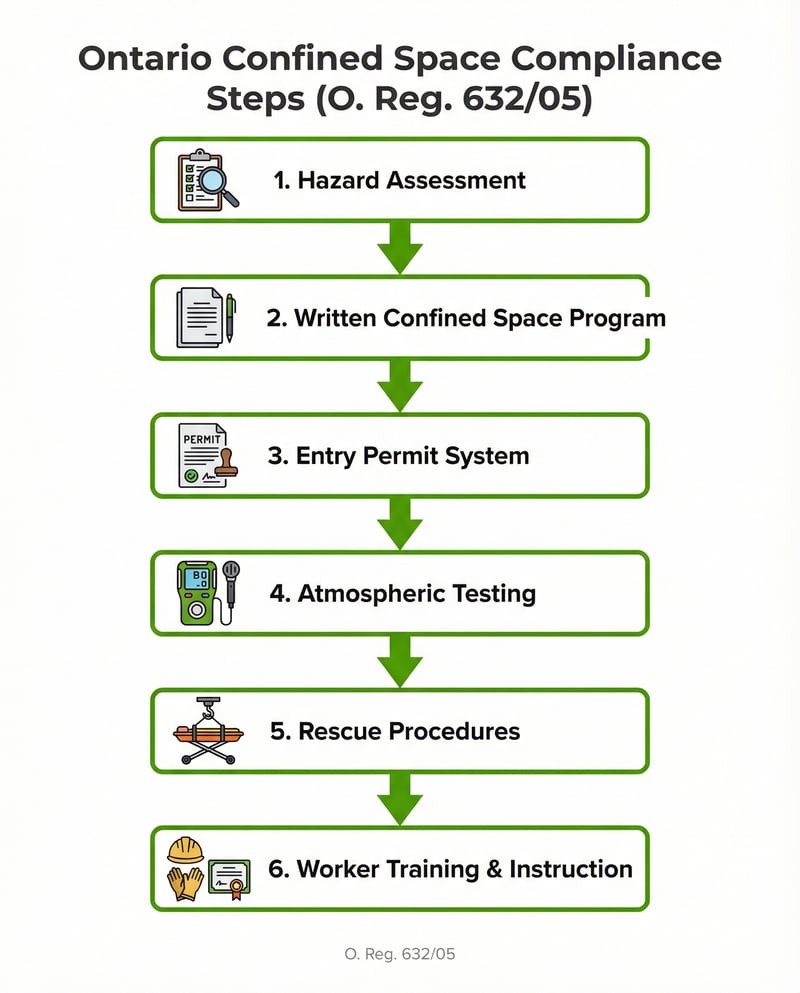
O. Reg. 632/05 is structured as a step-by-step process. Here is what you must have in place before a single worker enters any confined space:
1. Assess the Space (Section 5)
Before any worker enters a confined space, a competent person must conduct an adequate assessment of the space. The assessment must identify:
- All potential hazards the worker may be exposed to
- Whether the space has or may develop a hazardous atmosphere
- Whether there are physical hazards (engulfment, entrapment, energy sources)
This is not a check-the-box exercise. The assessment must be specific to that particular space and the work being done. A generic assessment that says "may contain atmospheric hazards" is not adequate.
2. Develop a Written Plan (Section 7)
Based on the assessment, the employer must prepare a written plan that includes:
- Duties of every person involved (entrants, attendant, supervisor)
- Measures to control identified hazards
- The equipment required for entry and rescue
- Rescue procedures
If there are multiple employers with workers in the same confined space (common on Ontario construction projects), a coordination document is required under Section 4. The lead employer or constructor must prepare this document before any worker enters.
3. Issue an Entry Permit (Section 10)
A separate confined space entry permit must be issued each time work is to be performed in a confined space, before any worker enters. The permit must include the location, description of work, hazards and controls, time period, attendant name, entry/exit records, equipment list, atmospheric test results, and hot work provisions if applicable.
A competent person must verify the permit complies with the plan before each shift. The permit must be readily available to everyone involved in the entry.
4. Provide Training (Section 8)
Every worker who enters a confined space or performs related work must have adequate training. The regulation requires training in:
- The hazards of the confined space
- The written plan, including emergency procedures
- Proper use of required equipment (gas monitors, rescue gear, ventilation)
Ontario does not prescribe a specific course or certification, it requires that workers are adequately trained for the specific confined space work they will perform. However, most GCs and project owners will require a recognized confined space entry course as a condition of site access.
5. Appoint an Attendant (Section 15)
An attendant (safety watch) must be stationed outside the confined space for every entry. The attendant must:
- Remain outside the space at all times
- Not be assigned any other work that could interfere with monitoring
- Have the means to communicate with workers inside
- Be prepared to call for emergency assistance
- Know the emergency and rescue procedures
In Ontario, the attendant cannot enter the space to attempt a rescue. If a worker is in distress inside, the attendant calls the rescue team. Attempted rescues by untrained attendants are one of the leading causes of multiple-fatality confined space incidents.
6. Conduct Atmospheric Testing (Section 18)
Before entry and as necessary during entry, a competent person must test the atmosphere for:
- Oxygen: Must be between 19.5% and 23.0%
- Flammable gases: Must be below 10% of the LEL. Hot work is prohibited above 5% LEL, and no worker may enter above 10% LEL unless performing inspection work that does not produce an ignition source and wearing appropriate respiratory protection.
- Toxic substances: Must be below applicable Ontario OELs (Regulation 833)
Continuous monitoring is required when conditions may change during work. For work involving H₂S exposure risks, see our H₂S exposure limits guide.
Bulletproof Your Provincial Compliance
Stop worrying about your next OHS audit. Build provincial compliance directly into your daily workflows and prove your hazard assessments and entry logs meet regional regulations with a single click.
30-Day Free Trial
Rescue Requirements in Ontario (Section 16)
This is where Ontario's regulation is particularly strict. Before any worker enters a confined space, the employer must have an adequate rescue plan in place. The plan must include:
- A method of rescue appropriate to the space, this could be non-entry retrieval (tripod + lifeline + harness), on-site rescue team, or off-site rescue services
- Rescue equipment on site, staged and ready at the entry point
- Trained rescue personnel, who have practiced the specific rescue procedures for that space
- Communication protocol, how to summon the rescue team immediately
If you are relying on off-site rescue services (e.g., the fire department), you need to confirm in advance that they are available, capable of performing the rescue, and can respond within a timeframe that protects the worker. Relying on 911 without prior coordination is not adequate compliance.
For more on rescue planning, see our confined space safety guide and our emergency response plan guide.
How Ontario Differs from Other Provinces
If your company works across provincial lines, these are the key differences to watch:
| Requirement |
Ontario |
Alberta |
British Columbia |
| Governing regulation |
O. Reg. 632/05 |
OHS Code Part 5 |
OHS Regulation Part 9 |
| Definition includes "may pose a hazard" |
Yes, third criteria |
No, uses "restricted space" for lower hazard |
No, hazard classification through atmosphere categories |
| Atmosphere categories |
Not formally categorized |
Not formally categorized |
Low / Moderate / High hazard |
| Multi-employer coordination |
Coordination document required (Section 4) |
Prime contractor duties apply |
Employer coordination per Part 9 |
| Permit signature required |
Not technically required (recommended) |
Yes, signed authorization |
Yes, documented authorization |
| Pre-entry test timing |
Before entry and as necessary |
Before entry |
Within 20 minutes of entry |
The biggest practical difference: Ontario uses a three-part definition that includes the "may pose a hazard" element, while Alberta separates the concept into "confined space" (hazardous) and "restricted space" (limited entry but not necessarily hazardous). BC classifies atmospheres into low, moderate, and high hazard categories, which determines the level of standby and rescue requirements.
For BC-specific requirements, see our WorkSafeBC confined space guide.
Penalties for Non-Compliance in Ontario
Violating any requirement of the OHSA or its regulations, including O. Reg. 632/05, is an offence with serious penalties:
- Individual (worker, supervisor, director): Up to $25,000 fine and/or up to 12 months imprisonment per offence
- Corporation: Up to $500,000 per offence
- Criminal charges: Under the Criminal Code (Section 217.1, the Westray Bill), an employer or supervisor who shows wanton or reckless disregard for worker safety can face criminal prosecution, with no cap on penalties including imprisonment
Ontario's Ministry of Labour inspectors have the authority to issue compliance orders, stop-work orders, and order the prosecution of offences. A stop-work order on a confined space entry halts not just the confined space work but potentially the entire operation until the order is lifted.
In practice, the financial damage goes beyond the fine. A stop-work order causes project delays, liquidated damages, and reputational harm that can cost far more than the penalty itself.
Practical Compliance Checklist for Ontario Contractors
Here is what you need to have in place to comply with O. Reg. 632/05. Use this as your self-audit:
- Identify every confined space on your worksite. Walk the site. Document each one.
- Complete a hazard assessment for each space, by a competent person, specific to that space and the planned work.
- Develop a written plan, duties, controls, equipment, and rescue for each space.
- Create a coordination document if multiple employers are involved (Section 4).
- Issue entry permits, new permit for each entry, verified before each shift.
- Train your crew, on the specific hazards, plan, and equipment for each space they will enter.
- Assign an attendant, for every entry, dedicated to that role only.
- Test the atmosphere, before entry and continuously when conditions may change.
- Have a rescue plan, with equipment staged, personnel trained, and rescue team confirmed available.
- Document everything. Keep completed permits, training records, hazard assessments, and atmospheric test records on file.
If your safety program needs an upgrade to meet Ontario's confined space requirements, our Toronto-based safety consulting team can help you build a compliant program from the ground up.
Bulletproof Your Provincial Compliance
Stop worrying about your next OHS audit. Build provincial compliance directly into your daily workflows and prove your hazard assessments and entry logs meet regional regulations with a single click.
30-Day Free Trial
Frequently Asked Questions
Ontario Confined Space Regulations FAQ
What regulation covers confined spaces in Ontario?
Ontario Regulation 632/05 (Confined Spaces) under the Occupational Health and Safety Act covers all confined space work in Ontario. Since July 1, 2011, it replaced the four previous sector-specific confined space regulations, applying uniformly across construction, industrial, healthcare, and all other OHSA-covered workplaces.
What is the maximum fine for a confined space violation in Ontario?
For an individual (worker, supervisor, or director), the maximum fine is $25,000 and/or up to 12 months imprisonment per offence. For a corporation, the maximum fine is $500,000 per offence. In cases of wanton or reckless disregard for worker safety, criminal charges can be laid under the Criminal Code with no cap on penalties.
Does Ontario require a specific confined space training course?
O. Reg. 632/05 does not prescribe a specific course or certification. It requires that every worker who enters a confined space or performs related work has "adequate training" in the hazards, the written plan, emergency procedures, and proper equipment use. In practice, most general contractors and project owners require a recognized confined space entry course as a condition of site access.
What is a coordination document for confined space entry?
When multiple employers have workers entering the same confined space (common on construction projects), Ontario Regulation 632/05 Section 4 requires the lead employer or constructor to prepare a coordination document. This document ensures that all employer duties, assessments, plans, permits, training, rescue, are coordinated so that every worker is protected regardless of which employer they work for.
Do I need a confined space entry permit in Ontario even for quick entries?
Yes. Section 10 of O. Reg. 632/05 requires a separate entry permit each time work is to be performed in a confined space, before any worker enters. There is no exception for "quick" entries. Entry occurs as soon as any part of a worker's body breaks the plane of the opening. Even a brief visual inspection where a worker leans into the space constitutes entry if any body part crosses the opening.
Get Weekly Safety Insights
Regulation updates, toolbox talk ideas, and compliance tips. One email per week.