Last updated: March 2026
Your worker's confined space ticket expired two months ago and you just found out because a GC flagged it during a site orientation. Now you are scrambling to find a course, wondering how much it costs, whether you can do it online, and how long the new certificate is actually good for. This happens to contractors every week, and it is completely avoidable.
Safety Evolution works with contractors across Canada who run into exactly this problem. Confined space training is one of the most commonly required safety tickets in construction, oil and gas, and industrial work, and understanding the requirements before you get caught short is part of running a tight operation.
⚡ Quick Answer
- What: Confined space training teaches workers to identify, enter, monitor, and work safely in confined spaces
- Cost: $30 to $250+ depending on the level (awareness vs entry/monitor) and delivery format
- Duration: Awareness: 1.5 to 4 hours. Entry and monitor: 4 to 8 hours
- Valid for: Typically 3 years, though some employers and GCs require annual refreshers
- Online available: Yes, for both awareness and entry/monitor levels from accredited providers
What Does Confined Space Training Cover?
Confined space training teaches workers how to identify confined spaces, assess hazards, use atmospheric testing equipment, follow entry permit procedures, and respond to emergencies inside enclosed work areas. The core objective is to make sure everyone on site understands what makes these spaces dangerous and what procedures keep people alive.
A standard confined space entry and monitor course covers:
- Definitions and identification of confined and restricted spaces
- Roles and responsibilities: entrant, attendant (safety watch), entry supervisor
- OHS legislation and regulatory requirements
- Hazard assessment for confined spaces
- Atmospheric testing procedures (oxygen, LEL, toxic gases)
- Ventilation requirements and methods
- Entry permit systems and documentation
- Personal protective equipment selection and use
- Communication procedures between entrant and attendant
- Emergency response and rescue awareness
Energy Safety Canada's (ESC) Confined Space Entry and Monitor course, developed using CSA Z1006-16, is the industry standard for oil and gas work in Western Canada. It covers all of the above and is recognized by major operators and GCs. The course is available online (with a proctored exam) or in-classroom format.
If you are new to confined space work altogether, start with our complete confined space guide for an overview of regulations, hazards, and entry requirements across Canada.
What Are the Provincial Training Requirements?
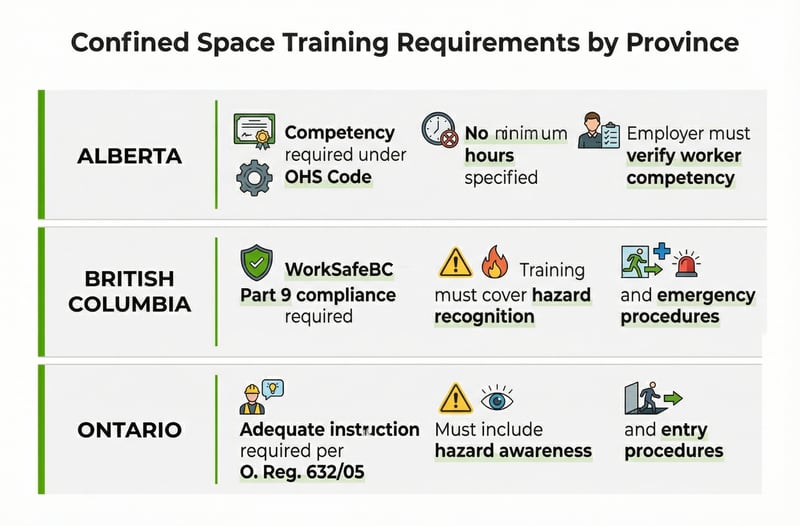
Every Canadian province requires employers to provide adequate confined space training, but the specifics vary. Here is what contractors need to know in the three provinces where most of our clients operate.
Alberta
Under Alberta's OHS Code Part 5, employers must ensure that workers entering confined spaces are trained in hazard assessment, atmospheric testing, entry and exit procedures, the use of PPE and rescue equipment, and emergency response procedures. Employers must keep records of this training. Alberta also requires that workers involved in emergency response within confined spaces receive additional rescue-specific training.
There is no government-prescribed course or minimum hour count in Alberta. The requirement is that training must be "adequate." In practice, most Alberta employers use ESC's Confined Space Entry and Monitor course or an equivalent because GCs in oil and gas and construction require it.
British Columbia
WorkSafeBC's OHS Regulation Part 9 requires training for all workers who enter confined spaces, all attendants (safety watches), and all persons involved in rescue. Training must cover the hazards of the specific confined spaces on the worksite, the entry and exit procedures, the use of monitoring and rescue equipment, and the emergency response plan.
BC does not prescribe a specific course or provider, but employers must be able to demonstrate that training was adequate for the specific hazards workers will encounter. Many BC construction and industrial employers use the same ESC or AASP courses recognized across Western Canada.
Ontario
Ontario's Confined Spaces regulation (O. Reg. 632/05) requires "adequate" training for every worker who enters, performs a rescue, or works as part of the confined space team. The training must cover hazard recognition, the specific confined space program at the workplace, and the worker's assigned duties.
In Ontario, the Workplace Safety and Prevention Services (WSPS) and Infrastructure Health and Safety Association (IHSA) are common training providers. Courses range from half-day awareness sessions to full-day entry programs with hands-on components.
Online vs In-Person Training: Which Should You Choose?
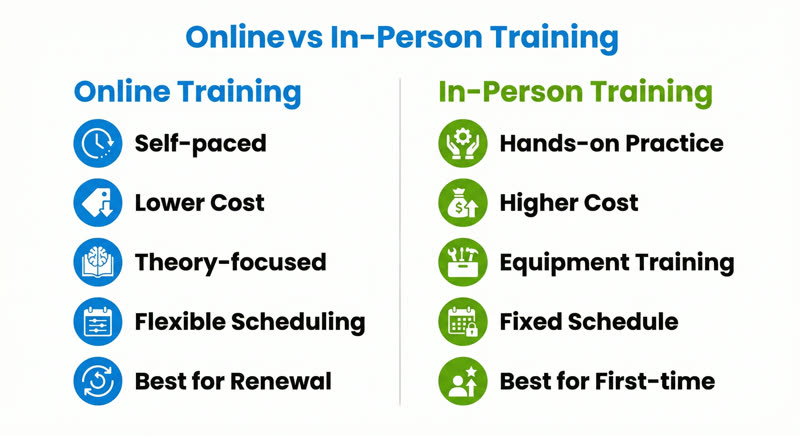
Most contractors think online training is a shortcut that cuts corners. That is not always true anymore. The quality gap between online and in-classroom confined space training has narrowed significantly, especially for the theory component.
Online training works well for:
- Awareness-level training where no hands-on skills are required
- Theory components of entry and monitor courses (many providers offer online theory + proctored exam)
- Renewal and refresher training for experienced workers
- Remote crews that cannot easily access a training centre
In-person training is better for:
- First-time entry and monitor certification where hands-on skills matter (atmospheric testing, tripod setup, harness fitting)
- Rescue-level training that involves physical skills practice
- Workers with limited experience in industrial environments
- Situations where the GC or project owner specifically requires classroom delivery
ESC's Confined Space Entry and Monitor course is available in both formats. The online version includes a proctored exam. Both produce the same certificate, valid for three years. Check with your GC or project owner before enrolling workers in online courses; some still require in-classroom delivery.
Never Miss an Expired Ticket Again
Is your training matrix a nightmare to manage? Track confined space certifications automatically, get alerts before they expire, and physically block uncertified workers from signing entry permits.
30-Day Free Trial
How Much Does Confined Space Training Cost?
Costs vary depending on the level of training, the delivery format, and the provider. Here are typical ranges as of 2026:
| Course Level |
Format |
Typical Cost |
Duration |
| Awareness | Online | $30 to $50 | 1.5 to 4 hours |
| Entry and Monitor | Online | $80 to $150 | 4 to 6 hours |
| Entry and Monitor | Classroom | $110 to $250+ | 6 to 8 hours |
| Rescue | Classroom | $250 to $500+ | 1 to 2 days |
These are per-worker costs. Group bookings from private training providers often come at a discount. Some providers offer combined packages that include confined space entry, rescue awareness, and first aid. If you are training multiple crew members, ask about on-site delivery, as bringing the instructor to your shop or site can save travel time and get your entire crew certified in one session.
For comparison, an expired ticket that gets flagged on a GC's site orientation costs you a day of lost production for that worker, plus the rush fee for a last-minute course. Prevention is cheaper.
How Long Is Confined Space Training Good For?
Most confined space training certificates are valid for 3 years. This applies to ESC's Confined Space Entry and Monitor course, AASP courses, and most other accredited providers across Canada.
However, the 3-year validity is the certificate expiry, not necessarily the employer's obligation. Several important caveats:
- Some GCs require annual refreshers regardless of certificate expiry. If you are bidding on work with a major operator, check their contractor management requirements before assuming a 3-year cycle.
- Provincial regulations say "adequate" training. If your workers have not entered a confined space in 2 years and their skills have degraded, "adequate" may mean refresher training before their certificate expires.
- Site-specific training is required for each new confined space. The generic course teaches the principles; the employer is responsible for training workers on the specific hazards and procedures for each space they will enter.
- COR and SECOR audits check training records. If your training matrix shows gaps or expired tickets, it will come up in your COR audit.
The smart move is to set up a training matrix that flags certificates 90 days before expiry and schedule renewals before they become urgent. Safety Evolution's training platform tracks expiry dates automatically and sends reminders, so you are never caught with expired tickets on site.
What Should You Look For in a Training Provider?
Not all confined space training is created equal. Here is what separates a legitimate provider from one that is just selling certificates:
- Industry recognition. Is the course recognized by the GCs and operators your crews work for? In oil and gas, ESC-accredited courses are the baseline. In construction, check whether your provincial safety association (IHSA in Ontario, BCCSA in BC, ACSA in Alberta) recognizes the program.
- Course content alignment. The course should align with CSA Z1006 (Management of Work in Confined Spaces) and cover your provincial OHS requirements specifically, not just generic "confined space safety."
- Instructor qualifications. For in-classroom courses, the instructor should have field experience in confined space work, not just a teaching credential. Ask.
- Proctored exams. For online courses, a proctored exam (webcam-monitored) is a sign of a legitimate provider. Courses with no exam or an unmonitored open-book test are less likely to be accepted by serious GCs.
- Certificate format. The certificate should include the worker's name, course name, completion date, expiry date, and the provider's accreditation details. Digital certificates that can be verified online are increasingly preferred.
For a detailed comparison of confined space certification options and what the credential actually means, see our certification guide. And if your crew needs rescue-level training beyond standard entry, our confined space rescue guide covers what is required.
Never Miss an Expired Ticket Again
Is your training matrix a nightmare to manage? Track confined space certifications automatically, get alerts before they expire, and physically block uncertified workers from signing entry permits.
30-Day Free Trial
Frequently Asked Questions
Does confined space training expire?
Yes. Most confined space training certificates are valid for 3 years from the date of completion. After that, workers must take a renewal course to maintain their certification. Some employers and GCs require annual refresher training regardless of certificate expiry. Always check the specific requirements for your worksite and province.
How long is confined space training good for?
Confined space training certificates are typically valid for 3 years. ESC's Confined Space Entry and Monitor certificate, one of the most widely recognized in Canada, has a 3-year validity period. However, employers are responsible for ensuring their workers' training remains "adequate" under their provincial OHS legislation, which may mean refresher training before the certificate expires if workers have not been performing confined space work regularly.
Can I get confined space training online?
Yes. Both awareness-level and entry-and-monitor courses are available online from accredited providers. ESC offers its Confined Space Entry and Monitor course online with a proctored exam, and it produces the same certificate as the classroom version. Online courses typically cost less ($30 to $150 depending on level) and offer scheduling flexibility. Verify that your GC or project owner accepts online delivery before enrolling workers.
Is confined space training required every year?
Not by most provincial regulations. Standard certificate validity is 3 years. However, some GCs and project owners require annual refresher training as a condition of working on their sites. Your provincial OHS legislation also requires that training be "adequate," meaning employers must provide refresher training when workers' skills have degraded, even if their certificate has not expired.
How much does confined space training cost in Canada?
Costs vary by level and format. Online awareness courses typically cost $30 to $50. Online entry and monitor courses range from $80 to $150. Classroom entry and monitor courses cost $110 to $250 or more per worker. Rescue-level training costs $250 to $500+ per worker and usually requires 1 to 2 days of in-person instruction. Group rates and on-site delivery may reduce per-worker costs.
Get Weekly Safety Insights
Regulation updates, toolbox talk ideas, and compliance tips. One email per week.