What Is a Confined Space? Definition & Examples
What is a confined space? Learn the legal definition under Canadian regulations, common examples by industry, and a contractor identification...
Confined space vs restricted space: learn the legal definitions, compliance requirements, and how Alberta OHS Code distinguishes between the two.
Last updated: March 2026
You are standing at the edge of a utility vault and your foreman asks whether this is a confined space or a restricted space. You shrug. He shrugs. The crew goes in anyway. Nobody gets hurt that day, but nobody filled out the right paperwork either. When an OHS inspector shows up next week, the distinction you ignored becomes the difference between a warning and a $10,000 penalty.
This is one of the most common compliance gaps we see at Safety Evolution when auditing contractor safety programs. The terms sound interchangeable. They are not. Getting the classification wrong means applying the wrong procedures, the wrong documentation, and the wrong level of protection. Here is exactly how to tell the difference and what it means for your crew.
Not every Canadian province draws a formal line between confined spaces and restricted spaces. Alberta does. It is one of the few jurisdictions in Canada where the OHS Code explicitly defines both terms as separate legal categories with different compliance requirements.
Under Alberta's OHS Code (Section 1, Definitions), a "restricted space" is an enclosed or partially enclosed space that is not designed or intended for continuous human occupancy, and has a restricted, limited, or impeded means of entry or exit because of its construction. Think of it as the base category: any space your crew enters that was not built for people to work in continuously and is hard to get in or out of.
A "confined space" is defined as a restricted space that may become hazardous to a worker entering it because of:
In plain terms: a confined space is a restricted space plus hazards. The restricted space definition is the foundation. The confined space definition adds the danger layer on top. For a deep look at the complete regulatory picture, see our complete Canadian guide to confined space.
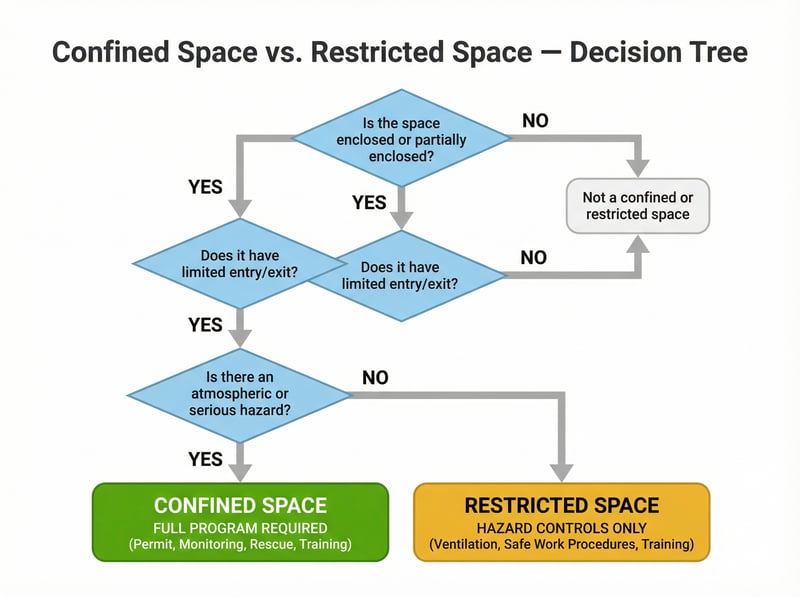
Here is the decision process your crew should follow every single time:
Step 1: Is it enclosed or partially enclosed? If your workers are entering a space that has walls, a floor, and a ceiling (or partial versions of these), you are dealing with at least a restricted space. Open trenches with blue sky overhead may still qualify if egress is limited.
Step 2: Is it designed for continuous human occupancy? An office, a break room, or a heated shop is designed for people to work in all day. A manhole, a tank, a pipe run, or an attic crawlspace is not. If it was not built for people to occupy continuously, it qualifies as a restricted space at minimum.
Step 3: Does it have restricted entry or exit? If getting in or out requires climbing, crawling, squeezing through an opening, or using a ladder, the entry is restricted. This confirms it is a restricted space.
Step 4: Could it become hazardous? This is the critical question. Could the atmosphere change? Could gases accumulate? Could oxygen levels drop? Could a worker become engulfed by material? Could the work being done inside (welding, painting, using adhesives) create a hazardous condition?
The catch: "could it become hazardous" requires a competent person to make that determination. Your best guess is not good enough. A competent person needs to assess the space, document the assessment, and sign off on the classification. If there is any doubt, classify it as a confined space. Overprotecting your crew never gets you fined. Under-protecting them does.
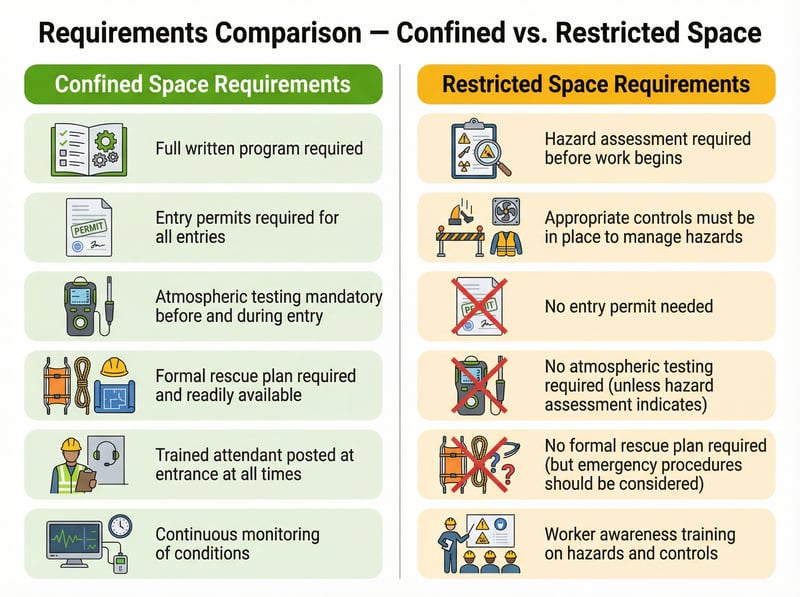
The requirements are significantly different. Here is a side-by-side comparison under Alberta's OHS Code:
| Requirement | Restricted Space | Confined Space |
|---|---|---|
| Written code of practice | Not required (safe work procedures are) | Required (OHS Code s. 44) |
| Hazard assessment | Required (OHS Code s. 45) | Required (OHS Code s. 45) |
| Entry permit | Not required | Required (OHS Code s. 47) |
| Atmospheric testing | Not required | Required before entry (OHS Code s. 52) |
| Ventilation/purging | Not required (unless hazard identified) | Required if hazardous atmosphere found (OHS Code s. 53) |
| Tending worker (safety watch) | Required (OHS Code s. 56) | Required, with additional duties (OHS Code s. 56) |
| Emergency/rescue procedures | Required (OHS Code s. 55) | Required (OHS Code s. 55) |
| Worker training | Required (OHS Code s. 46) | Required (OHS Code s. 46) |
| Record keeping | Required (OHS Code s. 58) | Required, including permits (OHS Code s. 58) |
The critical differences: confined spaces require a written code of practice, entry permits, and atmospheric testing. Restricted spaces do not. Both require hazard assessments, training, emergency procedures, and a tending worker. The overlap is significant, which is part of why contractors get confused.
Take the Guesswork Out of Confined Spaces
Are you struggling to keep track of which rules apply to which spaces? Build your baseline safety program digitally, standardize your hazard assessments, and ensure every entry is compliant.
30-Day Free TrialHere is where it gets practical. The same type of space can be classified differently depending on conditions.
An underground electrical vault with a ladder access hatch. No chemical storage, no gas lines nearby, good natural ventilation, and no work being performed that generates fumes. This is likely a restricted space: difficult entry/exit, not designed for continuous occupancy, but no atmospheric hazards expected.
Now add a propane heater inside because it is January in Edmonton. That same vault is now a confined space: the propane combustion reduces oxygen levels and produces carbon monoxide. The classification changed because the conditions changed.
A tank that held crude oil or produced water. Even "empty," residual hydrocarbons and hydrogen sulfide (H2S) can create a lethal atmosphere. This is always a confined space. There is no scenario where an oil storage tank should be classified as merely restricted.
A crawlspace with a small access point, used for running electrical or plumbing. If there is no history of atmospheric hazards, no gas lines, and no stored materials that off-gas, this is typically a restricted space. But if the crawlspace sits over clay soil that traps methane, or if workers will be using solvent-based adhesives inside, it becomes a confined space.
An open trench (blue sky above) with limited egress points can be a restricted space if the only hazard is difficulty getting out. If that trench runs near a gas main, or if organic decomposition in the soil is producing methane, the trench may qualify as a confined space. A proper field level hazard assessment (FLHA) before each entry is essential.
Grain bins present engulfment hazards plus potential atmospheric hazards from grain dust and decomposition gases. These are confined spaces. Alberta's agricultural sector has seen multiple fatalities in grain bin entries.
Alberta is unique in explicitly defining "restricted space" as a separate legal term in its OHS Code. Most other provinces use only "confined space" as a defined term:
If your crew works across provincial lines, this matters. A space classified as "restricted" in Alberta might fall under "confined space" in BC because BC does not have the intermediate category. When in doubt, apply the more protective standard. For a detailed breakdown of Alberta's specific requirements, see our guide to confined space requirements in Alberta.
Most contractors think misclassification is a paperwork problem. It is not. It is a survival problem.
If you classify a confined space as merely restricted, you skip:
An estimated 60% of confined space fatalities involve would-be rescuers who entered without proper equipment or training. That cascade starts with a crew entering a hazardous space without knowing it was hazardous. Misclassification is the first domino.
From a compliance standpoint, Alberta OHS administrative penalties can reach $10,000 per violation per day. A misclassified space that leads to multiple violations (no code of practice, no permits, no testing, no rescue plan) can generate $40,000 to $50,000 in penalties from a single inspection. If someone gets hurt or killed, prosecution under the OHS Act can result in fines up to $500,000 for a corporation.
If your safety program does not clearly define the classification process for restricted and confined spaces, Safety Evolution software can analyse your existing space records and flag where classifications may not match the actual hazards.
If your crew enters any enclosed spaces on the job, here is what you need:
If you are working toward COR certification in Alberta, your auditor will check that confined and restricted spaces are properly identified and classified. A job hazard analysis should include space classification as a standard step for any task involving enclosed spaces.
Take the Guesswork Out of Confined Spaces
Are you struggling to keep track of which rules apply to which spaces? Build your baseline safety program digitally, standardize your hazard assessments, and ensure every entry is compliant.
30-Day Free TrialA restricted space is any enclosed or partially enclosed area not designed for continuous human occupancy with restricted entry or exit. A confined space is a restricted space that also has the potential for hazardous atmospheric conditions, engulfment, or other dangerous conditions. The key difference is the presence or potential for hazardous conditions. All confined spaces are restricted spaces, but not all restricted spaces are confined spaces.
Yes. Under Alberta's OHS Code, confined spaces require a written code of practice, entry permits, atmospheric testing before entry, and a rescue plan. Restricted spaces require a hazard assessment, safe work procedures, training, and a tending worker, but do not require entry permits or atmospheric testing. Both require emergency procedures and record keeping.
Yes. A restricted space can become a confined space if conditions change. For example, a utility vault with no atmospheric hazards is a restricted space. If a worker starts welding inside that vault (consuming oxygen and producing fumes), it becomes a confined space. Seasonal changes, new equipment, and different work activities can all change the classification. This is why regular reassessment is critical.
Alberta is one of the few provinces that explicitly defines "restricted space" as a separate legal category. BC, Ontario, Saskatchewan, and most other provinces use only "confined space" as a defined regulatory term. The federal Canada Occupational Health and Safety Regulations distinguish between "confined space" and "hazardous confined space" instead. If your crew works across provincial borders, apply the more protective standard.
Misclassifying a confined space as merely restricted can result in multiple OHS violations: no written code of practice, no entry permits, no atmospheric testing, and no rescue plan. Alberta OHS administrative penalties can reach $10,000 per violation per day. A single inspection of a misclassified space can generate $40,000 to $50,000 in penalties. If a worker is injured or killed, fines under the OHS Act can reach $500,000 for a corporation.
Get Weekly Safety Insights
Regulation updates, toolbox talk ideas, and compliance tips. One email per week.
What is a confined space? Learn the legal definition under Canadian regulations, common examples by industry, and a contractor identification...
Confined space kills more construction workers than you think. Canadian rules for permits, atmospheric testing, rescue plans, and penalties.
Confined space hazards explained: atmospheric dangers (O2, H2S, CO, LEL), physical risks, testing thresholds, and control measures for contractors.