Your crew is about to drop into a tank, a vault, or a manhole. Somebody hands you the entry permit and you realize you have no idea whether your paperwork, your training records, or your rescue plan would survive a regulator walking onto site today. That question keeps a lot of contractors up at night, and it should.
At Safety Evolution, we help contractors across Canada build safety programs that actually pass audits and keep workers alive. Confined space work is one of the highest-risk activities your crew will ever do, and getting it wrong can cost you fines, shutdowns, or a phone call no employer wants to make.
What Is a Confined Space?
A confined space is a fully or partially enclosed area that is not designed or intended for continuous human occupancy, has limited or restricted means of entry or exit, and may present hazards to anyone who enters. That definition comes from CCOHS and aligns closely with how every Canadian province defines the term in legislation.
The three criteria are straightforward, but the third one catches contractors off guard. A space does not need to be small to be confined. A grain silo, a water tank, a large underground utility vault, a ship's cargo hold: they all qualify. The common thread is that the space can trap you, suffocate you, or expose you to something that the open air would normally dilute to safe levels.
Examples you will encounter on construction and industrial sites include:
Tanks, vats, and vessels
Manholes and utility vaults
Sewers and storm drains
Silos and hoppers
Boilers and pressure vessels
Trenches and excavations (when access is restricted)
Pipeline sections and ductwork
Storage bins and rail tank cars
If you are unsure whether a space qualifies, treat it as one until a competent person conducts a hazard assessment and proves otherwise. That approach keeps your crew alive and your company off the regulator's radar.
Why Is Confined Space Work So Dangerous?
Most contractors know confined spaces are risky. Few understand just how fast things go wrong. According to CCOHS, an estimated 60% of confined space fatalities in Canada are rescuers, not the original workers. That means the person who rushed in to help died because nobody had a real rescue plan.
Here is what makes these spaces lethal:
Atmospheric hazards are the biggest killer. Oxygen levels below 19.5% cause disorientation within seconds and unconsciousness within minutes. Toxic gases like hydrogen sulphide (H2S) and carbon monoxide can accumulate in enclosed spaces with no warning. Flammable gases or dust can turn a space into a bomb.
Physical hazards include engulfment (grain, sand, or other bulk material collapsing on a worker), entrapment from mechanical equipment, falls from height within the space, and electrical contact. These are standard construction hazards amplified by the fact that escape routes are restricted.
The rescue problem is the danger most contractors underestimate. In open air, your crew can pull someone out. In a confined space, the opening might be 600mm wide and 10 metres underground. Without the right equipment and training, attempted rescues become additional fatalities. Read our confined space rescue planning guide for the full breakdown.
Canadian Confined Space Regulations by Province
There is no single national confined space regulation in Canada. Each province sets its own rules under its OHS legislation. The core requirements are similar, but definitions, permit procedures, and enforcement differ.
Alberta: OHS Code Part 5
Alberta's Occupational Health and Safety Code, Part 5, governs confined and restricted spaces. Alberta distinguishes between confined spaces (spaces meeting all three criteria above) and restricted spaces (limited entry/exit but no atmospheric or engulfment hazards). The key requirements include:
A written code of practice for confined space entry
A hazard assessment before every entry
Atmospheric testing (oxygen, flammable gases, toxic gases) before and during entry
An entry permit system
A designated safety watch (attendant) at the entry point
A rescue plan with trained rescue personnel and equipment on site
Worker training with records kept by the employer
Alberta also requires employers to involve workers in developing the code of practice. That is not a suggestion; it is a regulatory requirement under the OHS Act.
British Columbia: OHS Regulation Part 9
BC's WorkSafeBC OHS Regulation, Part 9 (Confined Spaces), defines a confined space as an area other than an underground working that is enclosed or partially enclosed, not designed for continuous human occupancy, has limited entry/exit, and may become hazardous. Key BC requirements:
A written confined space program
A qualified person must conduct hazard assessments
Pre-entry and continuous atmospheric monitoring
A written entry permit for each entry
An attendant stationed at the entry point
Written rescue procedures, with rescue equipment available on site
Training for all workers, attendants, and rescue personnel
Ontario: O. Reg. 632/05
Ontario's Confined Spaces regulation (O. Reg. 632/05 under the Occupational Health and Safety Act) defines a confined space as a fully or partially enclosed space not designed for continuous human occupancy where atmospheric hazards may occur. Ontario requirements include:
A written confined space program with hazard assessment and control procedures
An entry plan for each confined space
Atmospheric testing before and during entry
On-site rescue procedures and equipment
Adequate training for every worker who enters, monitors, or performs rescue
A competent person must coordinate the entry
Regardless of your province, the pattern is the same: assess the hazards, control the atmosphere, get a permit, have a rescue plan, and train your people. If you are working across provinces, your safety program needs to address the most stringent requirements you will face.
Take the Guesswork Out of Confined Spaces
Are you struggling to keep track of which rules apply to which spaces? Build your baseline safety program digitally, standardize your hazard assessments, and ensure every entry is compliant.
What Are the Entry Requirements for a Confined Space?
Most contractors think the entry permit is the main requirement. It is the most visible piece of paper, but it sits on top of a stack of requirements that all have to be in place before anyone goes through that opening.
Hazard Assessment
Before any entry, a competent person must assess the confined space for atmospheric hazards, physical hazards, biological hazards, and process-related hazards. This is not a one-time exercise. The hazard assessment must happen before every entry, because conditions inside a confined space can change between shifts. If your crew completed an entry yesterday and is going back today, the assessment starts over. A good job hazard assessment process is your foundation.
Atmospheric Testing
This is where contractors cut corners and people die. Atmospheric testing must be done before entry and continuously during the work. You are testing for three things:
Oxygen levels: Safe range is 19.5% to 23%. Below 19.5%, workers become impaired. Below 16%, unconsciousness can occur within minutes.
Flammable gases: Must be below 10% of the Lower Explosive Limit (LEL). Above that threshold, you have an explosion hazard.
Toxic gases: Varies by substance. For H2S, Alberta's OEL is 10 ppm (8-hour TWA). For carbon monoxide, it is 25 ppm. Your gas monitor must be calibrated and bump-tested before each use.
Test at multiple levels within the space. Heavier-than-air gases (like H2S) settle to the bottom. Lighter-than-air gases rise to the top. Testing only at the opening tells you nothing about conditions at the bottom of a 5-metre tank.
Entry Permit
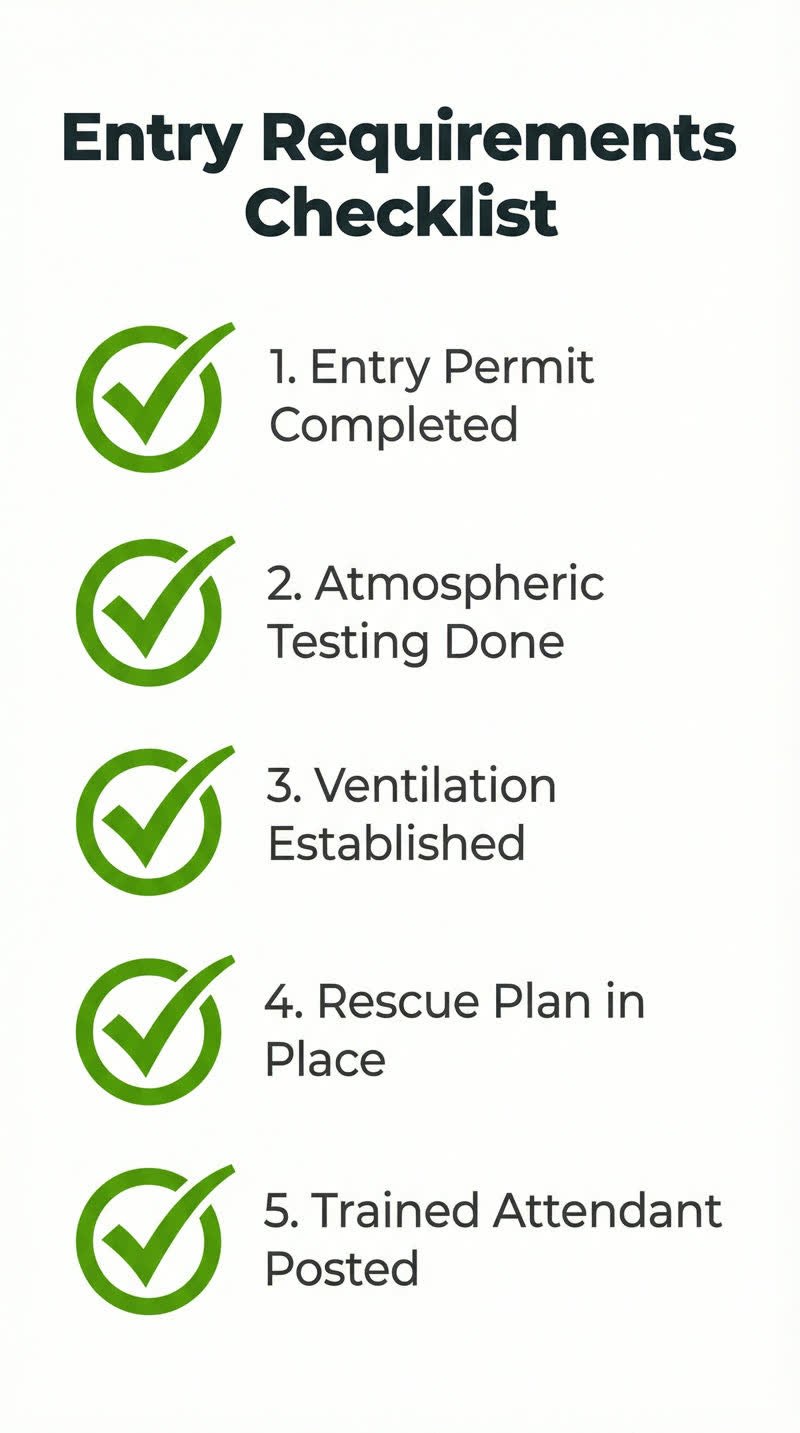
The entry permit documents that all preconditions have been met: hazard assessment complete, atmosphere tested, ventilation running, rescue plan in place, communication established, workers briefed. Every province requires a permit system for confined space entry. The permit is not paperwork for its own sake; it is a checklist that forces you to confirm the space is safe before anyone enters.
Ventilation
Mechanical ventilation is almost always required. Natural ventilation is rarely sufficient in an enclosed space. The ventilation must run before entry (to purge the atmosphere) and continuously during the work. Place the supply fan to push clean air to the bottom of the space, and ensure exhaust air exits away from the entry point.
Lockout/Tagout and Isolation
Before entry, all energy sources connected to the confined space must be locked out. That includes electrical, hydraulic, pneumatic, chemical, and gravity-fed systems. Pipes must be blanked or disconnected, not just valved off. If product can enter the space while your worker is inside, your isolation is inadequate. Our guide to lockout/tagout in construction covers the full process.
What Training Do Workers Need for Confined Space Entry?
Every Canadian jurisdiction requires confined space training for workers who enter, attend, or supervise confined space work. The training must cover hazard recognition, atmospheric testing, entry procedures, emergency response, and the use of PPE and rescue equipment.
There are generally two levels:
Confined space awareness: A shorter course (typically 1.5 to 4 hours, often available online) that covers hazard identification, recognition of confined spaces, and the basics of safe entry. Suitable for workers who may encounter confined spaces but do not enter them.
Confined space entry and monitor: A more comprehensive course (typically 4 to 8 hours) that covers atmospheric testing, entry permits, ventilation, PPE, rescue procedures, and attendant duties. Required for workers who will actually enter or attend confined spaces.
In the oil and gas sector, Energy Safety Canada's (ESC) Confined Space Entry and Monitor course is the industry standard. It is available online and in the classroom, and the certificate is valid for three years. Costs range from approximately $110 to $250 depending on the provider and delivery format.
Most certificates are valid for 3 years, but employers should check whether their clients or the project owner requires more frequent renewal. Some GCs require annual refreshers regardless of what the ticket says. Tracking expiry dates across dozens of workers and multiple certifications is where spreadsheets break down. AI-powered tools like Safety Evolution software monitor your workforce certifications and alert you 30, 60, and 90 days before any ticket expires. Read our full guide to confined space training requirements, costs, and providers for detailed information.
For confined space certification details, including the difference between a training certificate and a professional credential, see our certification guide.
What Equipment Is Required for Confined Space Entry?
The equipment list depends on the hazards identified in the assessment, but the following are standard for most entries:
Equipment
Purpose
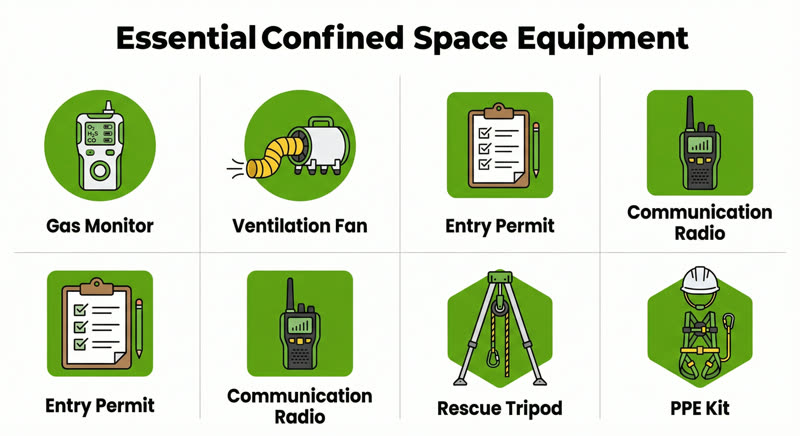
Multi-gas detector (4-gas)
Continuous atmospheric monitoring for O2, LEL, H2S, CO
Mechanical ventilation (blower/fan)
Purge and maintain safe atmosphere
Full-body harness with D-ring
Retrieval attachment point for rescue
Tripod and winch/retrieval system
Non-entry rescue from vertical spaces
Communication equipment
Maintain contact between entrant and attendant
Respiratory protection (SCBA or SAR)
When atmosphere cannot be made safe
Lighting (intrinsically safe)
Visibility inside the space
Entry permit and signage
Document safe conditions and warn others
All equipment must be inspected before each use. Harnesses must meet CSA Z259.10 standards. Gas detectors must be calibrated per the manufacturer's specifications and bump-tested daily. If the equipment is not in working order, the entry does not happen.
How Do You Build a Confined Space Rescue Plan?
Here is the blunt truth most contractors do not want to hear: if your rescue plan is "call 911," you do not have a rescue plan. Municipal fire departments may not have confined space rescue capability. Even if they do, response times of 15 to 30 minutes are common. A worker in an oxygen-deficient atmosphere has 3 to 4 minutes before brain damage begins.
Every Canadian province requires a written rescue plan before any confined space entry. The plan must address:
Type of rescue: self-rescue, non-entry rescue (mechanical retrieval from outside the space), or entry rescue (a trained team enters to extract the worker)
Rescue personnel: who is responsible, what training they have, and how quickly they can respond
Rescue equipment: tripod, winch, harness, SCBA, stretcher, communication devices
Communication: how the attendant alerts rescue personnel, how rescue personnel communicate with each other
Practice drills: rescue procedures must be practiced, not just written down
Non-entry rescue using a retrieval system (tripod + winch) is the preferred method whenever the space configuration allows it. Entry rescue is the last resort because it puts additional workers at risk.
Confined Space vs Restricted Space: Does It Matter?
In Alberta, the OHS Code distinguishes between confined spaces and restricted spaces, and getting the classification wrong creates real problems on site. A restricted space has limited entry or exit but does not have atmospheric hazards or engulfment risk when standard procedures are followed. Think of a mechanical room with one door, or a crawl space under a building with no process connections.
A confined space has those same physical constraints plus the potential for dangerous atmospheres, engulfment, or other life-threatening conditions. The distinction determines your entire control program: confined spaces require atmospheric testing, entry permits, a safety watch, and a written rescue plan. Restricted spaces require fewer controls but still need a hazard assessment and a code of practice.
BC and Ontario do not use this two-category system. In those provinces, the single "confined space" definition covers everything, and the control requirements scale based on the hazards identified in the assessment. If your company works across provincial borders, build your program to the confined space standard for all entries. You will never be non-compliant by having more controls than required.
Confined Space Hazard Assessment: What to Look For
The hazard assessment is the foundation of every confined space entry. Skip it or rush it and everything downstream falls apart. A competent person must assess:
Atmospheric hazards: What was previously stored or processed in the space? Could gases accumulate from adjacent processes, decomposing material, or chemical reactions? Are there natural sources of hazardous atmosphere (methane from organic material, CO2 from fermentation)?
Physical hazards: Is there loose material that could shift or collapse (engulfment)? Are there moving parts or mechanical equipment? What is the configuration of the space: depth, width of openings, internal obstructions?
Biological hazards: Is there mould, sewage, animal waste, or other biological material present?
Energy sources: What pipelines, electrical systems, hydraulic lines, or gravity-fed systems are connected to the space?
Environmental factors: Temperature extremes, noise, lighting, and proximity to traffic or other operations.
Document the assessment on a field-level hazard assessment form and keep it with the entry permit. The assessment determines what controls, PPE, and rescue provisions are needed for that specific entry.
Common Mistakes Contractors Make with Confined Space Entry
After working with hundreds of contractors on their safety programs, here are the mistakes we see most often:
"We've been in that tank a dozen times, it's fine." Conditions change. The tank that was safe last month had a chemical delivery yesterday. Complacency kills more people in confined spaces than any single hazard.
Testing the atmosphere at the opening only. Gas layers stratify. Test at the top, middle, and bottom of the space.
No rescue plan, or a plan that says "call 911." You need a plan that works in minutes, not the time it takes for a fire truck to arrive.
Training tickets are expired. Most confined space certificates are valid for 3 years. If your crew's tickets are expired, you are not compliant, and the regulator will not care that the course was "basically the same" 4 years ago. Safety Evolution software flags these gaps before the inspector does.
Using the space as a shortcut. Workers entering a manhole "for just a second" without a permit, harness, or attendant. There is no such thing as a quick entry into a confined space.
Skipping lockout/tagout. If the space is connected to a process system and you have not isolated every energy source, you are gambling with someone's life.
Take the Guesswork Out of Confined Spaces
Are you struggling to keep track of which rules apply to which spaces? Build your baseline safety program digitally, standardize your hazard assessments, and ensure every entry is compliant.
What are three characteristics of a confined space?
A confined space has three defining characteristics: (1) it is fully or partially enclosed, (2) it is not designed or intended for continuous human occupancy, and (3) it has limited or restricted means of entry or exit. If a space meets all three criteria, it must be treated as a confined space under Canadian OHS regulations, regardless of its size.
What is the difference between a confined space and a restricted space?
In Alberta, a restricted space has limited entry/exit but does not present atmospheric or engulfment hazards when procedures are followed. A confined space has those same physical restrictions plus the potential for atmospheric, engulfment, or other serious hazards. The distinction matters because confined spaces require additional controls including atmospheric testing, entry permits, and rescue plans. Not all provinces use this distinction; BC and Ontario regulate both under a single "confined space" framework.
Do I need a permit to enter a confined space?
Yes. Every Canadian province requires an entry permit system for confined space work. The permit documents that the hazard assessment is complete, atmospheric testing has been done, ventilation is running, rescue provisions are in place, and workers have been briefed. The permit must be completed and signed before any worker enters the space.
How often do confined spaces need to be tested for atmospheric hazards?
Atmospheric testing must be done before every entry and continuously during the work. Conditions inside a confined space can change rapidly due to work activities, chemical reactions, or changes in connected systems. Pre-entry testing alone is not sufficient. Continuous monitoring with a calibrated multi-gas detector is required while workers are inside the space.
What should I do if a worker collapses inside a confined space?
Do not enter the space to rescue them unless you are trained, equipped, and following your written rescue plan. An estimated 60% of confined space fatalities are would-be rescuers. Activate your rescue plan immediately: use the retrieval system (tripod and winch) for non-entry rescue if possible, alert your trained rescue team, and call emergency services. This is why having a written rescue plan with trained personnel and equipment on site is not optional.
Get Weekly Safety Insights
Regulation updates, toolbox talk ideas, and compliance tips. One email per week.