Confined spaces kill more workers per entry than almost any other workplace hazard. The reason is simple: hazards in confined spaces are invisible until they are deadly. You cannot see an oxygen-deficient atmosphere. You cannot smell most toxic gases until your brain is too impaired to escape. And physical hazards like engulfment can overwhelm a worker in seconds.
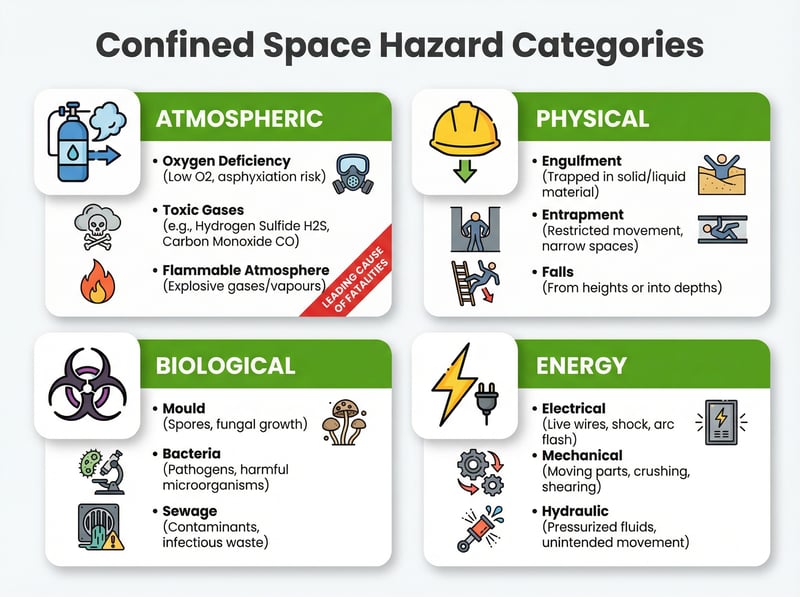
Confined space hazards fall into three categories: atmospheric hazards (the leading killer), physical hazards (engulfment, entrapment, energy sources), and biological hazards. Understanding each category, knowing the testing thresholds, and implementing the right controls is the difference between a crew that comes home and a confined space fatality investigation.
This guide covers every type of confined space hazard Canadian contractors encounter, the atmospheric testing procedures and thresholds you must know, and the control measures that keep workers alive. If your crews enter tanks, manholes, silos, vaults, or any other confined space, this is the hazard reference you need.
⚡ Quick Answer
Atmospheric hazards (O₂ deficiency, toxic gases, flammable atmospheres) cause the majority of confined space deaths
Atmospheric Hazards: The Leading Cause of Confined Space Deaths
Atmospheric hazards kill more workers in confined spaces than all other hazards combined. They are invisible, fast-acting, and unforgiving. There are three types.
Oxygen Deficiency
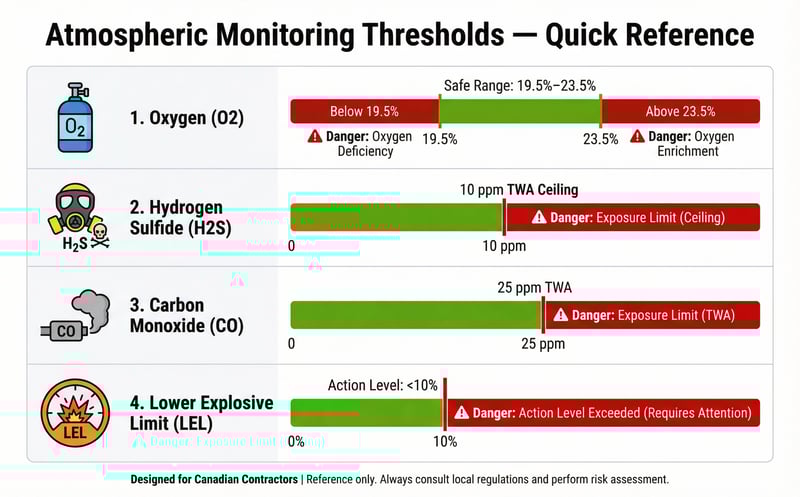
Normal atmospheric oxygen is 20.9% by volume. A confined space atmosphere below 19.5% oxygen is considered oxygen-deficient and dangerous.
Oxygen gets displaced or consumed in confined spaces through:
Biological processes: Decomposing organic matter, bacterial activity in sewers and tanks
Chemical reactions: Rusting (oxidation), fermentation, curing of concrete
Displacement: Heavier-than-air gases (CO₂, nitrogen, argon) pushing oxygen out
Absorption: Certain soils, grains, and materials absorb oxygen from the air
Combustion: Welding, cutting, or other hot work consuming oxygen
Rapid breathing, dizziness, poor coordination, impaired judgment, may not realize danger
8%–12%
Nausea, vomiting, inability to move, loss of consciousness within minutes
Below 8%
Unconsciousness within seconds, brain damage, death within minutes
The dangerous part: at 16% oxygen, your brain is already impaired, but you probably do not realize it. Workers in oxygen-deficient environments often feel fine right up until they collapse.
Toxic Gases and Vapours
Toxic gases accumulate in confined spaces because there is no natural ventilation to disperse them. The most common toxic gases in construction and industrial confined spaces:
Hydrogen sulphide (H₂S): The most dangerous gas in oil and gas, sewer work, and any space with decomposing organic material. More on this below.
Carbon monoxide (CO): Produced by internal combustion engines, welding, cutting, heating, and incomplete combustion. Odourless and colourless. OEL is 25 ppm (8-hr). IDLH at 1,200 ppm.
Carbon dioxide (CO₂): Produced by fermentation, decomposition, combustion, and dry ice. Heavier than air, settles at the bottom of spaces. OEL is 5,000 ppm (8-hr).
Nitrogen: Used for purging and inerting. Odourless and colourless. Displaces oxygen without warning, workers have been killed walking into nitrogen-purged spaces.
Solvent vapours: From cleaning agents, paints, coatings, adhesives. Can be both toxic and flammable.
Ammonia (NH₃): Found in refrigeration systems and agricultural settings. Strong odour, highly toxic at elevated concentrations.
Flammable and Explosive Atmospheres
A flammable atmosphere exists when the concentration of flammable gas or vapour is between the Lower Explosive Limit (LEL) and the Upper Explosive Limit (UEL). Within this range, any ignition source, a spark from a tool, static discharge, hot work, can cause an explosion or flash fire in the enclosed space.
Key thresholds for confined space entry:
Below 10% LEL: Entry permitted with continuous monitoring
5%–10% LEL: Entry permitted for non-hot work only. Continuous monitoring required.
Above 10% LEL: No entry permitted (with very limited exceptions for qualified inspection work with respiratory protection)
Above 5% LEL: No hot work permitted
Common sources of flammable atmospheres in confined spaces: residual petroleum products, natural gas leaks, methane from decomposition, solvent vapours, and hydrogen from battery charging.
H₂S in Confined Spaces: The Silent Killer
Hydrogen sulphide (H₂S) deserves its own section because it is the single most dangerous gas in Canadian confined space work, particularly in oil and gas, sewer maintenance, and any space containing decomposing organic material.
H₂S is heavier than air. It sinks to the bottom of confined spaces, exactly where workers are standing. At low concentrations it smells like rotten eggs, but above 100 ppm, H₂S paralyzes the olfactory nerve, eliminating your ability to smell it. Workers have walked into lethal concentrations thinking the space was clear because they could not smell anything.
H₂S Exposure Levels and Effects
Concentration (ppm)
Effects
0.01–0.3 ppm
Odour threshold, "rotten egg" smell detectable
10 ppm
8-hour OEL in most Canadian jurisdictions. Eye irritation begins.
15 ppm
15-minute STEL (short-term exposure limit) in Alberta
50–100 ppm
Severe eye and respiratory irritation. Prolonged exposure causes pulmonary edema.
100 ppm
IDLH (Immediately Dangerous to Life or Health). Olfactory nerve paralyzed, you can no longer smell it.
300–500 ppm
Loss of consciousness, respiratory arrest. Death within minutes to hours.
700+ ppm
Immediate collapse. Death within minutes.
H₂S is found in:
Oil and gas wells, pipelines, and processing facilities
Sewers, manholes, and wastewater treatment plants
Agricultural storage (manure pits, silage)
Pulp and paper mills
Geothermal areas
Any space where organic matter decomposes anaerobically
Pre-entry atmospheric testing is mandatory, test at multiple levels within the space, especially near the bottom where H₂S accumulates
Continuous monitoring. H₂S levels can spike without warning when sediment is disturbed, work creates agitation, or temperature changes
Mechanical ventilation, forced fresh air, with exhaust placed near the bottom of the space to remove settled H₂S
SCBA or supplied air respirators, required for any entry into an atmosphere with H₂S above the OEL. Air-purifying respirators are NOT adequate for H₂S IDLH atmospheres.
Alarm set points, most gas monitors should alarm at 10 ppm (TWA) and 15 ppm (STEL). Immediate evacuation at 10 ppm.
H₂S Alive or equivalent training, mandatory for oil and gas work in Alberta and recommended across all industries where H₂S may be present. See our H₂S Alive training guide.
Stop Chasing Paper Permits & Lost Gas Logs
Ditch the clipboard. Digitize your confined space entry permits, mandate real-time atmospheric testing logs before entry is allowed, and make rescue plans instantly accessible to everyone on site.
Atmospheric hazards get most of the attention, but physical hazards in confined spaces are equally capable of killing or seriously injuring workers.
Engulfment
Engulfment occurs when a worker is surrounded or captured by a liquid or finely divided solid material (grain, sand, gravel, coal, sawdust) that can aspirate into the airway or exert enough pressure to cause asphyxiation.
Engulfment deaths are common in grain bins, silos, hoppers, and storage tanks. A worker standing on top of stored grain can be pulled under in seconds when grain flows, known as "bridging" collapse. By the time someone is buried waist-deep in grain, the force required to pull them out can exceed 400 pounds.
Controls: lockout the flow of materials, use a body harness with lifeline attached to an anchor above the space, never enter alone, never walk on stored materials that could bridge or flow.
Entrapment
Entrapment occurs when a worker becomes caught or stuck in the confined space due to the configuration of the space, converging walls, narrowing passages, inward-sloping floors. A worker who enters a hopper through the top opening and descends to the converging bottom may be unable to return if they slip.
Controls: assess the space configuration before entry, use retrieval systems (tripod + lifeline), ensure the worker can be extracted from any position within the space.
Moving Parts and Mechanical Hazards
Agitators, mixers, augers, conveyors, and other mechanical equipment inside or connected to confined spaces can activate unexpectedly if energy sources are not properly locked out. Lockout/tagout procedures are essential for every confined space with mechanical equipment.
Electrical Hazards
The combination of moisture, metal walls, and limited escape routes makes electrical hazards in confined spaces especially dangerous. Portable equipment must be GFCI-protected. Where possible, use low-voltage tools (12V or 24V). Ground all equipment. For more on electrical safety, see our construction electrical safety guide.
Temperature Extremes
Confined spaces can be significantly hotter or colder than the surrounding environment. Boilers, steam lines, and sun-heated metal tanks can reach temperatures that cause heat stress or burns. Unheated underground vaults in winter can cause hypothermia. Limited ventilation makes temperature regulation difficult. Monitor worker exposure and establish work/rest cycles.
Noise
Sound reflects off the hard, enclosed surfaces of a confined space, amplifying noise from tools, ventilation equipment, and work activities. Hearing protection is often required. The confined environment also makes verbal communication between workers and the attendant more difficult, establish alternative communication methods.
Biological Hazards
Biological hazards in confined spaces are often overlooked but can cause serious illness:
Bacteria and viruses: Sewers, wastewater systems, and medical waste storage can expose workers to pathogenic organisms
Mould and fungi: Damp, enclosed spaces with organic material provide ideal growing conditions
Animal and insect hazards: Snakes, rodents, spiders, wasps, and bats can inhabit confined spaces, particularly those that have been sealed for extended periods
Decomposing organic material: Beyond producing H₂S and methane, decomposing material can release other harmful substances and create infection risks
Controls: assess biological hazards during the pre-entry assessment, provide appropriate PPE (including respiratory protection if biological aerosols are possible), and ensure workers are current on relevant vaccinations (tetanus, hepatitis A/B for sewer workers).
Atmospheric Testing Procedures
Getting the testing right is critical. Here is the standard procedure used across Canadian jurisdictions:
Testing Order (Never Skip This)
Oxygen (O₂) first, because the readings from combustible gas sensors are unreliable in oxygen-deficient atmospheres
Flammable gases (LEL) second, because a flammable atmosphere is the most immediately explosive hazard
Toxic gases (H₂S, CO, etc.) third, because these determine the respiratory protection and exposure controls needed
Use a remote sampling tube to test before entering, never stick your head in the opening to "check" the air.
Testing Frequency
Pre-entry: Every time, before any worker enters. In BC, within 20 minutes of entry.
During work: Continuous monitoring is best practice and mandatory when conditions may change.
After breaks: If all workers leave the space and continuous monitoring was not running, re-test before re-entry.
After condition changes: New work activities (hot work, applying coatings, disturbing sediment) require retesting.
Equipment Requirements
A calibrated 4-gas monitor is the minimum standard for confined space entry. Most provincial regulations require monitoring for O₂, LEL, H₂S, and CO simultaneously. Single-gas monitors alone do not meet confined space entry requirements in most jurisdictions. See our gas monitor guide for equipment selection.
The instrument must be:
Calibrated per the manufacturer's instructions (typically every 180 days maximum)
Bump tested before each use (expose to known gas concentration to verify sensor response)
Operated by a competent person who understands the readings and knows the action levels
Summary of Atmospheric Thresholds
Gas/Condition
Safe for Entry
Action Required
IDLH / Emergency
Oxygen (O₂)
19.5%–23.0%
Below 19.5%: ventilate or use SCBA
Below 16%: impaired judgment
LEL (flammable)
Below 10% LEL
Above 5%: no hot work
Above 10%: no entry
Hydrogen Sulphide (H₂S)
Below 10 ppm
10 ppm: evacuate
100 ppm: IDLH, immediate danger
Carbon Monoxide (CO)
Below 25 ppm
25 ppm: investigate and ventilate
1,200 ppm: IDLH
Carbon Dioxide (CO₂)
Below 5,000 ppm
5,000 ppm: ventilate
40,000 ppm: IDLH
Oxygen Enrichment
Below 23.0%
Above 23%: increased fire/explosion risk
Materials ignite more easily, burns more intensely
Control Measures: The Hierarchy Applied to Confined Spaces
Elimination: Can the work be done without entering the space? Remote cameras, robotic inspection, external cleaning methods, if you do not enter, you cannot be harmed.
Substitution: Can a less hazardous substance or process be used? Replace toxic cleaning solvents with less hazardous alternatives.
Engineering controls: Mechanical ventilation, blanking/blinding of adjacent piping, lockout/tagout of energy sources, retrieval systems (tripod + lifeline).
PPE: Respiratory protection (SCBA or supplied air for IDLH atmospheres, air-purifying for below-OEL with continuous monitoring), fall protection harnesses and lifelines, hearing protection, eye protection.
The critical principle: never rely solely on PPE. If you are sending workers into a space with SCBA as the primary control, you need to also ask whether the work can be done differently to avoid the exposure entirely.
Stop Chasing Paper Permits & Lost Gas Logs
Ditch the clipboard. Digitize your confined space entry permits, mandate real-time atmospheric testing logs before entry is allowed, and make rescue plans instantly accessible to everyone on site.
What is the most common cause of death in confined spaces?
Atmospheric hazards, particularly oxygen deficiency and toxic gas exposure, cause the majority of confined space deaths. Oxygen-deficient atmospheres are especially dangerous because workers often lose consciousness before they realize the danger. The second most common cause of multiple fatalities is would-be rescuers entering the space without proper equipment, becoming victims themselves.
What is the safe oxygen level for confined space entry?
The safe oxygen range for confined space entry in Canada is 19.5% to 23.0% by volume. Normal atmospheric oxygen is 20.9%. Below 19.5% is considered oxygen-deficient and requires ventilation or respiratory protection. Above 23.0% is oxygen-enriched, which creates a significantly increased fire and explosion risk.
What order should atmospheric testing be done in a confined space?
Always test in this order: oxygen (O₂) first, flammable gases (LEL) second, toxic gases (H₂S, CO, etc.) third. Oxygen must be tested first because combustible gas sensors give unreliable readings in oxygen-deficient atmospheres. LEL is tested second because a flammable atmosphere is the most immediately explosive hazard.
Why is H₂S especially dangerous in confined spaces?
H₂S is especially dangerous in confined spaces for three reasons: it is heavier than air and sinks to the bottom where workers stand, it paralyzes the sense of smell above 100 ppm so workers cannot detect it, and it acts extremely fast, concentrations above 300 ppm can cause loss of consciousness and death within minutes. In confined spaces with limited ventilation, H₂S concentrations can spike rapidly when sediment is disturbed or conditions change.
What is LEL and what percentage is safe for confined space entry?
LEL stands for Lower Explosive Limit, the minimum concentration of a flammable gas or vapour in air that can ignite. In confined spaces, the safe threshold is below 10% of the LEL for general entry and below 5% of the LEL if hot work (welding, cutting, grinding) will be performed. Above 10% LEL, no worker entry is permitted except in very limited circumstances with respiratory protection and no ignition sources.
Get Weekly Safety Insights
Regulation updates, toolbox talk ideas, and compliance tips. One email per week.