Training
H2S Alive: Training Guide for Canadian Workers
H2S Alive costs $150-$250, takes one day, and lasts 3 years. Here's what to expect, who needs it, and how to choose a provider.
H2S kills in seconds at high concentrations. Learn Canadian exposure limits, employer duties, and how to build an H2S safety plan for your crew.
Last updated: March 2026
A worker on a sour gas lease steps into a low-lying area without a personal monitor. The rotten egg smell hits, then disappears. Not because the gas cleared, but because at 100 ppm, hydrogen sulfide shuts down the sense of smell right before it shuts down everything else. By the time a co-worker notices the collapse, there are two people on the ground: the first victim, and the rescuer who rushed in without respiratory protection.
At Safety Evolution, we build H2S safety programs for oil and gas contractors across Alberta and BC. We've seen what happens when crews treat H2S as "just another gas" instead of the silent killer it is. Hydrogen sulfide (H2S) is a colourless, extremely toxic, and flammable gas that is 1.19 times heavier than air and accumulates in low-lying areas, confined spaces, and poorly ventilated enclosures. It is classified under WHMIS as a Category 1 flammable gas and Category 2 acute inhalation toxicity hazard.
H2S goes by several names in the field: sour gas, sewer gas, acid gas, stink damp. Regardless of what your crew calls it, the properties are the same. It is colourless, 1.19 times denser than air, and extremely flammable (flash point of -82°C). At low concentrations, it smells like rotten eggs. At higher concentrations, it deadens the olfactory nerve entirely.
That last point is the one that kills people. Most contractors assume their crew would smell H2S and evacuate. They're wrong. Olfactory fatigue sets in around 100 ppm, which is also the concentration classified as Immediately Dangerous to Life or Health (IDLH). The gas effectively disables the only warning system most workers rely on, right at the threshold where it becomes lethal. By the time a worker realizes they can no longer smell it, they may already be experiencing neurological effects: dizziness, confusion, loss of coordination.
H2S attacks the body through inhalation. It inhibits cellular respiration by binding to cytochrome oxidase, essentially suffocating cells from the inside even when the lungs are still pulling in air. At high concentrations (700+ ppm), this process happens so fast that workers collapse mid-stride. The industry calls it "knockdown," and it can happen with a single breath.
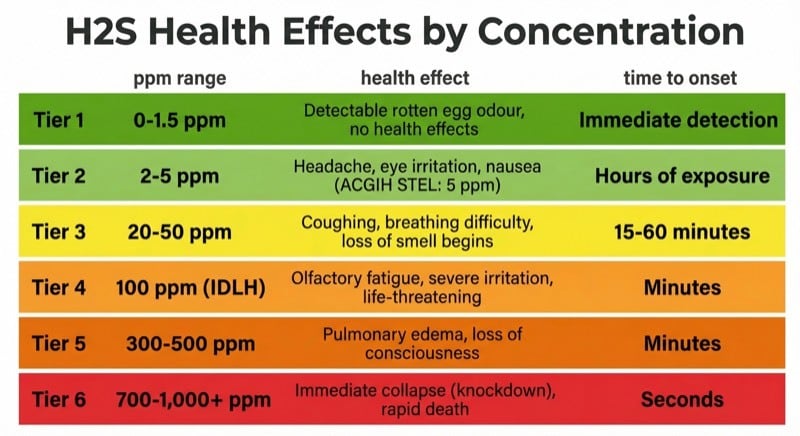
Understanding the health effects at each concentration level is critical for setting monitoring alarms, choosing respiratory protection, and training your crew on what to do when monitors go off. Here is what the science and Canadian regulatory agencies confirm:
| Concentration (ppm) | Health Effects | Time to Effect |
|---|---|---|
| 0.01 – 1.5 ppm | Detectable rotten egg odour. No health effects at normal exposure durations. | Immediate detection |
| 2 – 5 ppm | Prolonged exposure causes headache, eye irritation, nausea. ACGIH STEL is 5 ppm. | Hours of exposure |
| 20 – 50 ppm | Strong odour. Coughing, eye irritation, loss of smell begins. Breathing difficulty. | 15 – 60 minutes |
| 100 ppm (IDLH) | Olfactory fatigue (loss of smell). Severe eye and respiratory irritation. Life-threatening. | Minutes |
| 300 – 500 ppm | Pulmonary edema (fluid in lungs). Loss of consciousness. Life-threatening in minutes. | Minutes |
| 700 – 1,000+ ppm | Immediate collapse ("knockdown"). Rapid death. A single breath can be fatal. | Seconds |
The gap between "I smell something" and "I'm unconscious" is disturbingly small. At 100 ppm, a worker loses the ability to smell H2S. At 300 ppm, they may be unconscious within minutes. At 700 ppm, they may not take a second breath. This is why personal gas monitors are non-negotiable, not an optional upgrade.
If you run a crew in oil and gas in Western Canada, your workers will encounter H2S. Full stop. But sour gas operations are not the only risk. H2S shows up in more industries than most employers realize:
The common thread: anywhere organic material decomposes or petroleum products are processed, H2S is a potential hazard. If your crew works in any of these environments, you need a written H2S safety plan. Not a generic "be careful" instruction, but a documented plan that meets your provincial OHS requirements.
H2S is regulated at the provincial level in Canada, with a national standard providing the management framework. Here is what employers in Alberta and BC need to know. If you operate in both provinces, you follow the stricter limit.
Alberta's OHS Code addresses H2S through Part 4 (Chemical Hazards, Biological Hazards and Harmful Substances). The occupational exposure limit (OEL) for H2S is 10 ppm as an 8-hour time-weighted average (TWA) and 15 ppm as a 15-minute short-term exposure limit (STEL). Employers must:
For oil and gas specifically, Alberta references Energy Safety Canada's recommended practices. Most prime contractors on sour gas projects require the H2S Alive certification as a minimum entry requirement.
WorkSafeBC's OHS Regulation Part 5 (Chemical Agents and Biological Agents), s.5.48, adopts the American Conference of Governmental Industrial Hygienists (ACGIH) Threshold Limit Values. For H2S, this means the exposure limit is 1 ppm TWA and 5 ppm STEL, which is 10 times stricter than Alberta's limit for the same gas.
Employers in BC must conduct exposure assessments, implement controls following the hierarchy of controls, and ensure workers are not exposed above these limits. WorkSafeBC also requires employers to have emergency procedures for chemical releases.
CSA Z390-19, "Hydrogen Sulphide Occupational Health and Safety," is the national standard for H2S workplace management. It is not a regulation (it does not carry the force of law on its own), but it is widely referenced by provincial regulators and industry. It covers:
If you are building an H2S safety plan from scratch, CSA Z390-19 is the framework to follow. For employers pursuing COR certification, your H2S management plan feeds directly into the OHS management system requirements your auditor will assess.
Here is the detail that trips up multi-province contractors: Alberta allows workers to be exposed to H2S at up to 10 ppm over an 8-hour shift. BC's limit is 1 ppm. Same gas. Same health effects. Different rules. If your crew works projects in both provinces, your safety plan must meet the BC standard. You cannot maintain two different exposure protocols for the same gas.
Make H2S hazard awareness part of your daily routine.
Easily deploy digital toolbox talks and hazard IDs directly to your crew's phones. Start your 30-Day Free Trial to streamline field safety.
30-Day Free Trial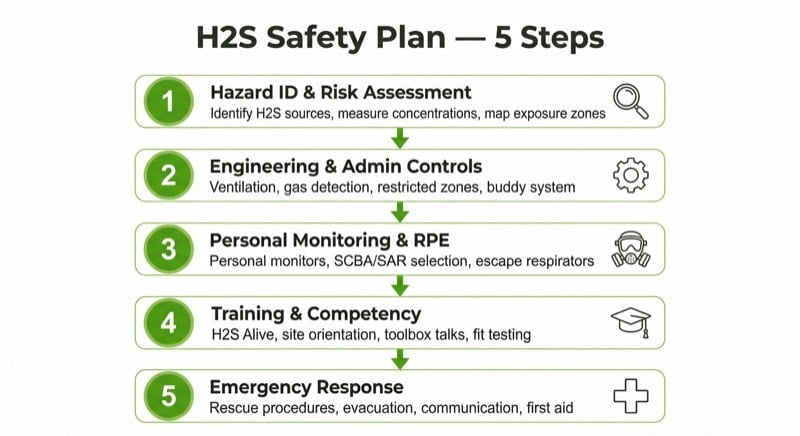
An H2S safety plan is not a binder that sits in the trailer. It is a working document that your crew references, your supervisors enforce, and your safety program auditor verifies. Here are the five core components, aligned with CSA Z390-19 and provincial OHS requirements:
Start by identifying every potential H2S source on your worksite. For oil and gas operations, this includes wellheads, flow lines, separators, tanks, and flare stacks. For other industries, map any process or location where organic decomposition or petroleum processing occurs. Document the expected concentration ranges and the conditions under which concentrations could spike (weather inversions, equipment failures, confined space entry).
Follow the hierarchy of controls. Ventilation comes first, including mechanical forced-air ventilation for confined spaces and natural ventilation planning for open sites. Install fixed gas detection systems at known risk points. Establish restricted access zones based on concentration levels. Implement a buddy system. Working alone in H2S environments is prohibited under Alberta codes of practice.
Every worker in a potential H2S exposure area needs a personal gas monitor, calibrated and bump-tested before each shift. Set low alarms at 5 ppm and high alarms at 10 ppm (or lower for BC operations). For respiratory protection, select equipment based on expected concentrations:
Your training matrix for H2S should include:
Your emergency response plan for H2S must cover:
Run tabletop exercises at least quarterly. A plan that has never been practised is just paper.
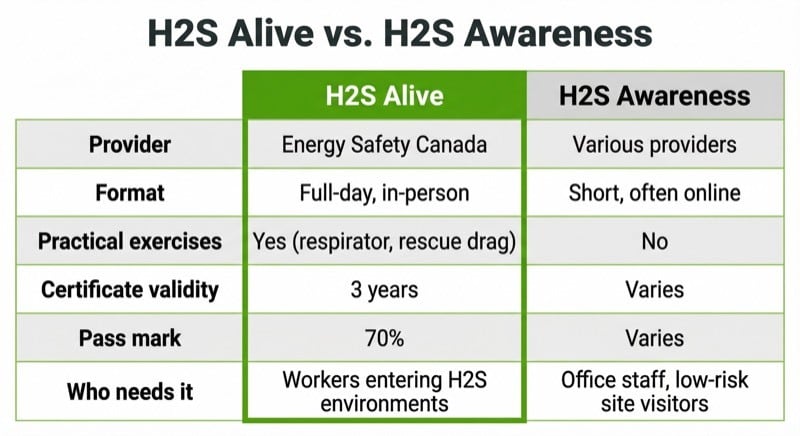
There are two main types of H2S training in Canada, and most employers confuse them. Getting this wrong can mean your worker shows up to site with the wrong ticket.
H2S Alive is the industry standard for workers who will enter H2S environments. It is a full-day, in-person course administered exclusively by Energy Safety Canada-approved instructors. It includes both theory and hands-on practical exercises, including respirator donning and rescue drag techniques. Participants must score a minimum of 70% on the examination to receive a certificate valid for 3 years.
Topics covered:
Most prime contractors in Alberta's oil and gas sector require H2S Alive as a site entry requirement. No ticket, no entry. If your crew works sour gas leases, turnarounds, or plant shutdowns, everyone needs this certification current.
H2S Awareness is a shorter, often online course that covers basic recognition of H2S hazards, health effects, and general safety precautions. It does not include hands-on respirator training or rescue exercises. It is suitable for:
H2S Awareness is not a substitute for H2S Alive. If a worker will be in an area where H2S concentrations could reach dangerous levels, they need the full certification.
Energy Safety Canada offers an H2S Blended Renewal course for workers recertifying their H2S Alive certificate. It includes an online theory component followed by an in-person practical session, reducing total classroom time. Check with your training provider for availability in your area.
The number one cause of multiple H2S fatalities is the second person rushing in to help without respiratory protection. One worker goes down. A co-worker runs over. Now there are two casualties. Then a third person tries to help. This chain reaction has killed entire crews.
If you suspect or detect an H2S release:
After any H2S exposure event, document the incident thoroughly. Use your incident report and investigation process to capture what happened, what controls failed, and what corrective actions are needed. If your crew doesn't have an H2S safety plan that covers all five components, Safety Evolution can analyse your records and identify the gaps before the next turnaround season.
Prove your workers are competent and protected.
Centralize your safety documentation and training records. Start your 30-Day Free Trial and ditch the paper binders.
30-Day Free TrialAt low concentrations (below 10 ppm), H2S smells like rotten eggs. Above 100 ppm, olfactory fatigue sets in and you lose the ability to smell it entirely. Never rely on smell as an H2S detection method; always use a calibrated personal gas monitor.
Yes. H2S is 1.19 times denser than air. It accumulates in low-lying areas, confined spaces, pits, and poorly ventilated enclosures. When monitoring for H2S, start measurements from ground level up, and be especially cautious in excavations, tanks, and basements.
The Energy Safety Canada H2S Alive certificate is valid for 3 years from the date of completion. An H2S Blended Renewal course is available for recertification, combining online theory with an in-person practical session.
At minimum, a calibrated personal H2S gas monitor is mandatory. Above 10 ppm, workers need a supplied air respirator (SAR) or self-contained breathing apparatus (SCBA). Above 100 ppm (IDLH), SCBA is mandatory and backup personnel must be present. All workers should also carry an escape-only respirator as a backup.
H2S Alive is a full-day, in-person course with practical exercises including respirator use and rescue techniques. It is required for workers entering H2S environments. H2S Awareness is a shorter, often online course covering basic hazard recognition. It is suitable for office staff or workers in low-risk areas but is not a substitute for H2S Alive in active H2S environments.
At concentrations above 700 ppm, H2S causes immediate collapse, which the industry calls "knockdown." At 1,000 ppm or higher, a single breath can be fatal. Even lower concentrations (100 to 500 ppm) can cause death within minutes to hours depending on exposure duration.
Get Weekly Safety Insights
Regulation updates, toolbox talk ideas, and compliance tips. One email per week.
H2S Alive costs $150-$250, takes one day, and lasts 3 years. Here's what to expect, who needs it, and how to choose a provider.
H2S kills in seconds at high concentrations. Learn Canadian exposure limits, employer duties, and how to build an H2S safety plan.
Learn how to respond to an H2S leak at work. Step-by-step emergency procedures, evacuation rules, and rescue protocols for Canadian workplaces.