H2S gas monitors save lives. Learn which types Canadian workplaces need, what features matter, calibration rules, and how to choose the right detector.
Your crew is heading into a confined space at a sour gas facility outside Red Deer. The foreman clips on his personal gas monitor, does a quick bump test, and watches the screen flash green. Thirty seconds later, that little device is the only thing standing between a normal shift and a body bag. If your H2S monitor fails, nobody gets a second chance.
We help contractors across Alberta and BC build safety programs that keep workers alive in H2S environments. Gas detection is one of the most critical pieces of that puzzle, and we see the same mistakes repeated: wrong monitor for the job, calibration months overdue, workers who don't know what their alarm set points mean. This guide covers what you actually need to know about choosing, maintaining, and deploying H2S gas monitors in Canadian workplaces.
⚡ Quick Answer
What: An H2S monitor is an electronic device that detects hydrogen sulfide gas concentrations in air and alerts workers when levels become dangerous
Types: Portable personal monitors (clip-on), portable multi-gas detectors, and fixed area monitoring systems
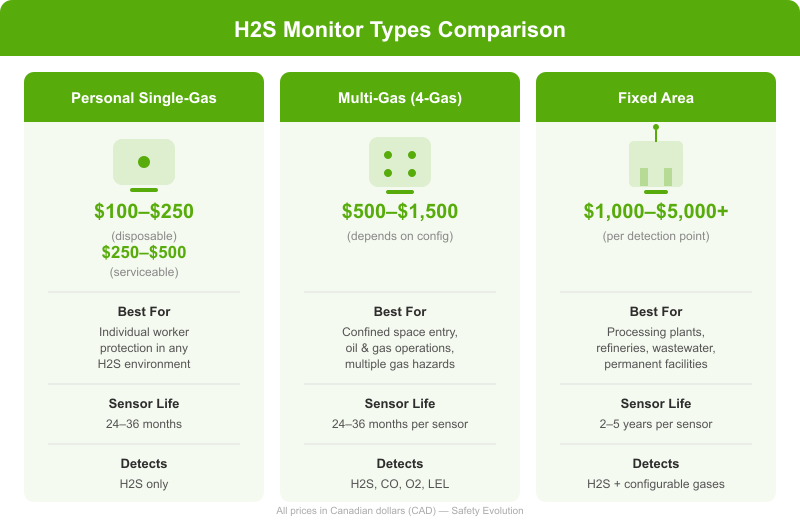
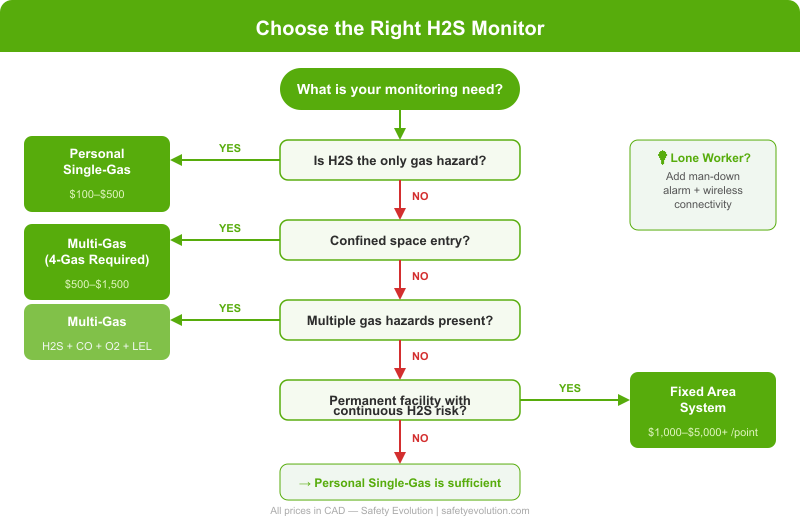
Cost: Disposable single-gas: $100–$250. Serviceable single-gas: $250–$500. Multi-gas (4-gas): $500–$1,500. Fixed systems: $1,000–$5,000+ per detection point
When required: Any workplace where workers may be exposed to H2S, including oil and gas, wastewater, confined spaces, and pulp and paper operations
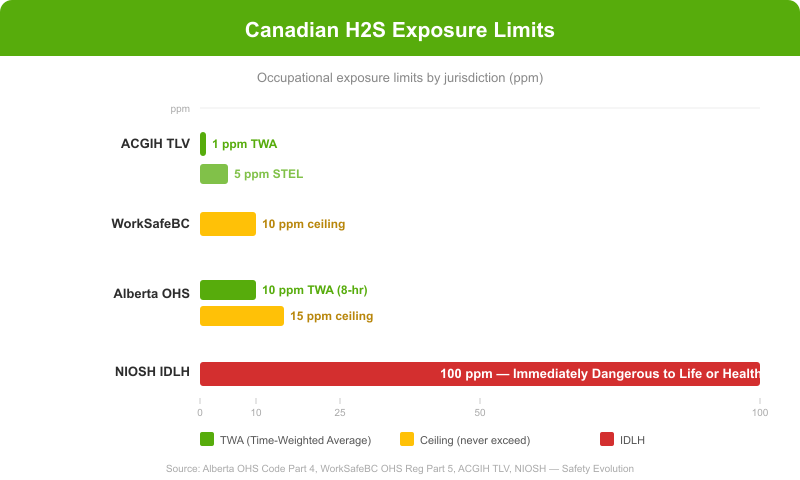
Key rule: Alberta OHS Code sets the occupational exposure limit at 10 ppm (8-hour TWA) with a 15 ppm ceiling. BC’s ceiling is 10 ppm. Your monitors must be set to alarm below these thresholds.
What Is an H2S Gas Monitor and Why Does It Matter?
An H2S gas monitor (also called an H2S detector or hydrogen sulfide sensor) is an electronic device that continuously measures the concentration of hydrogen sulfide gas in the surrounding air and warns the wearer through audible, visual, and vibration alarms when levels exceed safe thresholds.
Why can't you just rely on your nose? Hydrogen sulfide smells like rotten eggs at low concentrations, and some people assume that smell is a reliable warning. It isn't. At concentrations above 100 ppm, H2S causes olfactory fatigue: your sense of smell shuts down completely within 2 to 15 minutes. By the time you stop smelling it, you're already in the danger zone. At 700 to 1,000 ppm, rapid unconsciousness can occur within 1-2 breaths. Workers have died because they walked into a space, smelled nothing, and assumed it was safe.
An H2S monitor doesn't get tired, doesn't lose its sense of smell, and doesn't make assumptions. It gives you a number, and that number tells you whether to keep working, increase ventilation, or evacuate immediately.
If your crew works in oil and gas, wastewater treatment, confined spaces, pulp and paper, or any environment where organic matter decomposes, Safety Evolution can check your gas detection records and flag where your program has gaps in hazard coverage, calibration, or training.
What Types of H2S Monitors Are Available?
H2S gas monitors fall into three main categories, and each serves a different purpose. Using the wrong type for the job is a compliance gap and a safety risk.
Portable Personal H2S Monitors (Single-Gas)
These are small, clip-on devices worn on the worker's collar, chest, or hard hat brim, positioned in the breathing zone. They run continuously during the shift, monitoring the air immediately around the worker and triggering LED, audible, and vibration alarms if H2S levels spike.
Two sub-types exist:
Disposable (maintenance-free): Sealed units with a fixed lifespan, typically 2 to 3 years. No sensor changes, no battery replacements. When the unit expires, you replace the entire device. Examples: Honeywell BW Clip, GasClip Technologies Single Gas Clip, Dräger Pac 6000. Cost: roughly $100 to $250 per unit.
Serviceable: Reusable monitors with replaceable sensors and rechargeable batteries. Higher upfront cost ($250 to $500) but lower long-term cost per year of use if you maintain them properly. Examples: Dräger Pac 6500, MSA ALTAIR 2X, Industrial Scientific Tango TX1.
Best for: Individual worker protection in any H2S environment. Required for confined space entry. Most common type used across Canadian oil and gas, construction, and utilities.
Portable Multi-Gas Monitors (4-Gas or 5-Gas)
These detect H2S alongside other common hazards: carbon monoxide (CO), oxygen depletion (O2), and combustible gases (LEL). Some models add a fifth sensor for volatile organic compounds (VOCs) or sulfur dioxide (SO2).
Cost: $500 to $1,500 depending on sensor configuration and features (wireless connectivity, data logging, man-down alarm).
Best for: Confined space entry (most provincial regulations require 4-gas monitoring before entry), oil and gas operations where multiple gas hazards coexist, and any site where the hazard assessment identifies more than just H2S.
Fixed Area H2S Detection Systems
Wall-mounted or pole-mounted transmitters installed permanently at facilities. They feed continuous readings to a central controller or building management system, triggering facility-wide alarms, ventilation systems, or automatic shutdowns when H2S reaches set thresholds.
Common manufacturers: Dräger (Polytron 8000 series), Honeywell Analytics (Sensepoint XRL), MSA (ULTIMA X5000), RKI Instruments (M2A series), Teledyne Gas and Flame Detection.
Cost: $1,000 to $5,000+ per detection point, plus installation, wiring, controller hardware, and ongoing calibration. A multi-point system for a processing facility can run $20,000 to $100,000+ depending on coverage area.
Best for: Processing plants, refineries, compressor stations, wastewater treatment facilities, and any permanent installation where H2S is a known, continuous risk. Fixed systems must meet CSA certification requirements for the hazard classification of the installation location.
What Features Should You Look for in an H2S Monitor?
Not every H2S monitor is the same. Here are the features that actually matter when choosing equipment for Canadian workplaces:
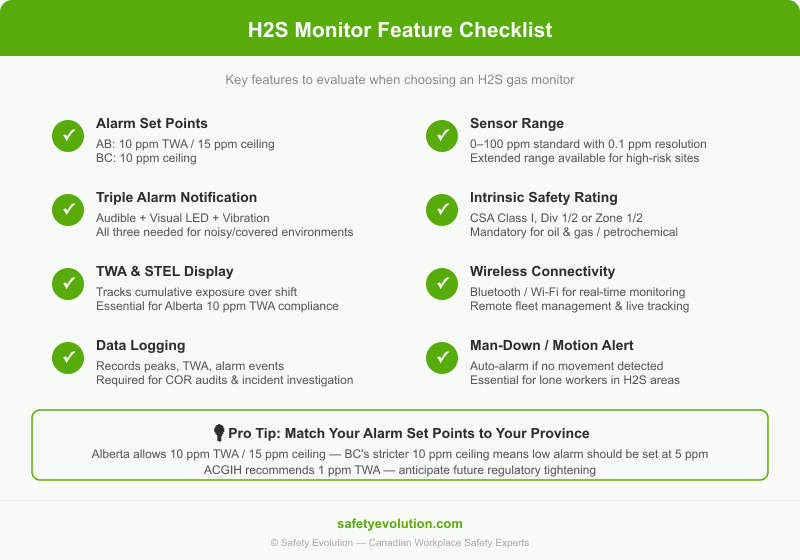
Alarm set points: Most monitors ship with factory defaults of 10 ppm (low alarm) and 15 ppm (high alarm), matching Alberta's OEL and ceiling. Verify these match your provincial requirements. BC's ceiling limit is 10 ppm, which means your low alarm should be set even lower (typically 5 ppm) to give workers time to react.
Triple alarm notification: Audible, visual (LED), and vibration. All three matter. A loud alarm isn't enough in a noisy plant. A flashing light isn't enough if the monitor is under a coverall. Vibration alerts catch what the other two miss.
TWA and STEL display: Monitors that show time-weighted average and short-term exposure limit readings help supervisors track cumulative exposure, not just peak spikes. This matters for compliance with Alberta's 10 ppm TWA limit.
Data logging: Records exposure events, peak readings, TWA values, and alarm events with timestamps. Critical for incident investigation, compliance audits, and COR documentation.
Sensor range: Most personal monitors cover 0 to 100 ppm with 0.1 ppm resolution. For environments where concentrations could exceed 100 ppm, you need extended-range sensors or different detection technology.
Intrinsic safety rating: For use in hazardous locations (oil and gas, petrochemical), the monitor must carry an intrinsic safety certification (CSA Class I, Division 1 or 2, or Zone 1 or 2) appropriate for the hazard classification of the area.
Wireless/connected features: Newer models offer Bluetooth or Wi-Fi connectivity for real-time monitoring by supervisors. Honeywell's Safety Suite and Industrial Scientific's iNet system allow remote fleet management, automatic bump test tracking, and live location monitoring.
Man-down/motion alert: If the monitor detects no movement for a set period, it triggers an alarm. Essential for lone workers in confined spaces or remote H2S environments.
Battery life: Disposable units run continuously for their full lifespan (2-3 years). Rechargeable units typically offer 12 to 24 hours per charge. For extended shifts or remote deployments, battery life is a real operational constraint.
When Are H2S Monitors Required in Canada?
Most contractors think they only need H2S monitors for oil and gas work. They're wrong. Any workplace where hydrogen sulfide may be present requires air monitoring, and the sources of H2S extend well beyond sour gas wells.
H2S is produced wherever organic matter decomposes in low-oxygen conditions: sewage systems, wastewater treatment plants, landfills, agriculture (manure pits), pulp and paper mills, and mining operations. It also occurs naturally in volcanic and geothermal areas.
Alberta Requirements
Alberta's OHS Code, Part 4 (Chemical Hazards, Biological Hazards, and Harmful Substances) requires employers to assess worker exposure to chemical hazards, including H2S. The occupational exposure limit is 10 ppm as an 8-hour time-weighted average (TWA) with a ceiling of 15 ppm that must never be exceeded.
If a hazard assessment identifies potential H2S exposure, the employer must implement controls following the hierarchy: elimination, engineering controls, administrative controls, and PPE (including gas monitoring). Air monitoring is required to verify that controls are working and exposure stays below the OEL.
For confined space entry, Alberta OHS Code Part 5 requires atmospheric testing before entry, including H2S detection, and continuous monitoring while workers are inside.
British Columbia Requirements
WorkSafeBC's OHS Regulation, Part 5 (Chemical Agents and Biological Agents), Section 5.48 sets a ceiling limit of 10 ppm for H2S. This is stricter than Alberta's 8-hour TWA. In BC, a worker's exposure must never exceed 10 ppm at any time.
WorkSafeBC also requires an exposure control plan for any workplace with a risk of H2S exposure. This plan must include air monitoring procedures, and personal or area monitors are typically part of that plan.
Energy Safety Canada Guidance
Energy Safety Canada's H2S monitoring guidance sheet specifies that monitors must be checked at least quarterly by a qualified person, or more frequently if recommended by the manufacturer. For sour gas operations, daily bump testing before use is standard practice. Any site where H2S is a known hazard should have a comprehensive H2S safety plan that includes gas detection protocols.
How Do H2S Gas Sensors Work?
Understanding the sensor technology helps you make better purchasing decisions and explains why calibration matters.
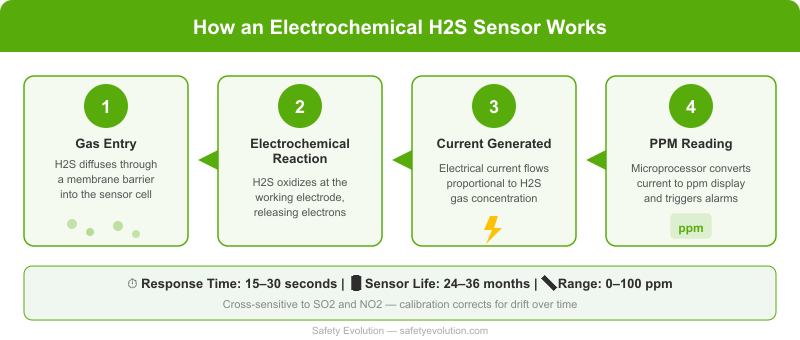
The vast majority of portable H2S monitors use electrochemical sensors. These contain a working electrode, a counter electrode, and an electrolyte solution. Because H2S is both toxic and flammable (explosive range of 4.3% to 46% in air), monitoring serves a dual safety purpose. When H2S gas reaches the sensor through a diffusion barrier, it triggers an electrochemical reaction at the working electrode. This reaction generates a tiny electrical current proportional to the gas concentration. The monitor's microprocessor converts that current into a parts-per-million (ppm) reading.
Pros: Small, fast response time (typically 15 to 30 seconds), relatively inexpensive, accurate at low concentrations, and immediate power-on (no warm-up period).
Cons: Limited sensor lifespan (24 to 36 months regardless of use), sensitivity drift over time (which is why calibration is required), cross-sensitivity to other gases (SO2, NO2), and performance is affected by temperature and humidity extremes.
Fixed-area systems may use electrochemical sensors, infrared, or open-path laser technology. Open-path laser H2S detectors (such as Teledyne's GD1) can monitor large areas without recalibration and have much longer service lives, but they cost significantly more.
Is your crew’s H2S equipment actually compliant?
Stop tracking bump tests and calibrations on messy spreadsheets. Start your 30-Day Free Trial to automate your equipment logs.
What Are the Calibration and Bump Test Requirements?
Here's the blunt truth about calibration: if your monitors aren't calibrated on schedule, they're expensive paperweights. A monitor that reads 0 ppm when the actual concentration is 15 ppm isn't protecting anyone. It's giving your worker false confidence in a lethal environment.
Bump Testing
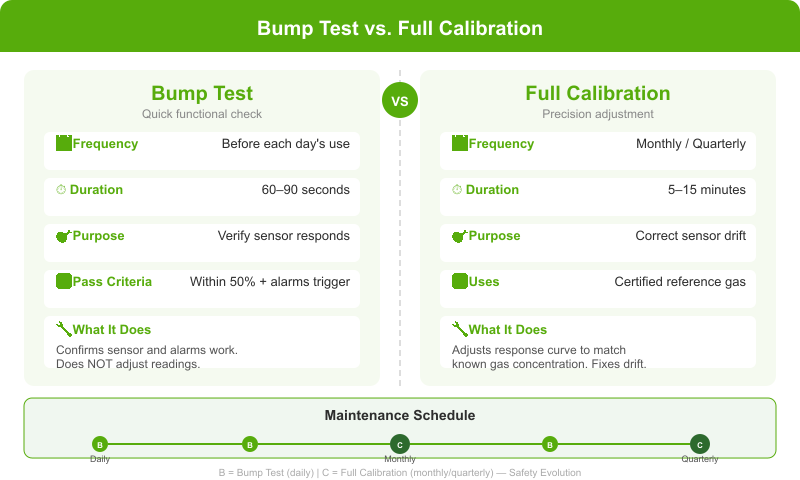
A bump test is a quick functional check. You expose the monitor to a known concentration of H2S gas (typically 25 ppm from a calibration gas cylinder) and verify that the sensor responds and the alarms activate. If the monitor reads within 50% of the applied gas concentration and the alarms trigger, it passes.
Frequency: Before each day's use. This is the standard recommended by most manufacturers, supported by ISGC (International Society of Gas Detection) guidelines, and consistent with Energy Safety Canada practices. Some Alberta operators have moved to before-each-shift bump testing, especially at sour gas sites.
A bump test takes 60 to 90 seconds. There is no legitimate reason to skip it.
Full Calibration
A full calibration adjusts the sensor reading to match a certified reference gas concentration. You expose the sensor to a known concentration and the monitor adjusts its response curve to read accurately.
Frequency: At minimum, quarterly (every 90 days) per Energy Safety Canada guidance. Many manufacturers recommend monthly calibration for H2S sensors. Industrial Scientific recommends monthly. If a monitor fails a bump test, full calibration is required immediately.
Best practice: Calibrate after any of these events: failed bump test, sensor replacement, firmware update, the monitor has been dropped or subjected to shock, exposure to very high gas concentrations, return from storage longer than 30 days, or after any maintenance.
Record Keeping
Document every bump test and calibration with date, technician name, gas lot number, concentration used, pass/fail result, and instrument serial number. This documentation is required for COR audits and can be critical during incident investigations. Modern digital safety management systems can automate this tracking.
How Much Do H2S Monitors Cost?
Cost is the question every contractor asks first. Here are realistic price ranges for equipment available in Canada as of 2026. These are estimates based on typical distributor pricing; your actual cost depends on volume, vendor, and configuration.
Monitor Type
Typical Cost Range (CAD)
Replacement Cycle
Disposable single-gas H2S
$100–$250
Every 2–3 years (entire unit)
Serviceable single-gas H2S
$250–$500
Sensor every 2–3 years ($50–$150)
Multi-gas (4-gas) portable
$500–$1,500
Sensors every 2–3 years ($150–$400)
Fixed area detector (per point)
$1,000–$5,000+
Sensor every 2–5 years; controller: 10+ years
Bump test gas cylinder (4-gas mix)
$50–$150
Per cylinder (varies by test frequency)
Automated calibration dock
$2,000–$6,000
Ongoing (gas cylinders, annual service)
Hidden costs to budget for: calibration gas cylinders ($50 to $150 each, consumed regularly), regulator and tubing kits ($50 to $100), sensor replacements on serviceable units, calibration labour time, and record-keeping systems. A fleet of 20 disposable single-gas monitors costs roughly $3,000 to $5,000 to equip and runs about $1,500 to $2,500 per year in replacements.
Don't cheap out on gas detection. The cost of a monitor is nothing compared to the cost of a workplace fatality, a stop-work order, or losing your COR because your gas detection records don't exist. Safety Evolution can analyse your gas detection program and show you where you need better equipment and where your current setup is sufficient.
How Should You Maintain Your H2S Monitors?
Buying the right monitor is step one. Keeping it functional is where most programs fall apart. Here's a maintenance framework that actually works:
Daily (before each shift): Visual inspection for damage. Bump test. Verify alarm set points are correct. Check battery level. Clean the sensor inlet if dirty (compressed air, never liquids on the sensor).
Monthly: Full calibration (or per manufacturer schedule). Review data logs for anomalies. Check sensor expiry dates. Inspect charging contacts and docks.
Quarterly: Full calibration if not done monthly. Review fleet status (how many units approaching end-of-life). Replace any expired or failing sensors. Update firmware if available.
Annually: Comprehensive fleet audit. Replace disposable units approaching expiry. Review alarm set points against current provincial OELs. Update your gas detection program documentation. Verify that toolbox talks cover proper monitor use.
Common maintenance mistakes we see:
Storing monitors in a truck toolbox in -30°C Alberta winters. Electrochemical sensors can be permanently damaged by extreme cold.
Never replacing calibration gas cylinders because "we still have gas left." Calibration gas has an expiry date. Expired gas gives you a false calibration.
Bump testing in a running vehicle with the window down. CO from exhaust throws off the test.
Clipping the monitor to a belt instead of the breathing zone. H2S is heavier than air (specific gravity 1.19). A monitor on your belt detects gas before it reaches your lungs, but the readings won't match what you're actually breathing.
What Canadian Standards Apply to H2S Gas Detection?
Gas detection equipment used in Canadian workplaces must comply with applicable standards. Here are the key ones:
CSA C22.2 No. 152-M1984: Construction and performance requirements for combustible gas detection instruments. Applies to devices measuring combustible gas concentrations.
Provincial OHS frameworks: Alberta OHS Code Part 4 and WorkSafeBC OHS Regulation Part 5 set enforceable exposure limits and monitoring requirements for H2S. Energy Safety Canada provides additional industry guidance for upstream oil and gas operations. The ANSI/ASSP Z390.1 standard is a supplementary best practice for H2S safety management but is not a Canadian regulation.
CSA electrical certification: Fixed gas detectors installed in hazardous locations must carry CSA certification appropriate for the zone or division classification. Zone 1 certification covers both Zone 1 and Zone 2 installations. Zone 2 certification is limited to Zone 2 only.
Alberta OHS Code, Part 4: Sets occupational exposure limits (Schedule 1) and requires employers to monitor worker exposure to chemical hazards.
WorkSafeBC OHS Regulation, Part 5: Sets exposure limits and requires exposure control plans for H2S.
ACGIH TLV guidelines: The American Conference of Governmental Industrial Hygienists sets the TLV at 1 ppm (TWA) and 5 ppm (STEL) for H2S. While not law in Canada, some jurisdictions reference ACGIH values, and they represent the direction exposure limits are trending. Alberta currently uses the higher 10 ppm limit, but the ACGIH recommendation of 1 ppm signals that stricter limits may come.
How Do You Choose the Right H2S Monitor for Your Operation?
Stop buying monitors because a supplier had a good price. Start with your hazard assessment. The right monitor depends on the job, not the brand.
Ask these questions:
Is H2S the only gas hazard, or are there others? If multiple gases are present (CO, O2 depletion, combustibles), a multi-gas monitor is the right call. If H2S is the sole concern, a single-gas unit works and costs less.
Personal protection or area monitoring? Workers moving through an area need personal monitors. A fixed facility with continuous H2S risk needs area monitors. Most operations need both.
How many workers need monitors? For large crews, disposable units are simpler to manage. For smaller crews with a dedicated safety person, serviceable units have lower long-term cost.
Confined space entry? Most provincial regulations require 4-gas monitoring for confined space entry. A single-gas H2S monitor alone won't satisfy that requirement. You need at minimum H2S, CO, O2, and LEL.
Lone worker situations? If workers operate alone in H2S environments, look for monitors with man-down alarms and wireless connectivity for remote monitoring.
Operating environment? Extreme cold (common in Alberta), extreme heat, high humidity, or explosive atmospheres all affect which monitors and certifications you need.
Building a gas detection program isn't just about buying monitors. It includes developing an H2S safety plan, training workers (H2S Alive for field staff), establishing bump test and calibration procedures, setting alarm points to match provincial requirements, and documenting everything for audits. Safety Evolution helps employers build these programs from scratch. Our safety services team handles everything from hazard assessments to equipment selection to worker training.
Never miss an H2S Alive certificate expiry again.
Safety Evolution alerts you before worker certs expire. Start your 30-Day Free Trial and protect your crew.
Bump test your H2S monitor before each day's use. This is recommended by most manufacturers and is consistent with Energy Safety Canada guidance for sour gas operations. A bump test takes 60 to 90 seconds and verifies that the sensor responds to gas and the alarms activate. If the monitor fails a bump test, perform a full calibration before using it.
What is the H2S exposure limit in Alberta?
Alberta's OHS Code sets the occupational exposure limit for H2S at 10 ppm as an 8-hour time-weighted average (TWA), with a ceiling of 15 ppm that must never be exceeded during the shift. Your H2S monitor alarm set points should be configured below these thresholds to give workers time to respond before limits are reached.
What is the difference between a bump test and a full calibration?
A bump test is a quick functional check that verifies the sensor responds to gas and the alarms trigger. It takes about 60 to 90 seconds and is done before each use. A full calibration adjusts the sensor's reading to match a certified reference gas concentration, correcting for drift over time. Full calibration is typically done monthly or quarterly, and whenever a monitor fails a bump test.
Can you use a single-gas H2S monitor for confined space entry?
In most Canadian jurisdictions, a single-gas H2S monitor alone does not satisfy confined space entry requirements. Alberta and BC regulations require atmospheric testing for multiple hazards before and during confined space entry, typically H2S, carbon monoxide (CO), oxygen levels (O2), and combustible gas (LEL). You need a multi-gas (4-gas) monitor for confined space work, though workers may also carry a personal H2S-only monitor as an additional layer of protection.
How long do H2S sensors last?
Electrochemical H2S sensors typically last 24 to 36 months, regardless of how often they are used. The sensor degrades over time due to the electrolyte drying out. Disposable monitors have a fixed lifespan matching the sensor life (2 to 3 years). On serviceable monitors, you replace just the sensor when it expires. Always check the manufacturer's stated sensor life and replace before expiry.
Do employers need to provide H2S training along with monitors?
Yes. Providing monitors without training is a compliance gap and a safety risk. Workers must understand what their alarm set points mean, how to respond when alarms activate, and basic monitor care. For workers in sour gas or high-risk H2S environments, H2S Alive certification through Energy Safety Canada is the standard. H2S Alive is a full-day course covering H2S properties, respiratory equipment, detection, and rescue techniques, valid for 3 years. Monitor-specific training on bump testing and daily checks should also be included in your safety program. See our complete employer guide to H2S safety for training requirements by province.
Get Weekly Safety Insights
Regulation updates, toolbox talk ideas, and compliance tips. One email per week.