Last updated: March 2026
You just got hired for a pipeline shutdown in northern Alberta. Your first day is Monday. Then the safety coordinator calls: "Do you have your H2S Alive?" You don't. Now you're scrambling to find a course before the weekend, hoping there's a seat open somewhere within driving distance.
That scenario plays out across Canada every week. Safety Evolution works with contractors who've lost workers to project delays, missed bids, and last-minute training scrambles, all because nobody tracked when the H2S tickets expired. This guide covers everything you need to know about H2S Alive: what the course includes, who needs it, what it costs, and how to keep your certification current so you never get that phone call.
Quick Answer: H2S Alive Training
- What: The industry-standard hydrogen sulfide safety course, developed and administered by Energy Safety Canada
- Duration: Full day (approximately 8 hours)
- Cost: Typically $150 to $250, depending on provider and location
- Certificate: Valid for 3 years
- Who needs it: Anyone working in or around environments where H2S may be present, especially oil and gas, construction, utilities, and wastewater
- Passing grade: 70% on the written exam, plus successful completion of hands-on skills
What Is H2S Alive?
H2S Alive is an 8-hour safety training course developed by Energy Safety Canada that teaches workers how to protect themselves in environments where hydrogen sulfide (H2S) gas may be present. It is the recognized standard for H2S safety training across Canada's oil and gas industry and is increasingly required in construction, utilities, mining, and wastewater treatment.
The course covers both theory and practical skills. You won't just sit in a classroom watching slides. You'll put on a self-contained breathing apparatus (SCBA), practice rescue drags on a mannequin, and learn how to use gas detection equipment. The hands-on component is what separates H2S Alive from basic awareness courses, and it's the reason employers and general contractors trust this specific certification.
Energy Safety Canada (formerly known as Enform) is the governing body that develops the course content, sets the standards, and authorizes training providers across the country. Only courses delivered by authorized training providers (ATPs) result in a valid Energy Safety Canada H2S Alive certificate.
If you're unfamiliar with the gas itself, including its health effects at different exposure levels and how it behaves on a work site, read our complete guide to H2S gas safety for employers.
Who Needs H2S Alive Training?
Here's the blunt truth: if there's any chance you'll encounter H2S on a job site, most employers and GCs won't let you past the gate without this ticket.
H2S Alive is required or strongly recommended for workers in:
- Oil and gas (drilling, production, pipeline, processing, turnarounds): this is where H2S Alive originated, and it's a non-negotiable requirement on virtually every sour gas site in Alberta and BC
- Construction (especially near oil and gas facilities, refineries, or wastewater infrastructure): GCs bidding on these projects require all subcontractor workers to hold current H2S Alive
- Utilities and wastewater (sewer systems, treatment plants, pumping stations): H2S is a byproduct of organic decomposition and is commonly found in confined spaces in these environments
- Mining (underground operations, mineral processing): H2S can occur naturally in underground environments
- Agriculture (manure pits, composting facilities): less common but real, particularly in confined space scenarios
- Pulp and paper (kraft process mills): H2S is a byproduct of the kraft pulping process
Even if your provincial legislation doesn't specifically name "H2S Alive" as a requirement, Alberta's OHS Code (Part 4) and WorkSafeBC's OHS Regulation (Part 5) both require employers to ensure workers exposed to chemical hazards, including H2S, receive adequate training. H2S Alive is the industry-accepted way to meet that obligation.
For employers: your responsibility goes beyond just sending workers to a course. You need a complete safety program that includes hazard assessment, exposure control plans, air monitoring, respiratory protection programs, emergency response procedures, and training records. If you're building out your onboarding process for new hires entering H2S environments, our orientation and onboarding package can help you structure that first-day safety briefing. The training is one piece of a larger system.
What Does the H2S Alive Course Cover?
Most contractors think H2S training is just "learn the symptoms, put on a mask." They're wrong. The course is a full day because the situations where you need this knowledge are the situations where you have seconds to make the right call, not minutes.
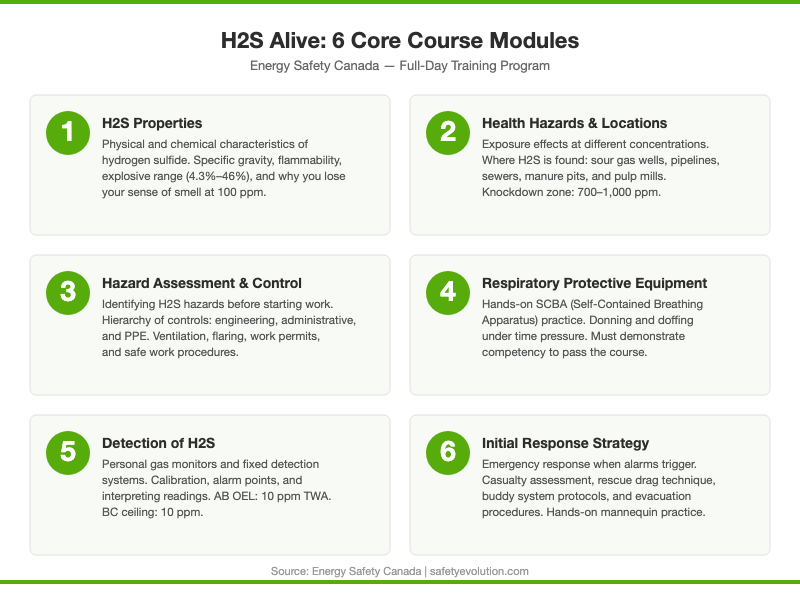
Energy Safety Canada's H2S Alive course covers six core modules:
1. H2S Properties
You'll learn the physical and chemical characteristics that make H2S so dangerous. It's colourless. It's heavier than air (specific gravity of 1.19), which means it pools in low spots, ditches, cellars, and confined spaces. It's flammable and explosive at concentrations between 4.3% and 46% in air. And here's the detail that catches people off guard: you can smell it at low concentrations (that rotten egg smell), but at 100 ppm your sense of smell shuts down completely. The gas doesn't go away. Your ability to detect it does.
2. Health Hazards and Locations
This module walks through exposure effects at different concentrations. At 2 to 5 ppm, you'll get headaches and nausea from prolonged exposure. At 100 ppm, you lose your sense of smell within minutes. At 700 to 1,000 ppm, you collapse within one or two breaths. This is the "knockdown" zone that kills workers every year in Canada. The course covers where H2S is found, from sour gas wells and pipeline operations to sewers, manure pits, and pulp mills.
3. Hazard Assessment and Control
You'll learn how to identify H2S hazards before starting work and the hierarchy of controls: engineering controls (ventilation, flaring), administrative controls (work permits, safe work procedures), and personal protective equipment as the last line of defence.
4. Respiratory Protective Equipment
This is where it gets physical. You'll practice donning and doffing a self-contained breathing apparatus (SCBA) under time pressure. You'll put on a mask and breathe under air. You need to demonstrate that you can physically do this; it's not optional. If you can't put on and operate an SCBA, you cannot pass the course.
5. Detection of H2S
You'll learn to use personal gas monitors and fixed detection systems, including how to calibrate equipment, set alarm points, and interpret readings. In Alberta, the occupational exposure limit is 10 ppm as an 8-hour time-weighted average with a 15 ppm ceiling. In BC, the ceiling limit is 10 ppm. Knowing these numbers matters because your gas monitor should be set to alarm well before you hit them.
6. Initial Response Strategy
When the alarm goes off, you need to act immediately. This module covers casualty assessment, rescue techniques (including the rescue drag), buddy system protocols, and evacuation procedures. You'll physically practice the rescue drag on a mannequin. This is the module that separates workers who freeze from workers who save lives.
How Much Does H2S Alive Cost?
H2S Alive course fees typically range from $150 to $250 across Canada, depending on the training provider, location, and whether you're taking the initial course or a renewal.
Here's what the pricing landscape looks like:
- Major cities (Calgary, Edmonton): $150 to $200 range, more competition keeps prices lower
- Smaller centres and remote locations: $175 to $250, fewer providers means less price pressure
- Vancouver Island and BC: $200 to $250, typical for the region
Most providers include the Energy Safety Canada certificate fee in the course price, but ask before you register. Some list it separately. There are no hidden fees from Energy Safety Canada itself; the cost is between you and the authorized training provider.
For employers sending crews: if you have 10 or more workers who need H2S Alive, many ATPs offer on-site group courses at your facility. This often works out cheaper per person and eliminates travel time. Contact providers in your area for group pricing.
How Do You Renew Your H2S Alive Certificate?
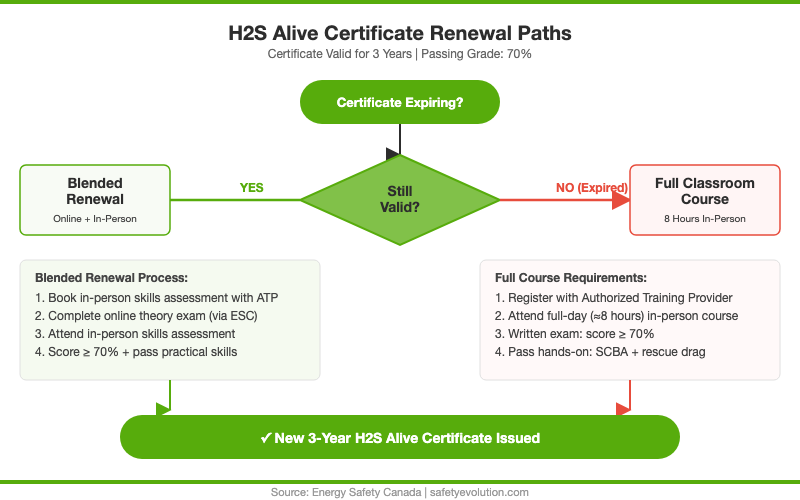
Your H2S Alive certificate is valid for 3 years from the date of successful completion. When it's time to renew, you have two options:
Option 1: Full Classroom Course (always available)
Retake the standard 8-hour H2S Alive course through any authorized training provider. This is the straightforward option and works whether your certificate is current or expired.
Option 2: H2S Alive Blended Renewal (for current, non-expired certificates)
Energy Safety Canada offers a blended renewal path that combines an online theory exam with an in-person skills assessment. Here's the process:
- Contact an Authorized Training Provider to confirm they offer the in-person skills assessment and book your date (assessment fees apply separately)
- Register through Energy Safety Canada for the online theory course
- Complete the online portion before your in-person assessment date (you have 90 days from registration)
- Attend the in-person skills assessment: demonstrate SCBA use, rescue drag, and other practical competencies
- Score 70% or higher on the online exam and pass the skills assessment
If you fail either component, you'll need to register for the full classroom course. Registration fees from the blended renewal are not transferable.
Important: the blended renewal is only available if your certificate has not expired. If you let it lapse, the full classroom course is your only option. This is one of the most common headaches we see with contractors: someone's cert expires on a Tuesday, they planned to renew on Thursday, and now they need a full day instead of a half-day assessment. Track your expiry dates.
Some employers and GC site requirements mandate annual refreshers even though the certificate is valid for 3 years. Check your specific project or employer requirements before assuming the 3-year cycle is all you need.
Are your workers' H2S tickets valid today?
Stop chasing paper certificates. Store every ticket digitally and track expirations automatically. Start your 30-Day Free Trial.
30-Day Free Trial
H2S Alive vs H2S Awareness: Which Do You Need?
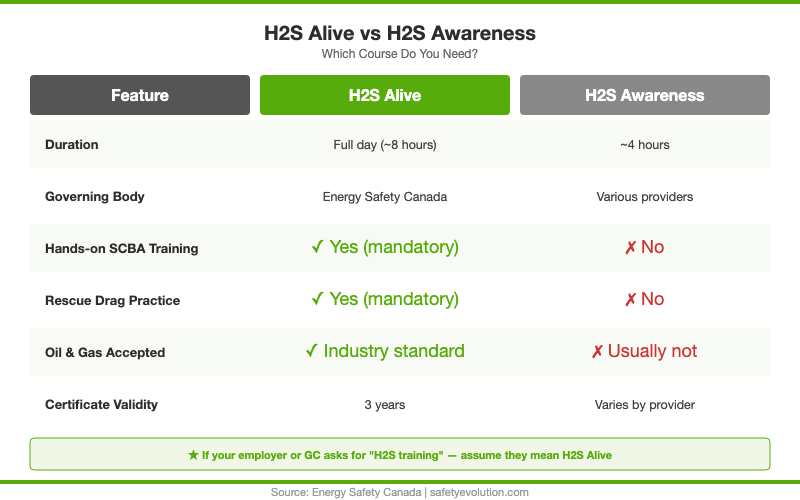
This is one of the most common questions in H2S training, and getting the answer wrong can cost you a job.
| Feature |
H2S Alive |
H2S Awareness |
| Duration |
Full day (~8 hours) |
Typically 4 hours |
| Governing body |
Energy Safety Canada |
Various providers |
| Hands-on SCBA/rescue |
Yes (mandatory) |
No (classroom/online only) |
| Accepted in oil and gas |
Yes (industry standard) |
Usually not |
| Certificate validity |
3 years |
Varies by provider |
| Best for |
Workers in H2S environments |
Support staff, low-risk exposure |
The short version: if you work in oil and gas, on sour gas sites, or in any environment where direct H2S exposure is possible, you need H2S Alive. H2S Awareness is appropriate for office staff, visitors, or workers in industries where H2S exposure is unlikely but possible.
If a GC or employer asks for "H2S training" without specifying which type, assume they mean H2S Alive. Showing up with an awareness certificate when they expected H2S Alive means you're not working that day.
How to Choose an H2S Alive Training Provider
Not all training experiences are equal, even though the certificate is the same. Here's what to look for:
- Verify they're an Energy Safety Canada Authorized Training Provider. This is non-negotiable. If they're not authorized, the certificate isn't valid. You can verify providers through Energy Safety Canada's website or by calling 1-800-667-5557.
- Check the instructor's background. The best instructors have field experience in oil and gas or emergency response. Ask if the instructor has worked in H2S environments. There's a difference between someone teaching from a manual and someone who's responded to a real H2S release.
- Look at the facility and equipment. You need to practice on real SCBA equipment and do rescue drags. The training facility should have adequate space and properly maintained equipment. Cramped classrooms with outdated gear create a poor learning experience.
- Consider scheduling flexibility. Some providers run courses weekly; others run monthly. If you need a cert fast, a provider running frequent classes matters more than saving $20.
- Ask about group rates. If you're an employer sending multiple workers, on-site group training can save money and reduce downtime.
Avoid providers advertising "H2S Alive online" as a complete course. The hands-on components (SCBA, rescue drag) cannot be completed online. Online options only exist for the theory portion of the blended renewal path, and you still need an in-person skills assessment to complete it.
What Are Employer Obligations for H2S Training?
Sending workers to H2S Alive is necessary but not sufficient. Employers have broader obligations under provincial OHS legislation.
In Alberta, the OHS Code Part 4 requires employers to:
- Conduct a hazard assessment identifying where H2S exposure may occur
- Develop an exposure control plan
- Implement an air monitoring program with personal and area monitors
- Provide a respiratory protection program, including fit testing (workers must be fit tested before using respiratory protection)
- Establish emergency response procedures, including evacuation routes, rescue procedures, and assembly points
- Ensure all workers who may be exposed to H2S receive adequate training
- Maintain records of all training
In BC, WorkSafeBC's OHS Regulation Part 5 sets similar requirements for chemical agents, including specific exposure limits for H2S (ceiling limit of 10 ppm) and requirements for training, monitoring, and emergency response.
The training record piece is where many small contractors fall short. You need to track who holds H2S Alive, when it was issued, and when it expires. You also need to track fit testing dates, which have their own expiry cycle. When a GC or an OHS inspector asks for proof, "I think it's in someone's truck" is not an acceptable answer.
If managing training records, expiry tracking, and compliance documentation sounds like a full-time job on top of running your crew, that's because it is. Safety Evolution's training management platform tracks certifications, sends expiry alerts, and gives you instant proof of compliance when a GC or inspector asks. Not sure where your program stands? Safety Evolution can check your training records and flag every gap in minutes.
For a deeper look at how H2S fits into your overall safety obligations, including exposure limits, safety plan requirements, and the properties that make this gas so dangerous, see our H2S gas safety employer guide.
Common Mistakes That Cost Workers and Employers
After working with hundreds of contractors on their safety programs, here are the mistakes we see most often with H2S Alive:
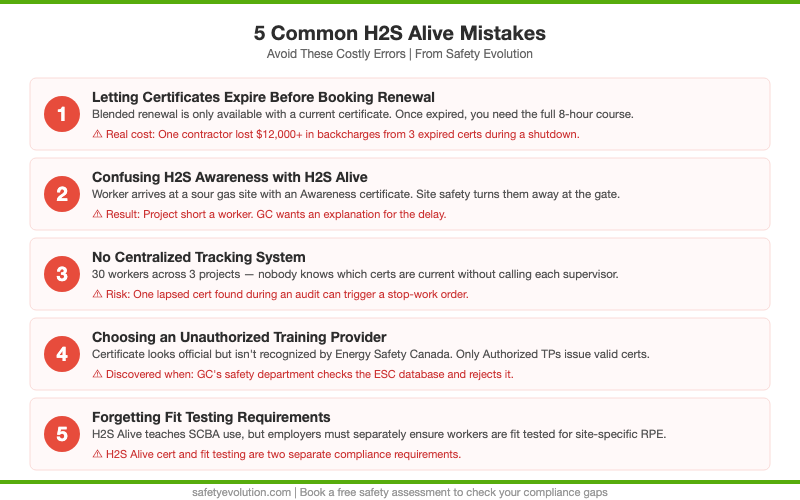
- Letting certificates expire before booking renewal. The blended renewal is faster, but it's only available with a current certificate. Once it expires, you're back to the full 8-hour course. Calendar reminders 60 days before expiry save real money and downtime.
- Confusing H2S Awareness with H2S Alive. A worker shows up to a sour gas site with an awareness certificate. The site safety coordinator turns them away. The project is now short a worker, and somebody has to explain the delay to the GC.
- No centralized tracking. An employer with 30 workers across three projects can't tell you which certs are current without calling each supervisor. One lapsed cert discovered during an audit can trigger a stop-work order.
- Choosing a provider that isn't an authorized ATP. The certificate looks official but isn't recognized by Energy Safety Canada. The worker finds out when a GC's safety department checks the ESC database and rejects it.
- Forgetting fit testing. H2S Alive teaches you to use an SCBA, but your employer still needs to ensure you're fit tested for the specific respiratory equipment on your site. The course cert and fit test are two separate requirements.
A 15-person electrical sub in Red Deer learned mistake number one the hard way last year. Three of their workers' H2S tickets expired during a shutdown. They couldn't get into a course for four days. The GC charged back the delay costs. The total bill for three missed days of $150 training: over $12,000 in lost productivity and backcharges.
Make safety training tracking effortless.
From H2S Alive to confined space, manage your entire workforce's competence in one place. Start your 30-Day Free Trial.
30-Day Free Trial
Frequently Asked Questions About H2S Alive
How much does H2S Alive cost in Canada?
H2S Alive typically costs between $150 and $250 in Canada, depending on the training provider and location. Major cities like Calgary and Edmonton tend to be at the lower end of the range due to more competition among providers. The fee generally includes the Energy Safety Canada certificate. Always confirm with your chosen provider whether the certificate fee is included in the course price.
How long is H2S Alive certification valid?
An H2S Alive certificate is valid for 3 years from the date of successful completion. However, some employers and work sites require annual refreshers even though the official certificate lasts 3 years. Check your specific employer or GC requirements. You can renew through a full classroom course or the blended renewal option (online theory plus in-person skills assessment) if your certificate has not yet expired.
Can you take H2S Alive online?
You cannot complete the full H2S Alive course entirely online. The course includes mandatory hands-on components, including practicing with a self-contained breathing apparatus (SCBA) and performing rescue drag techniques. Energy Safety Canada does offer an H2S Alive Blended Renewal for workers with a current (non-expired) certificate, which includes an online theory exam followed by an in-person skills assessment. The initial certification must be completed in person.
What is the difference between H2S Alive and H2S Awareness?
H2S Alive is a full-day (8-hour) course developed by Energy Safety Canada with hands-on SCBA and rescue components. It is the industry standard for workers directly exposed to H2S, particularly in oil and gas. H2S Awareness is a shorter (typically 4-hour) classroom or online course covering H2S properties, health effects, and safe work practices, but without the hands-on rescue and respiratory equipment components. Oil and gas sites and most GCs require H2S Alive, not H2S Awareness.
What happens if you fail the H2S Alive course?
The written exam requires a minimum score of 70% to pass. If you fail the exam or cannot successfully demonstrate the practical skills (SCBA use, rescue drag), you will not receive a certificate. For the blended renewal specifically, failing either the online theory or in-person skills assessment means you must register for the full one-day classroom course, and blended renewal fees are not reimbursed. There is no limit on how many times you can attempt the full course.
Is H2S Alive required by law in Canada?
Provincial OHS legislation (such as Alberta's OHS Code Part 4 and WorkSafeBC's OHS Regulation Part 5) requires employers to ensure workers exposed to hazardous substances, including H2S, are adequately trained. While the legislation does not always name "H2S Alive" specifically, it is the industry-accepted standard for meeting this training requirement. Most GCs and site owners in oil and gas require H2S Alive as a condition of site access, making it effectively mandatory for workers in these industries.
Get Weekly Safety Insights
Regulation updates, toolbox talk ideas, and compliance tips. One email per week.