Training
H2S Gas Safety: Complete Employer Guide
H2S kills in seconds at high concentrations. Learn Canadian exposure limits, employer duties, and how to build an H2S safety plan.
Canadian H2S exposure limits by province: Alberta OEL, BC ceiling, ACGIH TLV. Full ppm chart with health effects at every level from odour to fatal.
Last updated: March 2026
Your gas monitor hits 10 ppm and the alarm goes off. Half your crew freezes. The other half keeps working because "it's just a whiff." And nobody on site can tell you what that number actually means for their lungs, their eyes, or whether they should be running.
That gap between the alarm and the response kills people. In Alberta alone, H2S has been a contributing factor in multiple workplace fatalities over the past decade. The workers who died weren't reckless. They just didn't understand the numbers on their monitors.
At Safety Evolution, we build H2S safety plans for oil and gas contractors, and we see the same problem constantly: crews trained to carry a monitor but never taught what the readings mean. This guide fixes that.
Hydrogen sulfide (H2S) is a colourless, flammable, extremely toxic gas with a characteristic rotten egg odour at low concentrations. It is heavier than air (specific gravity 1.19), meaning it pools in low-lying areas, confined spaces, and excavations where workers are most vulnerable.
H2S is a chemical asphyxiant. It doesn't just irritate your airways; it poisons the cellular machinery your body uses to process oxygen. At concentrations of 700–1,000 ppm, rapid unconsciousness can occur within 1–2 breaths. This is why workers in oil and gas call it "knockdown gas."
H2S exposure limits exist because there is no safe margin of error with this gas. The distance between "I smell rotten eggs" and "I'm unconscious" can be measured in seconds at the wrong concentration. Every province in Canada sets legally enforceable occupational exposure limits (OELs) to protect workers, but the limits vary, and the variation matters.
Common sources of H2S in Canadian workplaces include:
If your crew works in any of these environments, they need to know the numbers below. Not as a poster on the wall. As knowledge they can act on in the 3 seconds between the alarm and the decision. (For a broader look at building a complete H2S safety program for your company, see our H2S gas safety employer guide.)
Most contractors assume there's one "Canadian limit" for H2S. There isn't. Each province sets its own occupational exposure limits through its own OHS legislation. Some provinces adopt the ACGIH Threshold Limit Values (TLVs) directly. Others set their own numbers.
Here's what you actually need to know, broken down by jurisdiction:
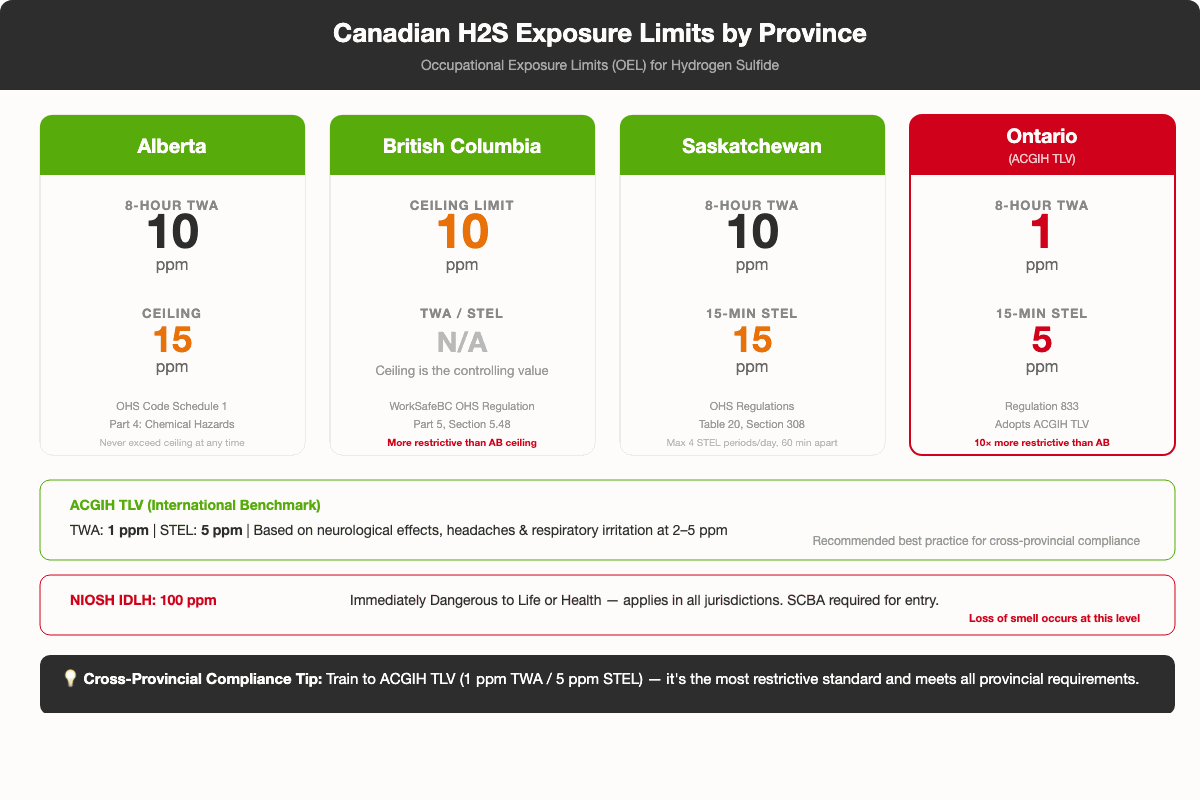
Alberta's OHS Code Schedule 1 sets the H2S occupational exposure limit at 10 ppm as an 8-hour time-weighted average (TWA) and 15 ppm as a ceiling limit. The ceiling means the concentration must never be exceeded at any point during the work shift, regardless of duration. Alberta's limits apply to all workplaces governed by the Occupational Health and Safety Code, Part 4: Chemical Hazards, Biological Hazards, and Harmful Substances.
WorkSafeBC sets a ceiling limit of 10 ppm for hydrogen sulfide. BC does not list a separate TWA or STEL in its E-Limit database for H2S; the ceiling limit is the controlling value. This is governed by OHS Regulation Part 5 (Chemical Agents and Biological Agents), Section 5.48. In practice, BC's ceiling of 10 ppm is more restrictive than Alberta's 15 ppm ceiling, because BC caps your exposure at 10 ppm at all times.
Saskatchewan's Occupational Health and Safety Regulations set the H2S limit at 10 ppm (8-hour TWA) and 15 ppm (15-minute STEL). The STEL (short-term exposure limit) allows brief peak exposures up to 15 ppm for no more than 15 minutes at a time, with at least 60 minutes between exposures, and no more than four such periods per day.
Ontario's Regulation 833 requires employers to comply with the ACGIH Threshold Limit Values unless the Ontario Table specifies a different limit. For H2S, the ACGIH TLV applies: 1 ppm TWA and 5 ppm STEL. This makes Ontario's legal limit significantly more restrictive than Alberta, BC, or Saskatchewan.
Most other Canadian provinces either adopt the ACGIH TLVs directly or set limits similar to the Alberta/Saskatchewan model (10 ppm TWA, 15 ppm ceiling or STEL). New Brunswick, for example, references ACGIH values. Quebec's CNESST sets its own values that may differ. Always check your specific provincial OHS regulation for the current enforceable limits in your jurisdiction.
The practical takeaway: if your company works across provinces, the safest approach is to train your crew to the most restrictive standard. For H2S, that means the ACGIH TLV: 1 ppm TWA and 5 ppm STEL. If you can meet that, you're compliant everywhere in Canada.
Need help building an H2S safety plan that meets your province's requirements? Safety Evolution can analyse your current H2S documentation and flag where your safety plan has gaps against provincial requirements.
Understanding where Canada sits relative to international bodies helps you gauge how protective your current standard is, and why the ACGIH limits are increasingly becoming the benchmark.
| Standard / Jurisdiction | TWA (8-hour) | STEL / Ceiling | IDLH |
|---|---|---|---|
| ACGIH TLV | 1 ppm | 5 ppm (STEL) | - |
| NIOSH REL | - | 10 ppm (10-min ceiling) | 100 ppm |
| US OSHA (General Industry) | - | 20 ppm (ceiling); 50 ppm (10-min peak) | - |
| US OSHA (Construction) | 10 ppm | - | - |
| Alberta OHS | 10 ppm | 15 ppm (ceiling) | - |
| WorkSafeBC | - | 10 ppm (ceiling) | - |
| Saskatchewan | 10 ppm | 15 ppm (STEL) | - |
| Ontario (ACGIH) | 1 ppm | 5 ppm (STEL) | - |
Notice the gap: Alberta allows 10 ppm over an 8-hour shift while the ACGIH recommends just 1 ppm. That's a 10x difference. The ACGIH based their lower limit on research showing neurological effects, headaches, and respiratory irritation at concentrations between 2-5 ppm over extended periods. Provincial regulators may eventually tighten their limits to match.
If you're building a safety program from scratch, design it around the ACGIH TLV. It's the direction the science is pointing, and working to a tighter standard today means fewer program overhauls when regulations catch up.
This is the section that matters most. Every person on your crew should understand what happens to the human body as H2S concentration increases. The progression is not gradual; it is a series of escalating thresholds where the risk jumps dramatically.
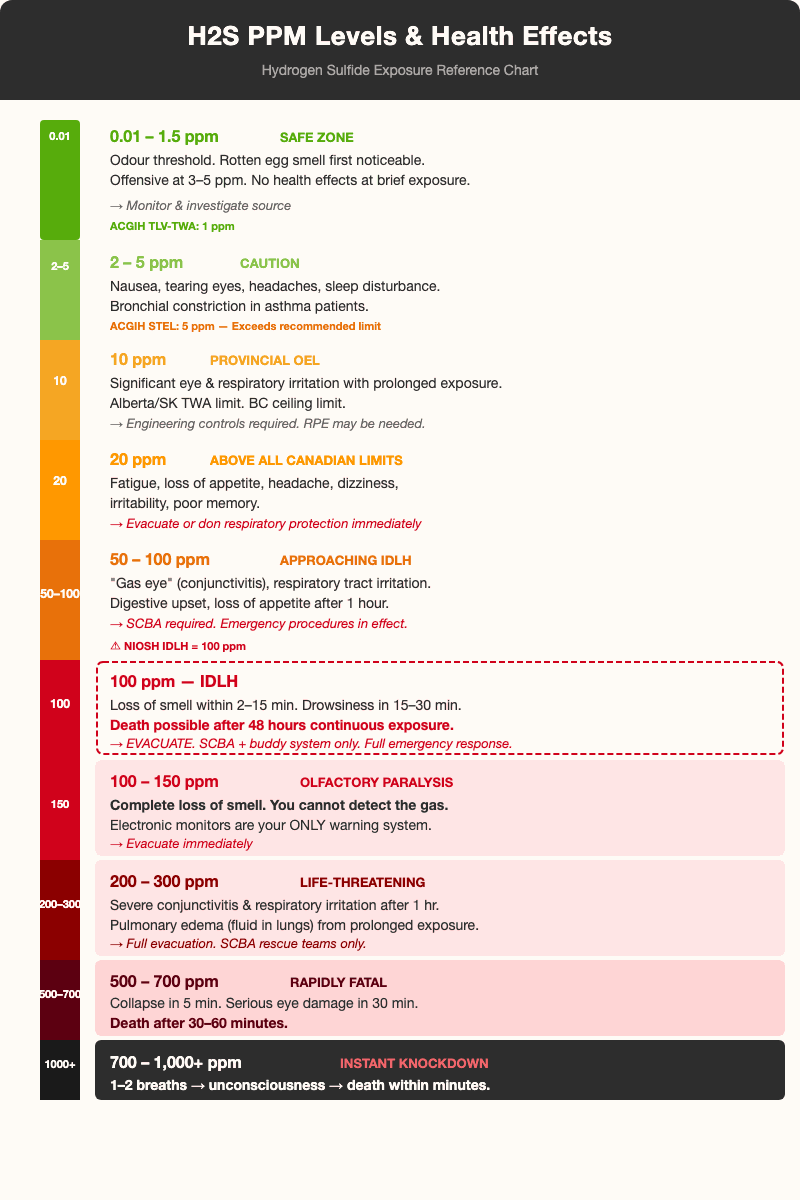
Most contractors think that H2S gives you a warning before it gets dangerous. They're wrong. The rotten egg smell that people rely on as a "natural alarm" disappears completely above 100 ppm because the gas paralyzes your olfactory nerve. By the time you can't smell it, you're already in the danger zone.
| PPM Level | Health Effects | Required Action |
|---|---|---|
| 0.01 - 1.5 ppm | Odour threshold. Rotten egg smell first noticeable. Offensive at 3-5 ppm. | Monitor. Investigate source. Ventilate if indoors. |
| 2 - 5 ppm | Prolonged exposure: nausea, tearing of eyes, headaches, loss of sleep. Bronchial constriction in some asthma patients. | Exceeds ACGIH STEL (5 ppm). Investigate and control source. Continuous air monitoring required. |
| 10 ppm | Alberta/BC/SK OEL ceiling range. Beginning of significant eye and respiratory irritation with prolonged exposure. | At or above most provincial OELs. Implement engineering controls. Respiratory protection may be required. |
| 20 ppm | Fatigue, loss of appetite, headache, irritability, poor memory, dizziness. | Exceeds all Canadian provincial limits. Evacuate or don appropriate respiratory protection immediately. |
| 50 - 100 ppm | Slight conjunctivitis ("gas eye") and respiratory tract irritation after 1 hour. Digestive upset, loss of appetite. | Approaching IDLH. SCBA required for entry. Emergency procedures in effect. |
| 100 ppm (IDLH) | Coughing, eye irritation, loss of smell (olfactory fatigue) after 2-15 minutes. Drowsiness after 15-30 minutes. Death possible after 48 hours of continuous exposure. | IDLH. Immediately dangerous to life or health. Evacuate. Only entry with SCBA and buddy system. Full emergency response. |
| 100 - 150 ppm | Complete loss of smell (olfactory paralysis). You cannot detect the gas by odour beyond this point. | Evacuate immediately. Electronic monitors are your only warning system. |
| 200 - 300 ppm | Marked conjunctivitis and respiratory tract irritation after 1 hour. Pulmonary edema (fluid in lungs) from prolonged exposure. | Life-threatening. Full evacuation. SCBA rescue teams only. |
| 500 - 700 ppm | Staggering, collapse in 5 minutes. Serious eye damage in 30 minutes. Death after 30-60 minutes. | Immediately fatal range. Do NOT attempt rescue without SCBA. Call emergency services. |
| 700 - 1,000 ppm | Rapid unconsciousness ("knockdown"). Immediate collapse within 1-2 breaths. Breathing stops. Death within minutes. | Lethal. Rescue only by trained personnel in SCBA. CPR if breathing stopped. |
| 1,000+ ppm | Nearly instant death. | Recovery of remains. Investigation. |
Here's the blunt truth: H2S doesn't negotiate. At 700–1,000 ppm, you have one to two breaths before you hit the ground. There is no coughing fit, no gradual onset, no chance to walk away. Your nervous system shuts down like someone pulled the plug. This is why the industry calls it "knockdown" and why rescue attempts without SCBA create multiple casualties instead of one.
This is the question people search but rarely get a straight answer to. So here it is.
H2S is a chemical asphyxiant, not a simple suffocant. It doesn't kill by displacing oxygen the way nitrogen or carbon dioxide would. Instead, H2S binds to cytochrome c oxidase in your mitochondria, the enzyme your cells use to convert oxygen into energy. Even if your lungs are full of air, your cells cannot use the oxygen. Your body suffocates from the inside out.
At concentrations of 700–1,000 ppm, this happens in one or two breaths. The gas reaches your bloodstream through your lungs almost instantly. It crosses into your brain within seconds. Your respiratory control center in the brainstem shuts down first, which is why breathing stops before the heart does. Unconsciousness is immediate. Without intervention (fresh air + CPR + advanced medical care), death follows within minutes.
At lower concentrations (100-500 ppm), the process is slower but still dangerous. The gas irritates your mucous membranes, causing "gas eye" (conjunctivitis) and pulmonary edema (fluid accumulating in your lungs). Prolonged exposure at these levels can be fatal within hours. And because you've lost your sense of smell above 100 ppm, you may not realize the concentration is rising.
This is why H2S training programs emphasize electronic monitoring and never relying on your nose. A properly calibrated gas detector is the only reliable warning system for H2S.
Keep your exposure policies aligned with local regulations.
Need a digital safety manual that stays updated? Start your 30-Day Free Trial and get access to compliance-ready templates.
30-Day Free TrialThe Immediately Dangerous to Life or Health (IDLH) concentration for H2S is 100 ppm, as established by NIOSH. This is the concentration at which a 30-minute exposure could cause death or irreversible health effects that prevent a worker from escaping.
At 100 ppm:
Any time your monitor reads 100 ppm or above, you are in an IDLH atmosphere. Entry is only permitted with:
Air-purifying respirators (APRs) with cartridges are not acceptable for IDLH atmospheres. Only atmosphere-supplying respirators provide adequate protection above 100 ppm.
Knowing the symptoms is critical because workers often dismiss early signs as allergies, fatigue, or a cold. H2S exposure symptoms follow a predictable progression:
Important: Pulmonary edema from H2S can be delayed. A worker exposed to moderate concentrations may feel relatively fine after leaving the area, then develop severe breathing difficulty 24-48 hours later. Any worker exposed to H2S above the OEL should receive medical evaluation, even if they feel okay at the time.
If anyone on your crew reports headaches, eye irritation, or nausea on a site where H2S is possible, treat it as an exposure event. Check monitors, ventilate the area, and get the worker to fresh air. Don't wait for worse symptoms.
Your gas monitor alarm set points should match your provincial OEL at minimum. Most H2S monitors in Canadian oil and gas are set with a low alarm at 10 ppm and a high alarm at 15 ppm. Here's what to do at each level:
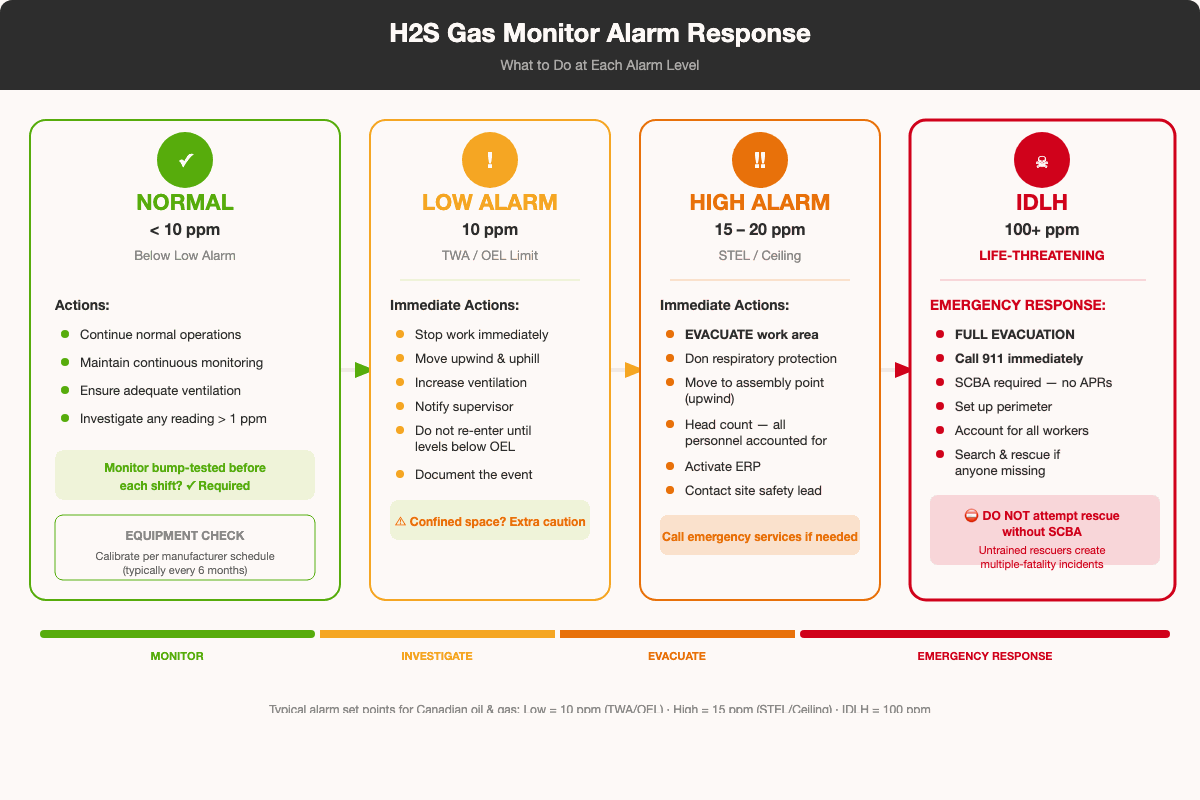
The number one mistake in H2S emergencies is untrained rescuers entering the hazard zone without respiratory protection. When a worker goes down in an H2S atmosphere, the instinct is to run in and pull them out. That instinct has created more multiple-fatality incidents than the original exposure. Never enter an H2S atmosphere above 100 ppm without SCBA. Period.
The right alarm set points depend on your province and the nature of your work. Here are common configurations used in Canadian oil and gas:
| Alarm Level | Typical Set Point | Response |
|---|---|---|
| Low Alarm (TWA) | 10 ppm | Investigate source, increase ventilation, notify supervisor |
| High Alarm (STEL/Ceiling) | 15 ppm | Evacuate work area, don respiratory protection |
| IDLH / TWA Alarm | 100 ppm | Full emergency evacuation, SCBA only, call emergency services |
If your company operates in Ontario or follows ACGIH TLVs as best practice, consider setting your low alarm at 5 ppm (STEL) and TWA alert at 1 ppm. Some safety-conscious operators in Western Canada are already moving to these tighter set points, especially on sour gas well sites where concentrations can spike without warning.
Monitors must be bump-tested before each shift and calibrated according to the manufacturer's schedule (typically every 6 months or after any failed bump test). A monitor that hasn't been calibrated is not a safety device; it's a paperweight clipped to your coveralls.
If your workers may encounter H2S on site, training isn't optional. Provincial OHS regulations (such as Alberta OHS Code Part 4, BC WorkSafeBC guidelines, and Saskatchewan OHS Regulations) set the legal framework for H2S safety management, including training requirements, risk assessment, emergency response planning, and PPE use. Energy Safety Canada provides industry-leading guidance and training standards. ANSI/ASSP Z390.1 is also widely referenced as a supplementary best-practice standard for H2S safety programs.
The two primary training levels are:
H2S Alive is the industry-standard, hands-on course administered through Energy Safety Canada. It's a full-day (approximately 8 hours) program that covers H2S properties, health hazards, hazard assessment and control, respiratory protective equipment (including SCBA), H2S detection, and initial response strategy. Workers must physically demonstrate putting on a mask, breathing under air, and performing a rescue drag. Certificates are valid for 3 years with a 70% passing grade.
H2S Awareness is a shorter awareness-level program (typically 4 hours) that covers the basics: properties, health effects, safe work practices, emergency response, and PPE. Unlike H2S Alive, it is typically classroom or online only, without the hands-on SCBA and rescue components.
For field workers on sour gas sites, oil rigs, or any environment where H2S concentrations could reach dangerous levels, H2S Alive is the standard. H2S Awareness is more appropriate for office staff, visitors, or support roles that may be on or near H2S-producing sites but are not directly exposed. For a detailed comparison of these training options, see our H2S Alive training guide.
Safety Evolution offers workplace safety training courses with instant certificates and expiry tracking built into your safety management program.
Track atmospheric testing results digitally.
Stop losing gas test logs in the truck. Capture atmospheric data right from the field. Start your 30-Day Free Trial today.
30-Day Free TrialAlberta's OHS Code Schedule 1 sets the hydrogen sulfide occupational exposure limit at 10 ppm as an 8-hour time-weighted average (TWA) and 15 ppm as a ceiling limit that must never be exceeded at any point during the shift. These limits are enforceable under Part 4 of the OHS Code.
H2S becomes immediately dangerous to life or health (IDLH) at 100 ppm. At this concentration, olfactory fatigue causes loss of smell within 2-15 minutes, and death is possible within 48 hours of continuous exposure. At 700-1,000 ppm, unconsciousness and death occur within minutes, often after just 1-2 breaths.
No. While H2S has a distinctive rotten egg odour detectable at concentrations as low as 0.01 ppm, olfactory fatigue (loss of smell) occurs at approximately 100-150 ppm. Above this concentration, your nose cannot detect the gas. This is why electronic gas monitors are the only reliable warning system for H2S, and why "I can't smell anything" is never a safe conclusion.
A TWA (Time-Weighted Average) is the average concentration over a full 8-hour shift. A STEL (Short-Term Exposure Limit) is the maximum average concentration over any 15-minute period. A Ceiling limit must never be exceeded at any point, even momentarily. For H2S in Alberta, the TWA is 10 ppm and the ceiling is 15 ppm. In Ontario, the ACGIH TLV of 1 ppm TWA and 5 ppm STEL applies.
H2S Alive certificates issued through Energy Safety Canada are valid for 3 years. The course requires a minimum 70% passing grade and includes hands-on components: putting on a mask, breathing under air, and performing a rescue drag. Workers must recertify before their certificate expires to maintain compliance.
Do NOT enter the area without SCBA or supplied air respiratory protection. Call 911 immediately. If the victim can be reached safely with proper respiratory protection, move them to fresh air. Begin CPR if they are not breathing, using a pocket mask or bag-valve-mask to avoid mouth-to-mouth contact (rescuers can be exposed to H2S from the victim's exhaled air). Keep the victim warm and still until emergency services arrive. Never attempt a rescue alone.
Get Weekly Safety Insights
Regulation updates, toolbox talk ideas, and compliance tips. One email per week.
H2S kills in seconds at high concentrations. Learn Canadian exposure limits, employer duties, and how to build an H2S safety plan.
H2S Alive costs $150-$250, takes one day, and lasts 3 years. Here's what to expect, who needs it, and how to choose a provider.
H2S kills in seconds at high concentrations. Learn Canadian exposure limits, employer duties, and how to build an H2S safety plan for your crew.