Training
Workplace First Aid Requirements in Canada
What employers must provide for first aid at work in Canada. Assessment steps, attendant levels, kit rules, and records by province.
Province-by-province first aid kit checklist for BC, Alberta, and Ontario. Exact contents required, kit types by crew size, and a printable audit list.
Last updated: April 2026
An OHS inspector opens your first aid kit on site. There is a half-empty box of bandages, an expired cold pack from 2021, and no CPR pocket mask. The kit you bought three years ago from a hardware store was never designed for a construction site with 20 workers.
This happens more often than anyone admits. Contractors buy a first aid kit, throw it in the gang box, and forget about it until someone gets hurt or an inspector asks to see it. The problem is that first aid kit requirements are not generic. They vary by province, by the number of workers on site, and by the hazard level of your workplace.
Workplace first aid kit requirements in Canada are set by provincial regulations that reference CSA Z1220-17, the national standard for first aid kit contents. BC, Alberta, and Ontario each have their own rules for what must be in the kit, how many kits you need, and what size and type matches your workplace. This checklist covers the specific requirements for all three provinces so you can audit your current kits and know exactly what to add, replace, or upgrade to pass your next inspection or COR audit.
A workplace first aid kit must contain the specific supplies mandated by your provincial regulator for your workplace classification. There is no single universal list because requirements differ by province, hazard level, and crew size. A 5-person office has different kit requirements than a 30-person construction site.
That said, every compliant workplace first aid kit in Canada will include some version of these core items:
Beyond these basics, your province adds specific requirements. Let us break it down.
WorkSafeBC overhauled its first aid requirements effective November 1, 2024. The old system used specific kit type numbers. The new system uses a risk-based approach with three levels.
Your first step in BC is completing a workplace first aid assessment using WorkSafeBC's updated criteria. The assessment determines your risk level, which determines your kit requirements.
For low-risk workplaces with fewer workers, close to medical facilities. Contents include basic wound care supplies, bandages, and a CPR barrier device.
For moderate-risk workplaces or larger crews. Expanded supplies including additional bandages, splinting materials, and an expanded wound care kit.
For high-risk workplaces, large crews, or remote sites. Full medical-grade supplies including oxygen equipment, IV supplies (where advanced first aid attendants are present), and comprehensive trauma supplies.
For the complete list of required items per level, refer to WorkSafeBC's OHS Regulation Schedule 3-A. The specific contents are detailed and must be followed exactly. Do not assume a generic "workplace first aid kit" from a supplier meets these requirements unless it explicitly states BC compliance with the 2024 regulations.
For a deeper look at BC requirements, read our BC first aid requirements guide.
As of March 31, 2023, Alberta requires workplace first aid kits to meet the CSA Z1220-17 standard ("First aid kits for the workplace"). This national standard replaced the previous Alberta-specific kit specifications.
Alberta OHS Code Schedule 2 (Tables 4 to 7) determines what type and number of kits you need based on:
| Kit Type | Workers Covered | Key Contents Beyond Basics |
|---|---|---|
| Personal (Type P) | Individual worker (field, vehicle) | Minimal: bandages, gauze, gloves, wipes. For personal use only. |
| Basic (Type 1) | 2 to 25 workers (low hazard) | Core supplies: bandages, gauze pads, triangular bandages, tape, gloves, cold pack, scissors, CPR mask. |
| Intermediate (Type 2) | 26 to 50 workers or medium hazard | Basic + additional quantities, eye pads, tensor bandages, emergency blanket. |
| Advanced (Type 3) | 50+ workers or high hazard | Intermediate + splints, additional trauma supplies, expanded wound care. |
For Alberta construction contractors, a Type 2 (Intermediate) or Type 3 (Advanced) kit is typical for most jobsites. Every work vehicle should carry at least a Type P (Personal) kit.
Not sure if your first aid readiness would hold up in a real emergency?
See training gaps, expiring certificates, and missing documentation before they become incidents.
Start Your 30-Day Free Trial →Ontario uses WSIB Regulation 1101 to specify first aid kit contents. The regulation defines two main kit sizes:
Expanded quantities of all items above, plus additional bandages, a stretcher, blankets, and a first aid room requirement for larger sites.
Ontario's new AED requirement (effective January 1, 2026): Construction projects with 20 or more workers regularly employed and expected to run 3 months or more must now have an Automated External Defibrillator (AED) on site under O. Reg. 157/25. If your Ontario construction project meets these criteria, add an AED to your first aid supplies.
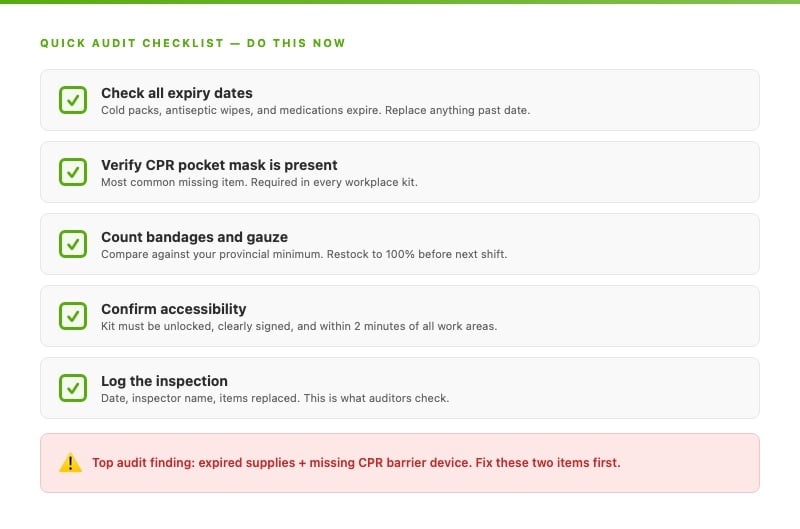
Use this checklist for a quick audit. Walk to your kit and check each item:
If your kit fails any of these checks, fix it today. Not tomorrow. Not "when the new supplies come in." An incomplete kit during an incident is a liability.
After years of helping contractors get their safety programs audit-ready, here are the items that are almost always missing or expired:
The fix is simple: schedule a quarterly kit inspection. Add it to your safety inspection routine. Check every item against the provincial list, replace expired supplies, and restock anything that has been used.
If you want a systematic approach to safety inspections including first aid kit audits, Safety Evolution can build that into your safety program. Our clients get inspection checklists, automated reminders, and a digital record of every inspection.
Do not buy a generic first aid kit from a hardware store and assume it meets your provincial requirements. Purchase kits specifically labeled as compliant with your province's regulations:
For the overall picture of what your workplace needs, read the complete guide to workplace first aid kit requirements.
If your last kit audit revealed more than two expired or missing items, schedule a full replacement rather than restocking piecemeal. Buying a new CSA-compliant kit of the correct type and size is often faster and more cost-effective than tracking down individual components, and it ensures you start with a complete, current inventory that matches your provincial requirements.
Still chasing first aid records across files and inboxes?
Centralize corrective actions and proof so your next review is predictable.
Start Your 30-Day Free Trial →As of November 1, 2024, WorkSafeBC requires construction sites to have first aid kits based on a risk-level assessment. Most construction sites with moderate-to-high hazards require Level 2 or Level 3 kits. Contents are specified in OHS Regulation Schedule 3-A. You must complete WorkSafeBC's first aid assessment to determine your specific requirements.
Yes. Antiseptic wipes, instant cold packs, CPR masks, and some ointments have expiry dates. Expired supplies are considered non-compliant by regulators. Check expiry dates during your quarterly kit inspection and replace any expired items immediately.
It depends on your province, crew size, and site layout. A general rule: one first aid kit should be accessible within 2 minutes from any work area. Multi-floor buildings, large sites, and projects with multiple work zones need multiple kits. Work vehicles should each carry a personal kit. Check your provincial OHS Code for specific ratios.
CSA Z1220-17 is the Canadian Standards Association standard for workplace first aid kits. It defines four kit types (Personal, Basic, Intermediate, Advanced) with specific contents for each. Alberta adopted this standard effective March 31, 2023. Ontario's WSIB also accepts CSA Z1220-17 kits. Kits labeled as CSA Z1220-17 compliant meet the standard.
It varies by province. Ontario introduced a new AED requirement effective January 1, 2026 (O. Reg. 157/25): construction projects with 20 or more workers regularly employed and expected to run 3 months or more must have an AED on site. BC and Alberta do not currently mandate AEDs for construction sites, but many safety programs include them as a best practice. AED units run $1,500 to $3,000 and require minimal training to use.
Get Weekly Safety Insights
Regulation updates, toolbox talk ideas, and compliance tips. One email per week.
What employers must provide for first aid at work in Canada. Assessment steps, attendant levels, kit rules, and records by province.
COR certification requirements, costs, and timelines for every Canadian province. Compare certifying bodies, WCB discounts, and get your province...
COR-certified contractors earn 10%-20% WCB premium discounts. Province-by-province breakdown with real math at $1M, $5M, $10M payroll.