Last updated: May 2026
Most near misses are not reported to OSHA simply because they happened. A near miss usually belongs in your internal reporting and investigation process. OSHA does, however, strongly encourage employers to investigate close calls because they reveal hazards and control failures before a worker gets hurt.
⚡ Quick Answer
- Internal reporting: Near misses should be captured and reviewed inside the company.
- OSHA reporting: A near miss by itself is generally not an OSHA reporting event unless another specific reporting trigger applies.
- Recordkeeping: OSHA recordkeeping focuses on work-related injuries and illnesses that meet recording criteria, not every close call.
- Best practice: Investigate serious close calls and track corrective actions before a recordable event occurs.
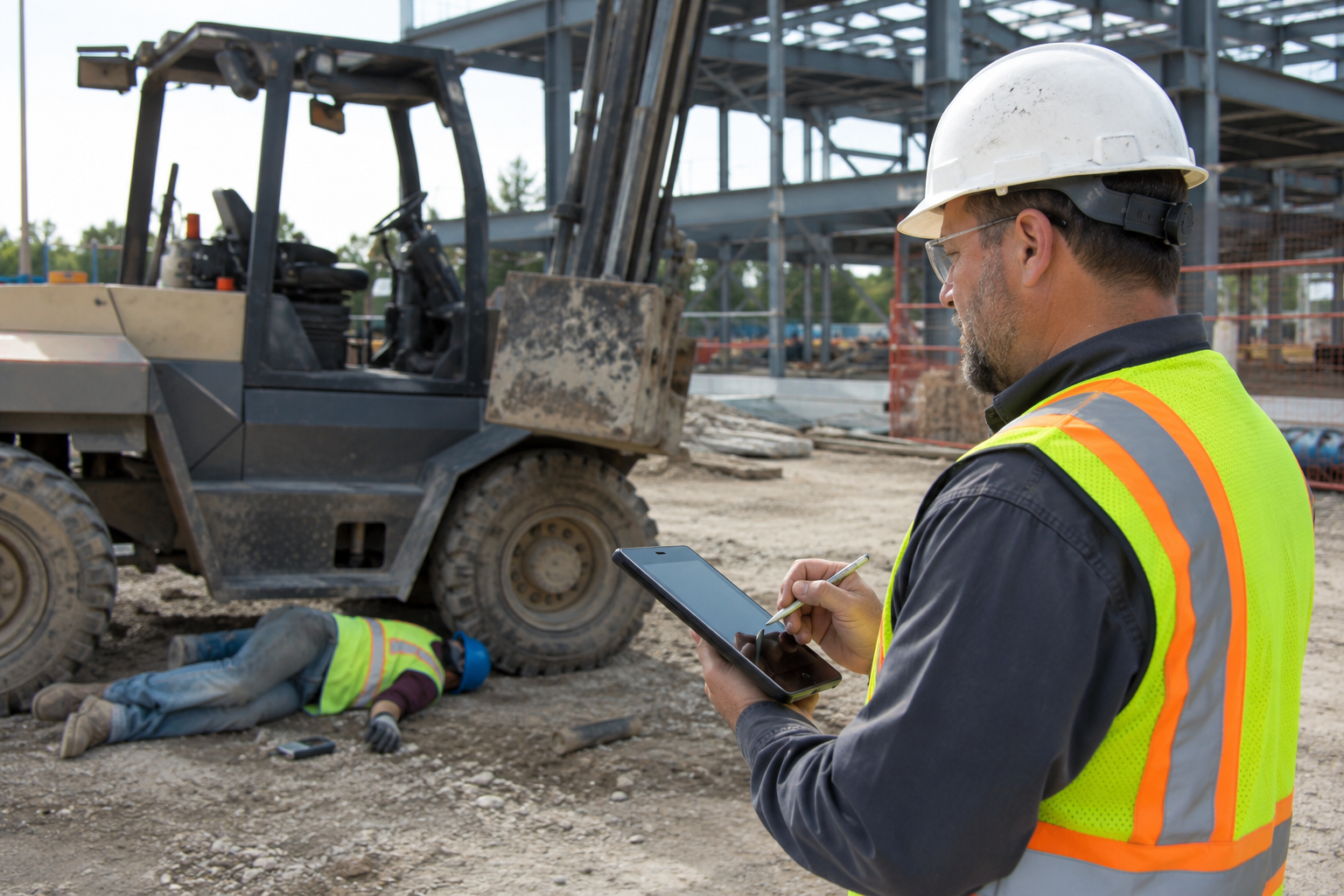
The practical OSHA answer
For US employers, separate three concepts: internal near miss reporting, OSHA recordkeeping, and OSHA reporting. A close call should usually be reported internally. It is not automatically recorded on the OSHA 300 log because no recordable injury or illness occurred. It is not automatically reported to OSHA unless the event also meets a separate serious-event reporting requirement.
OSHA's incident investigation guidance encourages employers to investigate close calls, sometimes called near misses, because circumstances could have been slightly different and a worker might have been hurt. That makes near miss investigation a prevention practice even when it is not an OSHA recordkeeping entry.
For the complete cluster overview, start with the near miss reporting guide. For Canada-specific guidance, use near miss reporting in Canada instead.
Internal near miss reporting versus OSHA recordkeeping
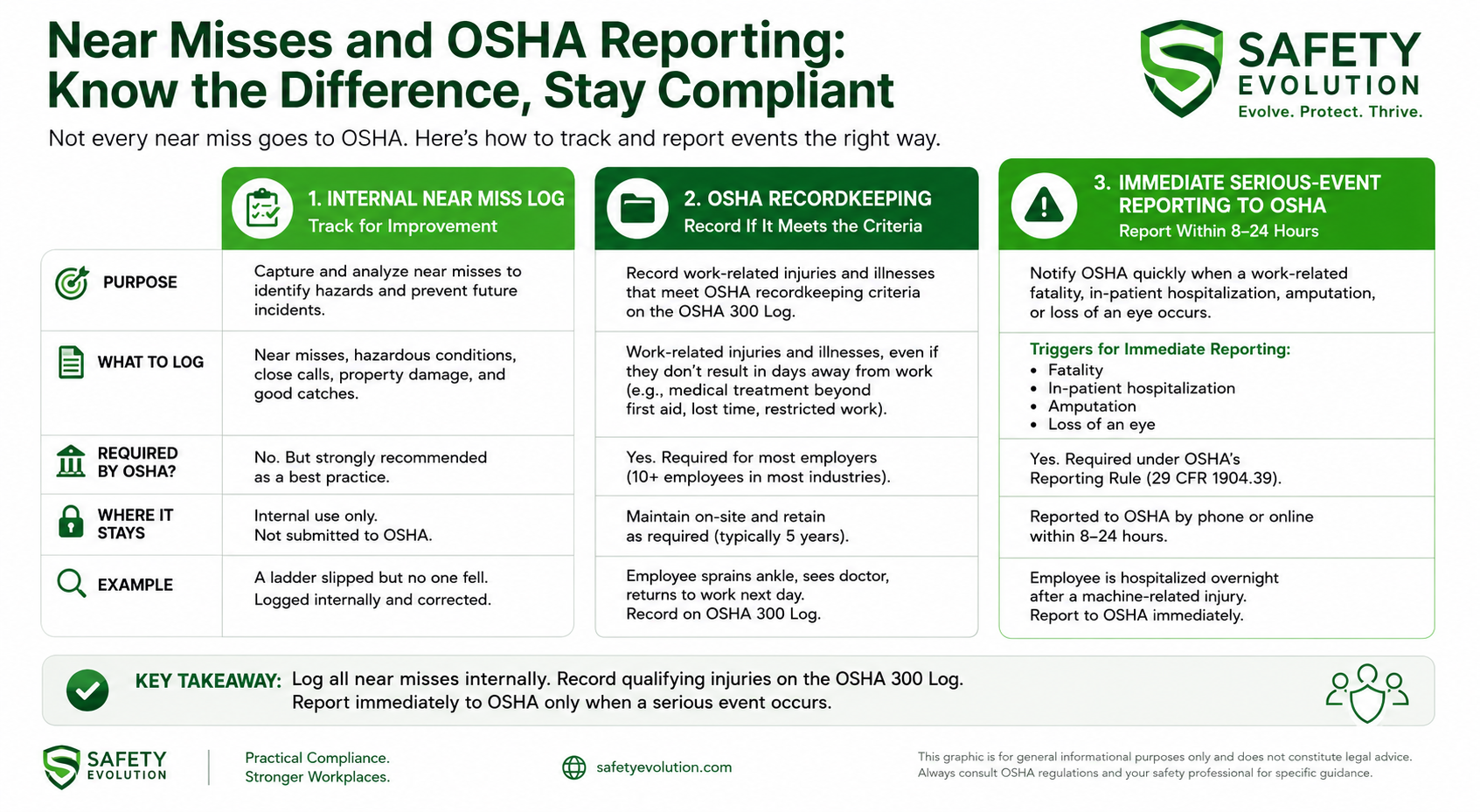
| Process | What it covers | Typical near miss treatment |
|---|
| Internal near miss reporting | Close calls, hazards, no-loss events, potential serious exposures. | Report internally, review, investigate as needed, assign corrective action. |
| OSHA recordkeeping | Work-related injuries and illnesses that meet OSHA recording criteria. | Near misses usually are not recordable because no injury or illness occurred. |
| OSHA reporting | Specific severe events that must be reported to OSHA, such as fatalities and certain serious injuries. | A near miss alone usually does not trigger reporting unless another required event occurred. |
Still relying on memory after close calls?
If near misses live in text messages, notebooks, or verbal updates, patterns disappear fast. Start your 30-day free trial and make reporting easier for supervisors and crews in the field.
Start Your 30-Day Free Trial →
Why OSHA still matters for near misses
Even when a near miss is not reportable to OSHA, OSHA guidance still matters because it frames close calls as important learning opportunities. A serious close call can involve the same hazards that lead to recordable injuries: falls, struck-by events, caught-in or between exposures, electrical hazards, chemical releases, mobile equipment, and hazardous energy.
If an employer ignores repeated close calls and a worker is later injured, the earlier reports may show that the hazard was known and controls were weak. That is one reason internal near miss reporting should be practical, consistent, and tied to corrective action.
Near miss versus OSHA recordable
A near miss is a no-loss event. An OSHA recordable involves a work-related injury or illness that meets OSHA's recording criteria. The distinction is important. A wrench falling beside a worker is a near miss. A wrench striking the worker and causing medical treatment beyond first aid may become recordable. A forklift stopping inches from a pedestrian is a near miss. A forklift striking a worker and causing days away from work would be handled very differently.
For classification help, use near miss vs incident and near miss vs hazard.
When a near miss should be escalated internally
Some close calls should go beyond a basic report. Escalate internally when the credible outcome could have been serious injury, fatality, major damage, or a major release. Examples include a fall-from-height exposure, a line-of-fire event with heavy equipment, an unexpected energy release, a trench collapse risk, a suspended load exposure, or a serious electrical close call.
Use the high-potential near miss guide to define escalation criteria, and use the near miss investigation process when the event needs deeper review.
What US employers should do after a near miss
- Make the area safe. Stop the task, isolate the hazard, barricade, clean up, or remove equipment from service.
- Capture the event internally. Use a simple reporting form that workers and supervisors can complete quickly.
- Classify the event. Confirm whether it is a hazard, near miss, high-potential near miss, or incident.
- Check recordkeeping and reporting boundaries. If no injury or illness occurred, the event usually stays internal, but always check if another regulatory trigger applies.
- Investigate based on potential severity. Serious-potential events need more than a quick note.
- Assign and verify corrective actions. Do not close the event until the control is in place.
- Review trends. Use near miss data to find repeated exposure before injuries occur.
What should be in a US near miss report?
A strong near miss report should include the date, time, location, task, event description, people or equipment exposed, potential consequence, immediate action, photos, classification, root cause notes if investigated, corrective action, owner, due date, and verification. It should also include a field for recordkeeping or reporting review when the event involves unusual severity or uncertainty.
For a practical layout, use the near miss report template. For leadership reporting, connect the form to near miss KPIs so serious themes do not get lost.
Common OSHA-related mistakes
- Assuming every near miss must be sent to OSHA. Internal reporting and OSHA reporting are different workflows.
- Ignoring near misses because they are not recordable. A no-recordable event can still reveal a serious hazard.
- Confusing a hazard observation with a near miss. Use a consistent classification process.
- Closing with reminders only. Serious close calls often need stronger controls than coaching alone.
- Failing to investigate repeat events. Repeated close calls suggest the system is not learning.
How near miss reporting supports OSHA readiness
A good near miss program helps employers demonstrate that hazards are identified, reviewed, and corrected. It can also help supervisors prepare better job hazard analyses, toolbox talks, inspections, and training. The point is not to create paperwork for its own sake. The point is to show that the organization is paying attention to early warnings.
Internal reports should be factual and useful. They should not exaggerate, hide, or blame. A clean process helps the company learn and gives safety leaders a better record of what was done after the close call.
Building a no-blame US near miss process
Workers are less likely to report close calls if they think the report will be used against them. The process should focus on what happened, what control failed, and what needs to change. That does not mean ignoring reckless behavior. It means the default response should be learning and prevention, not punishment.
For adoption, use the near miss reporting culture page and the near miss toolbox talk to bring the message into field conversations.
How to handle uncertainty
If a supervisor is unsure whether an event is only a near miss or whether it involves injury, illness, damage, or another reporting concern, the event should be escalated to the safety lead or designated recordkeeping person. Field crews should not have to make complex OSHA recordkeeping decisions in the moment. Their job is to make the area safe and report accurate facts quickly.
That is why the form should include a review field for recordkeeping or reporting uncertainty. If the event is clearly a no-loss close call, it can stay in the internal near miss workflow. If new facts show injury, medical treatment, restricted work, damage, or a severe event, the classification and next steps may need to change.
How near miss records help prevent future OSHA problems
Near miss records are not just safety culture documents. They can help leadership see known hazards before those hazards create recordable injuries. If the same equipment blind spot appears in multiple close calls, the company can change traffic flow, add physical controls, retrain operators, or redesign the work area before someone is struck.
Strong records also help managers show follow-through. A report with photos, assigned corrective actions, closeout evidence, and trend review is much more useful than a verbal comment that disappears after the shift.
US-specific QC note before publishing
Before publishing, confirm that the page stays clear on the difference between OSHA encouragement to investigate close calls, OSHA recordkeeping requirements, and OSHA severe event reporting. Those are related but not identical. The page should help readers understand the workflow without turning into legal advice.
Want better near miss reporting without more admin drag?
When reporting is clunky, supervisors skip it and crews stop believing it matters. Use Safety Evolution to capture close calls, assign follow-up, and keep the learning visible.
Start Your 30-Day Free Trial →
Final practical takeaway for US employers
When in doubt, report the close call internally, make the area safe, and escalate uncertainty to the person responsible for OSHA recordkeeping or safety compliance.
Frequently Asked Questions
Do near misses have to be reported to OSHA?
A near miss by itself is generally handled internally and is not automatically reported to OSHA. Separate OSHA reporting requirements may apply if a serious reportable event occurs.
Are near misses OSHA recordable?
Usually no. OSHA recordkeeping focuses on work-related injuries and illnesses that meet recording criteria. A no-injury close call is typically not recordable.
Does OSHA recommend investigating near misses?
Yes. OSHA encourages employers to investigate close calls because they can reveal hazards and control failures before someone is hurt.
What should US employers do with near misses?
Capture them internally, classify potential severity, investigate serious or repeated events, assign corrective actions, and review trends.
Useful official references