Last updated: May 2026
A near miss is one of the clearest warnings a safety team can get. Nothing went wrong enough to create an injury, damage, spill, fire, or recordable incident, but the exposure was real. A worker stepped out of the line of fire just in time. A dropped object missed someone by a few feet. A vehicle stopped before contact. A load shifted, a tool failed, a barricade was missing, or a crew found unexpected energy before starting work.
Near miss reporting is the process of capturing those close calls, reviewing what happened, assigning corrective action, and using the information to prevent a repeat event. It turns “we got lucky” into a usable safety signal.
⚡ Quick Answer
- A near miss is an unplanned event that could have caused injury, illness, damage, or environmental impact, but did not.
- Near miss reporting is the workflow used to record the event, review risk, investigate causes, assign corrective action, and close the loop.
- The best programs make reporting simple, blame-free, mobile-friendly, and tied to visible follow-up.
- The goal is not more paperwork. The goal is earlier visibility into uncontrolled hazards and weak controls.
Make near miss reporting easier for field crews
Safety Evolution helps teams replace paper forms, scattered photos, and spreadsheet follow-up with a digital near miss reporting workflow that crews can use from the field.
Start a 30-day free trial Explore digital safety forms
What is a near miss in workplace safety?
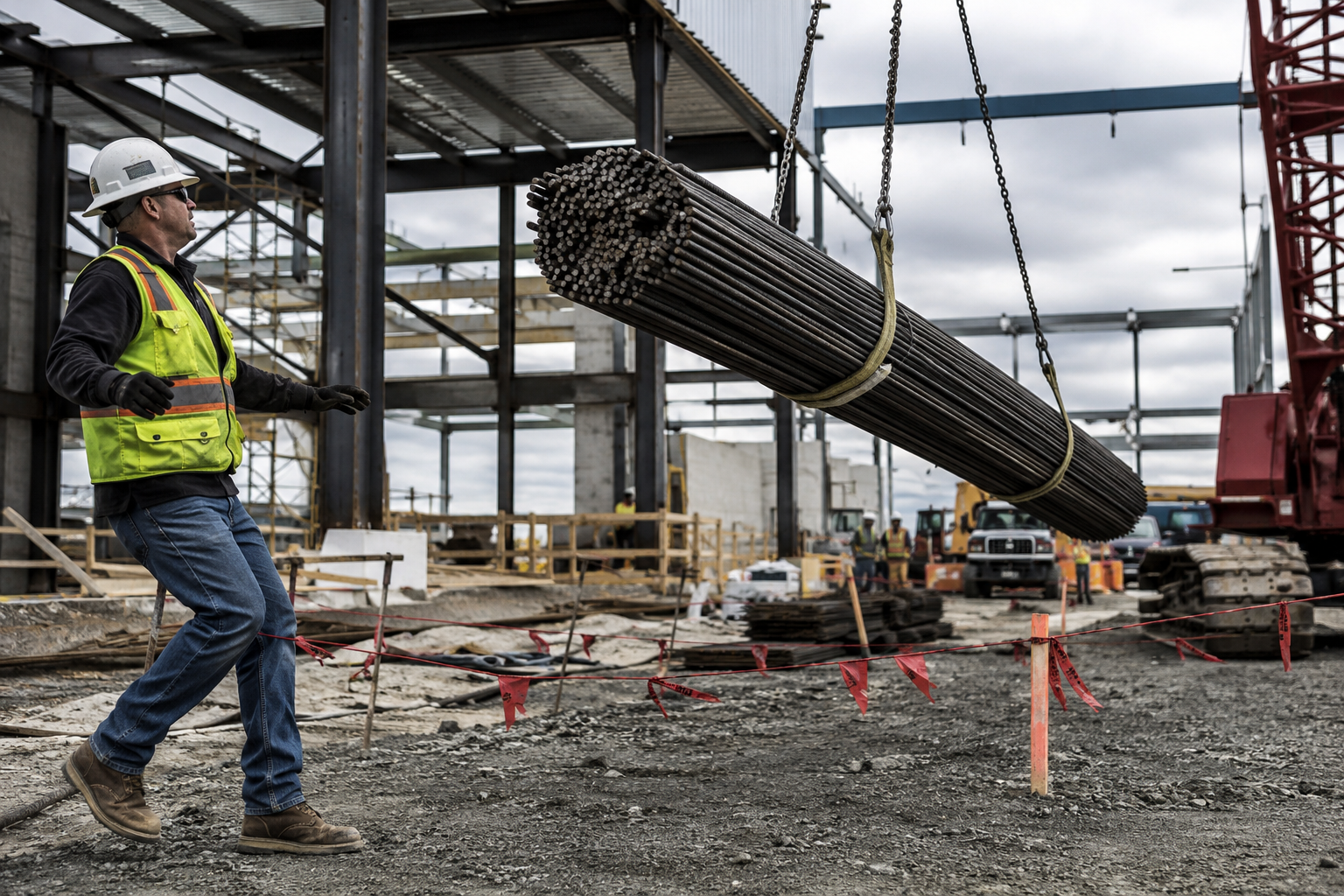
A near miss is an event where harm could have happened, but did not. It is sometimes called a close call, near hit, no-loss incident, or good catch. The wording may change by company or industry, but the idea is the same: an event occurred, there was a real exposure, and only timing, chance, intervention, or existing controls prevented a worse outcome.
Near misses matter because they show where the system is vulnerable before the company pays the price. They give supervisors and safety leaders a chance to learn from weak signals instead of waiting for a serious injury, equipment damage, environmental release, or client escalation.
Common workplace near misses include:
- a worker almost being struck by mobile equipment;
- a tool, material, or object falling near a worker;
- a worker slipping but recovering before falling;
- a trench, excavation, or ground disturbance exposure being caught before entry;
- unexpected stored energy being identified before maintenance work begins;
- a vehicle backing incident where contact was narrowly avoided;
- a missing guardrail or barricade discovered after workers were already exposed;
- a chemical container leaking but being contained before contact or release.
For more scenario-based examples, use the dedicated guide to near miss examples at work. This pillar focuses on the system behind the reporting process.
Near miss vs incident vs hazard: the simple difference
Classification is one of the first places near miss programs get messy. If workers are not sure whether something is a hazard, near miss, incident, unsafe condition, or observation, they either overthink the report or skip it entirely.
Here is the practical distinction:
- A hazard is a condition or source of potential harm. Example: an unguarded edge, frayed cord, icy walkway, or missing label.
- A near miss is an event with exposure, but no loss. Example: a worker slips on the icy walkway but catches themselves before falling.
- An incident is an event that results in injury, illness, damage, spill, release, or another loss outcome.
The difference is not just wording. It affects how the event is triaged, who gets notified, how much investigation is required, and what records the company needs to keep. If the outcome caused injury or damage, use the near miss vs incident guide. If the confusion is between a condition and an event, use the near miss vs hazard guide.
Why near miss reporting matters
Near misses are leading indicators. They show what could hurt someone before the injury happens. That makes them especially useful in field-based industries where crews are mobile, conditions change quickly, and supervisors cannot personally see every exposure in real time.
A strong near miss reporting program helps companies:
- spot repeat hazards across sites, crews, assets, or tasks;
- identify weak controls before they fail completely;
- prioritize corrective actions based on risk, not just noise;
- give workers a clear way to speak up without waiting for an injury;
- build a better audit trail for follow-up, investigation, and closeout;
- show clients and leadership that safety concerns are being acted on;
- move from reactive incident management to proactive prevention.
OSHA says employers are strongly encouraged to investigate close calls, sometimes called near misses, where a worker might have been hurt if circumstances had been slightly different. CCOHS also frames near misses as events worth reporting and investigating because they can identify process improvements before injury or damage occurs. Those two ideas point to the same operational truth: near misses are only valuable when the company does something with them.
The report itself is not the win. The win is the fix, the trend, the coaching moment, and the reduced chance of recurrence.
What should be reported as a near miss?
A good rule is simple: report any unplanned event where a small change in timing, location, energy, or control could have led to harm. Workers do not need to prove the event was serious before they report it. They should be able to capture what happened quickly, then let the supervisor or safety lead triage severity.
Near misses worth reporting often include:
- Line-of-fire events: workers almost struck by equipment, tools, materials, pressure, or moving loads.
- Fall exposures: slips, trips, edge exposures, ladder instability, scaffold issues, or missing fall controls.
- Energy exposures: unexpected electrical, mechanical, hydraulic, pneumatic, thermal, or stored energy.
- Vehicle and mobile equipment close calls: backing events, blind-spot issues, traffic control failures, or pedestrian conflicts.
- Dropped objects: tools, fittings, materials, or components falling near people or critical assets.
- Environmental close calls: leaks, spills, releases, or containment failures caught before impact.
- Confined space, excavation, or ground disturbance concerns: exposures discovered before the work escalates.
- Procedural misses: task steps skipped or misunderstood, where controls were almost bypassed.
The important part is to remove hesitation. If the event made someone say “that could have been bad,” it is worth capturing. The supervisor can later decide whether it is a standard near miss, high-potential near miss, hazard observation, or incident.
What should a near miss report include?
A near miss report should be detailed enough to support action, but simple enough that field workers will actually use it. If the form takes too long, asks for too much legal language, or feels like a blame exercise, reporting volume and quality will drop.
At minimum, a near miss report should capture:
- date and time;
- site, location, crew, department, or project;
- person reporting the event;
- task being performed;
- short description of what happened;
- what could have happened if conditions changed;
- immediate action taken;
- photos, if useful and safe to capture;
- initial severity or potential severity;
- supervisor review status;
- corrective action owner and due date;
- closeout evidence and verification.
The best forms also separate fact from opinion. “Worker was not paying attention” is not a useful root cause. “Spotter was unavailable, blind spot was not controlled, and the reversing route crossed a pedestrian path” gives the company something to fix.
If you need the fields and workflow laid out in more detail, use the near miss report template and workflow guide. If you are digitizing forms, Safety Evolution’s digital safety forms can help standardize how reports are submitted, routed, and closed out.
A practical near miss reporting workflow
A near miss program needs more than a form. It needs a workflow that makes responsibilities clear from the moment the event is noticed to the moment the corrective action is verified. Without that workflow, near miss reports become a folder of disconnected observations.
1. Worker reports the near miss
The worker or supervisor captures what happened as close to the event as possible. Mobile reporting helps here because the details are fresh and photos can be attached before the scene changes. The first report should not require perfect root cause analysis. It should focus on what happened, where, who was exposed, what could have happened, and what immediate controls were put in place.
2. Supervisor makes the area safe
Before anyone worries about paperwork quality, the supervisor needs to make sure the exposure is controlled. That may mean stopping work, moving people out of the line of fire, isolating energy, barricading the area, removing defective equipment, or changing the task plan.
3. Event is triaged by potential severity
Not every near miss needs the same level of investigation. A minor slip with no ongoing hazard may need a quick review and corrective action. A dropped object from height, uncontrolled energy exposure, or vehicle-pedestrian close call may need immediate escalation. This is where a high-potential category helps. The guide to high-potential near misses explains how to separate routine close calls from serious precursor events.
4. Investigation identifies causes and failed controls
The investigation should ask why the exposure existed, not who can be blamed. What changed? What control was missing, weak, bypassed, unclear, or unavailable? Was the procedure realistic for field conditions? Did the worker have the right training, equipment, time, and supervision? Did the work area create competing pressures?
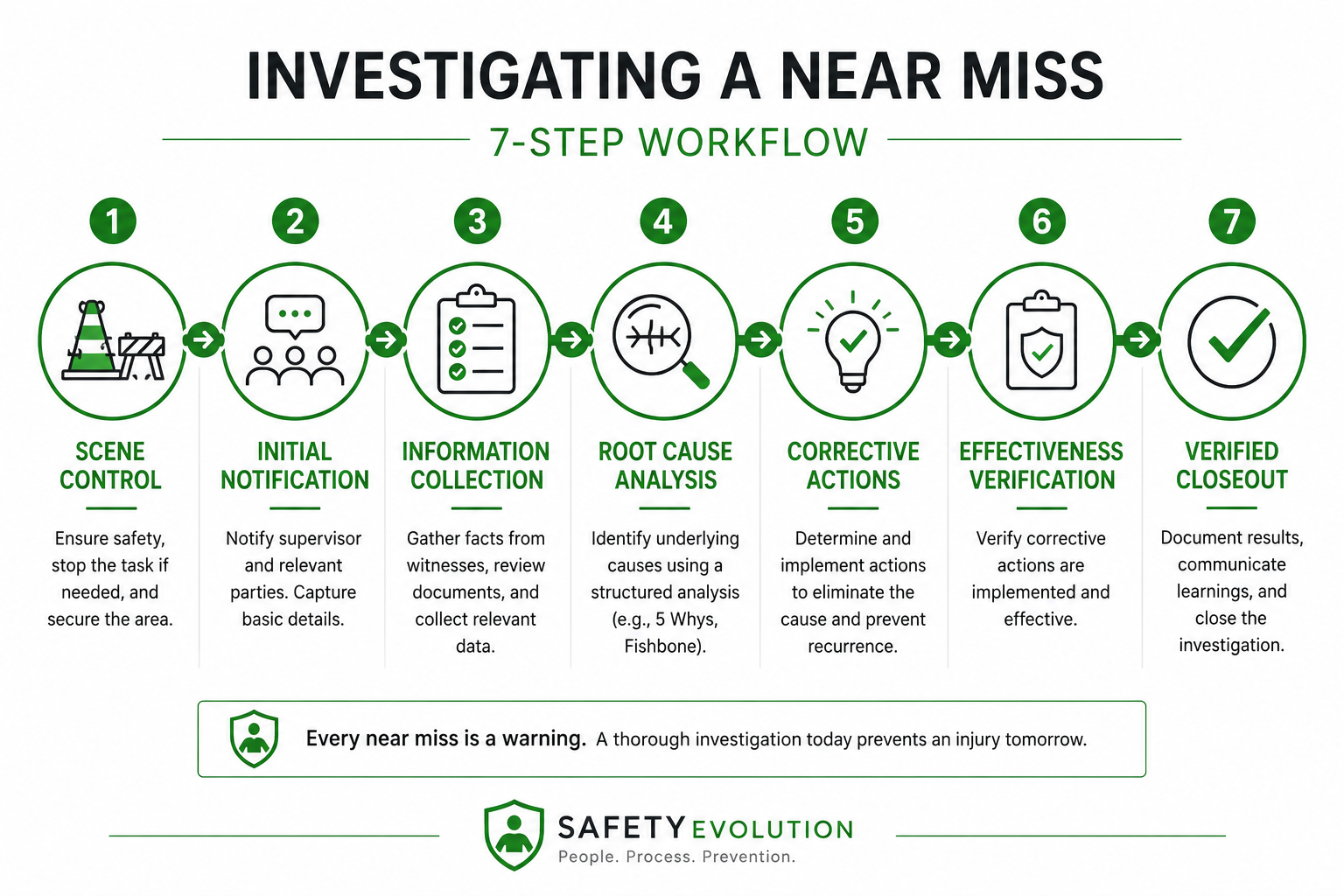
For a fuller step-by-step process, use the guide on how to investigate a near miss.
5. Corrective actions are assigned
A corrective action should have an owner, due date, risk priority, and verification step. “Remind workers to be careful” is rarely enough. Stronger actions may include fixing equipment, improving traffic control, updating a JSA, changing storage layout, retraining a crew, adding inspection checkpoints, or changing how work is planned.
If corrective actions often get lost in spreadsheets or email threads, the company may need a better closeout system. The corrective action request software guide explains what contractors should track.
6. Closeout is verified and shared
The loop is not closed when someone writes down a task. It is closed when the fix is completed, evidence is attached, and someone verifies the control is working. Sharing the outcome with the crew matters because it proves reporting leads to action. Without visible follow-up, workers quickly learn that reporting is just extra admin.
Need a cleaner workflow from report to corrective action?
With Safety Evolution, near miss reports can move from field submission to supervisor review, corrective action assignment, and closeout evidence in one connected workflow.
Try Safety Evolution free for 30 days or review how corrective action tracking helps close the loop.
How to prioritize near misses
One of the common objections to near miss reporting is that it creates too much volume. That usually means the company has a triage problem, not a reporting problem.
Not all near misses deserve the same response. A smart system separates reports by potential severity, recurrence, and control failure. For example:
- Low potential: quick correction, supervisor review, trend capture.
- Moderate potential: corrective action, documented follow-up, crew communication.
- High potential: escalation to safety leadership, deeper investigation, formal corrective action plan, leadership review.
The strongest programs pay special attention to serious injury and fatality potential. A high-potential near miss should not be buried in the same queue as a minor housekeeping issue. It should trigger faster review because it may expose a critical control failure.
Canada and US reporting considerations
This pillar is written for companies operating in Canada and the United States, but legal reporting rules should not be blended into one generic answer. The practical program can be similar across both markets: report internally, investigate, assign corrective action, and keep records. The legal duties may differ by jurisdiction, event severity, industry, and outcome.
Canada
In Canada, workers are generally expected to report hazards through their workplace process, and CCOHS describes near-miss reporting and investigation as good practice because it helps prevent recurrence. Some jurisdictions and federally regulated workplaces have specific requirements around hazardous occurrence investigation and reporting. For example, federally regulated employers have requirements tied to hazardous occurrences, and some provincial systems require investigation or reporting for serious near misses that could have caused serious injury.
Because Canada is jurisdiction-specific, do not rely on a generic near miss answer for legal reporting. Use your province, territory, federal jurisdiction, client requirements, and internal program. The Canada-specific spoke, do near misses need to be reported in Canada, should handle that detail separately.
United States
In the United States, OSHA strongly encourages employers to investigate close calls, but not every near miss is automatically reportable to OSHA. OSHA’s injury and illness recordkeeping and reporting rules focus on defined recordable injuries, illnesses, fatalities, hospitalizations, amputations, and losses of an eye. That does not remove the value of internal near miss reporting. It means companies should separate internal prevention workflows from government reporting obligations.
The US-specific spoke, do near misses need to be reported to OSHA, should handle OSHA-specific questions without confusing Canadian readers.
How to build a reporting culture crews trust
Near miss reporting fails when workers believe reports will be ignored, punished, or used against them. A company can have the best form in the world and still get weak data if the culture tells workers to stay quiet.
To build trust, leaders need to make reporting feel useful and safe. That means:
- thank workers for reporting close calls;
- avoid blame-heavy language in the first response;
- focus on exposure, controls, and conditions;
- share what changed because of reports;
- recognize good catches in toolbox talks and safety meetings;
- train supervisors on how to respond when a report comes in;
- make the form short enough for the field;
- never let reports disappear without follow-up.
Supervisor behavior is especially important. If the first response to a near miss is frustration, sarcasm, or discipline before facts are known, the next report may never be submitted. If the first response is “thank you, let’s make sure the area is safe and understand what happened,” the company gets better visibility.
Use the guide on how to build a near miss reporting culture for the behavior-change side of the cluster. A near miss toolbox talk can also help introduce the topic to crews in a practical way.
Near miss KPIs to track
Counting near misses is useful, but count alone can be misleading. A low number may mean the workplace is safe, but it may also mean workers are not reporting. A sudden increase may mean risk is rising, but it may also mean the culture is improving and workers finally trust the system.
Better near miss KPIs include:
- reporting rate by site, crew, or department;
- percentage of reports reviewed within the expected timeframe;
- corrective action closure time;
- overdue corrective actions;
- repeat near miss categories;
- high-potential near misses identified;
- percentage of reports with photos or useful detail;
- actions verified effective after closeout.
The goal is to measure whether the system is learning. If reports increase but corrective actions are overdue, the process is creating backlog. If reports are detailed but no trends are reviewed, leadership is missing the management signal. If every site reports zero near misses for months, that may be a cultural red flag rather than a perfect score.
The dedicated guide to near miss KPIs covers which metrics matter and which vanity metrics to avoid.
Common near miss reporting mistakes
Most near miss programs do not fail because the company lacks policy language. They fail because the process is too slow, too unclear, or too disconnected from action.
Mistake 1: Making the form too long
If a worker needs ten minutes and a desktop computer to report a close call, many reports will never happen. Keep the first report simple. Let supervisors or safety leads add investigation detail later.
Mistake 2: Treating every report the same
A minor housekeeping close call and a dropped object from height should not follow the same escalation path. Triage by potential severity and recurrence.
Mistake 3: Tracking reports but not corrective actions
A report without follow-up does not reduce risk. The corrective action workflow is where prevention actually happens.
Mistake 4: Using blame as the default response
There may be cases where discipline is appropriate, but jumping there first kills reporting. Start with facts, controls, conditions, and system causes.
Mistake 5: Not sharing outcomes
Workers need to see that reports lead to change. Share fixes in toolbox talks, site meetings, bulletins, or supervisor huddles.
How safety software supports near miss reporting
Near miss reporting can be done on paper, spreadsheets, email, or shared drives, but those systems often break down once the company has multiple sites, crews, supervisors, or clients asking for documentation. Paper makes it hard to trend. Spreadsheets are easy to miss. Email chains bury closeout evidence. Photos and signatures get separated from the report. Corrective actions sit with no clear owner.
Safety software helps by putting the workflow in one place:
- mobile reports from the field;
- custom forms for near misses, hazards, incidents, inspections, and corrective actions;
- photo attachments and location details;
- notifications to supervisors or safety leads;
- severity triage and escalation;
- corrective action assignment and due dates;
- closeout evidence and verification;
- dashboards for trends, overdue items, and repeat exposure.
Safety Evolution is built for field-based companies that need practical safety workflows without chasing paper. The platform supports incident, near miss, hazard reporting, corrective actions, training, inspections, forms, and KPI reporting in one system. If your current process relies on handwritten reports, photos in text messages, and spreadsheet follow-up, the 30-day free trial is the clearest next step.
Near miss reporting program checklist
Use this checklist to assess whether your near miss reporting process is complete:
- Workers know what counts as a near miss.
- Workers can report from the field without waiting for office access.
- The form captures what happened, what could have happened, and immediate action taken.
- Supervisors know how quickly to review each report.
- High-potential near misses have an escalation path.
- Investigations focus on controls and causes, not blame alone.
- Corrective actions have owners, due dates, and evidence.
- Reports are trended by site, task, equipment, crew, and category.
- Workers hear what changed because they reported.
- Canada and US reporting obligations are handled separately where needed.
If any of those steps are missing, the company is probably collecting some information but not yet running a complete near miss reporting program.
Final takeaway
A near miss is not a paperwork problem. It is an early warning. The best safety teams use near miss reporting to capture weak signals, understand exposure, fix controls, and prevent repeat events before someone gets hurt.
Start with a simple reporting channel. Train workers on what to report. Give supervisors a clear triage process. Investigate high-potential events. Assign corrective actions with owners and due dates. Track the right KPIs. Most importantly, close the loop with crews so they know their reports matter.
That is how near miss reporting becomes more than a form. It becomes a practical prevention system.
Ready to turn near miss reports into prevention?
Safety Evolution gives teams a practical way to capture near misses, route reports, assign corrective actions, verify closeout, and track trends across crews, projects, equipment, and locations.
Start your 30-day free trial
Frequently Asked Questions
What is near miss reporting?
Near miss reporting is the process of documenting close calls that could have caused injury, illness, damage, or environmental impact, then reviewing the event and assigning corrective action to prevent recurrence.
What is an example of a near miss?
A common example is a dropped tool that lands near a worker but does not hit them. No injury occurred, but the event still exposed a serious risk that should be reported and reviewed.
Is a near miss the same as an incident?
No. A near miss is an event with potential for harm but no loss outcome. An incident results in injury, illness, damage, release, or another actual consequence.
Should near misses be investigated?
Yes, especially if the event had serious potential or shows a repeated pattern. The depth of investigation should match the potential severity and risk of recurrence.
Do near misses need to be reported to OSHA?
Not every near miss is reportable to OSHA. OSHA strongly encourages employers to investigate close calls, but government reporting rules focus on specific serious outcomes such as fatalities, hospitalizations, amputations, losses of an eye, and recordable injuries or illnesses.
Do near misses need to be reported in Canada?
Canadian requirements depend on the jurisdiction, employer type, event severity, and workplace program. Near misses should generally be reported internally, and some serious near misses may trigger investigation or reporting duties depending on the applicable legislation.
What should be included in a near miss report?
A near miss report should include the date, location, task, description of what happened, what could have happened, immediate action taken, photos if useful, potential severity, corrective action owner, due date, and closeout evidence.
How do you encourage workers to report near misses?
Make reporting easy, respond without blame, show visible follow-up, recognize good catches, train supervisors, and share what changed because workers spoke up.
What KPIs should safety teams track for near misses?
Track reporting rate, review time, corrective action closure time, overdue actions, repeat categories, high-potential near misses, report quality, and verified effectiveness of completed actions.
Sources used for accuracy