Health & Safety Program
Near Miss Examples at Work
Real near miss examples from jobsites, shops, and field work. Learn what counts, what crews miss, and what should trigger a report.
Learn the difference between a near miss, hazard, unsafe condition, and incident so supervisors can classify and report events consistently.
Last updated: May 2026
When workers and supervisors use the wrong label, the safety system loses clarity. A hazard gets reported as a near miss. A near miss gets treated like a general observation. An unsafe condition sits open without ownership. The result is inconsistent reporting and weak trend data.
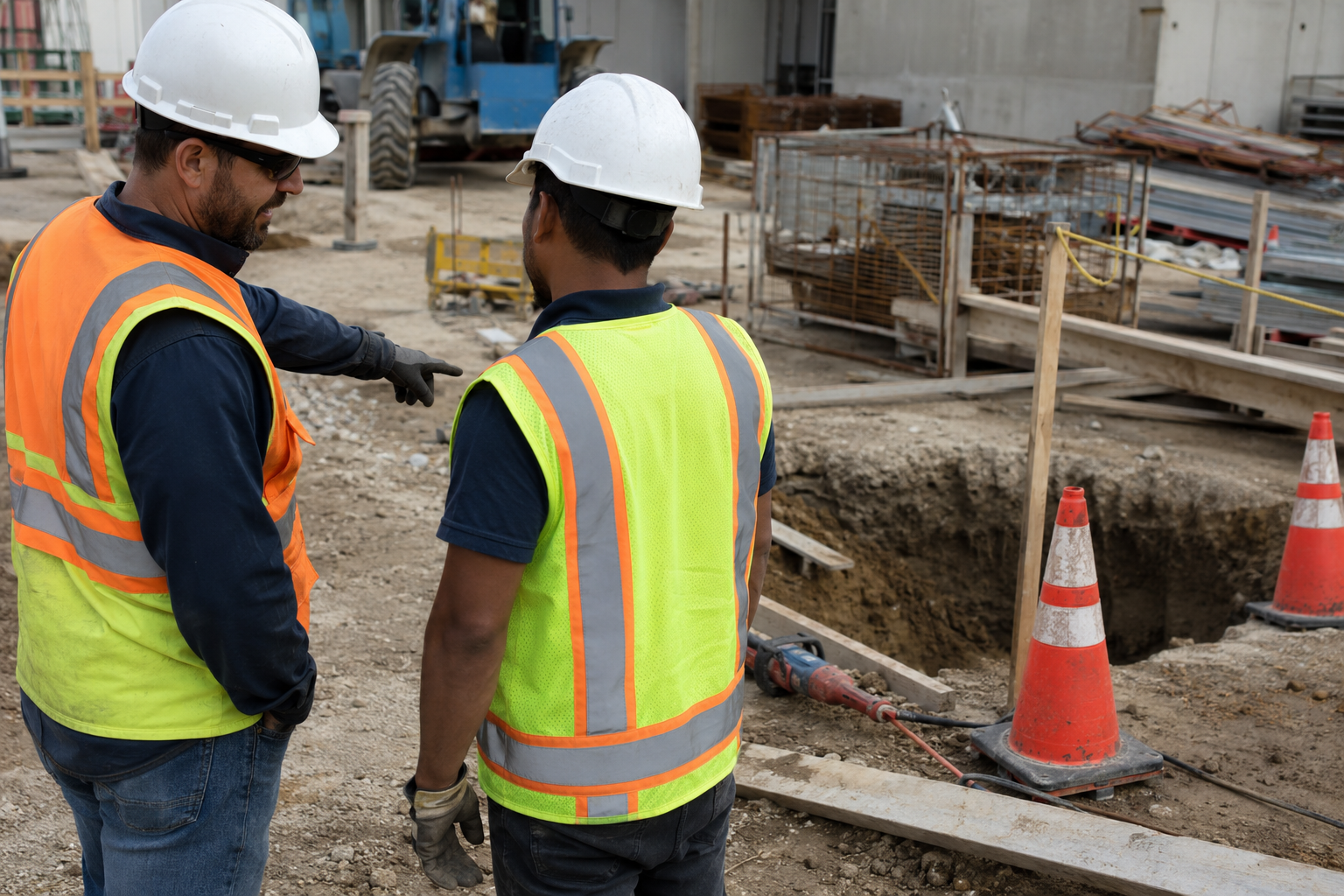
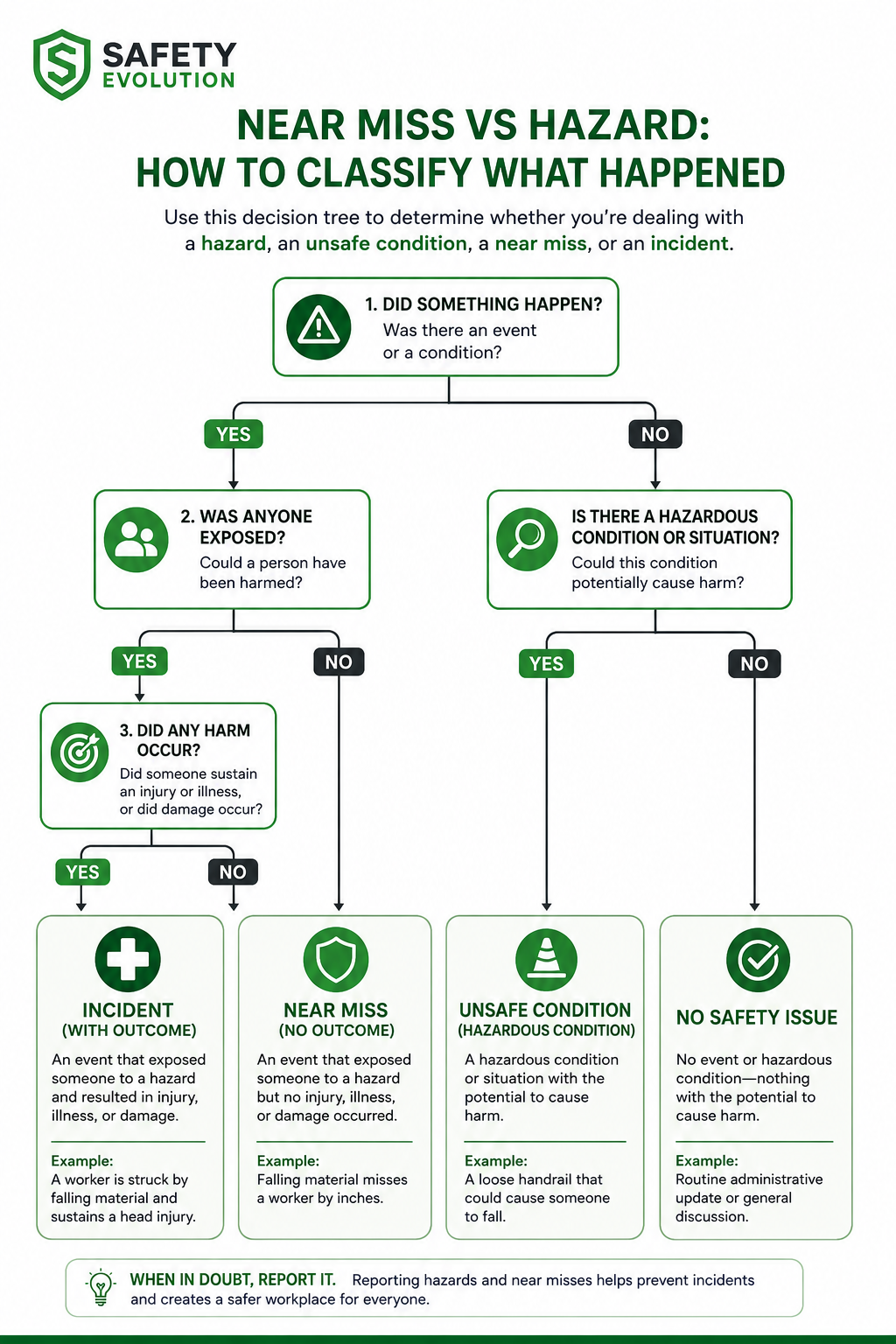
A hazard is something that could cause harm. A near miss is when that potential almost turns into harm. An incident is when harm or damage actually occurs. That sounds simple until a supervisor is standing on a noisy jobsite trying to decide what form to complete.
Use this rule: if nothing happened yet, it is probably a hazard or unsafe condition. If something happened and the outcome could easily have been worse, it is probably a near miss. If someone was hurt or something was damaged, it is an incident. For a broader overview, see the near miss reporting guide. For loss events specifically, use our guide on near miss vs incident.
| Category | Plain-language test | Example | Typical next step |
|---|---|---|---|
| Hazard | Could this cause harm if conditions line up? | A missing guardrail discovered during inspection. | Log hazard, control it, assign corrective action. |
| Unsafe condition | Is there a condition that makes work unsafe right now? | Oil on a walkway before anyone slips. | Fix or isolate condition and document follow-up. |
| Near miss | Did something happen, with exposure, but no loss? | Worker slips on the oil and catches themselves. | Report near miss and decide if investigation is needed. |
| Incident | Did injury, illness, damage, or loss occur? | Worker falls and sprains a wrist. | Follow incident response, reporting, and investigation process. |
Still relying on memory after close calls?
If near misses live in text messages, notebooks, or verbal updates, patterns disappear fast. Start your 30-day free trial and make reporting easier for supervisors and crews in the field.
Start Your 30-Day Free Trial →Classification is not paperwork trivia. It affects how the event is routed, who owns follow-up, what metrics show up on the dashboard, and whether the organization sees the pattern early enough to act. If every hazard is called a near miss, the near miss count becomes inflated and harder to interpret. If every near miss is treated as a minor hazard, leaders miss warnings that controls are failing during actual work.
Classification also affects the tone of the conversation. A worker who reports a loose handrail should not feel like they are reporting an incident. A worker who jumps back from a falling object should not be told, "nothing happened." Something did happen. The outcome was just better than it could have been.
A loose extension cord across a walkway is a hazard. A worker trips on the cord but catches themselves is a near miss. A worker trips, falls, and injures their knee is an incident. A missing barricade around a floor opening is a hazard or unsafe condition. A worker steps toward the opening and is pulled back by a coworker is a near miss. A worker falls through the opening is an incident.
For more scenario-based examples, use the near miss examples at work page. If the event had serious injury potential, compare it with the escalation examples in our high-potential near miss guide.
Hazard reporting and near miss reporting should not compete with each other. They are two parts of the same prevention loop. Hazards tell you where risk exists before an event. Near misses tell you where risk broke through a control during real work. Incidents tell you where the system failed with a loss outcome.
A mature safety program wants all three streams. If workers only report hazards, you may miss how controls behave under pressure. If they only report incidents, you are learning too late. If they report near misses well, your team gets a better view of which hazards are active, repeated, and credible.
The reporting form should help workers classify without making them memorize definitions. Add simple choices such as hazard, unsafe condition, near miss, incident, and high-potential near miss. Then add a short prompt: "Did something happen? Was anyone exposed? Was there injury or damage? Could the outcome have been serious?" Those questions guide the worker and help the reviewer standardize the final classification.
If you need a field-ready structure, use the near miss report template. If you are building the follow-up process after classification, use the near miss investigation guide.
Good classification makes your safety metrics more useful. Hazard reports can show where unsafe conditions are found. Near miss reports can show where controls are failing during work. High-potential near misses can show where serious injury risk is most credible. Incidents can show where loss already occurred. When those categories are clean, the leadership team can make better decisions about training, inspection focus, equipment changes, and supervisor coaching.
For dashboard design, see our guide to near miss KPIs. For adoption, pair the classification rules with a no-blame reporting culture so workers are not afraid to report close calls honestly.
Want better near miss reporting without more admin drag?
When reporting is clunky, supervisors skip it and crews stop believing it matters. Use Safety Evolution to capture close calls, assign follow-up, and keep the learning visible.
Start Your 30-Day Free Trial →No. An unsafe condition is a condition that could cause harm. A near miss is an event where that condition or another failure almost caused injury, damage, or loss.
Yes. A hazard can lead to a near miss if an event occurs and someone or something is exposed but no loss results.
Workers should be able to submit quickly, but a supervisor or safety lead should review classification for consistency, especially when the event had serious potential.
They can use the same digital intake if the form clearly separates classification, exposure, immediate action, and follow-up requirements.
Real near miss examples from jobsites, shops, and field work. Learn what counts, what crews miss, and what should trigger a report.
Learn the practical difference between near miss and incident, with field examples, decision flow, and Canada and US reporting context.
Learn whether near misses need to be reported to OSHA, how near misses differ from OSHA recordables, and how US employers should handle close calls...